
What is LASIK eye surgery?
LASIK stands for Laser-Assisted In Situ Keratomileusis—a modern, widely used refractive surgery to correct common vision problems such as nearsightedness (myopia), farsightedness (hyperopia), and astigmatism.
In a healthy eye, the cornea (the clear, dome-shaped surface at the front of the eye) bends light so that it focuses correctly onto the retina. But if the cornea’s shape isn’t ideal, light doesn’t focus properly—causing blurry vision.
LASIK reshapes the cornea so that light refracts properly, reducing or eliminating the need for glasses or contact lenses.
How does the LASIK procedure work?
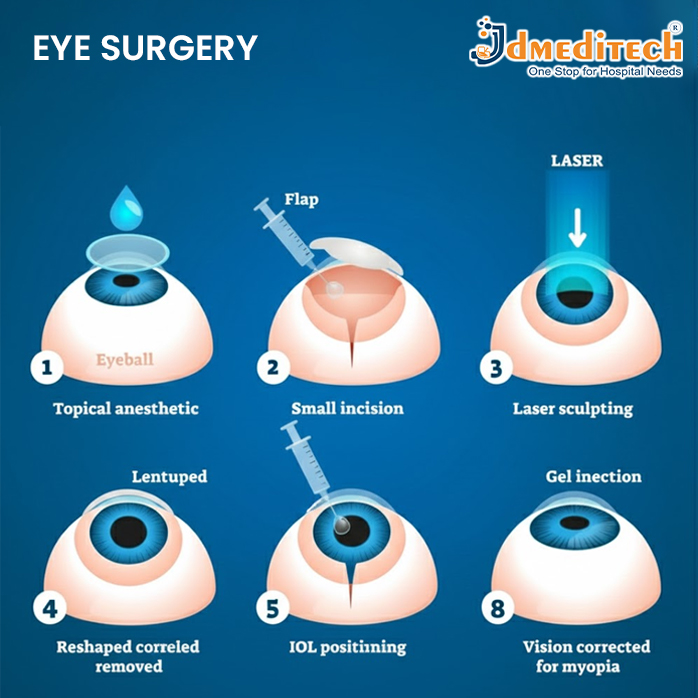
1. Pre-op preparation
On the day of surgery, numbing eye drops are applied to ensure a painless procedure. Your eyelids are gently held open so you don’t blink during surgery.
2. Flap creation:
The surgeon makes a thin, hinged flap on the surface of the cornea using either a microkeratome blade or, more commonly, a femtosecond laser.
3. Cornea reshaping
Once the flap is lifted, an excimer laser reshapes the underlying corneal tissue. The exact reshaping depends on your refractive error: flattening for nearsightedness, steepening for farsightedness, or smoothing for astigmatism.
4. Flap repositioning & healing
The flap is carefully repositioned; it sticks naturally without stitches. The cornea begins to heal almost immediately, and your vision gradually improves.
Why LASIK Eye Surgery Is Done
LASIK eye surgery is performed to correct refractive vision problems so that a person can see clearly without depending heavily on glasses or contact lenses. It reshapes the cornea so that light focuses properly on the retina.

1. Nearsightedness (Myopia)
You can see nearby objects clearly, but distant objects look blurry. LASIK flattens the cornea to improve distance vision
2. Farsightedness (Hyperopia)
You can see distant objects better, but nearby objects appear blurry. LASIK steepens the cornea to correct the focus.
3. Astigmatism
You can see distant objects better, but nearby objects appear blurry. LASIK steepens the cornea to correct the focus.
Overall Reasons Why LASIK Is Performed
• To reduce or eliminate the need for glasses
• To avoid daily use and maintenance of contact lenses
• For better visual comfort during sports, driving, or daily activities
• To provide long-term vision correction in eligible patients
What happens during LASIK eye surgery?
LASIK (Laser-Assisted In Situ Keratomileusis) eye surgery is a quick outpatient procedure that uses a laser to permanently change the shape of the cornea, the clear, dome-shaped front surface of the eye. This reshaping corrects refractive errors like nearsightedness, farsightedness, and astigmatism, allowing light to focus correctly on the retina for clear vision.
The entire process typically takes less than 30 minutes for both eyes and involves three primary steps:
1. Numbing and Preparation
• Numbing Drops:
On the day of surgery, numbing eye drops are applied to ensure a painless procedure. Your eyelids are gently held open so you don’t blink during surgery.
• Lid Holder:
An instrument called a lid speculum is used to gently hold the eyelids open and prevent blinking.
• Stabilization:
A suction ring is placed on the eye to keep it still during the procedure. This pressure may cause your vision to dim or momentarily go black.
2. Creating and Lifting the Corneal Flap
• The surgeon uses a specialized instrument to create a very thin, hinged flap on the outermost layer of the cornea.
• His instrument can be a microkeratome (a precise surgical blade) or, more commonly today, a femtosecond laser (creating a “bladeless” flap).
• The surgeon gently lifts this flap and folds it back to expose the middle layer of the cornea, called the stroma.
3. Reshaping and Repositioning
• Laser Reshaping:
A computer-controlled excimer laser is used to precisely vaporize (remove) microscopic amounts of the exposed stromal tissue to correct the refractive error.
• To treat nearsightedness, the laser flattens the cornea.
• To treat farsightedness, the laser steepens the central cornea.
• To treat astigmatism, the laser makes the cornea more spherical (uniformly curved).
• Flap Replacement:
Once the reshaping is complete, the surgeon folds the corneal flap back into its original position. It adheres on its own, acting as a natural bandage, and does not require stitches.
Conclusion
LASIK eye surgery offers a powerful and proven way to correct refractive errors, reduce dependence on glasses or contact lenses, and significantly improve the quality of life for many. However, it is not a universal solution—success depends on careful candidate selection, realistic expectations, and disciplined aftercare.
If you’re considering LASIK, consult with an experienced ophthalmologist to discuss your eye health, options, risks, and benefits. With proper guidance and care, LASIK can be a life-changing decision—but it’s important to make that choice with full awareness.