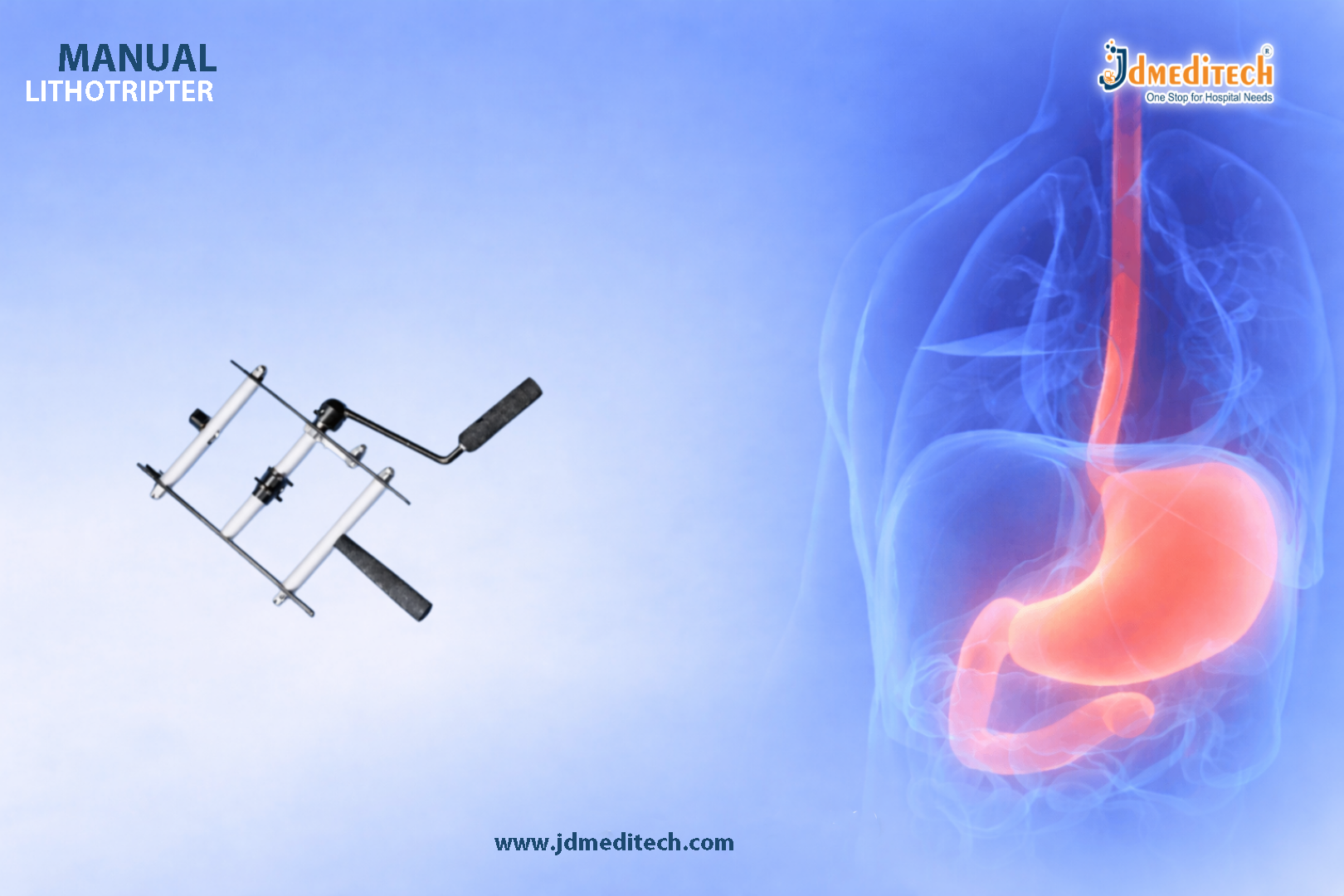
In modern gastroenterology, the management of biliary and pancreatic duct stones has evolved significantly. Among the essential tools used in endoscopic procedures, manual lithotripters in gastroenterology play a crucial role in safely and effectively fragmenting large or difficult stones.
These devices are widely used during Endoscopic Retrograde Cholangiopancreatography (ERCP) procedures, enabling physicians to crush stones that cannot be removed using standard extraction techniques. Their precision, reliability, and cost-effectiveness make them indispensable in both advanced hospitals and routine clinical settings.
What is a Manual Lithotripter?
A manual lithotripter is a mechanical medical device designed to crush large stones located in the bile duct or pancreatic duct. It works by applying controlled mechanical force to fragment stones into smaller pieces, making them easier to extract.
Unlike powered or electrohydraulic lithotripsy systems, manual lithotripters are:
- Simple to operate
- Highly reliable
- Cost-efficient
Importance of Manual Lithotripters in Gastroenterology
The role of manual lithotripters in gastroenterology has become increasingly significant due to the rising incidence of gallstones and bile duct stones.
Why They Are Essential:
- Enable removal of large or impacted stones
- Reduce the need for surgical intervention
- Improve success rates of ERCP procedures
- Offer a minimally invasive solution
Manual lithotripters are particularly valuable in situations where standard baskets fail to retrieve stones.
Key Features of Manual Lithotripters
Modern manual lithotripters are engineered for performance, safety, and ease of use.
1. High Mechanical Strength
Designed to exert strong crushing force for effective stone fragmentation.
2. Ergonomic Handle Design
Provides better control and reduces operator fatigue during procedures.
3. Durable Construction
Made from medical-grade stainless steel and high-quality polymers for long-term use.
4. Compatibility with ERCP Accessories
Works seamlessly with stone retrieval baskets and guidewires.
5. Smooth Operation Mechanism
Ensures controlled and precise crushing without sudden force application.
Clinical Applications
Manual lithotripters are widely used in various gastroenterological procedures:
1. Bile Duct Stone Removal
Crushing large common bile duct (CBD) stones during ERCP.
2. Pancreatic Duct Stone Management
Used in selected cases for pancreatic stone fragmentation.
3. Difficult Stone Cases
Ideal for impacted or hard stones that cannot be removed by baskets alone.
4. Rescue Procedures
Used when standard stone retrieval techniques fail.
Advantages of Manual Lithotripters
✔ Cost-Effective Solution
Compared to advanced lithotripsy systems, manual lithotripters are more affordable.
✔ High Success Rate
Effective in breaking large stones, improving procedural outcomes.
✔ Minimally Invasive
Eliminates the need for open or laparoscopic surgery in many cases.
✔ Easy Handling
Simple mechanism ensures ease of use even in complex procedures.
✔ Reliable Performance
No dependency on electricity or complex equipment.
Manual vs. Advanced Lithotripsy Techniques
| Feature | Manual Lithotripter | Advanced Lithotripsy (Laser/EHL) |
| Cost | Low | High |
| Complexity | Simple | Advanced |
| Equipment Needed | Minimal | Specialized setup |
| Accessibility | Widely available | Limited to advanced centers |
| Effectiveness | High for most stones | Ideal for very hard stones |
Manual lithotripters remain the first-line solution in many clinical scenarios due to their efficiency and practicality.
Safety Considerations
While manual lithotripters are generally safe, proper technique is essential:
- Ensure correct basket positioning before crushing
- Avoid excessive force to prevent duct injury
- Use fluoroscopic guidance during ERCP
- Always follow standard procedural protocols
Future of Manual Lithotripters in Gastroenterology
Despite advancements in laser and electrohydraulic lithotripsy, manual lithotripters in gastroenterology continue to hold strong clinical relevance.
Future innovations may include:
- Improved ergonomic designs
- Enhanced durability materials
- Better integration with endoscopic systems
However, their simplicity, affordability, and effectiveness ensure their continued use worldwide.
Conclusion
The role of manual lithotripters in modern gastroenterology is both significant and indispensable. These devices provide a safe, efficient, and cost-effective solution for managing difficult biliary and pancreatic stones.
As healthcare systems strive for minimally invasive and accessible treatments, manual lithotripters remain a trusted tool for gastroenterologists performing ERCP procedures.
Get Connected:
+91 79909 93062 | +91 63513 72032 | exports@jdmeditech.com