



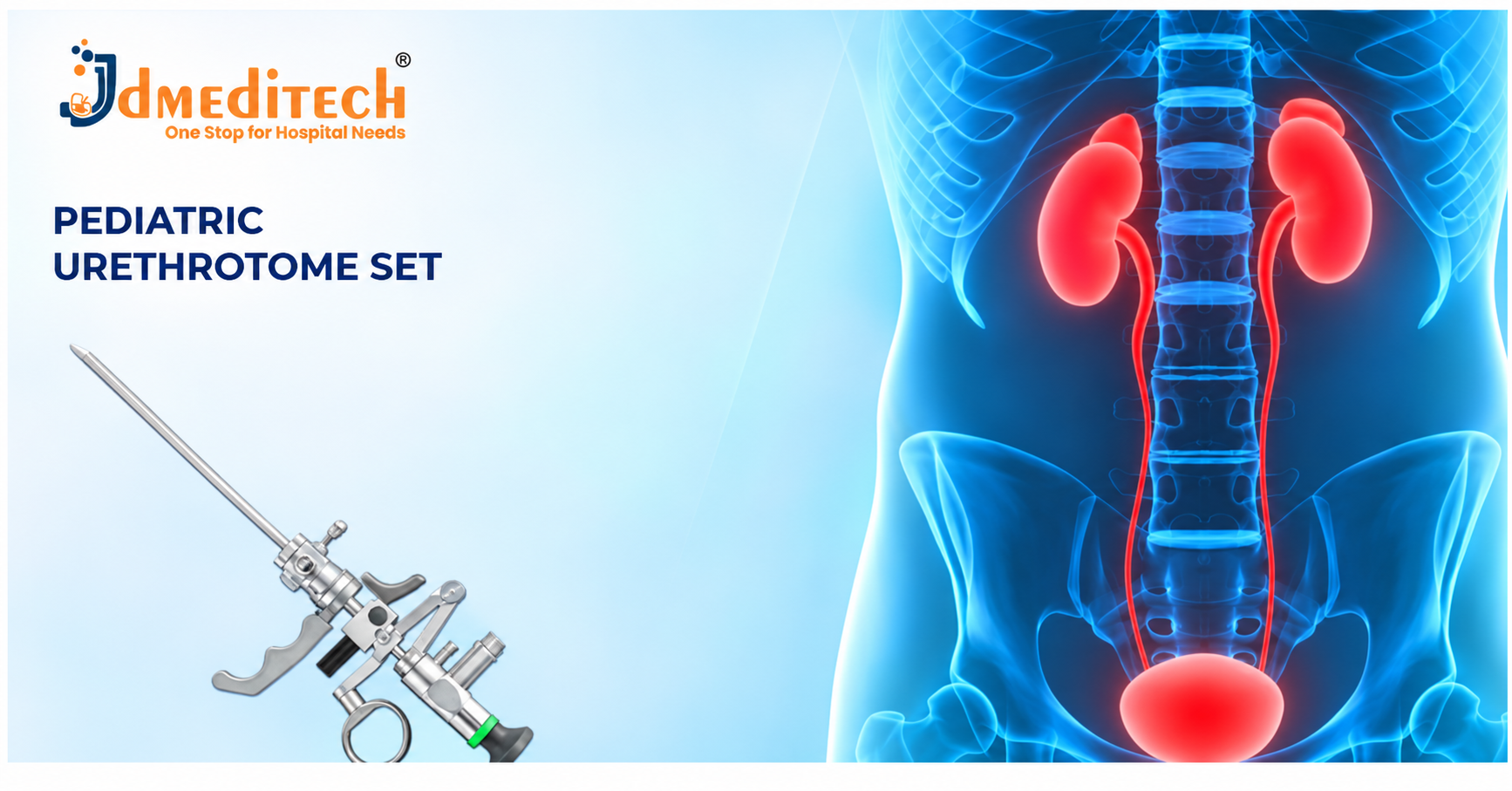
Pediatric Urethrotome Set – Features, Components, Applications and Benefits
The Pediatric Urethrotome Set is a specialized endoscopic surgical instrument system designed for selected urethral procedures in pediatric urology. Pediatric urologists may use a compatible urethrotome to perform an internal urethral incision in carefully selected patients with urethral narrowing or other approved indications.
Furthermore, a pediatric urethrotome combines an endoscopic access system with a compatible cutting mechanism. As a result, the surgeon can visualize the operative area and perform the intended incision under endoscopic guidance.
However, not every pediatric urethral stricture requires urethrotomy. Treatment depends on the cause, location and length of the narrowing, as well as the child’s age, anatomy and previous treatment history.
JDMeditech supplies urology surgical instruments and endoscopic accessories for hospitals, surgical centers and medical distributors. Additionally, our team can assist customers with available Pediatric Urethrotome Set configurations and product inquiries.
What Is a Pediatric Urethrotome Set?
A Pediatric Urethrotome Set is an endoscopic instrument assembly used to support selected internal urethrotomy procedures in pediatric patients.
Typically, a compatible set includes an endoscopic sheath, working mechanism, cutting instrument and optical components.
Furthermore, the system allows the surgeon to visualize the urethral passage during an approved procedure.
However, exact set contents vary by manufacturer and selected model.
What Is Pediatric Urethrotomy?
Pediatric urethrotomy is an endoscopic surgical technique that may be considered for selected children with urethral narrowing.
During an internal urethrotomy, a trained pediatric urologist uses a compatible endoscopic instrument to incise scar tissue at the narrowed urethral segment.
Furthermore, the procedure aims to improve the urethral passage in appropriately selected cases.
However, urethral strictures may recur after endoscopic treatment. Therefore, some patients may require further evaluation or reconstructive surgery.
Purpose of the Pediatric Urethrotome Set
The primary purpose of the Pediatric Urethrotome Set is to support endoscopic access, visualization and controlled incision during selected urethral procedures.
Additionally, the instrument system helps the surgeon work within the urethral passage using compatible pediatric-sized equipment.
Therefore, the set serves as a specialized accessory system for pediatric urological surgery.
How Does a Pediatric Urethrotome Set Work?
The Pediatric Urethrotome Set combines a compatible endoscopic telescope with a cutting mechanism.
First, the surgical team verifies instrument compatibility and prepares the approved endoscopic system.
Next, the surgeon visualizes the urethral passage and assesses the relevant anatomy.
During the selected procedure, the surgeon uses the appropriate cutting mechanism to treat the targeted narrowing.
Finally, the surgical team evaluates the operative result and determines the appropriate postoperative management.
However, only trained healthcare professionals should perform pediatric urethrotomy.
Main Components of a Pediatric Urethrotome Set
A typical Pediatric Urethrotome Set may include:
- Pediatric Urethrotome Sheath
- Compatible Working Element
- Urethrotome Cutting Knife
- Rigid Endoscopic Telescope
- Instrument Obturator
- Optical Connection Components
- Irrigation Connections
- Compatible Accessories
However, the telescope, knife and other accessories may be supplied separately.
1. Pediatric Urethrotome Sheath
The pediatric sheath provides an access channel for the compatible urethrotome assembly.
Furthermore, its dimensions must match the intended instrument configuration.
However, sheath diameter and working length vary by model.
2. Urethrotome Working Element
The working element controls the movement of the compatible cutting instrument.
Furthermore, its operating mechanism depends on the selected urethrotome design.
Therefore, users must verify the approved working element configuration.
3. Urethrotome Cutting Knife
The cutting knife provides the mechanical cutting function during an approved internal urethrotomy procedure.
Additionally, manufacturers may offer different knife designs for specific instrument systems.
However, the cutting mechanism must match the approved urethrotome assembly.
4. Rigid Endoscopic Telescope
The rigid telescope provides endoscopic visualization during the procedure.
Furthermore, it connects to compatible illumination and imaging equipment.
However, telescope diameter, length and viewing angle vary between systems.
5. Instrument Obturator
A compatible obturator may support instrument sheath introduction.
Additionally, its design depends on the selected urethrotome system.
Therefore, users should confirm the obturator configuration before use.
6. Optical Connection Components
Optical connection components support integration with compatible endoscopic visualization equipment.
Furthermore, proper connections help maintain the intended viewing arrangement.
However, the required components depend on the selected telescope and camera system.
7. Irrigation Connections
Irrigation connections support fluid delivery during compatible endoscopic procedures.
Furthermore, appropriate irrigation helps maintain visibility.
However, fluid selection and management must follow the manufacturer’s instructions and clinical protocol.
Key Features of a Pediatric Urethrotome Set
Depending on the selected model, a Pediatric Urethrotome Set may offer:
- Compatibility With Selected Pediatric Endoscopic Systems
- Specialized Urethral Cutting Mechanism
- Endoscopic Visualization Capability
- Pediatric-Sized Instrument Configurations
- Compatible Working Element Design
- Model-Specific Sheath Dimensions
- Compatible Irrigation Connections
- Reusable Components Where Approved by Labeling
- Specialized Instrument Configuration for Selected Urethral Procedures
However, customers should verify all features against the official product datasheet.
Applications of Pediatric Urethrotome Sets
Healthcare professionals may use compatible pediatric urethrotome systems during selected urethral procedures.
Potential applications include:
- Selected Pediatric Internal Urethrotomy Procedures
- Endoscopic Treatment of Selected Urethral Strictures
- Endoscopic Assessment During Approved Urethral Procedures
- Other Manufacturer-Approved Pediatric Urological Applications
However, the exact indications depend on the patient’s clinical condition and the device’s approved intended use.
Understanding Pediatric Urethral Stricture
A urethral stricture is a narrowing of the urethral passage caused by scar tissue or other structural changes.
Furthermore, the narrowing may affect urinary flow.
However, pediatric urethral strictures have several possible causes, and their management differs from adult urethral stricture treatment.
Possible Causes of Pediatric Urethral Stricture
Several factors may contribute to urethral narrowing in children.
- Previous Urethral Injury
- Pelvic Trauma
- Previous Urological Instrumentation
- Postoperative Scar Formation
- Selected Congenital or Acquired Urethral Conditions
- Inflammatory or Infectious Injury in Certain Cases
However, the underlying cause requires professional clinical evaluation.
Symptoms of Pediatric Urethral Narrowing
Children with urethral narrowing may experience urinary symptoms.
- Weak Urinary Stream
- Difficulty Starting Urination
- Straining During Urination
- Prolonged Urination
- Incomplete Bladder Emptying
- Urinary Retention
- Recurrent Urinary Tract Infections
However, these symptoms can occur with several other urological conditions.
Therefore, a pediatric urologist must determine the underlying diagnosis.
Potential Benefits of Pediatric Urethrotomy
In appropriately selected patients, pediatric urethrotomy may offer certain clinical advantages.
- Endoscopic Access Without an External Urethral Incision
- Direct Visualization During the Procedure
- Potential Improvement in Urinary Flow
- Potential Relief of Selected Obstructive Symptoms
- Use of Specialized Pediatric Endoscopic Instruments
However, treatment success varies, and urethral narrowing may recur.
Pediatric Urethrotomy vs Urethral Dilation
Urethrotomy and urethral dilation are different approaches to selected urethral narrowing conditions.
| Feature | Pediatric Urethrotomy | Urethral Dilation |
|---|---|---|
| Primary Technique | Incision of Selected Narrowed Tissue | Mechanical Widening of the Narrowed Segment |
| Instrument | Compatible Urethrotome | Appropriate Dilators |
| Visualization | Endoscopic Visualization | Technique-Dependent |
| Clinical Selection | Selected Cases | Selected Cases |
| Recurrence | Possible | Possible |
However, neither approach is suitable for every pediatric stricture. Therefore, a pediatric urologist should determine the treatment plan.
Technical Specifications of Pediatric Urethrotome Sets
Exact technical specifications depend on the manufacturer and selected model. Therefore, buyers should request the official product datasheet.
| Parameter | Product Information |
|---|---|
| Product Name | Pediatric Urethrotome Set |
| Product Category | Pediatric Urology Surgical Instruments |
| Instrument Type | Endoscopic Urethrotome System |
| Primary Function | Selected Endoscopic Urethral Incision Procedures |
| Clinical Application | Selected Pediatric Urethral Procedures |
| Sheath Diameter | Confirm Available Sizes |
| Working Length | Confirm Manufacturer Specifications |
| Working Element | Confirm Supplied Configuration |
| Cutting Knife | Compatible Model-Specific Design |
| Telescope | Confirm Compatible Model |
| Telescope Viewing Angle | Confirm Manufacturer Specifications |
| Obturator | Confirm Supplied Configuration |
| Irrigation System | Model-Dependent |
| Material | Confirm Manufacturer Specifications |
| Reusable or Single-Use | Component-Dependent |
| Sterile Status | Confirm Product Labeling |
| Cleaning and Sterilization | Follow Manufacturer Instructions |
| Packaging | Confirm Complete Set Contents |
| Regulatory Documentation | Verify for Destination Market |
Importance of Pediatric Instrument Sizing
Pediatric endoscopic procedures require careful instrument selection.
Furthermore, the patient’s age and urethral anatomy influence the suitability of the selected instrument.
However, an incorrectly sized instrument may increase the risk of injury.
Therefore, the operating pediatric urologist must select an appropriate configuration.
Importance of Endoscopic Visualization
Endoscopic visualization allows the surgeon to assess the operative area directly.
Furthermore, a compatible telescope provides a view of relevant urethral structures.
However, visibility depends on the instrument system and operative conditions.
Therefore, users must confirm that the imaging and illumination components function correctly.
Important Safety Precautions
Only appropriately trained healthcare professionals should use pediatric urethrotome systems.
Furthermore, users must follow the manufacturer’s instructions and institutional protocols.
- Verify the Approved Intended Use
- Confirm Pediatric Instrument Size
- Check Sheath Compatibility
- Inspect the Cutting Knife
- Verify Working Element Compatibility
- Check the Telescope and Optical Components
- Confirm Irrigation Requirements
- Inspect for Visible Instrument Damage
- Verify Sterile Status
- Follow Approved Reprocessing Instructions
- Assess Patient-Specific Contraindications
Potential Risks of Pediatric Urethrotomy
Pediatric urethrotomy carries potential risks and complications.
- Bleeding
- Urinary Tract Infection
- Urethral Injury
- False Passage Formation
- Urethral Stricture Recurrence
- Urinary Retention
- Scar Formation
- Need for Additional Treatment
Furthermore, repeated endoscopic treatment may not provide durable relief for every patient.
Therefore, the treating pediatric urologist should discuss appropriate alternatives and follow-up requirements.
Postoperative Care and Follow-Up
Postoperative management depends on the child’s clinical condition and the procedure performed.
Furthermore, the healthcare team may monitor urinary flow, symptoms and other relevant findings.
However, some children require further investigation or treatment if narrowing recurs.
Therefore, families should follow the treating clinician’s postoperative instructions and scheduled appointments.
Inspection Before Use
Healthcare professionals should inspect the Pediatric Urethrotome Set according to the manufacturer’s instructions.
- Confirm Product Identification
- Inspect the Sheath
- Check the Working Element
- Inspect the Cutting Knife
- Check the Telescope
- Verify Instrument Connections
- Confirm Component Compatibility
- Inspect for Visible Damage
- Verify Sterile Status
Furthermore, personnel should remove damaged instruments from service.
Cleaning and Sterilization Guidelines
Reusable pediatric urethrotome components require validated cleaning and sterilization according to the manufacturer’s instructions.
Furthermore, delicate optical components and working mechanisms may require specialized handling.
However, not every component supports the same reprocessing method.
Therefore, healthcare facilities must follow the approved instructions for use.
Storage and Handling Guidelines
Proper handling helps protect precision endoscopic instruments.
- Store Instruments According to Manufacturer Instructions
- Protect the Cutting Knife From Damage
- Protect Telescope Optics From Impact
- Avoid Bending Instrument Shafts
- Keep Compatible Components Properly Identified
- Inspect Instruments Before Use
- Remove Damaged Instruments From Service
How to Choose the Right Pediatric Urethrotome Set
Hospitals and medical distributors should evaluate several factors before purchasing.
- Approved Intended Use
- Patient and Procedure Requirements
- Sheath Diameter
- Working Length
- Working Element Design
- Cutting Knife Compatibility
- Telescope Compatibility
- Irrigation Arrangement
- Material Specifications
- Reusable or Single-Use Classification
- Cleaning and Sterilization Requirements
- Regulatory Documentation
Furthermore, procurement teams should consult the operating pediatric urologist before finalizing the instrument configuration.
Why Choose JDMeditech?
JDMeditech supplies urology surgical instruments, endoscopic accessories and medical equipment for hospitals, surgical centers and medical distributors.
Furthermore, our team can assist customers with product inquiries, available configurations and quotation requests.
Customers can contact JDMeditech regarding:
- Pediatric Urethrotome Set
- Pediatric Urology Endoscopic Instruments
- Urethrotome Cutting Knives
- Urethrotome Working Elements
- Urethrotome Sheaths
- Rigid Endoscopic Telescopes
- Pediatric Resectoscope Accessories
- Hospital Procurement Requirements
- International Distributor Inquiries
However, exact product availability and technical specifications require confirmation.
Frequently Asked Questions About Pediatric Urethrotome Sets
1. What Is a Pediatric Urethrotome Set?
A Pediatric Urethrotome Set is an endoscopic instrument system used during selected pediatric urethral incision procedures.
2. What Is the Main Purpose of a Pediatric Urethrotome?
Its primary purpose is to support endoscopic incision during approved urethral procedures.
3. Is a Pediatric Urethrotome Used for Urethral Stricture?
Yes. Pediatric urologists may consider internal urethrotomy for selected urethral strictures.
4. Is Urethrotomy Suitable for Every Child With Urethral Narrowing?
No. Treatment depends on the cause, location and extent of the narrowing.
5. Does a Pediatric Urethrotome Require a Telescope?
Endoscopic urethrotome systems use compatible optical components for visualization.
6. Are Pediatric Urethrotome Sets Available in Different Sizes?
Different instrument configurations may be available. However, customers should confirm the actual dimensions.
7. What Is the Function of the Urethrotome Cutting Knife?
The cutting knife supports the intended urethral incision during an approved procedure.
8. Can a Pediatric Urethrotome Fit Any Endoscopic Sheath?
No. Users must verify compatibility with the selected instrument system.
9. Is a Pediatric Urethrotome Set Reusable?
Reuse depends on the manufacturer’s approved labeling and reprocessing instructions.
10. Can Pediatric Urethrotome Instruments Be Autoclaved?
Only components with validated steam sterilization instructions should undergo autoclaving.
11. Can Urethral Strictures Recur After Urethrotomy?
Yes. Urethral narrowing may recur, and some patients require additional treatment.
12. Where Can Customers Request Pediatric Urethrotome Set Information?
Hospitals, pediatric urology departments and medical distributors can contact JDMeditech for product information and quotations.
Conclusion
In conclusion, the Pediatric Urethrotome Set is a specialized endoscopic instrument system used during selected pediatric urethral procedures.
Furthermore, compatible sheaths, working elements, cutting instruments and optical components support endoscopic visualization and treatment.
However, safe and appropriate use depends on specialist training, correct instrument selection and adherence to manufacturer instructions.
Therefore, hospitals and medical distributors should verify the complete technical specifications before purchasing.
JDMeditech – One Stop for Hospital Needs
Website:
www.jdmeditech.com
Related Pediatric Urology Instruments
- Pediatric Resectoscope Set
- Pediatric TURP Loop
- Urethrotome Cutting Knife
- Urethrotome Working Element
- Urethrotome Sheath
- Rigid Endoscopic Telescope
- Urology Endoscopic Accessories
Medical Disclaimer
This article provides general educational and product information only. It does not replace professional medical advice, specialist training, clinical judgment or manufacturer instructions. Healthcare professionals must verify device compatibility, approved intended use, sterile status, reprocessing requirements and contraindications before use.




