



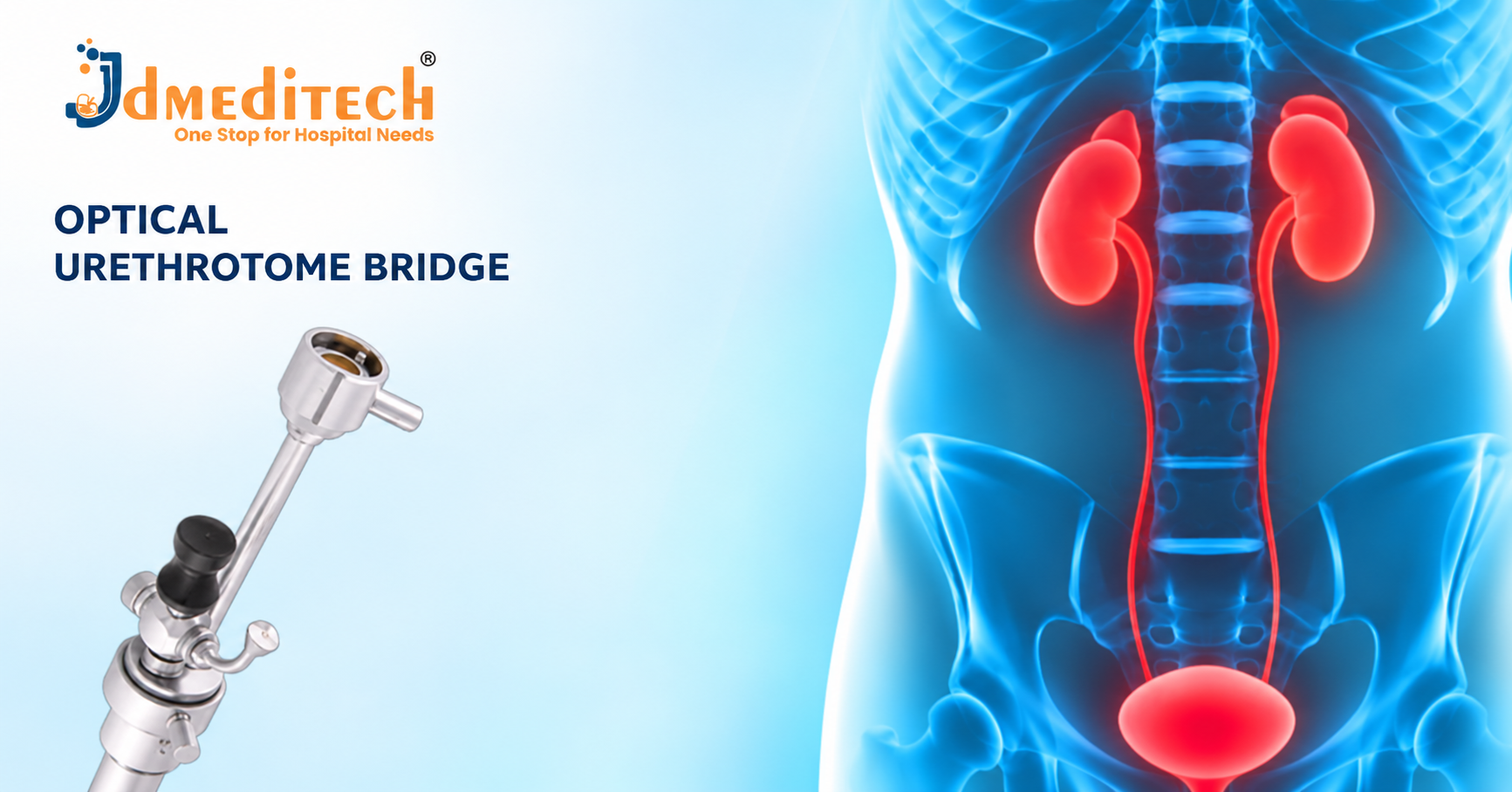
Optical Urethrotome Bridge – Features, Uses, Components and Specifications
The Optical Urethrotome Bridge is a specialized urological endoscopic accessory used with compatible optical urethrotome systems. It helps connect and position designated instrument components during selected endoscopic procedures.
Furthermore, the bridge supports the intended mechanical arrangement of compatible optical and surgical accessories. Therefore, proper selection and assembly are important for the complete system.
JDMeditech supplies urology surgical instruments and endoscopic accessories for hospitals, surgical centers and medical distributors worldwide.
What Is an Optical Urethrotome Bridge?
An optical urethrotome bridge is a connecting component within a compatible urethrotome assembly. Depending on its design, it may provide an interface for an optical telescope, sheath or other designated instrument components.
Additionally, its mechanical features help maintain the intended connection between compatible parts. However, the exact function depends on the manufacturer and product configuration.
Purpose of the Urethrotome Bridge
The primary purpose of this accessory is to support the connection and positioning of compatible endoscopic components.
For example, selected configurations help integrate the optical telescope with the urethrotome assembly.
Moreover, the bridge may include connection or locking features that support the intended instrument arrangement.
However, this accessory does not independently cut tissue or treat a urethral stricture.
Key Features of the Optical Urethrotome Bridge
- Designed for compatible optical urethrotome systems
- Supports designated endoscopic component connections
- Model-specific optical telescope compatibility
- Mechanical connection and alignment features
- Locking mechanism on selected configurations
- Compatible with specified instrument sheaths
- Reusable options depending on product labeling
- Suitable for selected endoscopic urology applications
Furthermore, available designs may differ in dimensions, material and connection mechanisms. Therefore, customers should confirm the exact configuration before ordering.
Main Components of an Optical Urethrotome Bridge
- Main bridge body
- Optical connection interface
- Instrument connection interface
- Locking or retention mechanism
- Alignment features
- Model-specific connection components
Main Bridge Body
The bridge body provides structural support for the designated connection interfaces. Additionally, its shape helps accommodate compatible instrument components.
Optical Connection Interface
Depending on the model, the optical interface supports attachment of a compatible endoscopic telescope. Consequently, correct compatibility is essential for the intended instrument configuration.
Instrument Connection Interface
This section connects the bridge to its designated urethrotome component. However, connector dimensions and locking arrangements vary between manufacturers.
Locking and Alignment Mechanism
Selected models include locking or alignment features to maintain the intended connection. Furthermore, correct engagement helps prevent unintended component movement during approved use.
Clinical Applications
Compatible optical urethrotome assemblies may support selected urological procedures, including:
- Direct Vision Internal Urethrotomy (DVIU)
- Selected endoscopic urethral stricture procedures
- Optical urethrotome instrument assembly
- Other manufacturer-approved urological applications
However, the bridge is an accessory rather than a standalone surgical instrument. Therefore, its clinical application depends on the complete approved system.
Understanding Urethral Stricture
A urethral stricture is a narrowing of the urethra, commonly associated with scar tissue. As a result, patients may experience difficulty passing urine.
Common symptoms include:
- Weak urinary stream
- Difficulty starting urination
- Straining while urinating
- Incomplete bladder emptying
- Urinary spraying
- Recurrent urinary tract infections
- Urinary retention in severe cases
However, these symptoms may have several causes. Therefore, patients should seek professional medical evaluation.
Role in Direct Vision Internal Urethrotomy
Direct Vision Internal Urethrotomy, commonly known as DVIU, is an endoscopic treatment option for selected urethral strictures.
During the procedure, a urologist uses a compatible optical urethrotome to visualize the narrowed urethral segment.
Furthermore, the surgeon may use an appropriate cutting instrument to incise the stricture.
The bridge supports the designated mechanical connections within the complete urethrotome assembly. However, it does not independently perform the incision.
Benefits of the Urethrotome Bridge
- Supports compatible endoscopic instrument assembly
- Helps connect designated optical components
- Provides model-specific mechanical interfaces
- Supports intended component alignment
- Allows integration with selected urethrotome systems
- Supports approved urological instrument workflows
Additionally, the correct accessory may help maintain the intended system configuration. However, it does not guarantee a specific surgical outcome.
Technical Specifications of the Optical Urethrotome Bridge
| Specification | Details |
|---|---|
| Product Name | Optical Urethrotome Bridge |
| Product Category | Urology Endoscopic Accessories |
| Product Type | Urethrotome Connection Bridge |
| Primary Function | Connection of compatible endoscopic components |
| Application | Selected optical urethrotome systems |
| Material | Confirm manufacturer specifications |
| Connection Type | Model-dependent |
| Telescope Compatibility | Confirm approved models |
| Sheath Compatibility | Confirm approved models |
| Locking Mechanism | Confirm available configuration |
| Dimensions | Confirm manufacturer specifications |
| Reusable or Single-Use | As specified in product labeling |
| Sterile Status | Confirm product labeling |
| Sterilization Method | Follow manufacturer instructions |
| Packaging | Confirm supplied configuration |
Importance of Instrument Compatibility
Correct compatibility is essential when selecting an endoscopic connection accessory.
Furthermore, the telescope, sheath and other designated components must match the approved bridge configuration.
Therefore, healthcare facilities should verify instrument model numbers and manufacturer instructions before use.
Safety Precautions
- Verify the approved intended use
- Confirm telescope and sheath compatibility
- Inspect the bridge before use
- Check locking and connection mechanisms
- Avoid excessive assembly force
- Do not modify the accessory
- Do not use damaged components
- Verify sterile or reprocessed status
- Follow manufacturer instructions
- Use only with trained healthcare professionals
Potential Risks of Incorrect Use
Incorrect assembly or incompatible components may lead to equipment problems or procedure-related complications.
- Instrument misalignment
- Connection failure
- Equipment damage
- Reduced instrument function
- Procedure interruption
- Potential tissue injury
- Infection risk from improper reprocessing
Therefore, appropriate inspection and approved assembly procedures remain essential.
Cleaning and Sterilization Guidelines
Reusable bridge accessories require cleaning and sterilization according to the manufacturer’s validated instructions.
Additionally, connection surfaces and locking features may require careful inspection during reprocessing.
However, sterilization compatibility varies between models. Therefore, users should not assume that every bridge supports autoclaving.
Storage and Handling Recommendations
- Store according to manufacturer instructions
- Protect connection surfaces from damage
- Avoid dropping or striking the instrument
- Keep components properly identified
- Inspect before every use
- Remove damaged accessories from service
How to Choose the Right Optical Urethrotome Bridge
Hospitals and medical distributors should consider the following factors before purchasing:
- Optical urethrotome model
- Compatible telescope model
- Compatible sheath model
- Connection mechanism
- Instrument dimensions
- Material specifications
- Reusable or single-use classification
- Cleaning and sterilization requirements
- Packaging configuration
- Applicable regulatory documentation
Furthermore, procurement teams should confirm the required system configuration with their urology department.
Why Choose JDMeditech?
JDMeditech supplies urology surgical instruments, endoscopic accessories and medical equipment for hospitals, surgical centers and medical distributors.
Additionally, our team assists customers with product inquiries, available configurations and quotation requests.
Customers can contact JDMeditech regarding:
- Optical Urethrotome Bridge
- Optical Urethrotome Set
- Urethrotome Sheath
- Rigid Endoscopic Telescope
- Urethrotomy Cutting Instruments
- Urology Endoscopic Accessories
- Hospital Procurement Requirements
- International Distributor Inquiries
Frequently Asked Questions
1. What Is an Optical Urethrotome Bridge?
It is an accessory that connects or supports designated components within a compatible optical urethrotome system.
2. What Is Its Main Function?
Its primary function is to support the intended mechanical connection and alignment of compatible endoscopic components.
3. Is It Used During DVIU?
Compatible urethrotome systems may use bridge accessories during selected DVIU procedures.
4. Does the Bridge Cut Urethral Tissue?
No. The bridge is a connection accessory. A separate compatible cutting instrument performs the incision.
5. Can It Fit Any Urethrotome?
No. Compatibility depends on the selected urethrotome model and its approved components.
6. Is It Compatible With Every Telescope?
No. Users must confirm compatibility with the intended optical telescope.
7. Is the Instrument Reusable?
Reuse depends on the manufacturer’s product labeling and approved reprocessing instructions.
8. Can It Be Autoclaved?
Only models with validated steam sterilization instructions should undergo autoclaving.
9. Is It Included in a Complete Urethrotome Set?
Inclusion depends on the manufacturer’s supplied product configuration.
10. What Should Users Inspect Before Use?
Users should inspect the bridge body, connectors, locking features and compatibility with the intended instruments.
11. Who Should Use Optical Urethrotome Instruments?
Only appropriately trained healthcare professionals should operate these systems.
12. Where Can Customers Request Product Information?
Hospitals, urology departments and medical distributors can contact JDMeditech for product details and quotations.
Conclusion
In conclusion, the Optical Urethrotome Bridge is an important connection accessory for compatible endoscopic urethrotome systems.
Furthermore, its mechanical interfaces support the intended assembly and positioning of designated instrument components.
However, safe operation depends on correct compatibility, proper assembly and adherence to manufacturer instructions.
Therefore, hospitals and medical distributors should verify the complete technical specifications before purchasing.
JDMeditech – One Stop for Hospital Needs
Website:
www.jdmeditech.com
Related Urology Instruments
- Optical Urethrotome Set
- Optical Urethrotome Sheath
- Rigid Endoscopic Telescope
- Urethrotomy Cutting Instruments
- Urology Working Elements
- Endoscopic Urology Accessories
Medical Reference
For additional clinical information about urethral strictures, visit the
European Association of Urology Guidelines on Urethral Strictures.
Medical Disclaimer
This article provides general educational and product information only. It does not replace professional medical advice, clinical judgment, specialist training or manufacturer instructions. Healthcare professionals must verify instrument compatibility, approved intended use, sterile status, reprocessing requirements and contraindications before use.




