



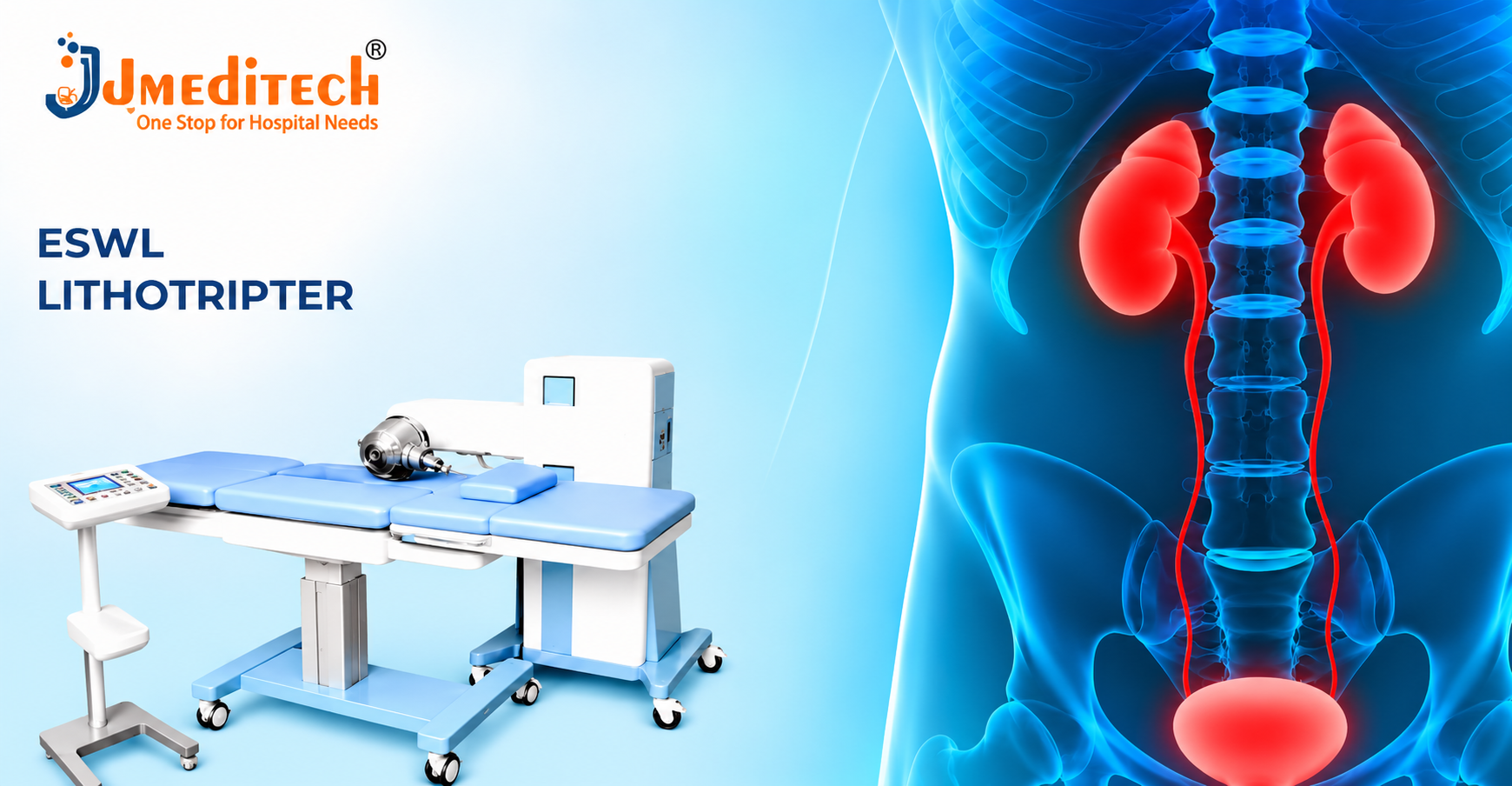
ESWL Lithotripter – Working Principle, Features, Uses and Benefits
An ESWL Lithotripter is a
medical system used to
fragment selected urinary
stones through externally
generated shock waves.
ESWL stands for
Extracorporeal Shock
Wave Lithotripsy.
During treatment, the
system directs focused
shock waves toward
a targeted urinary stone.
Consequently, suitable stones
may break into smaller
fragments that can
pass through the
urinary tract.
Furthermore, this
non-incisional approach
may offer an alternative
to invasive stone
removal for
appropriately selected
patients.
JDMeditech supplies
urology equipment,
surgical instruments
and medical accessories
for hospitals,
urology centers
and medical distributors.
What Is an ESWL Lithotripter?
An extracorporeal
lithotripsy system
generates shock waves
outside the patient’s
body and focuses
them on a
urinary stone.
The shock waves
travel through
body tissues
and interact
with the stone.
As a result,
the stone may
fragment into
smaller pieces.
However, treatment
success depends
on several factors,
including stone
size, location,
composition and
patient anatomy.
What Is Extracorporeal Shock Wave Lithotripsy?
Extracorporeal Shock
Wave Lithotripsy
is a non-incisional
treatment for
selected kidney
and ureteral stones.
During the procedure,
a trained clinical
team positions
the patient
and identifies
the target stone.
Next, the system
delivers focused
shock waves
according to
the treatment
plan.
However, not
every urinary
stone responds
equally to
shock wave
treatment.
How Does an ESWL Lithotripter Work?
The system
generates acoustic
shock waves
through a
specialized source.
Next, a focusing
mechanism directs
the waves toward
the selected
stone.
Furthermore, an
appropriate imaging
system helps
the operator
locate and
monitor the
target.
Repeated shock
wave exposure
may gradually
fragment the
stone.
However, the
number and
energy of
shock waves
depend on
the clinical
treatment plan.
Working Principle of Shock Wave Lithotripsy
Shock waves
create mechanical
stress within
the targeted
stone.
Furthermore, pressure
changes and
cavitation effects
can contribute
to fragmentation.
As a result,
the stone
may break
into smaller
pieces.
However, surrounding
tissues may
also experience
shock wave
effects.
Therefore, clinicians
must follow
approved treatment
and safety
protocols.
Key Features of an ESWL Lithotripter
- Extracorporeal Shock Wave Generation
- Focused Stone Fragmentation
- Non-Incisional Treatment Approach
- Patient Treatment Table
- Shock Wave Coupling Arrangement
- Model-Specific Energy Adjustment
- Stone Localization With Compatible Imaging
- Operator Control Interface
- Model-Specific Treatment Monitoring
- Manufacturer-Defined Safety Functions
Furthermore, exact
features vary
by equipment
model and
configuration.
Main Components of an ESWL Lithotripter
A typical
lithotripsy system
may include
the following
components.
- Shock Wave Generator
- Shock Wave Focusing Assembly
- Patient Treatment Table
- Coupling System
- Operator Control Console
- Stone Localization Equipment
- Positioning Controls
- Power Supply
- System Monitoring Components
- Manufacturer-Approved Accessories
However, not
every component
is included
with every
system configuration.
1. Shock Wave Generator
The shock wave
generator produces
acoustic pressure
pulses for
stone fragmentation.
Furthermore, generator
technology varies
between manufacturers.
2. Shock Wave Focusing Assembly
The focusing
assembly concentrates
shock wave
energy near
the target
stone.
Consequently, accurate
targeting is
important for
effective treatment.
3. Patient Treatment Table
The treatment
table supports
patient positioning
during the
procedure.
Furthermore, selected
systems provide
motorized positioning
functions.
4. Coupling System
The coupling
system helps
transmit shock
wave energy
from the
generator into
the patient’s
body.
Furthermore, proper
acoustic coupling
supports efficient
energy transmission.
5. Operator Control Console
The operator
console provides
access to
the system’s
designated treatment
controls.
Additionally, selected
models display
energy settings
and treatment
information.
6. Stone Localization System
Stone localization
equipment helps
the clinical
team identify
the treatment
target.
Common localization
methods include
fluoroscopy and
ultrasonography.
However, imaging
capabilities depend
on the selected
system.
Types of ESWL Lithotripters
Lithotripsy systems
may use different
shock wave
generation technologies.
Therefore, buyers
should compare
technical specifications
and clinical
requirements.
Electrohydraulic Lithotripter
An electrohydraulic
system generates
shock waves
through an
electrical discharge
in a
suitable medium.
Furthermore, a
focusing arrangement
directs the
generated energy.
Electromagnetic Lithotripter
An electromagnetic
system uses
electromagnetic
principles to
generate pressure
waves.
Furthermore, an
appropriate focusing
mechanism directs
the shock
wave energy.
Piezoelectric Lithotripter
A piezoelectric
system uses
piezoelectric elements
to generate
acoustic pressure
waves.
However, treatment
characteristics
depend on
the device
design.
Clinical Applications of ESWL
- Selected Kidney Stones
- Selected Ureteral Stones
- Non-Incisional Urinary Stone Fragmentation
- Urology Stone Management Programs
- Other Approved Stone Treatment Applications
However, treatment
selection depends
on stone
characteristics
and patient
assessment.
ESWL for Kidney Stones
Kidney stones
form when
certain substances
crystallize within
the urinary
system.
For selected
renal stones,
shock wave
treatment may
support fragmentation.
Furthermore, smaller
fragments may
pass through
the urinary
tract over
time.
However, residual
fragments may
require additional
evaluation or
treatment.
ESWL for Ureteral Stones
Some ureteral
stones may
respond to
extracorporeal
shock wave
treatment.
However, suitability
depends on
stone location,
size, composition
and clinical
circumstances.
Therefore, the
urologist must
evaluate available
treatment options.
Factors Affecting ESWL Treatment Success
- Stone Size
- Stone Location
- Stone Composition
- Stone Density
- Skin-to-Stone Distance
- Patient Anatomy
- Stone Targeting Accuracy
- Acoustic Coupling Quality
- Shock Wave Delivery Parameters
- Urinary Drainage Conditions
Furthermore, clinical
outcomes vary
between patients.
Potential Benefits of ESWL Treatment
- Non-Incisional Treatment Approach
- Suitable for Selected Urinary Stones
- May Avoid Endoscopic Stone Removal
- May Support Outpatient Treatment
- Can Fragment Stones Without Surgical Incisions
- Provides an Additional Stone Management Option
However, ESWL
does not
guarantee complete
stone clearance.
Furthermore, some
patients require
repeat treatment
or another
procedure.
ESWL vs Ureteroscopy vs PCNL
| Feature | ESWL | Ureteroscopy | PCNL |
|---|---|---|---|
| Approach | External Shock Waves | Endoscopic Access | Percutaneous Kidney Access |
| Surgical Incision | No Incision | Usually No External Incision | Small Skin Incision |
| Stone Treatment | Shock Wave Fragmentation | Endoscopic Fragmentation or Extraction | Percutaneous Fragmentation and Removal |
| Typical Selection | Selected Kidney and Ureteral Stones | Selected Urinary Stones | Often Larger or More Complex Renal Stones |
| Anesthesia | Depends on Patient and Protocol | Often General Anesthesia | Usually General Anesthesia |
| Additional Treatment | May Be Required | May Be Required | May Be Required |
Technical Specifications of ESWL Lithotripter
The supplied
product image
shows a
lithotripsy treatment
system with
a patient
table and
associated equipment.
However, the
image alone
does not
confirm exact
shock wave
energy, focal
dimensions or
imaging capabilities.
Therefore, customers
should verify
the manufacturer’s
official datasheet.
| Parameter | Product Information |
|---|---|
| Product Name | ESWL Lithotripter |
| Full Form | Extracorporeal Shock Wave Lithotripsy |
| Category | Urology Medical Equipment |
| Primary Function | Urinary Stone Fragmentation |
| Shock Wave Technology | Confirm Manufacturer Specifications |
| Maximum Energy | Confirm Manufacturer Specifications |
| Energy Adjustment Range | Confirm Manufacturer Specifications |
| Shock Wave Frequency | Confirm Manufacturer Specifications |
| Focal Zone Dimensions | Confirm Manufacturer Specifications |
| Stone Localization | Confirm Imaging Configuration |
| Patient Table | Confirm Available Configuration |
| Patient Weight Capacity | Confirm Manufacturer Specifications |
| Coupling System | Confirm Manufacturer Specifications |
| Control Interface | Confirm Manufacturer Specifications |
| Input Voltage | Confirm Manufacturer Specifications |
| Power Consumption | Confirm Manufacturer Specifications |
| Dimensions | Confirm Manufacturer Specifications |
| Weight | Confirm Manufacturer Specifications |
| Supplied Accessories | Confirm Packaging Configuration |
| Regulatory Documentation | Verify for Destination Market |
Importance of Stone Localization
Accurate localization
helps the
clinical team
target the
selected stone.
Furthermore, imaging
may support
monitoring during
treatment.
However, imaging
technology varies
between systems.
Importance of Acoustic Coupling
Acoustic coupling
helps transmit
shock wave
energy into
the body.
Furthermore, poor
coupling can
reduce energy
transmission.
Therefore, clinical
teams must
follow the
manufacturer’s
coupling instructions.
Patient Selection for ESWL
A qualified
urologist determines
whether shock
wave treatment
is appropriate.
Furthermore, assessment
may include
stone imaging,
medical history
and laboratory
investigations.
However, treatment
may not
be appropriate
for certain
patients.
When ESWL May Not Be Appropriate
Certain conditions
can make
shock wave
treatment unsuitable
or require
additional precautions.
- Pregnancy
- Uncorrected Bleeding Disorders
- Active Uncontrolled Urinary Infection
- Urinary Obstruction That Prevents Fragment Clearance
- Certain Vascular Conditions Near the Treatment Area
- Other Patient-Specific Contraindications
Therefore, the
treating clinician
must review
current guidelines
and device
instructions.
Potential Risks and Complications
- Blood in the Urine
- Temporary Pain or Discomfort
- Skin Bruising
- Residual Stone Fragments
- Ureteral Obstruction From Fragments
- Renal Hematoma or Bleeding
- Urinary Infection
- Need for Additional Treatment
- Other Procedure-Related Complications
Furthermore, the
risk profile
depends on
patient factors
and treatment
parameters.
Patient Recovery After ESWL
Recovery varies
according to
the patient’s
condition and
treatment response.
Some patients
experience temporary
discomfort or
blood in
the urine.
Furthermore, stone
fragments may
pass over
several days
or weeks.
However, fever,
severe pain,
difficulty urinating
or significant
bleeding require
prompt medical
assessment.
Inspection Before Equipment Use
- Confirm Equipment Identification
- Inspect the Shock Wave Generator
- Verify Coupling System Condition
- Inspect Patient Table
- Check Positioning Controls
- Verify Imaging System Readiness
- Inspect Power Connections
- Confirm Emergency Stop Functions
- Check Maintenance Status
- Follow Manufacturer Pre-Use Procedures
Cleaning and Maintenance Guidelines
Healthcare facilities
should clean
equipment surfaces
according to
the manufacturer’s
instructions.
Furthermore, authorized
personnel should
inspect and
maintain the
shock wave
system regularly.
Additionally, biomedical
engineers should
perform required
safety checks
and calibration.
However, service
procedures must
follow the
specific equipment
manual.
Safety Precautions
- Use Only With Trained Clinical Personnel
- Verify Patient Eligibility
- Confirm Stone Localization
- Follow Approved Treatment Protocols
- Use Appropriate Acoustic Coupling
- Monitor Patient Condition
- Follow Imaging Radiation Safety Procedures
- Inspect Equipment Before Use
- Verify Emergency Stop Functions
- Follow Manufacturer Instructions
- Perform Scheduled Maintenance
How to Choose the Right ESWL Lithotripter
Hospitals and
procurement teams
should evaluate
several factors
before purchasing
a lithotripsy
system.
- Shock Wave Generation Technology
- Energy Adjustment Capability
- Stone Localization Method
- Focal Zone Characteristics
- Patient Table Design
- Coupling System
- Treatment Control Interface
- Patient Positioning Features
- Safety Functions
- Maintenance Requirements
- Regulatory Documentation
- Installation Requirements
- Training and Technical Support
Why Choose JDMeditech?
JDMeditech supplies
urology equipment,
surgical instruments
and medical accessories
for hospitals,
urology centers
and medical
distributors.
Furthermore, our
team assists
customers with
product inquiries,
available configurations
and quotation
requests.
Customers can
contact JDMeditech
regarding:
- ESWL Lithotripter
- Urology Surgical Equipment
- Ureteroscopy Instruments
- PCNL Instruments
- Stone Retrieval Baskets
- Ureteral Access Sheaths
- Guide Wires
- Hospital Equipment Procurement
Frequently Asked Questions
1. What Is an ESWL Lithotripter?
An ESWL lithotripter is a medical system that uses externally generated shock waves to fragment selected urinary stones.
2. What Does ESWL Stand For?
ESWL stands for Extracorporeal Shock Wave Lithotripsy.
3. Is ESWL a Surgical Procedure?
ESWL is a non-incisional medical procedure used to treat selected urinary stones.
4. Can ESWL Treat Kidney Stones?
Yes. It may treat appropriately selected kidney stones, depending on their size, location and other characteristics.
5. Can ESWL Treat Ureteral Stones?
Yes. Some ureteral stones are suitable for shock wave treatment.
6. Does ESWL Require an Incision?
No. Shock waves are generated outside the body.
7. Does ESWL Always Remove Stones Completely?
No. Some patients retain fragments or require additional treatment.
8. Is ESWL Painful?
Discomfort varies. The clinical team may provide appropriate analgesia or anesthesia.
9. How Long Does ESWL Treatment Take?
Procedure duration varies according to the treatment plan and equipment.
10. What Imaging Is Used During ESWL?
Fluoroscopy or ultrasound may be used to localize the stone, depending on the system.
11. Can ESWL Be Used During Pregnancy?
No. Pregnancy is a contraindication to urinary stone ESWL.
12. What Are Common Side Effects?
Temporary discomfort, blood in the urine and passage of stone fragments may occur.
13. Can ESWL Be Repeated?
Repeat treatment may be considered when clinically appropriate, following specialist assessment.
14. Where Can Customers Request Product Information?
Hospitals, urology centers and medical distributors can contact JDMeditech for product information and quotations.
Conclusion
In conclusion,
the ESWL Lithotripter
is an important
medical system
for selected
urinary stone
treatments.
Furthermore, focused
shock wave
technology offers
a non-incisional
method of
stone fragmentation.
However, treatment
success depends
on patient
selection, stone
characteristics and
clinical technique.
Therefore, hospitals
and medical
distributors should
verify complete
technical specifications
before purchasing.
JDMeditech – One Stop for Hospital Needs
Website:
www.jdmeditech.com
Related Urology Equipment
- Ureteroscopy Instruments
- PCNL Instruments
- Stone Retrieval Baskets
- Ureteral Access Sheaths
- Urology Guide Wires
- Endoscopic Stone Management Accessories
Medical Equipment Reference
For general information
about kidney stone
management, visit the
European Association of Urology –
Urolithiasis Guidelines
.
Medical Disclaimer
This article provides
general educational
and product information
only. It does not
replace professional
medical advice,
clinical judgment,
specialist training
or manufacturer
instructions.
Healthcare professionals
must verify approved
indications, contraindications,
shock wave specifications,
imaging compatibility,
patient safety requirements
and regulatory documentation
before clinical use.




