



Holmium Laser – Working Principle, Features, Uses and Benefits
A Holmium Laser is a surgical laser system that supports selected urological procedures, including urinary stone fragmentation and soft tissue surgery. It uses holmium-doped yttrium aluminium garnet (Ho:YAG) technology to generate laser energy.
During endoscopic procedures, surgeons can deliver laser energy through a compatible optical fiber. As a result, the system supports precise treatment of selected stones and tissues.
Furthermore, Ho:YAG technology plays an important role in modern endourology. Urologists commonly use it for laser lithotripsy and holmium laser enucleation of the prostate, also known as HoLEP.
JDMeditech supplies urology equipment, surgical instruments and medical accessories for hospitals, urology centers and medical distributors.
What Is a Holmium Laser?
A holmium laser is a solid-state medical laser that generates pulsed infrared energy. The system uses a holmium-doped YAG crystal as its laser medium.
Typically, Ho:YAG lasers operate near a wavelength of 2,100 nanometers. Water absorbs this wavelength strongly, which influences the laser’s interaction with biological tissue.
Additionally, surgeons can transmit the energy through compatible optical fibers. Therefore, the technology supports selected minimally invasive procedures.
However, the available power, pulse settings and operating modes vary by equipment model.
What Is a Ho:YAG Laser?
Ho:YAG stands for Holmium-Doped Yttrium Aluminium Garnet. It describes the laser medium used to generate the treatment beam.
The technology produces pulsed laser energy for approved surgical applications. Furthermore, its interaction with water-rich tissue allows clinicians to perform selected cutting and ablation procedures.
However, effective and safe treatment depends on appropriate energy settings, fiber selection and surgical technique.
How Does a Holmium Laser Work?
The laser system uses an energy source to excite the holmium-doped crystal. Consequently, the laser medium generates pulsed infrared light.
Next, a compatible optical fiber transmits the energy toward the treatment site. During urinary stone treatment, laser pulses interact with the stone and surrounding fluid.
As a result, the stone may break into smaller fragments or particles. In soft tissue surgery, the energy can support cutting, ablation and coagulation.
However, the clinical effect depends on the treatment parameters, target material and equipment configuration.
Working Principle of Holmium Laser Technology
Ho:YAG laser energy interacts strongly with water. Consequently, much of the energy absorption occurs close to the point of application in water-rich tissue.
During lithotripsy, laser pulses create physical effects that contribute to stone fragmentation. Furthermore, different pulse settings can influence fragmentation behavior.
However, inappropriate laser delivery can injure tissue or damage endoscopic equipment. Therefore, trained clinicians must follow approved treatment protocols.
Key Features of a Holmium Laser
- Ho:YAG Laser Technology
- Pulsed Infrared Laser Energy
- Fiber-Based Energy Delivery
- Endoscopic Surgical Applications
- Urinary Stone Fragmentation Capability
- Selected Soft Tissue Surgical Applications
- Model-Specific Power Adjustment
- Model-Specific Pulse Energy Control
- Model-Specific Pulse Frequency Control
- Compatible Laser Fiber Connections
- Operator Control Interface
- Manufacturer-Defined Safety Features
Furthermore, customers should confirm the exact features and available operating modes before purchasing.
Main Components of a Holmium Laser System
A typical surgical laser system may include the following components:
- Laser Generator Unit
- Ho:YAG Laser Medium
- Power Supply
- Control Panel
- Laser Fiber Connection Port
- Compatible Laser Fiber
- Footswitch
- Cooling System
- Safety Interlock System
- Emergency Stop Control
- Protective Accessories
However, not every component is included with every product configuration.
1. Laser Generator Unit
The generator produces laser energy through the system’s optical and electrical components. Furthermore, its design determines the available operating capabilities.
2. Ho:YAG Laser Medium
The laser medium contains holmium-doped YAG crystal. This material enables the generation of infrared laser pulses.
3. Control Panel
The control panel allows trained operators to select supported operating settings. Additionally, selected systems display treatment parameters and equipment status.
4. Laser Fiber Connection Port
The fiber connection provides an interface between the generator and an approved optical fiber. However, fiber compatibility depends on the laser system.
5. Optical Laser Fiber
The optical fiber transmits laser energy toward the treatment site. Furthermore, surgeons select compatible fiber dimensions according to the procedure and endoscopic instrument.
6. Footswitch
A compatible footswitch allows the operator to activate laser emission according to the system’s design and safety controls.
7. Cooling System
The cooling system helps manage heat generated within the laser equipment. However, cooling technology varies between manufacturers.
8. Safety Interlock System
Safety interlocks help prevent laser operation under designated unsafe conditions. Additionally, emergency controls support equipment shutdown when required.
Clinical Applications of Holmium Laser
Ho:YAG technology supports several established urological applications. However, clinicians must verify the intended use of the specific equipment.
- Ureteroscopic Laser Lithotripsy
- Selected Kidney Stone Procedures
- Selected Ureteral Stone Procedures
- Holmium Laser Enucleation of the Prostate
- Selected Bladder Stone Procedures
- Selected Urological Soft Tissue Procedures
- Other Manufacturer-Approved Applications
Holmium Laser for Kidney Stone Treatment
Kidney stones develop when minerals and other substances crystallize within the urinary system. Some stones require endoscopic intervention when spontaneous passage or other treatment options are unsuitable.
During selected procedures, surgeons use a compatible ureteroscope or nephroscope to access the stone. Next, a suitable laser fiber delivers energy to fragment the stone.
Furthermore, the surgeon may remove larger fragments using compatible retrieval instruments. However, complete stone clearance depends on several clinical factors.
Holmium Laser for Ureteral Stones
Ureteral stones may obstruct urine flow and cause pain or other complications. Therefore, urologists evaluate treatment options based on stone characteristics and patient condition.
For selected cases, ureteroscopy with laser lithotripsy allows endoscopic stone fragmentation. Furthermore, the procedure may support removal of fragments through appropriate instruments.
Holmium Laser for Bladder Stones
Bladder stones can develop when urine remains concentrated or bladder emptying becomes impaired. Some patients require endoscopic stone treatment.
During selected procedures, a compatible laser system may fragment the stone into smaller pieces. Subsequently, the clinical team removes fragments using appropriate methods.
Holmium Laser for HoLEP Surgery
HoLEP stands for Holmium Laser Enucleation of the Prostate. It is an endoscopic surgical technique used to treat selected patients with benign prostatic hyperplasia (BPH).
During HoLEP, the surgeon uses laser energy to separate obstructing prostate tissue from the surrounding surgical capsule. Subsequently, the team removes the enucleated tissue using suitable equipment.
Furthermore, HoLEP is an established surgical option for appropriately selected patients with urinary obstruction caused by BPH.
However, the procedure requires specialist training and suitable equipment.
Holmium Laser for Soft Tissue Surgery
Selected Ho:YAG systems support soft tissue cutting, ablation and coagulation. Consequently, the technology can assist surgeons during approved endoscopic procedures.
However, tissue response depends on laser settings, fiber position and clinical technique.
Potential Benefits of Holmium Laser Technology
- Supports Endoscopic Stone Fragmentation
- Suitable for Many Urinary Stone Compositions
- Supports Selected Minimally Invasive Procedures
- Enables Fiber-Based Laser Delivery
- Supports Selected Prostate Surgery Techniques
- Provides Adjustable Energy Parameters on Compatible Systems
- Supports Selected Soft Tissue Applications
- Offers an Established Endourology Treatment Technology
However, these potential benefits do not guarantee specific treatment outcomes.
Holmium Laser vs Pneumatic Lithotripter
| Feature | Holmium Laser | Pneumatic Lithotripter |
|---|---|---|
| Technology | Pulsed Laser Energy | Mechanical Impact Energy |
| Energy Delivery | Optical Fiber | Mechanical Probe |
| Stone Fragmentation | Yes | Yes |
| Soft Tissue Applications | Available on Approved Systems | Not a Typical Application |
| Stone Retropulsion | Depends on Laser Parameters | May Be Significant |
| Clinical Suitability | Depends on Procedure | Depends on Procedure |
Holmium Laser vs Thulium Fiber Laser
Both Ho:YAG and thulium fiber laser systems support selected urological procedures. However, their laser generation technologies and operating characteristics differ.
| Parameter | Ho:YAG Laser | Thulium Fiber Laser |
|---|---|---|
| Laser Medium | Holmium-Doped YAG Crystal | Thulium-Doped Optical Fiber |
| Typical Wavelength | Approximately 2,100 nm | Approximately 1,940 nm |
| Stone Fragmentation | Yes | Yes |
| Operating Parameters | Model-Specific | Model-Specific |
| Clinical Selection | Depends on Equipment and Procedure | Depends on Equipment and Procedure |
Technical Specifications of Holmium Laser
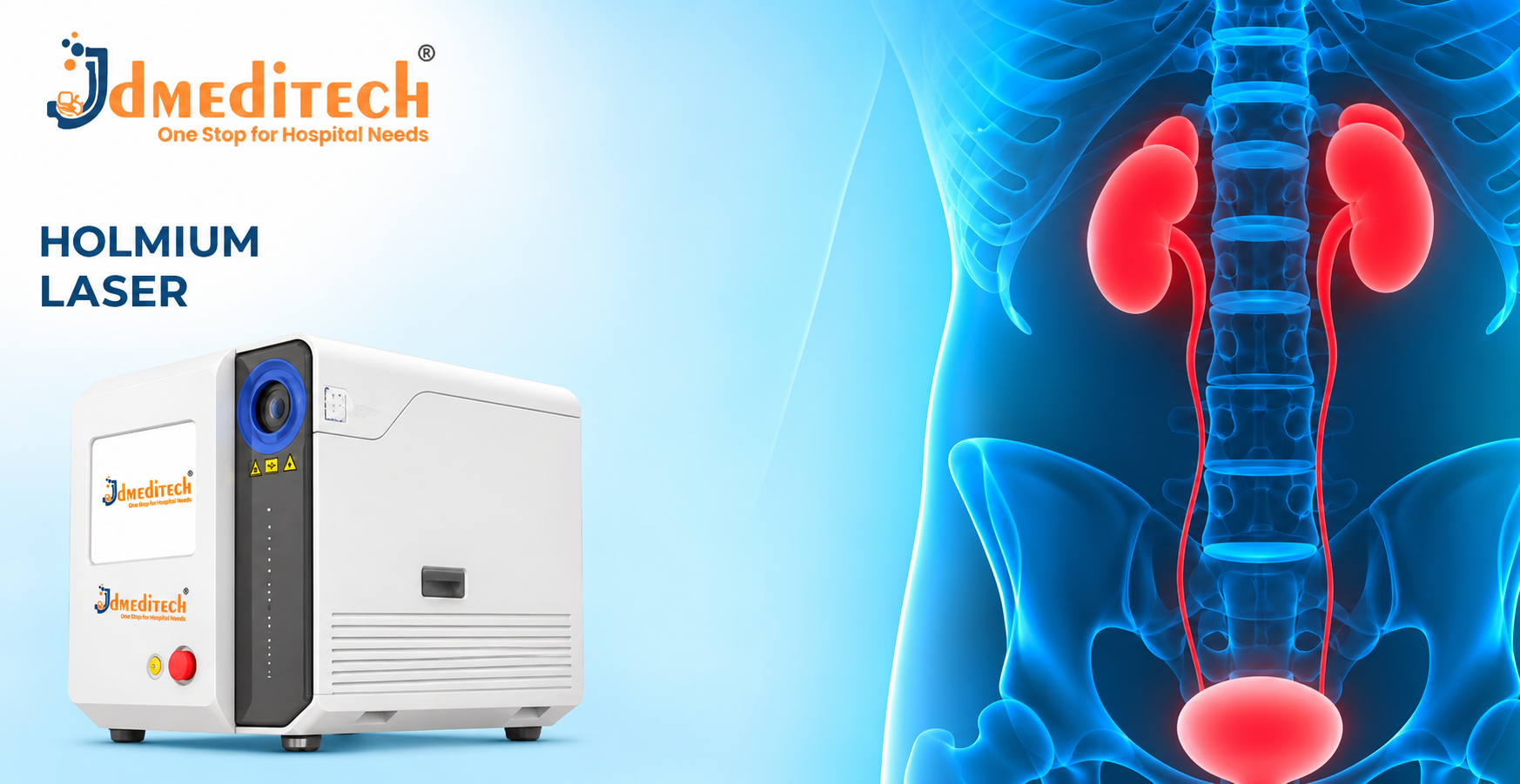
The supplied product image shows a compact surgical laser unit. However, the image does not establish its exact power rating, pulse frequency, pulse energy or approved clinical indications.
Therefore, buyers should verify the manufacturer’s official technical datasheet before placing an order.
| Parameter | Product Information |
|---|---|
| Product Name | Holmium Laser |
| Laser Technology | Ho:YAG |
| Category | Urology Surgical Equipment |
| Laser Wavelength | Approximately 2,100 nm for Ho:YAG Technology |
| Maximum Output Power | Confirm Manufacturer Specifications |
| Pulse Energy Range | Confirm Manufacturer Specifications |
| Pulse Frequency Range | Confirm Manufacturer Specifications |
| Pulse Duration Options | Confirm Manufacturer Specifications |
| Operating Modes | Confirm Available Configuration |
| Fiber Compatibility | Confirm Approved Fiber Types |
| Control Interface | Confirm Manufacturer Specifications |
| Cooling System | Confirm Manufacturer Specifications |
| Footswitch | Confirm Supplied Accessories |
| Input Voltage | Confirm Manufacturer Specifications |
| Power Consumption | Confirm Manufacturer Specifications |
| Dimensions | Confirm Manufacturer Specifications |
| Weight | Confirm Manufacturer Specifications |
| Approved Applications | Confirm Manufacturer Labeling |
| Regulatory Documentation | Verify for Destination Market |
Importance of Laser Power
Laser power influences the energy delivery capability of the equipment. Furthermore, different procedures may require different operating ranges.
However, higher power does not automatically produce better clinical outcomes. Therefore, clinicians must select appropriate parameters.
Importance of Pulse Energy
Pulse energy describes the amount of energy delivered in an individual laser pulse.
Furthermore, pulse energy influences the interaction between laser radiation and the target material.
However, the appropriate setting depends on the procedure, fiber and treatment objectives.
Importance of Pulse Frequency
Pulse frequency describes how often the laser emits pulses. Typically, the system expresses this parameter in hertz.
Furthermore, frequency and pulse energy together influence average output power.
However, operators must remain within the manufacturer’s approved operating limits.
Importance of Laser Fiber Compatibility
Laser fibers transmit treatment energy through compatible endoscopic instruments.
Therefore, surgeons must select fibers that match the laser generator and the working channel of the endoscope.
Furthermore, damaged or incompatible fibers can create serious safety risks.
Safety Precautions for Holmium Laser
- Use Only With Trained Clinical Personnel
- Verify Approved Clinical Indications
- Follow Laser Safety Procedures
- Use Appropriate Protective Eyewear Where Required
- Confirm Fiber Compatibility
- Inspect Optical Fibers Before Use
- Protect Patients and Staff From Laser Exposure
- Verify Emergency Stop Functions
- Follow Approved Irrigation Protocols
- Prevent Unintended Laser Activation
- Maintain Appropriate Treatment Visibility
- Follow Manufacturer Instructions
- Perform Scheduled Equipment Maintenance
Potential Risks and Complications
- Thermal Tissue Injury
- Unintended Laser Exposure
- Bleeding
- Infection
- Urinary Tract Injury
- Ureteral Perforation During Stone Procedures
- Residual Stone Fragments
- Laser Fiber Damage
- Endoscope Damage
- Procedure-Specific Complications
Furthermore, clinical risks depend on the patient’s condition, procedure and treatment technique.
Inspection Before Equipment Use
- Confirm Equipment Identification
- Inspect the Laser Generator
- Check Electrical Connections
- Verify Cooling System Readiness
- Inspect the Control Panel
- Confirm Laser Fiber Compatibility
- Check Fiber Connection Integrity
- Verify Footswitch Operation
- Confirm Emergency Stop Functions
- Check Maintenance Status
- Follow Manufacturer Pre-Use Procedures
Cleaning and Maintenance Guidelines
Healthcare facilities should clean the external laser unit according to the manufacturer’s instructions.
Furthermore, trained technical personnel should perform periodic inspections and scheduled maintenance.
Additionally, clinical teams must follow validated reprocessing procedures for reusable accessories.
However, the electronic laser generator must not undergo surgical instrument sterilization.
Storage and Handling Recommendations
- Store According to Manufacturer Instructions
- Protect the Equipment From Excessive Moisture
- Avoid Mechanical Impact
- Protect Optical Fiber Connections
- Maintain Suitable Ventilation
- Protect Electrical Connections
- Store Laser Fibers Appropriately
- Inspect Equipment Before Use
- Remove Malfunctioning Equipment From Service
How to Choose the Right Holmium Laser
Hospitals and procurement teams should evaluate several important factors before purchasing a surgical laser system.
- Approved Clinical Applications
- Maximum Output Power
- Pulse Energy Range
- Pulse Frequency Range
- Available Pulse Modes
- Laser Fiber Compatibility
- Control Panel Design
- Cooling System Requirements
- Electrical Requirements
- Laser Safety Features
- Equipment Dimensions
- Maintenance Requirements
- Regulatory Documentation
- Installation and Training Support
- Technical Service Availability
Why Choose JDMeditech?
JDMeditech supplies urology equipment, surgical instruments and medical accessories for hospitals, urology centers and medical distributors.
Furthermore, our team assists customers with product inquiries, available configurations and quotation requests.
Customers can contact JDMeditech regarding:
- Holmium Laser
- Laser Lithotripsy Accessories
- Ureteroscopy Instruments
- Flexible Ureteroscopes
- Rigid Ureteroscopes
- Nephroscopes
- HoLEP Surgical Instruments
- Stone Retrieval Baskets
- Ureteral Access Sheaths
- Hospital Equipment Procurement
Frequently Asked Questions
1. What Is a Holmium Laser?
A holmium laser is a medical laser system that generates pulsed infrared energy for selected surgical applications.
2. What Does Ho:YAG Stand For?
Ho:YAG stands for Holmium-Doped Yttrium Aluminium Garnet.
3. What Is the Wavelength of a Holmium Laser?
Ho:YAG surgical lasers typically operate near 2,100 nanometers.
4. Can a Holmium Laser Treat Kidney Stones?
Yes. Compatible systems support endoscopic laser fragmentation of selected kidney stones.
5. Can It Treat Ureteral Stones?
Yes. Urologists commonly use Ho:YAG laser lithotripsy during selected ureteroscopic procedures.
6. What Is HoLEP Surgery?
HoLEP is Holmium Laser Enucleation of the Prostate, an endoscopic procedure used to treat selected patients with benign prostatic hyperplasia.
7. Does Every Holmium Laser Support HoLEP?
No. Suitability depends on the system’s approved indications, performance capabilities and compatible accessories.
8. Does the Laser Require an Optical Fiber?
Endoscopic Ho:YAG procedures commonly use compatible optical fibers to deliver laser energy.
9. Can It Fragment Different Stone Types?
Ho:YAG laser technology can fragment many urinary stone compositions. However, treatment performance varies.
10. Is Holmium Laser Surgery Minimally Invasive?
Many Ho:YAG urological procedures use endoscopic access. However, the exact surgical approach depends on the procedure.
11. What Are the Main Safety Requirements?
Important requirements include trained personnel, laser safety controls, compatible accessories and adherence to manufacturer instructions.
12. Does the Equipment Require Maintenance?
Yes. Healthcare facilities should follow the manufacturer’s inspection, servicing and maintenance schedule.
13. Where Can Customers Request Product Information?
Hospitals, urology centers and medical distributors can contact JDMeditech for product details and quotations.
Conclusion
In conclusion, the Holmium Laser is an established surgical technology for selected urological procedures.
Furthermore, Ho:YAG energy supports urinary stone fragmentation and selected soft tissue applications.
However, safe and effective treatment depends on appropriate equipment selection, clinical expertise and approved operating protocols.
Therefore, hospitals and medical distributors should verify complete technical specifications before purchasing.
JDMeditech – One Stop for Hospital Needs
Website:
www.jdmeditech.com
Related Urology Equipment
- Ureteroscopy Instruments
- Flexible Ureteroscopes
- Rigid Ureteroscopes
- Nephroscopes
- HoLEP Surgical Instruments
- Stone Retrieval Baskets
- Ureteral Access Sheaths
- Laser Lithotripsy Accessories
Medical Equipment Reference
For general information about urinary stone management, visit the
European Association of Urology – Urolithiasis Guidelines
.
Medical Disclaimer
This article provides general educational and product information only. It does not replace professional medical advice, clinical judgment, specialist training or manufacturer instructions. Healthcare professionals must verify approved indications, laser specifications, fiber compatibility, safety requirements and regulatory documentation before clinical use.




