



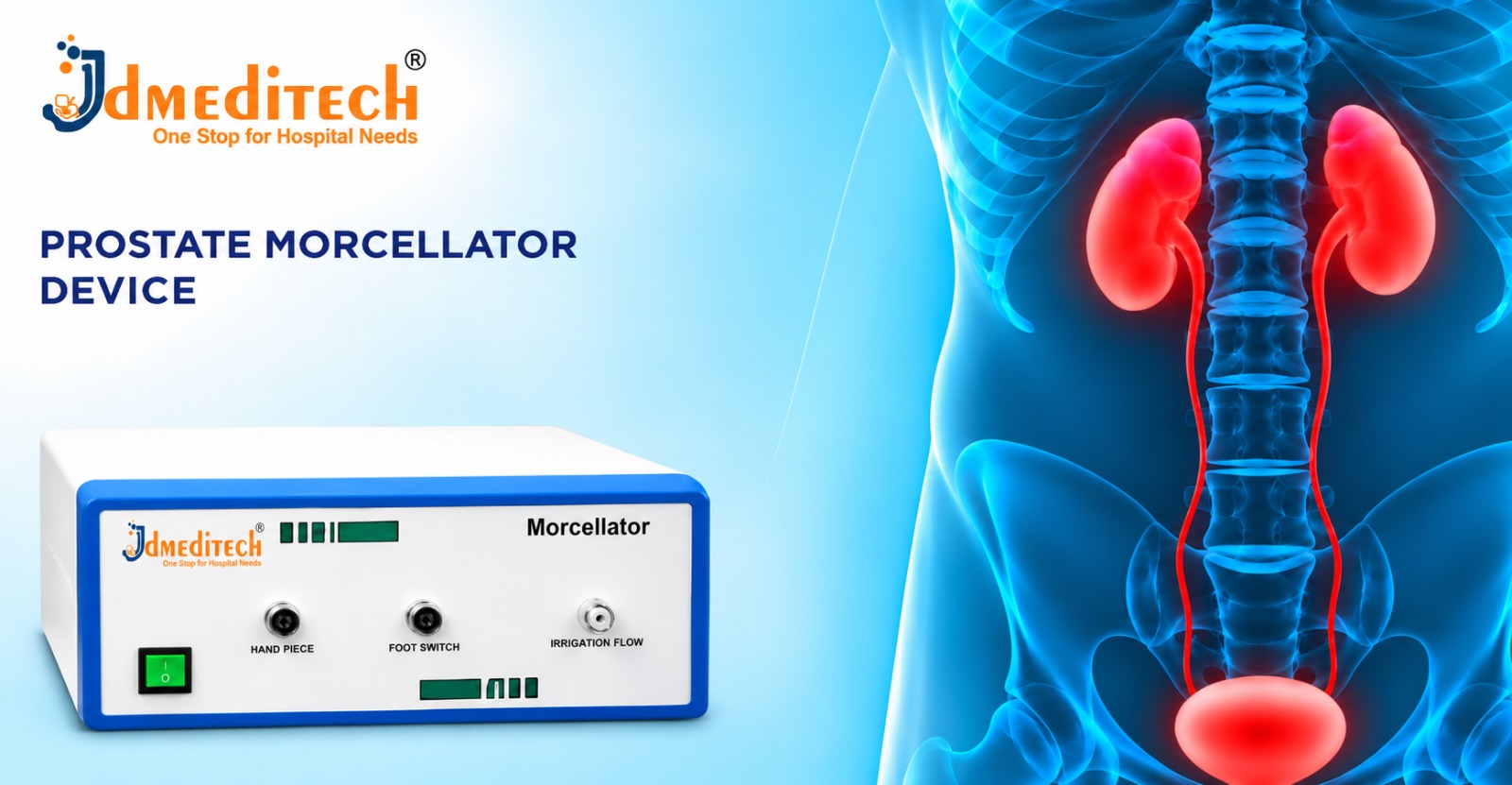
Prostate Morcellator Device – Features, Working Principle and Applications
A Prostate Morcellator Device is specialized urological equipment that supports the removal of enucleated prostate tissue during selected endoscopic procedures.
Urologists commonly use compatible morcellation systems during holmium laser enucleation of the prostate, also known as HoLEP.
During surgery, the surgeon separates obstructing prostate tissue from the surrounding surgical capsule. Subsequently, a compatible morcellation system helps fragment and remove the detached tissue.
Furthermore, endoscopic morcellation supports tissue retrieval without requiring a large surgical incision.
JDMeditech supplies urology surgical equipment, endoscopic instruments and medical accessories for hospitals, urology centers and medical distributors.
What Is a Prostate Morcellator?
A prostate morcellator is a surgical tissue retrieval system designed to fragment and remove previously enucleated prostate tissue.
Typically, the equipment includes a powered control unit and compatible surgical accessories.
Additionally, the system may work with a specialized morcellator handpiece, cutting mechanism and suction arrangement.
However, the exact components depend on the equipment model and configuration.
What Is Prostate Morcellation?
Prostate morcellation is the process of dividing enucleated prostate tissue into smaller fragments for removal.
During selected endoscopic prostate procedures, the surgeon first separates the obstructing tissue. Next, the clinical team retrieves the detached tissue through a compatible endoscopic system.
Consequently, morcellation helps complete the tissue removal stage of the procedure.
However, the process requires appropriate visibility, specialized equipment and trained surgical personnel.
How Does a Prostate Morcellator Work?
A powered morcellation system uses a mechanical cutting mechanism to fragment detached tissue.
During the procedure, the surgeon positions a compatible morcellator under direct endoscopic visualization.
Next, the system engages and fragments the previously enucleated tissue according to its approved operating design.
Furthermore, a compatible suction arrangement may assist with tissue removal.
However, the precise operating mechanism and tissue retrieval method vary between manufacturers.
Working Principle of Endoscopic Morcellation
Endoscopic morcellation combines mechanical tissue fragmentation with controlled tissue retrieval.
First, the surgeon completes the enucleation stage of the selected prostate procedure.
Next, a compatible endoscopic system provides visualization of the detached tissue.
Subsequently, the morcellation equipment fragments and retrieves the tissue.
However, the clinical team must maintain adequate visibility and follow the manufacturer’s safety instructions throughout the procedure.
Key Features of a Prostate Morcellator Device
- Powered Tissue Morcellation
- Endoscopic Tissue Retrieval Applications
- Compatibility With Selected HoLEP Procedures
- Electronic Control Unit
- Model-Specific Cutting Control
- Compatible Morcellator Handpiece
- Compatible Tissue Cutting Accessories
- Model-Specific Suction Integration
- Operator Control Interface
- Manufacturer-Defined Safety Functions
- Compatibility With Approved Endoscopic Instruments
Furthermore, exact features and included accessories depend on the selected product configuration.
Main Components of a Prostate Morcellator System
A typical endoscopic morcellation arrangement may include the following components:
- Morcellator Control Unit
- Power Supply
- Control Panel
- Compatible Morcellator Handpiece
- Mechanical Cutting Assembly
- Compatible Tissue Retrieval Accessories
- Suction Tubing or Suction Connection
- Footswitch or Other Approved Activation Control
- Compatible Endoscopic Instruments
- Manufacturer-Approved Accessories
However, some components may require separate purchase.
1. Morcellator Control Unit
The control unit manages the equipment’s designated operating functions.
Furthermore, it provides the electrical interface for compatible accessories.
2. Morcellator Handpiece
The handpiece supports the surgical tissue fragmentation process.
However, its design and compatibility depend on the specific system.
3. Mechanical Cutting Assembly
The cutting assembly divides previously detached tissue into smaller fragments.
Furthermore, cutting performance depends on the equipment design and approved operating parameters.
4. Suction Arrangement
Selected systems use suction to help engage and retrieve tissue fragments.
However, suction capabilities vary between models and accessory configurations.
5. Control Interface
The control interface allows trained personnel to operate the equipment within its approved settings.
Additionally, selected systems provide adjustable operating parameters.
6. Footswitch
Some morcellation systems use a compatible footswitch to control activation.
However, users must confirm the supplied accessories and activation method.
Clinical Applications of Prostate Morcellator
Endoscopic morcellation equipment supports selected procedures that require retrieval of enucleated tissue.
- Holmium Laser Enucleation of the Prostate (HoLEP)
- Selected Endoscopic Prostate Enucleation Procedures
- Thulium Laser Enucleation of the Prostate (ThuLEP), Where Compatible
- Other Manufacturer-Approved Tissue Retrieval Applications
However, not every device supports every listed procedure.
Role of Morcellation in HoLEP Surgery
HoLEP is an established endoscopic treatment option for selected patients with benign prostatic hyperplasia (BPH).
During the procedure, the surgeon uses a compatible holmium laser to separate obstructing prostate tissue.
After enucleation, the detached tissue requires removal from the bladder.
Therefore, a compatible morcellator supports the tissue retrieval stage.
Furthermore, the collected tissue may undergo histopathological examination when clinically indicated.
Role in ThuLEP Surgery
ThuLEP refers to thulium laser enucleation of the prostate.
During selected procedures, surgeons use thulium laser technology to enucleate obstructing prostate tissue.
Subsequently, a compatible morcellation system may support tissue retrieval.
However, the surgical team must verify equipment compatibility before use.
Importance of Tissue Retrieval in Prostate Surgery
After endoscopic enucleation, detached tissue must be managed appropriately.
Furthermore, tissue retrieval allows the clinical team to remove the enucleated material from the bladder.
Consequently, this stage plays an important role in completing selected prostate procedures.
However, the surgeon must avoid injury to surrounding urinary structures.
Potential Benefits of Prostate Morcellation
- Supports Endoscopic Tissue Retrieval
- Helps Remove Previously Enucleated Prostate Tissue
- Supports Selected HoLEP Procedures
- May Support Other Compatible Enucleation Techniques
- Allows Tissue Collection for Examination
- Supports Minimally Invasive Surgical Workflows
- Provides a Powered Tissue Fragmentation Method
However, clinical benefits depend on patient selection, surgical technique and equipment performance.
Prostate Morcellator vs Traditional Tissue Removal
| Feature | Endoscopic Morcellation | Other Tissue Retrieval Methods |
|---|---|---|
| Approach | Endoscopic Tissue Fragmentation | Depends on Surgical Technique |
| Primary Function | Fragments and Retrieves Detached Tissue | Retrieves Tissue Through Other Methods |
| Powered Cutting | Commonly Used | Not Always Required |
| Equipment Requirements | Dedicated Compatible Morcellation System | Procedure-Specific Instruments |
| Clinical Selection | Depends on Procedure and Surgeon | Depends on Procedure and Surgeon |
Technical Specifications of Prostate Morcellator Device
The supplied product image shows an electronic morcellator control unit.
However, the image does not confirm the cutting speed, motor specifications, suction performance or accessory compatibility.
Therefore, buyers should verify the official manufacturer’s datasheet before purchasing.
| Parameter | Product Information |
|---|---|
| Product Name | Prostate Morcellator Device |
| Category | Urology Surgical Equipment |
| Primary Function | Endoscopic Tissue Morcellation |
| Operating Principle | Powered Mechanical Tissue Fragmentation |
| Control Unit | Electronic Morcellator Controller |
| Cutting Speed | Confirm Manufacturer Specifications |
| Cutting Mechanism | Confirm Manufacturer Specifications |
| Motor Power | Confirm Manufacturer Specifications |
| Suction Compatibility | Confirm Approved Configuration |
| Handpiece Compatibility | Confirm Manufacturer Specifications |
| Cutting Accessories | Confirm Approved Accessories |
| Activation Method | Confirm Manufacturer Specifications |
| Operating Modes | Confirm Available Configuration |
| Input Voltage | Confirm Manufacturer Specifications |
| Power Consumption | Confirm Manufacturer Specifications |
| Dimensions | Confirm Manufacturer Specifications |
| Weight | Confirm Manufacturer Specifications |
| Supplied Accessories | Confirm Packaging Configuration |
| Regulatory Documentation | Verify for Destination Market |
Importance of Cutting Performance
Cutting performance influences the mechanical fragmentation of detached tissue.
Furthermore, appropriate cutting operation supports the intended tissue retrieval process.
However, cutting performance depends on the equipment design, tissue characteristics and surgical technique.
Importance of Suction Control
Selected morcellation systems use suction to engage tissue during retrieval.
Furthermore, appropriate suction control supports the equipment’s intended operation.
However, excessive or uncontrolled suction may increase the risk of tissue injury.
Importance of Endoscopic Visualization
Clear endoscopic visualization is essential during morcellation.
Furthermore, the surgeon must identify the detached tissue and surrounding bladder structures.
Consequently, inadequate visibility can increase the risk of complications.
Therefore, clinicians should not continue morcellation when they cannot maintain safe visualization.
Safety Precautions for Prostate Morcellator
- Use Only With Trained Surgical Personnel
- Verify Approved Clinical Indications
- Confirm Equipment Compatibility
- Maintain Direct Endoscopic Visualization
- Inspect Cutting Accessories
- Check Suction Connections
- Verify Activation Controls
- Follow Approved Irrigation Protocols
- Avoid Contact With Surrounding Bladder Tissue
- Follow Manufacturer Instructions
- Perform Required Equipment Maintenance
Potential Risks and Complications
- Bladder Mucosal Injury
- Bladder Perforation
- Bleeding
- Urinary Tract Injury
- Infection
- Incomplete Tissue Retrieval
- Equipment Malfunction
- Cutting Accessory Damage
- Procedure-Specific Complications
Furthermore, the clinical risk profile depends on patient condition, surgical technique and equipment performance.
Inspection Before Equipment Use
- Confirm Equipment Identification
- Inspect the Control Unit
- Check Electrical Connections
- Verify Compatible Handpiece
- Inspect Cutting Components
- Check Suction Connections
- Verify Activation Controls
- Confirm Irrigation System Readiness
- Inspect Endoscopic Equipment
- Check Maintenance Status
- Follow Manufacturer Pre-Use Procedures
Cleaning and Maintenance Guidelines
Healthcare facilities should clean the external control unit according to the manufacturer’s instructions.
Furthermore, reusable surgical accessories require validated cleaning and sterilization procedures.
However, single-use components must not be reused unless the manufacturer explicitly permits validated reprocessing.
Additionally, biomedical personnel should perform scheduled inspections and maintenance.
Storage and Handling Recommendations
- Store According to Manufacturer Instructions
- Protect the Equipment From Moisture
- Avoid Mechanical Impact
- Protect Electrical Connections
- Store Cutting Accessories Appropriately
- Follow Accessory Sterility Requirements
- Inspect Equipment Before Use
- Remove Malfunctioning Equipment From Service
How to Choose the Right Prostate Morcellator
Hospitals and procurement teams should evaluate several important factors before purchasing a morcellation system.
- Approved Clinical Applications
- Cutting Mechanism
- Cutting Speed Range
- Motor Performance
- Compatible Handpieces
- Suction Requirements
- Compatible Endoscopic Instruments
- Control Interface
- Activation Method
- Electrical Requirements
- Cleaning and Sterilization Requirements
- Safety Features
- Regulatory Documentation
- Technical Service Availability
Why Choose JDMeditech?
JDMeditech supplies urology equipment, surgical instruments and medical accessories for hospitals, urology centers and medical distributors.
Furthermore, our team assists customers with product inquiries, available configurations and quotation requests.
Customers can contact JDMeditech regarding:
- Prostate Morcellator Device
- Holmium Laser
- HoLEP Surgical Instruments
- Resectoscope Sets
- Urology Endoscopic Instruments
- Laser Lithotripsy Accessories
- Hospital Equipment Procurement
Frequently Asked Questions
1. What Is a Prostate Morcellator Device?
A prostate morcellator is specialized equipment used to fragment and retrieve enucleated prostate tissue during selected endoscopic procedures.
2. What Is the Main Purpose of a Prostate Morcellator?
Its primary purpose is to support the removal of detached prostate tissue after endoscopic enucleation.
3. Is a Morcellator Used During HoLEP?
Yes. Compatible morcellation systems commonly support tissue retrieval during HoLEP surgery.
4. Can It Be Used During ThuLEP?
Selected morcellation systems may support ThuLEP procedures when compatible with the surgical equipment.
5. Does a Prostate Morcellator Remove Tissue?
Yes. It fragments previously enucleated tissue and supports its retrieval through a compatible system.
6. Does Every Morcellator Have Suction?
No. Suction integration and operating arrangements depend on the equipment design.
7. Is Morcellation a Separate Stage of HoLEP?
Yes. Tissue morcellation generally follows the prostate enucleation stage.
8. Does Morcellation Require Endoscopic Visualization?
Yes. Direct visualization is essential for safe tissue retrieval.
9. Can the Retrieved Tissue Be Examined?
Yes. Retrieved tissue may undergo histopathological examination when clinically indicated.
10. What Are the Main Risks?
Potential risks include bladder injury, bleeding, infection and incomplete tissue retrieval.
11. Does the Equipment Require Maintenance?
Yes. Healthcare facilities should follow the manufacturer’s inspection and maintenance instructions.
12. Where Can Customers Request Product Information?
Hospitals, urology centers and medical distributors can contact JDMeditech for product information and quotations.
Conclusion
In conclusion, the Prostate Morcellator Device is an important component of selected endoscopic prostate surgery workflows.
Furthermore, powered morcellation supports the fragmentation and retrieval of previously enucleated prostate tissue.
However, safe operation depends on suitable equipment, trained personnel and adequate endoscopic visualization.
Therefore, hospitals and medical distributors should verify technical specifications and accessory compatibility before purchasing.
JDMeditech – One Stop for Hospital Needs
Website:
www.jdmeditech.com
Related Urology Equipment
- Holmium Laser
- HoLEP Surgical Instruments
- Resectoscope Sets
- Urology Endoscopic Instruments
- Laser Lithotripsy Accessories
- Endoscopic Tissue Retrieval Equipment
Medical Equipment Reference
For general information about benign prostatic obstruction and surgical treatment options, visit the
European Association of Urology – Management of Non-Neurogenic Male LUTS Guidelines
.
Medical Disclaimer
This article provides general educational and product information only. It does not replace professional medical advice, clinical judgment, specialist training or manufacturer instructions. Healthcare professionals must verify approved indications, cutting mechanism specifications, handpiece compatibility, suction requirements, safety precautions and regulatory documentation before clinical use.




