



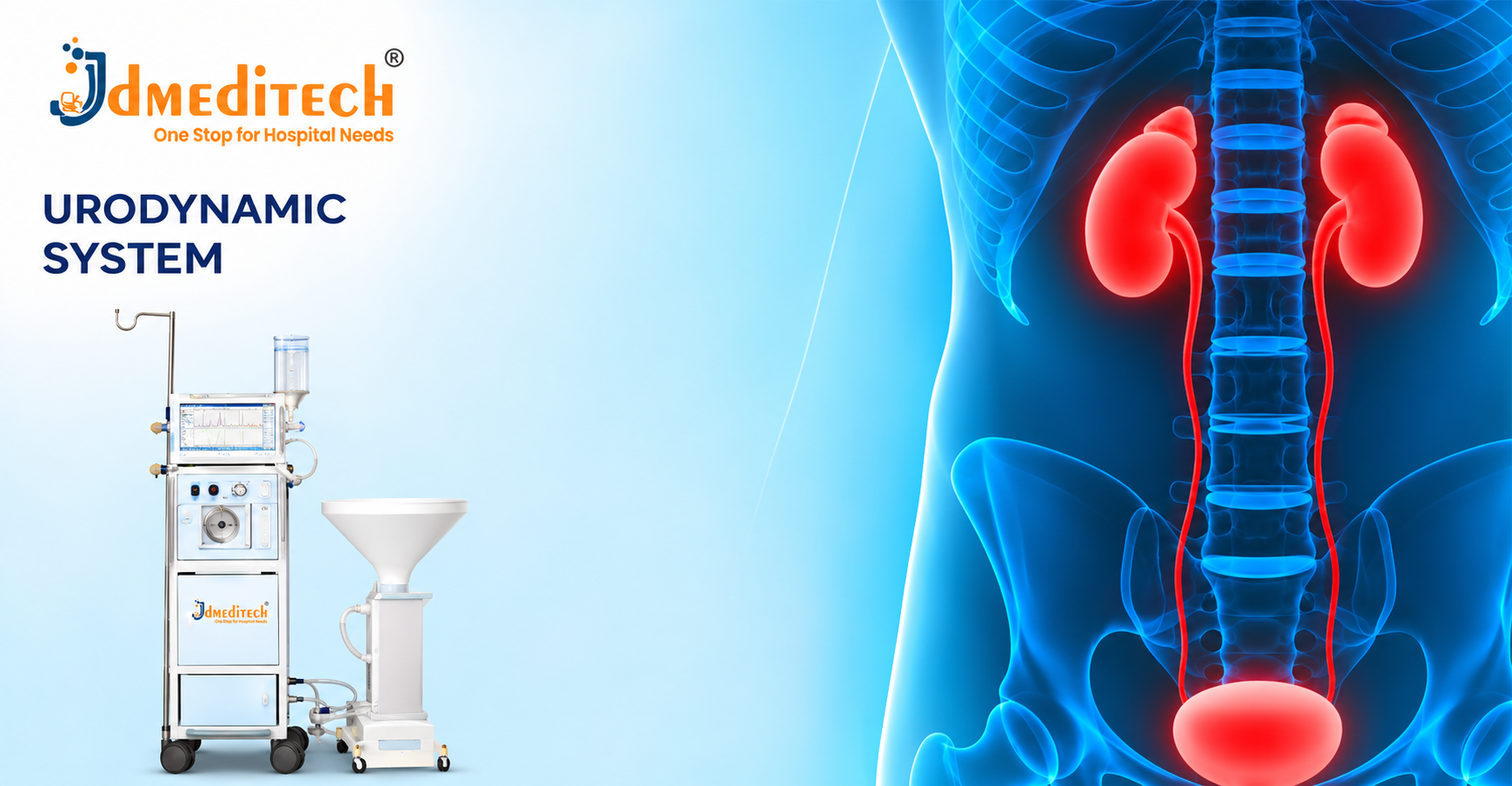
Urodynamic System – Working Principle, Features, Uses and Benefits
A Urodynamic System is specialized diagnostic equipment that helps healthcare professionals evaluate how the bladder and urethra store and release urine.
Urodynamic testing measures selected aspects of lower urinary tract function. Consequently, clinicians can investigate urinary symptoms and assess bladder behavior during filling and emptying.
Furthermore, a compatible testing setup may measure urinary flow, bladder pressure and abdominal pressure.
JDMeditech supplies urology diagnostic equipment, surgical instruments and medical accessories for hospitals, urology centers and medical distributors.
What Is a Urodynamic System?
A urodynamic testing system collects and displays physiological measurements related to bladder storage and urination.
Depending on its configuration, the equipment may support uroflowmetry, filling cystometry and pressure-flow studies.
Additionally, selected systems provide electromyography or urethral pressure measurement capabilities.
However, the exact testing functions depend on the equipment model and supplied accessories.
What Is Urodynamic Testing?
Urodynamic testing describes a group of diagnostic investigations that assess lower urinary tract function.
These investigations help clinicians understand bladder filling, urinary flow and pressure changes.
Furthermore, testing may provide useful information when symptoms alone do not establish the underlying problem.
However, clinicians should interpret test results alongside the patient’s history, examination and other investigations.
How Does a Urodynamic System Work?
The equipment collects information from compatible sensors, pressure transducers and flow measurement accessories.
During selected investigations, the clinical team uses appropriate catheters to measure bladder and abdominal pressures.
Meanwhile, a compatible uroflowmeter can record urinary flow during voiding.
Next, the system processes the measurements and presents them as numerical values and graphical recordings.
Consequently, clinicians can evaluate pressure changes, flow patterns and other relevant findings.
Working Principle of Urodynamic Testing Equipment
Urodynamic equipment uses physiological measurement technology to assess lower urinary tract function.
Pressure transducers convert pressure changes into electrical signals. Similarly, a compatible flow measurement device records urine flow characteristics.
The software then processes these signals and displays them for clinical review.
Furthermore, selected systems allow clinicians to record patient sensations and procedural events during testing.
Key Features of a Urodynamic System
- Lower Urinary Tract Function Assessment
- Bladder Pressure Measurement
- Abdominal Pressure Measurement
- Detrusor Pressure Calculation on Compatible Systems
- Urinary Flow Measurement
- Graphical Data Display
- Digital Recording Functions
- Patient Data Management
- Model-Specific Diagnostic Test Modes
- Compatible Pressure Transducers
- Compatible Urodynamic Catheters
- Manufacturer-Defined Safety Functions
Furthermore, customers should verify the exact testing functions and available accessories before purchasing.
Main Components of a Urodynamic System
A typical testing arrangement may include the following components:
- Diagnostic Control Unit
- Computer or Display Interface
- Urodynamic Analysis Software
- Pressure Transducers
- Bladder Pressure Catheter
- Abdominal Pressure Catheter
- Uroflowmetry Measurement Unit
- Urine Collection Container
- Infusion Pump, Where Applicable
- Compatible Connection Tubing
- Electrical Power Supply
- Manufacturer-Approved Accessories
However, the exact system configuration varies between manufacturers.
1. Diagnostic Control Unit
The diagnostic control unit receives measurement signals from connected accessories.
Furthermore, it supports data processing and communication with compatible software.
2. Urodynamic Analysis Software
The software displays measurement values and graphical recordings.
Additionally, selected systems provide reporting, data storage and patient record management.
3. Pressure Transducers
Pressure transducers measure pressure changes through compatible catheter and tubing arrangements.
Consequently, clinicians can evaluate bladder and abdominal pressure recordings.
4. Bladder Pressure Catheter
A bladder pressure catheter allows measurement of intravesical pressure during selected tests.
However, catheter selection depends on the clinical investigation and equipment compatibility.
5. Abdominal Pressure Catheter
A compatible rectal or vaginal pressure catheter may help measure abdominal pressure.
Furthermore, the equipment can use this measurement when calculating detrusor pressure.
6. Uroflowmetry Unit
A uroflowmeter records urine flow characteristics during voiding.
Typically, the results include flow rate and voided volume.
7. Infusion Pump
Selected testing systems include a pump that supports controlled bladder filling during cystometry.
However, the available filling functions and operating parameters depend on the equipment configuration.
Types of Urodynamic Tests
Urodynamic investigations include several complementary testing methods.
- Uroflowmetry
- Filling Cystometry
- Pressure-Flow Study
- Urethral Pressure Profilometry
- Electromyography, Where Indicated
- Video Urodynamics, Where Available
Uroflowmetry Test
Uroflowmetry measures the rate at which urine leaves the bladder.
During testing, the patient urinates into a compatible flow measurement device.
The equipment records flow characteristics and voided volume.
Consequently, clinicians can assess the urinary flow pattern.
Cystometry Test
Filling cystometry evaluates bladder pressure and sensation during controlled filling.
During the investigation, the clinical team records pressure changes and relevant patient sensations.
Furthermore, the results may help identify abnormal bladder activity or storage dysfunction.
Pressure-Flow Study
A pressure-flow study evaluates the relationship between bladder pressure and urinary flow during voiding.
Consequently, the investigation may help clinicians distinguish selected causes of impaired bladder emptying.
However, results require specialist interpretation.
Urethral Pressure Profilometry
Urethral pressure profilometry measures pressure along the urethra using appropriate equipment.
However, clinical use and interpretation depend on the diagnostic question and local practice.
Electromyography in Urodynamic Testing
Selected investigations include electromyography to assess pelvic floor muscle activity.
Furthermore, these recordings may support evaluation of muscle activity during bladder filling and voiding.
However, electromyography is not included in every system.
Clinical Applications of Urodynamic Testing
Clinicians may request urodynamic investigations when additional functional information could influence diagnosis or treatment.
- Selected Urinary Incontinence Cases
- Suspected Bladder Outlet Obstruction
- Unexplained Voiding Dysfunction
- Selected Neurogenic Lower Urinary Tract Conditions
- Complex Bladder Storage Symptoms
- Selected Preoperative Evaluations
- Assessment of Bladder Emptying Dysfunction
- Other Clinically Indicated Investigations
However, not every patient with urinary symptoms requires invasive urodynamic testing.
Urodynamic Testing for Urinary Incontinence
Urinary incontinence involves involuntary urine leakage.
In selected cases, urodynamic testing provides additional information about bladder function and pressure changes.
Furthermore, clinicians may use the findings to support treatment planning.
Urodynamic Testing for Bladder Outlet Obstruction
Bladder outlet obstruction can interfere with normal urinary flow.
A pressure-flow study may help evaluate the relationship between bladder pressure and urinary flow.
Consequently, the findings may support diagnosis in selected patients.
Urodynamic Testing for Neurogenic Bladder
Neurological conditions can affect bladder storage and emptying.
Therefore, selected patients may require specialized lower urinary tract assessment.
Furthermore, urodynamic findings can help clinicians evaluate bladder pressures and functional abnormalities.
Potential Benefits of Urodynamic Testing
- Provides Objective Functional Measurements
- Supports Assessment of Bladder Storage
- Supports Assessment of Bladder Emptying
- Records Urinary Flow Characteristics
- Measures Selected Pressure Parameters
- Supports Investigation of Complex Urinary Symptoms
- Provides Information for Clinical Decision-Making
- Supports Follow-Up in Selected Patients
However, diagnostic value depends on appropriate test selection, measurement quality and interpretation.
Urodynamic System vs Uroflowmeter
| Feature | Urodynamic Testing System | Uroflowmeter |
|---|---|---|
| Primary Function | Comprehensive Functional Assessment | Urinary Flow Measurement |
| Bladder Pressure | Available on Compatible Systems | Not Typically Measured |
| Abdominal Pressure | Available on Compatible Systems | Not Typically Measured |
| Flow Rate | Available on Compatible Systems | Yes |
| Cystometry | Available on Compatible Systems | No |
| Testing Complexity | Depends on Selected Investigation | Generally Simpler |
Technical Specifications of Urodynamic System
The supplied product image shows a mobile urodynamic testing arrangement with a diagnostic unit and urine collection accessory.
However, the image does not confirm pressure measurement ranges, pump performance, software functions or sensor compatibility.
Therefore, buyers should verify the manufacturer’s official technical datasheet.
| Parameter | Product Information |
|---|---|
| Product Name | Urodynamic System |
| Equipment Category | Urology Diagnostic Equipment |
| Primary Function | Lower Urinary Tract Function Testing |
| Pressure Measurement Channels | Confirm Manufacturer Specifications |
| Pressure Measurement Range | Confirm Manufacturer Specifications |
| Pressure Measurement Accuracy | Confirm Manufacturer Specifications |
| Uroflowmetry Range | Confirm Manufacturer Specifications |
| Voided Volume Measurement | Confirm Manufacturer Specifications |
| Infusion Pump | Confirm Available Configuration |
| Infusion Rate Range | Confirm Manufacturer Specifications |
| EMG Function | Confirm Available Configuration |
| Urethral Pressure Measurement | Confirm Available Configuration |
| Software Functions | Confirm Manufacturer Specifications |
| Data Storage | Confirm Available Configuration |
| Report Generation | Confirm Available Configuration |
| Catheter Compatibility | Confirm Approved Accessories |
| Input Voltage | Confirm Manufacturer Specifications |
| Dimensions | Confirm Manufacturer Specifications |
| Weight | Confirm Manufacturer Specifications |
| Regulatory Documentation | Verify for Destination Market |
Importance of Pressure Measurement
Pressure measurement helps clinicians evaluate bladder and abdominal pressure changes.
Furthermore, accurate measurement supports the interpretation of selected functional abnormalities.
However, poor catheter positioning or measurement artifacts can affect results.
Importance of Uroflowmetry
Uroflowmetry provides information about urinary flow rate and voided volume.
Furthermore, flow patterns may help clinicians identify abnormalities that require additional investigation.
However, uroflowmetry alone cannot establish every cause of urinary dysfunction.
Importance of Accurate Data Recording
Reliable measurements support clinical interpretation.
Therefore, operators should follow standardized testing protocols and manufacturer instructions.
Furthermore, clinicians should identify and correct measurement artifacts when possible.
Patient Preparation for Urodynamic Testing
Preparation depends on the investigation and the patient’s medical condition.
The clinical team may review urinary symptoms, medications and relevant medical history.
Furthermore, clinicians may assess for urinary infection before invasive testing.
However, patients should follow instructions provided by their healthcare professional.
Safety Precautions for Urodynamic Testing
- Use Only With Trained Healthcare Personnel
- Confirm Clinical Indications
- Follow Infection Prevention Protocols
- Use Appropriate Catheter Techniques
- Verify Sensor Connections
- Check Pressure Measurement Accuracy
- Follow Manufacturer Instructions
- Monitor Patient Comfort
- Protect Patient Data
- Perform Required Equipment Maintenance
Potential Risks and Limitations
- Temporary Discomfort
- Urinary Tract Infection
- Minor Urethral Irritation
- Temporary Blood in Urine
- Measurement Artifacts
- Incomplete Test Data
- Patient-Specific Complications
Furthermore, risks depend on the selected investigation and the patient’s condition.
Inspection Before Equipment Use
- Confirm Equipment Identification
- Inspect the Diagnostic Control Unit
- Check Electrical Connections
- Verify Pressure Transducer Connections
- Inspect Compatible Catheters
- Check Uroflowmetry Accessories
- Verify Software Readiness
- Confirm Measurement Calibration
- Check Maintenance Status
- Follow Manufacturer Pre-Use Procedures
Cleaning and Maintenance Guidelines
Healthcare facilities should clean equipment surfaces according to the manufacturer’s instructions.
Furthermore, reusable accessories require validated cleaning and reprocessing procedures.
However, single-use catheters and accessories must not be reused unless validated reprocessing is expressly permitted by applicable requirements.
Additionally, authorized technical personnel should perform scheduled inspections and calibration.
Storage and Handling Recommendations
- Store According to Manufacturer Instructions
- Protect Equipment From Excessive Moisture
- Avoid Mechanical Impact
- Protect Pressure Sensors
- Store Catheters According to Labeling
- Inspect Electrical Connections
- Follow Environmental Requirements
- Remove Malfunctioning Equipment From Service
How to Choose the Right Urodynamic System
Hospitals and procurement teams should evaluate several factors before purchasing diagnostic equipment.
- Supported Diagnostic Tests
- Pressure Measurement Channels
- Pressure Measurement Accuracy
- Uroflowmetry Capability
- Infusion Pump Configuration
- Software Functions
- Data Recording and Reporting
- Catheter Compatibility
- Available Accessories
- Patient Data Management
- Calibration Requirements
- Electrical Requirements
- Regulatory Documentation
- Operator Training
- Technical Support Availability
Why Choose JDMeditech?
JDMeditech supplies urology diagnostic equipment, surgical instruments and medical accessories for hospitals, urology centers and medical distributors.
Furthermore, our team assists customers with product inquiries, available configurations and quotation requests.
Customers can contact JDMeditech regarding:
- Urodynamic Testing Equipment
- Uroflowmetry Equipment
- Urodynamic Catheters
- Rectal Balloon Catheters
- Urology Diagnostic Accessories
- Urology Surgical Instruments
- Hospital Equipment Procurement
Frequently Asked Questions
1. What Is a Urodynamic System?
A urodynamic system is diagnostic equipment used to assess selected aspects of bladder and urethral function.
2. What Is Urodynamic Testing Used For?
Clinicians use it to investigate selected urinary storage and emptying problems.
3. What Is Uroflowmetry?
Uroflowmetry measures urine flow rate and voided volume during urination.
4. What Is Cystometry?
Cystometry evaluates bladder pressure and sensation during controlled filling.
5. What Is a Pressure-Flow Study?
A pressure-flow study measures the relationship between bladder pressure and urinary flow during voiding.
6. Does Every Urodynamic System Include EMG?
No. Electromyography functions depend on the equipment model and configuration.
7. Can Urodynamic Testing Help Evaluate Urinary Incontinence?
Yes. In selected cases, it provides information that supports clinical assessment.
8. Can It Help Evaluate Bladder Outlet Obstruction?
Yes. Pressure-flow studies can support assessment of suspected obstruction in appropriate patients.
9. Is Urodynamic Testing Painful?
Some tests may cause temporary discomfort, especially when catheter placement is required.
10. Does Every Patient With Urinary Symptoms Need Testing?
No. Clinicians select investigations according to symptoms, medical history and diagnostic needs.
11. Does the Equipment Require Calibration?
Yes. Healthcare facilities should follow manufacturer requirements for measurement checks and calibration.
12. Where Can Customers Request Product Information?
Hospitals, urology centers and medical distributors can contact JDMeditech for product details and quotations.
Conclusion
In conclusion, the Urodynamic System provides important diagnostic information about lower urinary tract function.
Furthermore, pressure measurements and urinary flow recordings help clinicians investigate selected bladder storage and emptying disorders.
However, reliable results depend on appropriate patient selection, standardized testing and professional interpretation.
Therefore, healthcare facilities should verify complete technical specifications and accessory compatibility before purchasing.
JDMeditech – One Stop for Hospital Needs
Website:
www.jdmeditech.com
Related Urology Equipment
- Uroflowmetry Equipment
- Urodynamic Catheters
- Rectal Balloon Catheters
- Urology Diagnostic Accessories
- Urology Surgical Instruments
Medical Equipment Reference
For information about professional urodynamic standards and terminology, visit the
International Continence Society
.
Medical Disclaimer
This article provides general educational and product information only. It does not replace professional medical advice, clinical judgment, specialist training or manufacturer instructions. Healthcare professionals must verify approved indications, measurement specifications, catheter compatibility, safety requirements and regulatory documentation before clinical use.




