



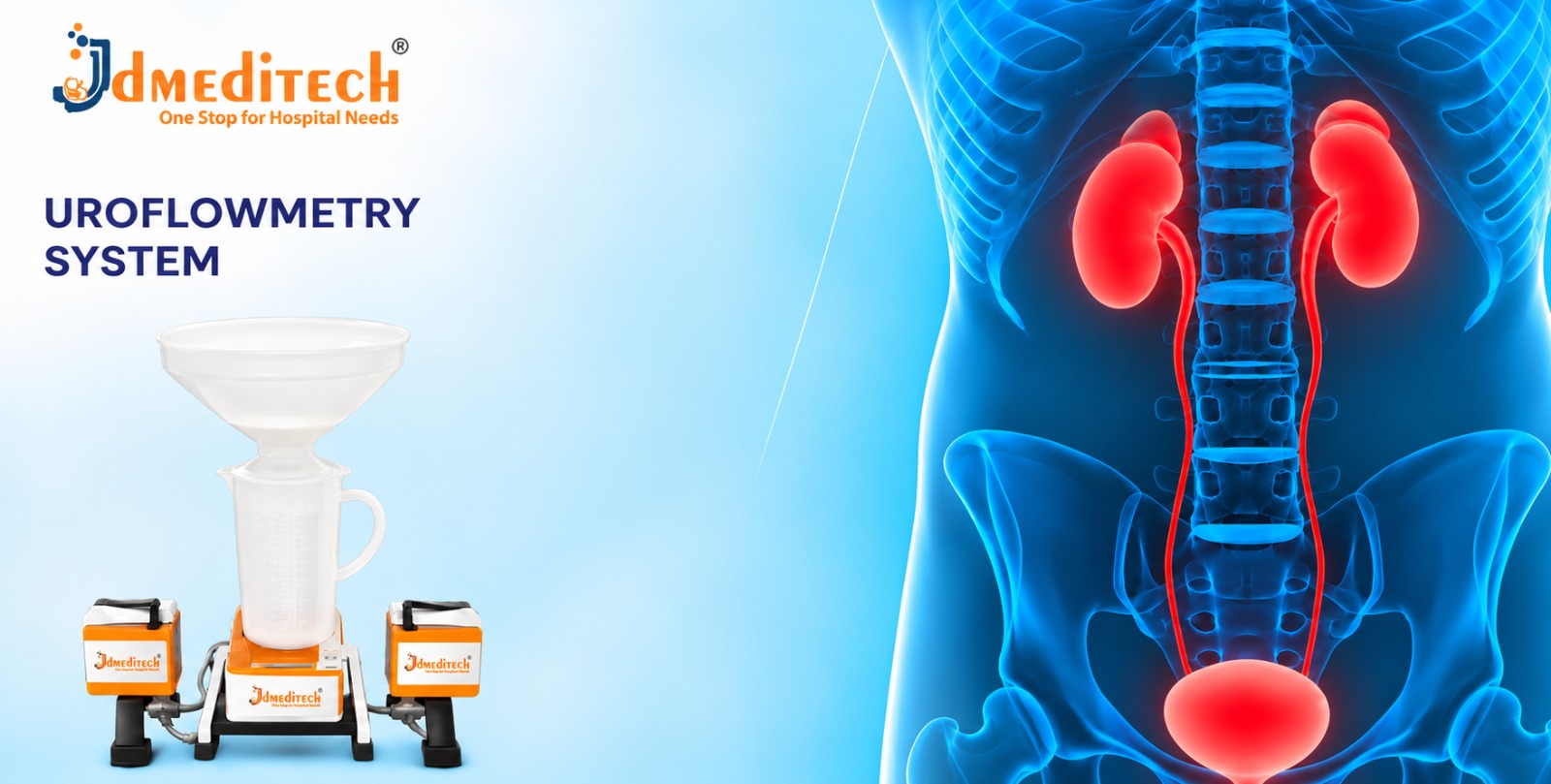
Uroflowmetry System – Features, Working Principle, Uses and Benefits
A Uroflowmetry System is a diagnostic device that measures the flow rate and volume of urine during urination. Urologists use this equipment to evaluate urinary flow patterns and investigate selected lower urinary tract symptoms.
The test provides objective information about how quickly urine leaves the bladder. Additionally, it helps clinicians assess voiding function without routinely requiring catheter insertion.
As a result, uroflowmetry plays an important role in the assessment of selected urinary conditions in adults and children.
JDMeditech supplies urology diagnostic equipment, surgical instruments and medical accessories for hospitals, clinics and medical distributors.
What Is a Uroflowmetry System?
A uroflowmeter measures urine flow during natural voiding. The equipment records the amount of urine passed over time and calculates flow-related parameters.
Typically, the testing arrangement includes a urine collection funnel, measurement unit and compatible recording or display system.
Furthermore, some models provide digital reports and graphical flow curves.
However, available features depend on the equipment model and configuration.
What Is a Uroflowmetry Test?
Uroflowmetry is a noninvasive diagnostic test that evaluates urinary flow during urination.
During the test, the patient urinates into a designated collection device connected to the measuring equipment.
The system records urine flow over time. Subsequently, clinicians review the resulting measurements and flow curve.
However, a single test may not provide enough information to identify the underlying cause of abnormal urination.
How Does a Uroflowmetry System Work?
The system measures urine passing into a compatible collection arrangement.
Depending on its design, the device may use weight-based measurement, a rotating sensor or another approved flow measurement method.
Next, the equipment converts the measurement signals into urinary flow data.
Consequently, clinicians can review parameters such as maximum flow rate, average flow rate and voided volume.
Additionally, compatible systems may display a graphical representation of urinary flow.
Working Principle of Uroflowmetry Equipment
Uroflowmetry equipment measures the relationship between urine volume and time.
The device continuously records changes in the collected urine measurement.
Next, the software calculates urinary flow rates and generates the flow curve.
Therefore, clinicians can evaluate the overall pattern of voiding.
However, measurement accuracy depends on proper equipment operation and suitable test conditions.
Key Features of a Uroflowmetry System
- Noninvasive Urinary Flow Assessment
- Urine Flow Rate Measurement
- Voided Volume Measurement
- Maximum Flow Rate Calculation
- Average Flow Rate Calculation
- Urinary Flow Curve Recording
- Compatible Urine Collection Funnel
- Model-Specific Digital Display
- Model-Specific Patient Data Storage
- Compatible Reporting Functions
- Easy Access for Clinical Testing
- Manufacturer-Defined Measurement Functions
Furthermore, the exact functions depend on the selected equipment configuration.
Main Components of a Uroflowmetry System
A typical uroflowmetry testing arrangement may include:
- Urine Collection Funnel
- Urine Collection Container
- Flow Measurement Unit
- Electronic Sensor
- Processing Unit
- Display or Computer Interface
- Compatible Uroflowmetry Software
- Connection Cables, Where Applicable
- Power Supply
- Manufacturer-Approved Accessories
However, the exact components and accessories vary by manufacturer.
1. Urine Collection Funnel
The collection funnel directs urine into the measurement arrangement.
Furthermore, its design supports convenient sample collection during testing.
2. Urine Collection Container
The collection container receives urine during the investigation.
However, its capacity and compatibility depend on the system design.
3. Flow Measurement Unit
The measurement unit records urine flow characteristics.
Additionally, it supplies the information required to calculate flow parameters.
4. Electronic Sensor
The sensor detects changes associated with urine collection.
Consequently, the system can calculate flow-related measurements.
5. Processing Unit
The processing unit converts measurement signals into usable diagnostic data.
Furthermore, it supports calculation of flow rate and voided volume.
6. Display and Reporting Interface
Selected systems provide a digital interface for viewing results.
Additionally, compatible software may support report generation and patient data storage.
Important Parameters Measured During Uroflowmetry
A uroflowmetry investigation commonly provides several important measurements.
- Maximum Flow Rate (Qmax)
- Average Flow Rate (Qavg)
- Voided Volume
- Flow Time
- Voiding Time
- Time to Maximum Flow
- Urinary Flow Curve
Maximum Flow Rate (Qmax)
Qmax represents the highest recorded urinary flow rate during a voiding event.
Clinicians interpret this value alongside the patient’s age, voided volume, symptoms and other clinical findings.
However, Qmax alone cannot reliably distinguish bladder outlet obstruction from impaired bladder muscle contraction.
Average Flow Rate (Qavg)
Qavg represents the average urine flow rate during the recorded flow period.
Furthermore, this measurement helps describe the overall flow characteristics.
Voided Volume
Voided volume indicates the amount of urine passed during the test.
Adequate voided volume is important for meaningful interpretation.
Therefore, clinicians may recommend repeating a test when the collected volume is insufficient.
Urinary Flow Curve
The urinary flow curve shows how urine flow changes during voiding.
A smooth, bell-shaped pattern may occur during normal voiding.
However, irregular or flattened patterns can occur for several reasons.
Consequently, clinicians must interpret the curve in the appropriate clinical context.
Clinical Applications of Uroflowmetry
Urologists use uroflowmetry to investigate selected urinary symptoms and monitor voiding function.
- Weak Urinary Stream
- Difficulty Starting Urination
- Intermittent Urinary Flow
- Suspected Bladder Outlet Obstruction
- Selected Benign Prostatic Hyperplasia Cases
- Suspected Urethral Stricture
- Selected Pediatric Voiding Disorders
- Follow-Up After Urological Treatment
- Other Clinically Indicated Assessments
Uroflowmetry in Benign Prostatic Hyperplasia
Benign prostatic hyperplasia (BPH) may contribute to lower urinary tract symptoms in men.
Uroflowmetry helps clinicians evaluate urinary flow characteristics in selected patients.
Furthermore, repeated measurements may support assessment of changes after treatment.
However, the test does not independently confirm BPH or establish the precise cause of reduced flow.
Uroflowmetry in Urethral Stricture Evaluation
A urethral stricture can restrict urine passage through the urethra.
Consequently, patients may experience a weak or prolonged urinary stream.
Uroflowmetry can identify abnormal flow patterns that warrant additional evaluation.
However, clinicians may require imaging or endoscopic investigations to confirm the diagnosis.
Uroflowmetry in Pediatric Urology
Pediatric urologists may use uroflowmetry to assess selected voiding problems in children.
Furthermore, the test may help evaluate urinary flow patterns during follow-up.
However, interpretation requires age-appropriate clinical assessment.
Potential Benefits of Uroflowmetry Testing
- Noninvasive Assessment
- No Routine Catheter Insertion
- Objective Urinary Flow Measurements
- Useful Flow Curve Information
- Supports Investigation of Voiding Symptoms
- May Support Treatment Follow-Up
- Relatively Simple Testing Process
- Suitable for Selected Adult and Pediatric Patients
However, diagnostic usefulness depends on appropriate patient selection and test quality.
Uroflowmetry System vs Urodynamic System
| Feature | Uroflowmetry System | Urodynamic System |
|---|---|---|
| Primary Function | Measures Urinary Flow | Evaluates Multiple Lower Urinary Tract Functions |
| Maximum Flow Rate | Yes | Available on Compatible Systems |
| Voided Volume | Yes | Available on Compatible Systems |
| Bladder Pressure | Not Typically Measured | Available on Compatible Systems |
| Abdominal Pressure | Not Typically Measured | Available on Compatible Systems |
| Catheter Requirement | Not Routinely Required | Required for Selected Invasive Studies |
| Testing Complexity | Generally Simpler | Depends on the Investigation |
Technical Specifications of Uroflowmetry System
The supplied product image shows a urine collection funnel and associated measurement equipment.
However, the image does not confirm the measurement technology, flow range, accuracy or software configuration.
Therefore, buyers should verify the manufacturer’s official technical datasheet.
| Parameter | Product Information |
|---|---|
| Product Name | Uroflowmetry System |
| Equipment Category | Urology Diagnostic Equipment |
| Primary Function | Urinary Flow Measurement |
| Measurement Principle | Confirm Manufacturer Specifications |
| Flow Rate Range | Confirm Manufacturer Specifications |
| Flow Measurement Accuracy | Confirm Manufacturer Specifications |
| Volume Measurement Range | Confirm Manufacturer Specifications |
| Volume Measurement Accuracy | Confirm Manufacturer Specifications |
| Maximum Flow Rate | Available as a Common Test Parameter |
| Average Flow Rate | Available as a Common Test Parameter |
| Voided Volume | Available as a Common Test Parameter |
| Flow Curve Recording | Confirm Available Configuration |
| Display Type | Confirm Manufacturer Specifications |
| Software Functions | Confirm Manufacturer Specifications |
| Report Generation | Confirm Available Configuration |
| Data Storage | Confirm Available Configuration |
| Power Requirements | Confirm Manufacturer Specifications |
| Dimensions | Confirm Manufacturer Specifications |
| Weight | Confirm Manufacturer Specifications |
| Regulatory Documentation | Verify for Destination Market |
How Is a Uroflowmetry Test Performed?
The clinical team first explains the investigation and prepares the equipment.
Next, the patient urinates naturally into the designated collection device when ready.
The system records urinary flow characteristics during the voiding event.
Afterward, the clinician reviews the measurements and flow curve.
Furthermore, additional testing may be recommended when the results are inconclusive.
Patient Preparation for Uroflowmetry
Patients generally need a comfortably full bladder for meaningful testing.
However, they should follow the healthcare professional’s specific preparation instructions.
Additionally, clinicians may review urinary symptoms, medication history and previous investigations.
Importance of Adequate Voided Volume
Voided volume influences the interpretation of urinary flow measurements.
Therefore, clinicians should consider whether the patient passed enough urine during the investigation.
Furthermore, a low-volume test may require repetition under suitable conditions.
Importance of Accurate Flow Measurement
Accurate measurements support reliable clinical interpretation.
Therefore, operators should follow manufacturer instructions and appropriate testing protocols.
Additionally, equipment calibration and correct collection setup help reduce measurement errors.
Safety Precautions for Uroflowmetry Testing
- Use Equipment According to Manufacturer Instructions
- Maintain Appropriate Hygiene
- Clean Collection Accessories
- Confirm Equipment Readiness
- Provide Patient Privacy
- Prevent Spillage and Slip Hazards
- Verify Measurement Accuracy
- Protect Patient Data
- Follow Clinical Testing Protocols
Limitations of Uroflowmetry
- Does Not Directly Measure Bladder Pressure
- Cannot Independently Confirm Bladder Outlet Obstruction
- Results Depend on Voided Volume
- Patient Anxiety May Affect Voiding
- Collection Errors May Affect Measurements
- Abnormal Flow Patterns May Have Multiple Causes
- Additional Investigations May Be Required
Inspection Before Equipment Use
- Confirm Equipment Identification
- Inspect the Collection Funnel
- Check the Measurement Unit
- Verify Sensor Connections
- Check Electrical Connections
- Confirm Software Readiness
- Verify Calibration Status
- Inspect Collection Accessories
- Follow Manufacturer Pre-Use Procedures
Cleaning and Maintenance Guidelines
Healthcare facilities should clean urine collection accessories according to the manufacturer’s instructions.
Furthermore, operators should follow approved infection prevention procedures.
Additionally, technical personnel should inspect the measurement equipment and perform required calibration.
However, maintenance procedures depend on the specific equipment model.
Storage and Handling Recommendations
- Store Equipment in a Suitable Environment
- Protect Electronic Components From Moisture
- Avoid Mechanical Impact
- Inspect Collection Accessories
- Follow Manufacturer Environmental Requirements
- Check Equipment Before Testing
- Remove Malfunctioning Equipment From Service
How to Choose the Right Uroflowmetry System
Hospitals and procurement teams should evaluate several factors before purchasing diagnostic equipment.
- Measurement Technology
- Flow Rate Measurement Range
- Measurement Accuracy
- Voided Volume Capacity
- Flow Curve Recording
- Display Functions
- Software Compatibility
- Patient Data Storage
- Report Generation
- Cleaning Requirements
- Calibration Requirements
- Electrical Requirements
- Regulatory Documentation
- Technical Support Availability
Why Choose JDMeditech?
JDMeditech supplies urology diagnostic equipment, surgical instruments and medical accessories for hospitals, clinics and medical distributors.
Furthermore, our team assists customers with product inquiries, available configurations and quotation requests.
Customers can contact JDMeditech regarding:
- Uroflowmetry Equipment
- Urodynamic Testing Equipment
- Urodynamic Catheters
- Rectal Balloon Catheters
- Urology Diagnostic Accessories
- Urology Surgical Instruments
- Hospital Equipment Procurement
Frequently Asked Questions
1. What Is a Uroflowmetry System?
A uroflowmetry system measures urinary flow rate and voided volume during urination.
2. What Is a Uroflowmetry Test Used For?
Clinicians use it to evaluate urinary flow patterns in patients with selected voiding symptoms.
3. Is Uroflowmetry Noninvasive?
Yes. Standard uroflowmetry does not routinely require catheter insertion.
4. What Is Qmax?
Qmax represents the maximum recorded urine flow rate during a voiding event.
5. What Is Qavg?
Qavg represents the average urine flow rate during the recorded flow period.
6. Can Uroflowmetry Diagnose BPH?
No. It provides flow measurements that may support assessment, but it cannot independently diagnose BPH.
7. Can It Help Evaluate Urethral Stricture?
Yes. Abnormal flow patterns may indicate the need for additional investigations.
8. Is Uroflowmetry Used in Pediatric Urology?
Yes. Clinicians may use it to evaluate selected voiding disorders in children.
9. Does the Test Measure Bladder Pressure?
No. Standard uroflowmetry measures urinary flow rather than bladder pressure.
10. Does Every Uroflowmetry System Have Digital Reporting?
No. Reporting and data storage functions depend on the equipment model.
11. Does the Equipment Require Calibration?
Yes. Facilities should follow the manufacturer’s measurement verification and calibration instructions.
12. Where Can Customers Request Product Information?
Hospitals and medical distributors can contact JDMeditech for product information and quotations.
Conclusion
In conclusion, the Uroflowmetry System provides objective information about urinary flow during natural voiding.
Furthermore, measurements such as Qmax, Qavg and voided volume support the assessment of selected lower urinary tract symptoms.
However, clinicians must interpret the results alongside the patient’s history and other investigations.
Therefore, healthcare facilities should verify the complete technical specifications before purchasing.
JDMeditech – One Stop for Hospital Needs
Website:
www.jdmeditech.com
Related Urology Equipment
- Urodynamic Testing Equipment
- Urodynamic Catheters
- Rectal Balloon Catheters
- Urology Diagnostic Accessories
- Urology Surgical Instruments
Medical Equipment Reference
For professional information about lower urinary tract function and urodynamic terminology, visit the
International Continence Society
.
Medical Disclaimer
This article provides general educational and product information only. It does not replace professional medical advice, clinical judgment, specialist training or manufacturer instructions. Healthcare professionals must verify approved indications, measurement specifications, accessory compatibility, safety requirements and regulatory documentation before clinical use.




