



Full HD Endoscopy Camera System – Features, Working Principle, Applications and Benefits
A Full HD Endoscopy Camera System is specialized medical imaging equipment that helps healthcare professionals view internal anatomical structures during compatible endoscopic procedures.
The system connects a camera head to an appropriate endoscope and processes captured images for display on a medical monitor. Consequently, clinicians can observe anatomical details during examination and surgery.
Furthermore, high-definition imaging supports visualization during selected minimally invasive procedures. However, actual image quality depends on the complete imaging setup, including the endoscope, light source, display and system configuration.
JDMeditech supplies endoscopy equipment, surgical instruments and medical accessories for hospitals, clinics and medical distributors.
What Is a Full HD Endoscopy Camera System?
An endoscopy camera system captures and processes images from compatible medical endoscopes.
A typical configuration includes a camera control unit, camera head, connection cable and compatible imaging accessories.
Additionally, the system may connect to a medical-grade monitor for real-time viewing.
Full HD generally refers to a video resolution of 1920 x 1080 pixels. However, buyers should verify the native sensor resolution and supported output formats for the specific model.
How Does an Endoscopy Camera System Work?
A compatible light source illuminates the examination area through an appropriate endoscope.
Next, the endoscope’s optical system transfers the image toward the connected camera head.
The camera sensor converts incoming light into electronic signals.
Subsequently, the camera control unit processes these signals and sends the video to a compatible monitor.
Therefore, the clinical team can view the endoscopic field during the procedure.
Working Principle of Full HD Endoscopic Imaging
Digital endoscopic imaging combines optical transmission, image sensing and electronic signal processing.
First, the endoscope delivers an optical image to the camera head.
Next, the image sensor captures the visual information.
The processor then adjusts the image according to the available system settings.
Finally, the video output delivers the processed image to a compatible display.
However, available processing functions vary between camera models.
Key Features of a Full HD Endoscopy Camera System
- High-Definition Endoscopic Imaging
- Compatible Digital Camera Head
- Electronic Camera Control Unit
- Real-Time Video Display
- Endoscope Connection Capability
- Operator Control Interface
- Model-Specific Image Adjustment Functions
- Compatible Video Output Connections
- Potential Image and Video Recording Support
- Compatibility With Selected Surgical Specialties
- Manufacturer-Defined Safety Functions
- Optional Imaging Accessories
Furthermore, customers should verify the exact functions and supplied accessories before purchasing.
Main Components of an Endoscopy Camera System
A typical endoscopic imaging setup may include:
- Camera Control Unit
- Endoscopy Camera Head
- Camera Connection Cable
- Compatible Endoscope
- Optical Coupler or Adapter
- Medical-Grade Monitor
- Compatible Light Source
- Fiber Optic Light Cable
- Power Supply
- Optional Recording Equipment
- Manufacturer-Approved Accessories
However, some components may be optional or sold separately.
1. Camera Control Unit
The camera control unit receives and processes image signals from the connected camera head.
Additionally, it manages available imaging controls and video output functions.
2. Endoscopy Camera Head
The camera head contains the image sensor and connects to the compatible optical system.
Consequently, it converts the endoscopic image into electronic information for further processing.
3. Camera Connection Cable
The camera cable transfers electronic signals between the camera head and control unit.
Furthermore, correct cable handling helps prevent connection damage.
4. Optical Coupler
An optical coupler connects compatible endoscopes to the camera head.
Depending on its design, the coupler may provide focus adjustment or other optical functions.
5. Medical-Grade Monitor
A compatible monitor displays the processed endoscopic video.
Furthermore, monitor resolution and calibration can influence the appearance of anatomical details.
6. Endoscopic Light Source
The light source provides illumination for the examination area.
Typically, a compatible light cable transfers illumination to a rigid endoscope.
However, the exact arrangement depends on the endoscope type.
7. Image Recording Accessories
Selected camera systems support image capture or video recording through compatible equipment.
Additionally, recording may support documentation, education and clinical review where permitted.
However, these functions require verification against the product specifications.
Understanding Full HD Resolution
Full HD commonly describes a video format with 1920 horizontal pixels and 1080 vertical pixels.
This format provides more image detail than standard-definition video when the complete imaging chain supports the required resolution.
However, displayed quality also depends on sensor performance, illumination, optics and monitor settings.
Clinical Applications of Endoscopy Camera Systems
Compatible endoscopy camera systems support visualization during a variety of medical procedures.
- Laparoscopic Procedures
- Urological Endoscopy
- Diagnostic Cystoscopy
- Selected Ureteroscopy Procedures
- Hysteroscopic Procedures
- Arthroscopic Procedures
- ENT Endoscopy
- Selected General Surgical Procedures
- Medical Education and Training
However, clinical suitability depends on the equipment’s intended use, compatibility and regulatory authorization.
Full HD Camera System in Laparoscopy
Laparoscopy allows surgeons to view internal structures through compatible minimally invasive instruments.
An endoscopy camera system displays images from the connected laparoscope.
Furthermore, appropriate illumination and image processing support visualization of the operative field.
Endoscopy Camera System in Urology
Urologists use compatible camera systems with selected rigid endoscopes during diagnostic and therapeutic procedures.
For example, compatible systems may support visualization during cystoscopy and selected ureteroscopic procedures.
However, the camera must match the endoscope and associated optical components.
Endoscopy Camera System in Hysteroscopy
Hysteroscopy involves visualization of the uterine cavity using a suitable hysteroscope.
A compatible camera system displays the endoscopic image on a monitor.
Consequently, clinicians can observe the cavity during the indicated procedure.
Endoscopy Camera System in Arthroscopy
Arthroscopy uses specialized instruments to visualize the inside of a joint.
Furthermore, compatible imaging systems support real-time viewing during selected orthopedic procedures.
Potential Benefits of Full HD Endoscopy Imaging
- Detailed Endoscopic Visualization
- Real-Time Image Display
- Supports Selected Minimally Invasive Procedures
- Compatible With Appropriate Optical Instruments
- May Support Clinical Documentation
- Useful for Medical Education
- Digital Imaging Functions
- Model-Specific Image Adjustment Options
However, improved resolution alone does not guarantee better clinical outcomes.
Full HD vs Standard HD Endoscopy Camera
| Feature | Standard HD | Full HD |
|---|---|---|
| Common Video Resolution | 1280 x 720 Pixels | 1920 x 1080 Pixels |
| Pixel Count | Approximately 0.92 Million | Approximately 2.07 Million |
| Image Detail | Depends on Imaging Setup | Potentially More Detail |
| Monitor Requirement | Compatible HD Display | Compatible Full HD Display |
| Image Quality | Depends on Complete System | Depends on Complete System |
Technical Specifications of Full HD Endoscopy Camera System
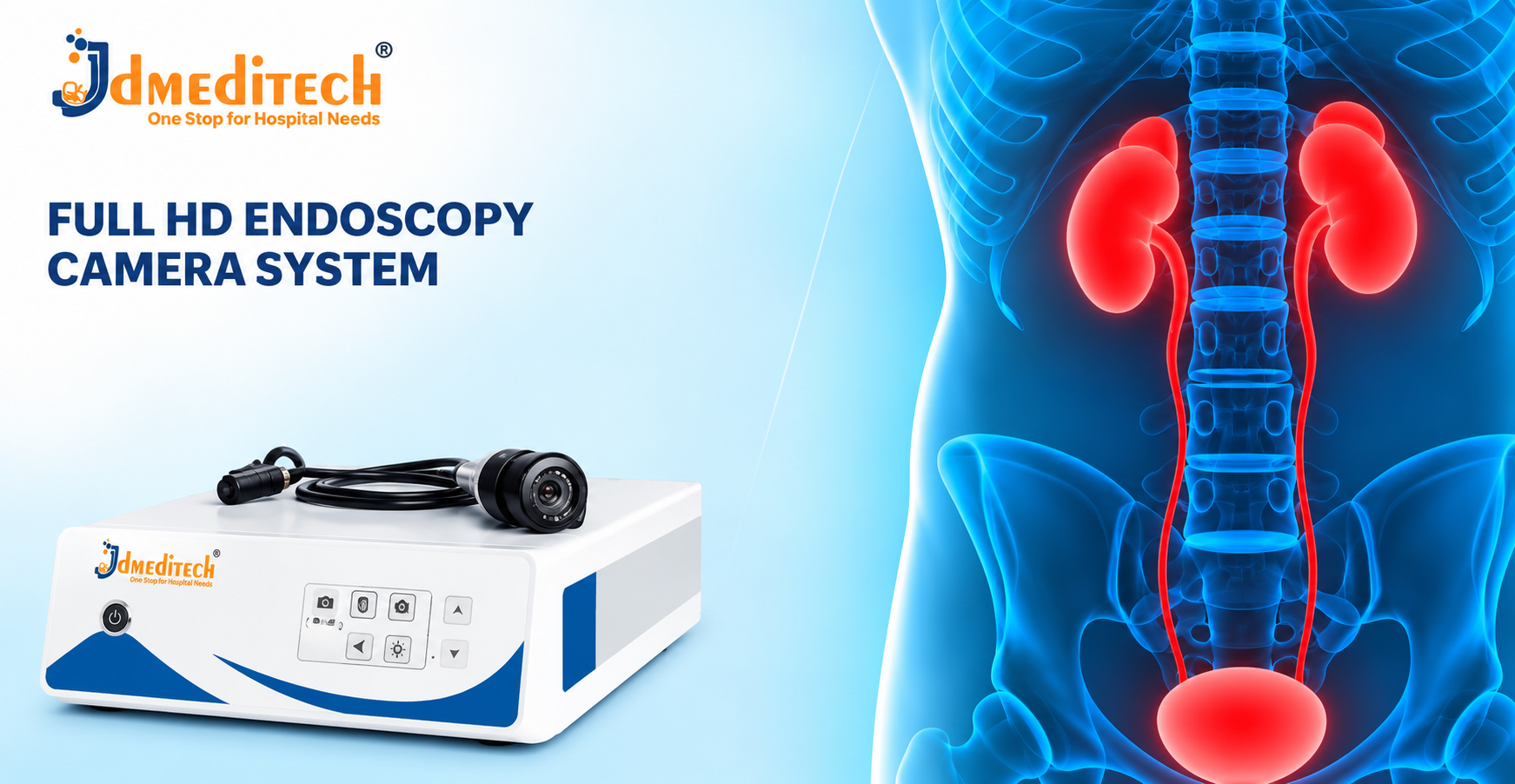
The supplied product image shows an endoscopic camera control unit with a connected camera head.
However, the image does not establish native sensor resolution, frame rate, video output interfaces or recording functions.
Therefore, customers should verify the official manufacturer datasheet before confirming an order.
| Parameter | Product Information |
|---|---|
| Product Name | Full HD Endoscopy Camera System |
| Equipment Category | Medical Endoscopic Imaging Equipment |
| Advertised Video Format | Full HD |
| Full HD Reference Resolution | 1920 x 1080 Pixels |
| Native Sensor Resolution | Confirm Manufacturer Specifications |
| Image Sensor Type | Confirm Manufacturer Specifications |
| Frame Rate | Confirm Manufacturer Specifications |
| Camera Head Type | Confirm Manufacturer Specifications |
| Optical Coupler | Confirm Available Configuration |
| White Balance Function | Confirm Available Configuration |
| Image Adjustment Functions | Confirm Manufacturer Specifications |
| Video Output Interfaces | Confirm Manufacturer Specifications |
| Image Capture | Confirm Available Configuration |
| Video Recording | Confirm Available Configuration |
| Monitor Compatibility | Confirm Manufacturer Specifications |
| Endoscope Compatibility | Confirm Approved Endoscope Models |
| Power Requirements | Confirm Manufacturer Specifications |
| Camera Head Reprocessing | Follow Manufacturer Instructions |
| Dimensions | Confirm Manufacturer Specifications |
| Weight | Confirm Manufacturer Specifications |
| Regulatory Documentation | Verify for Destination Market |
Importance of Image Quality in Endoscopy
Clear endoscopic imaging supports visualization of anatomical structures.
Furthermore, appropriate lighting and focus help the clinical team examine the operative field.
However, image quality depends on the entire optical and electronic imaging chain.
Importance of White Balance
White balance helps the camera represent colors appropriately under the connected illumination system.
Consequently, correct adjustment can improve color consistency during imaging.
However, the availability and operation of white balance controls depend on the model.
Importance of Camera Head Compatibility
Camera heads must connect correctly to the designated control units and optical adapters.
Therefore, healthcare facilities should verify mechanical, optical and electrical compatibility.
Additionally, operators should use only manufacturer-approved combinations.
Installation and Setup Considerations
Qualified personnel should install and configure the equipment according to the manufacturer’s instructions.
Furthermore, the clinical team should verify the camera connection, display output and compatible light source before use.
However, the exact installation process depends on the system model.
Safety Precautions for Endoscopy Camera Systems
- Use Only With Trained Healthcare Personnel
- Follow Manufacturer Instructions
- Verify Electrical Safety
- Inspect the Camera Head and Cable
- Confirm Endoscope Compatibility
- Use Appropriate Medical Displays
- Follow Approved Reprocessing Procedures
- Maintain Proper Cable Connections
- Verify Imaging Performance Before Procedures
- Protect Patient Information
Inspection Before Equipment Use
- Confirm Equipment Identification
- Inspect the Camera Control Unit
- Check the Camera Head
- Inspect Connection Cables
- Verify Optical Coupler Compatibility
- Confirm Video Output
- Check Monitor Display
- Verify Illumination
- Review Equipment Maintenance Status
- Follow Manufacturer Pre-Use Checks
Cleaning and Maintenance Guidelines
Healthcare facilities should clean the camera control unit according to the manufacturer’s instructions.
Furthermore, reusable camera heads and optical accessories require validated reprocessing procedures appropriate to their intended use.
However, not every camera head supports immersion or sterilization.
Therefore, operators must follow the exact reprocessing instructions for the supplied model.
Additionally, authorized technical personnel should perform required electrical safety checks and maintenance.
Storage and Handling Recommendations
- Store Equipment in a Suitable Environment
- Protect the Camera Head From Impact
- Avoid Excessive Cable Bending
- Protect Electrical Connectors
- Follow Manufacturer Temperature Requirements
- Keep Equipment Away From Excessive Moisture
- Inspect Components Before Use
- Remove Malfunctioning Equipment From Service
How to Choose the Right Endoscopy Camera System
Hospitals and procurement teams should compare the following factors before purchasing equipment.
- Native Sensor Resolution
- Supported Video Resolution
- Frame Rate
- Image Sensor Technology
- Camera Head Compatibility
- Optical Coupler Requirements
- Video Output Connections
- Monitor Compatibility
- Image Adjustment Functions
- Recording Capabilities
- Cleaning and Reprocessing Requirements
- Electrical Safety Documentation
- Regulatory Documentation
- Technical Support Availability
Why Choose JDMeditech?
JDMeditech supplies endoscopy equipment, surgical instruments and medical accessories for hospitals, clinics and medical distributors.
Furthermore, our team assists customers with product inquiries, available configurations and quotation requests.
Customers can contact JDMeditech regarding:
- Full HD Endoscopy Camera Systems
- Endoscopic Imaging Accessories
- Laparoscopy Equipment
- Urology Endoscopy Instruments
- Compatible Endoscopes
- Endoscopic Light Sources
- Hospital Equipment Procurement
Frequently Asked Questions
1. What Is a Full HD Endoscopy Camera System?
It is medical imaging equipment that captures and displays images from compatible endoscopes.
2. What Does Full HD Mean?
Full HD generally refers to a video resolution of 1920 x 1080 pixels.
3. What Is an Endoscopy Camera Used For?
Clinicians use compatible camera systems to visualize internal structures during selected endoscopic procedures.
4. Can the Camera System Be Used for Laparoscopy?
Yes, provided the camera, optical components and laparoscope are compatible and approved for the intended application.
5. Can It Be Used for Urology Procedures?
Selected systems support urological endoscopy when connected to compatible instruments.
6. Does Every System Include a Monitor?
No. The monitor may be a separate component depending on the supplied configuration.
7. Does Every Camera System Include a Light Source?
No. Light sources may be separate equipment.
8. Can the System Record Images and Videos?
Selected models support recording through built-in or compatible external equipment.
9. Is a Camera Head Reusable?
Many camera heads are reusable, but cleaning and reprocessing requirements depend on the specific model.
10. Is Full HD Better Than Standard HD?
Full HD offers a higher nominal pixel count, although overall image quality depends on the complete system.
11. Does the Equipment Require Maintenance?
Yes. Healthcare facilities should follow manufacturer requirements for inspection, cleaning and electrical safety checks.
12. Where Can Customers Request Product Information?
Hospitals, clinics and medical distributors can contact JDMeditech for product details and quotations.
Conclusion
In conclusion, the Full HD Endoscopy Camera System supports visualization during compatible endoscopic procedures.
Furthermore, digital imaging technology helps clinicians observe anatomical structures through suitable optical instruments.
However, performance depends on the camera sensor, endoscope, illumination system and monitor.
Therefore, healthcare facilities should verify technical specifications and equipment compatibility before purchasing.
JDMeditech – One Stop for Hospital Needs
Website:
www.jdmeditech.com
Related Endoscopy Equipment
- Endoscopy Camera Heads
- Endoscopic Light Sources
- Laparoscopes
- Rigid Cystoscopes
- Ureteroscopes
- Endoscopic Imaging Accessories
Medical Equipment Reference
For general information about medical device safety and regulation, visit the
World Health Organization – Medical Devices
.
Medical Disclaimer
This article provides general educational and product information only. It does not replace professional medical advice, clinical judgment, specialist training or manufacturer instructions. Healthcare professionals must verify approved indications, imaging specifications, endoscope compatibility, reprocessing requirements, electrical safety and regulatory documentation before clinical use.




