



Wireless Endoscope Camera – Features, Working Principle, Applications and Benefits
A Wireless Endoscope Camera is a digital imaging device designed to capture images from compatible endoscopic optical instruments and transmit video through a supported wireless connection.
Wireless imaging technology can reduce the need for a direct video signal cable between the camera and compatible receiving equipment. Additionally, selected configurations may support portable imaging and educational demonstrations.
However, reliable clinical use requires suitable wireless performance, equipment compatibility, electrical safety and regulatory authorization.
JDMeditech supplies endoscopy equipment, urology instruments, laparoscopy accessories and medical imaging solutions for hospitals, clinics and medical distributors.
What Is a Wireless Endoscope Camera?
A wireless endoscopic camera captures optical images from a compatible endoscope and transfers the resulting digital video to an approved receiving device.
Typically, the camera system contains an image sensor, optical connection, electronic processing components and wireless communication hardware.
Depending on the model, the receiving equipment may include a dedicated display, receiver or compatible computer.
Furthermore, selected systems may support still-image capture and video recording.
How Does a Wireless Endoscope Camera Work?
A compatible endoscope transfers an optical image toward the camera sensor.
Next, the sensor converts the incoming light into electronic signals.
The camera electronics then process the image data.
Subsequently, the wireless communication system transmits the digital video to a compatible receiver.
Finally, the receiving device displays the image through appropriate software or imaging hardware.
Therefore, the clinical team can view the captured image when the complete system supports the intended application.
Working Principle of Wireless Endoscopic Imaging
Wireless endoscopic imaging combines optical capture, digital processing and radio-frequency communication.
First, the camera receives the optical image.
Next, the imaging electronics convert the signal into digital information.
The communication module then sends the information to a paired receiver.
Consequently, compatible display equipment can present the captured video.
However, image quality, transmission delay and connection reliability depend on the camera, receiver and operating environment.
Key Features of a Wireless Endoscope Camera
- Wireless Digital Video Transmission
- Compact Camera Head Design
- Compatible Endoscope Connection
- Electronic Image Capture
- Model-Specific Wireless Communication
- Compatible Receiver Integration
- Potential Portable Imaging Configuration
- Model-Specific Image Resolution
- Optional Image Capture Functions
- Potential Video Recording Support
- Manufacturer-Defined Power Arrangement
- Compatibility With Selected Optical Instruments
Furthermore, available functions vary according to the selected camera model.
Main Components of a Wireless Endoscope Camera
A typical wireless endoscopic imaging arrangement may include:
- Wireless Camera Head
- Digital Image Sensor
- Optical Coupler or Adapter
- Image Processing Circuit
- Wireless Communication Module
- Power Supply or Battery
- Compatible Wireless Receiver
- Display Equipment
- Imaging Software
- Manufacturer-Approved Accessories
However, not every package includes all listed components.
1. Wireless Camera Head
The camera head contains the optical and electronic imaging components.
Furthermore, its mechanical connection allows attachment to compatible endoscopes.
2. Digital Image Sensor
The image sensor captures light from the connected optical system.
Consequently, it converts the optical image into electronic data.
However, sensor technology and native resolution vary between models.
3. Optical Coupler
The optical coupler connects the camera to a compatible endoscope.
Additionally, selected couplers provide focusing or other optical adjustment functions.
Therefore, buyers should verify mechanical and optical compatibility.
4. Image Processing Circuit
The processing circuit prepares captured image data for transmission.
Furthermore, selected systems provide image adjustment or encoding functions.
5. Wireless Communication Module
The communication module transmits video data to compatible receiving equipment.
However, wireless frequency, transmission protocol and operating range depend on the camera model.
6. Power Supply or Battery
Wireless camera systems require electrical power for imaging and communication.
Depending on the model, the camera may use a rechargeable battery or another approved power arrangement.
Furthermore, users should follow the manufacturer’s charging and power safety instructions.
7. Wireless Receiver
The receiver collects transmitted image data from the compatible camera.
Next, the system processes the received information for display.
However, receiver compatibility and pairing requirements depend on the product configuration.
8. Display and Imaging Software
Compatible display equipment presents the received video.
Additionally, selected software may provide image capture, recording or playback functions.
However, the available features depend on the camera and receiver configuration.
Clinical and Educational Applications
Approved wireless imaging systems may support selected endoscopic visualization and educational activities.
- Selected Urological Endoscopy
- Compatible Diagnostic Endoscopic Examinations
- Medical Education
- Endoscopic Training
- Optical Instrument Demonstrations
- Selected Clinical Documentation
- Portable Imaging Demonstrations
- Authorized Case Review
However, suitability for real-time surgical use requires specific verification of the complete system.
Wireless Endoscope Camera in Urology
Urological endoscopy uses compatible optical instruments to visualize structures within the urinary tract.
An approved wireless camera may connect to suitable endoscopes for selected applications.
Furthermore, digital transmission may support display on compatible receiving equipment.
However, clinicians must verify image performance and regulatory authorization before patient use.
Wireless Endoscope Camera in Laparoscopy
Laparoscopy requires dependable real-time imaging and suitable clinical equipment.
Wireless imaging may be considered only when the complete system meets the requirements of the intended procedure.
However, transmission latency, interference and connection reliability can affect image availability.
Therefore, surgical teams must use systems validated for the specific clinical application.
Wireless Endoscope Camera for Medical Education
Wireless imaging can support demonstrations of compatible optical instruments.
Additionally, selected systems may transmit images to suitable displays for teaching activities.
Consequently, trainees can observe demonstrations without a direct video cable between the camera and receiver.
Potential Benefits of Wireless Endoscopic Imaging
- Reduced Direct Video Cabling
- Compact Imaging Configuration
- Compatible Digital Image Transmission
- Potential Portable Imaging Arrangement
- Useful for Selected Training Activities
- Optional Image Documentation
- Model-Specific Recording Functions
- Integration With Compatible Optical Instruments
However, wireless operation also introduces requirements for connection stability, security and power management.
Wireless vs Wired Endoscopy Camera
| Feature | Wireless Camera | Wired Camera |
|---|---|---|
| Video Transmission | Supported Wireless Connection | Physical Signal Cable |
| Camera Power | Model-Dependent | Model-Dependent |
| Connection Reliability | Depends on Wireless Environment | Depends on Cable and Equipment |
| Transmission Latency | Model-Dependent | Model-Dependent |
| Mobility | Potentially Less Signal Cabling | Limited by Cable Arrangement |
| Clinical Suitability | Requires Verification | Requires Verification |
Technical Specifications of Wireless Endoscope Camera
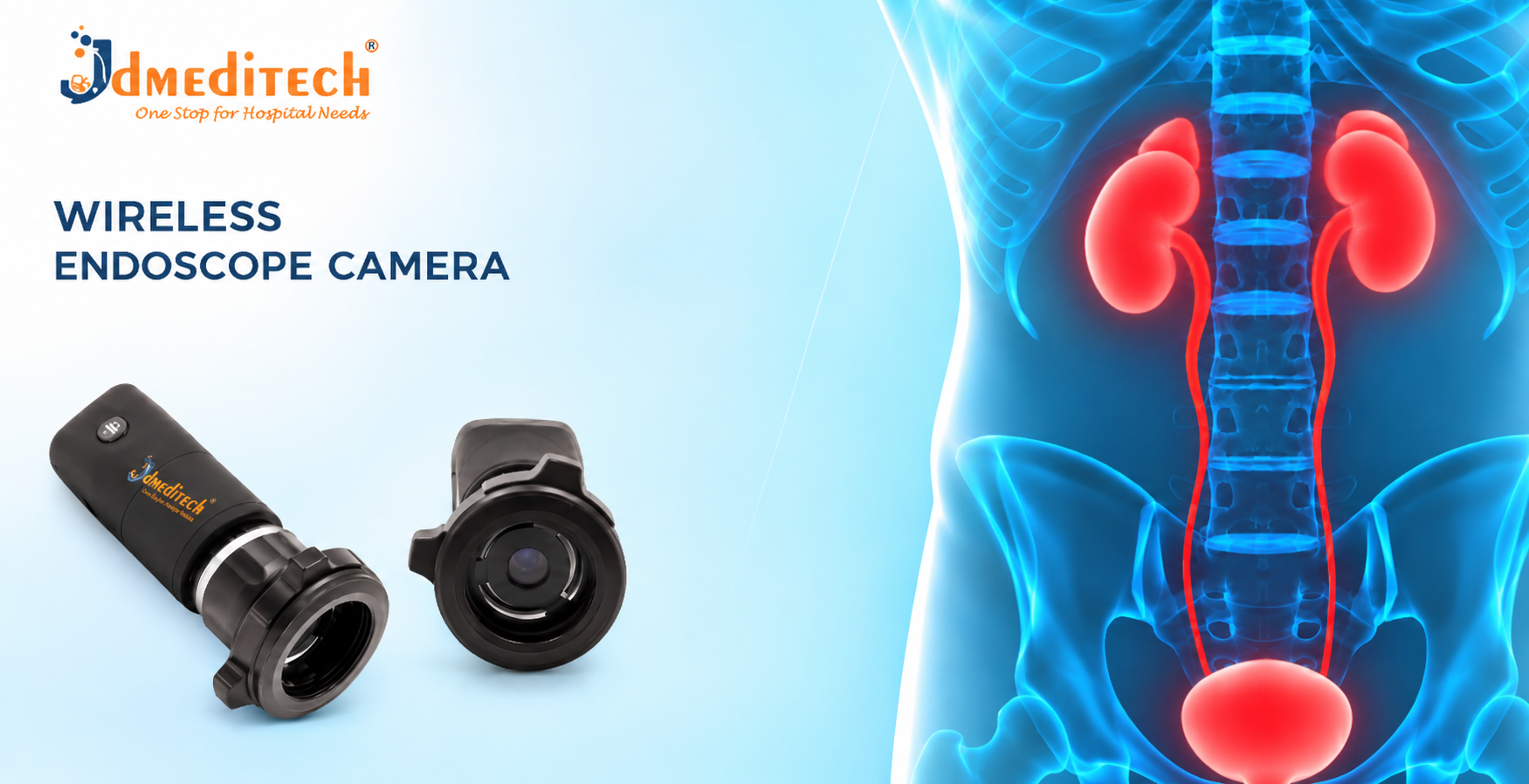
The supplied product image shows compact black endoscopic camera components with circular optical connections.
However, the image does not establish the wireless protocol, transmission range, sensor resolution, battery capacity or clinical certification.
Therefore, buyers should verify the manufacturer’s official technical datasheet.
| Parameter | Product Information |
|---|---|
| Product Name | Wireless Endoscope Camera |
| Equipment Category | Digital Endoscopic Imaging Equipment |
| Primary Function | Wireless Digital Image Transmission |
| Camera Configuration | Compact Camera Head |
| Image Sensor Type | Confirm Manufacturer Specifications |
| Native Image Resolution | Confirm Manufacturer Specifications |
| Video Frame Rate | Confirm Manufacturer Specifications |
| Wireless Technology | Confirm Manufacturer Specifications |
| Wireless Frequency | Confirm Manufacturer Specifications |
| Transmission Range | Confirm Manufacturer Specifications |
| Transmission Latency | Confirm Manufacturer Specifications |
| Optical Coupler | Confirm Available Configuration |
| Focus Adjustment | Confirm Available Configuration |
| Power Arrangement | Confirm Manufacturer Specifications |
| Battery Capacity | Confirm Manufacturer Specifications |
| Operating Time | Confirm Manufacturer Specifications |
| Receiver Compatibility | Confirm Approved Equipment |
| Display Compatibility | Confirm Manufacturer Specifications |
| Image Capture | Confirm Available Configuration |
| Video Recording | Confirm Available Configuration |
| Endoscope Compatibility | Confirm Approved Instruments |
| Cleaning and Reprocessing | Follow Manufacturer Instructions |
| Dimensions and Weight | Confirm Manufacturer Specifications |
| Regulatory Documentation | Verify for Destination Market |
Importance of Wireless Transmission Stability
Stable transmission helps the receiving device display consistent image data.
However, interference, distance and physical obstructions may affect wireless performance.
Therefore, users should follow manufacturer requirements for operating range and connection setup.
Importance of Transmission Latency
Latency describes the delay between image capture and display.
Furthermore, low and predictable latency is particularly important in applications that require real-time visual feedback.
However, actual latency depends on the camera, wireless connection and receiver.
Importance of Battery Performance
Battery-powered camera systems require suitable power management.
Consequently, operators should verify available operating time before the intended use.
Additionally, charging and battery replacement must follow manufacturer instructions.
Importance of Wireless Security
Wireless medical imaging may transmit sensitive visual information.
Therefore, healthcare facilities should verify appropriate security controls and authorized device connections.
Furthermore, users should protect patient information according to applicable laws and institutional policies.
Installation and Setup Considerations
Qualified personnel should install the equipment according to the manufacturer’s instructions.
First, they should confirm the camera and receiver compatibility.
Next, they should verify power availability and wireless connection settings.
Finally, they should check image display, connection stability and system performance.
However, installation procedures vary between models.
Safety Precautions for Wireless Endoscope Cameras
- Follow Manufacturer Instructions
- Verify Approved Intended Use
- Confirm Endoscope Compatibility
- Inspect Camera Housing
- Check Optical Connections
- Verify Wireless Connection Stability
- Follow Electrical and Battery Safety Requirements
- Use Approved Reprocessing Methods
- Protect Patient Data
- Remove Malfunctioning Equipment From Service
Inspection Before Equipment Use
- Confirm Camera Identification
- Inspect the Camera Housing
- Check Optical Components
- Verify Power Availability
- Confirm Receiver Compatibility
- Test Wireless Connection
- Check Image Display
- Verify Illumination
- Review Equipment Maintenance Status
- Follow Manufacturer Pre-Use Checks
Cleaning and Maintenance Guidelines
Healthcare facilities should clean and reprocess the camera according to the manufacturer’s validated instructions.
Furthermore, operators should protect optical surfaces and electrical components from damage.
However, not every wireless camera supports immersion or sterilization.
Therefore, users must verify the approved cleaning method for the exact model.
Additionally, technical personnel should inspect power components and wireless performance when required.
Storage and Handling Recommendations
- Store Equipment in a Clean Environment
- Protect Optical Surfaces
- Avoid Mechanical Impact
- Follow Manufacturer Temperature Requirements
- Protect Electrical Connections
- Follow Battery Storage Instructions
- Inspect Equipment Before Use
- Remove Damaged Equipment From Service
How to Choose the Right Wireless Endoscope Camera
Hospitals, training institutions and procurement teams should evaluate several factors before purchasing.
- Approved Intended Use
- Native Sensor Resolution
- Video Frame Rate
- Wireless Transmission Technology
- Transmission Range
- Latency Performance
- Receiver Compatibility
- Optical Coupler Compatibility
- Power and Battery Requirements
- Image Capture Functions
- Recording Capabilities
- Wireless Security Features
- Cleaning and Reprocessing Requirements
- Regulatory Documentation
- Technical Support Availability
Why Choose JDMeditech?
JDMeditech supplies endoscopy equipment, urology instruments, laparoscopy accessories and medical imaging solutions for hospitals, clinics and medical distributors.
Furthermore, our team assists customers with product inquiries, available configurations and quotation requests.
Customers can contact JDMeditech regarding:
- Wireless Endoscope Cameras
- Full HD Endoscopy Camera Systems
- USB Camera Systems
- Camera Couplers
- Endoscopy Video Recorders
- Endoscopic Light Sources
- Urology and Laparoscopy Equipment
Frequently Asked Questions
1. What Is a Wireless Endoscope Camera?
It is a digital imaging device that captures images from compatible optical instruments and transmits video to supported receiving equipment.
2. How Does Wireless Endoscopy Imaging Work?
The camera converts optical images into digital data and transmits the information through a supported wireless connection.
3. Does Every Wireless Camera Use Wi-Fi?
No. Wireless communication technologies vary between camera models.
4. Can It Connect to a Cystoscope?
Selected cameras may connect to compatible cystoscopes using approved optical adapters.
5. Can It Be Used During Surgery?
Only when the complete imaging system is authorized and validated for the intended surgical application.
6. Does the Camera Require a Battery?
Many wireless cameras use batteries, but power arrangements vary between models.
7. Can It Record Videos?
Recording functions depend on the camera, receiver and software configuration.
8. What Is Wireless Transmission Range?
It is the distance over which the camera can communicate with its compatible receiver under specified conditions.
9. Does Wireless Imaging Have Delay?
Wireless systems can introduce transmission latency, which varies with the equipment and operating environment.
10. Is the Camera Sterilizable?
Reprocessing compatibility depends on the specific model and manufacturer instructions.
11. What Determines Image Quality?
Sensor performance, optical components, illumination, transmission and display settings influence image quality.
12. Where Can Customers Request Product Information?
Hospitals, clinics and medical distributors can contact JDMeditech for product details and quotations.
Conclusion
In conclusion, the Wireless Endoscope Camera supports digital imaging and wireless video transmission through compatible equipment.
Furthermore, selected systems can provide flexible imaging arrangements for approved clinical and educational applications.
However, performance depends on optical compatibility, transmission stability, latency and power management.
Therefore, customers should verify the manufacturer’s technical specifications before purchasing.
JDMeditech – One Stop for Hospital Needs
Website:
www.jdmeditech.com
Related Endoscopy Equipment
- Full HD Endoscopy Camera Systems
- USB Camera Systems
- Endoscopy Video Recorders
- Camera Couplers
- LED Light Sources
- Rigid Endoscopes
Medical Equipment Reference
For general information about medical device safety and regulation, visit the
World Health Organization – Medical Devices
.
Medical Disclaimer
This article provides general educational and product information only. It does not replace professional medical advice, clinical judgment, specialist training or manufacturer instructions. Healthcare professionals must verify approved indications, imaging specifications, wireless performance, optical compatibility, electrical safety, reprocessing requirements and regulatory documentation before clinical use.




