



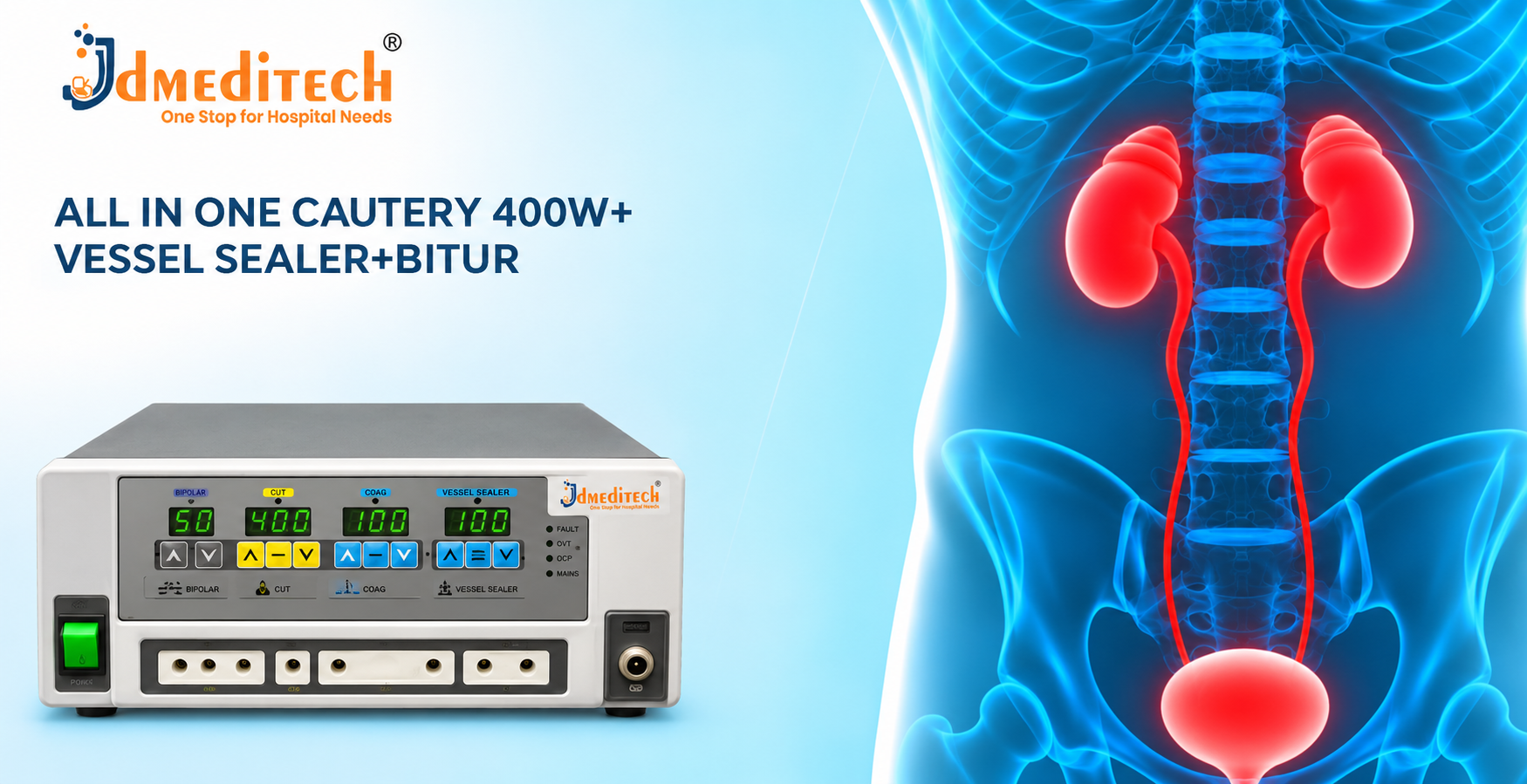
All in One Cautery 400W+ Vessel Sealer + BiTUR – Features, Working Principle and Applications
The All in One Cautery 400W+ Vessel Sealer + BiTUR is a multifunctional electrosurgical equipment category that combines surgical energy functions within a single generator platform.
Electrosurgical systems use controlled high-frequency electrical energy to support tissue cutting, coagulation and selected surgical procedures.
Furthermore, compatible multifunctional systems may support vessel sealing and bipolar transurethral resection applications.
However, the exact available modes, power ratings and compatible accessories depend on the specific generator model.
JDMeditech supplies surgical equipment, urology instruments, laparoscopy accessories and medical devices for hospitals, clinics and medical distributors.
What Is an All in One Cautery Machine?
An all-in-one electrosurgical generator combines multiple electrosurgical functions within one equipment platform.
Depending on the model, these functions may include monopolar cutting, monopolar coagulation, bipolar coagulation, vessel sealing and specialized bipolar resection modes.
Consequently, a compatible system can support different surgical applications without requiring a separate generator for every energy mode.
However, each function requires approved instruments, connections and operating settings.
Understanding the 400W+ Designation
The product title includes the designation 400W+.
However, the supplied image does not establish the maximum rated output, individual mode power limits or the conditions under which the rating applies.
Therefore, buyers should verify the manufacturer’s official power specifications and technical documentation.
How Does an Electrosurgical Generator Work?
An electrosurgical generator produces controlled high-frequency electrical energy.
Next, a compatible surgical instrument delivers energy to the selected tissue.
The resulting tissue effects depend on the waveform, energy delivery, instrument design and tissue characteristics.
Consequently, different operating modes can support cutting, coagulation or specialized tissue treatment.
However, only appropriately trained healthcare professionals should operate the system according to its approved instructions.
Working Principle of Electrosurgical Energy
Electrosurgery uses alternating electrical current at radiofrequency levels to produce controlled tissue effects.
When current passes through tissue, electrical resistance contributes to heat generation.
The resulting thermal effect depends on current density, exposure duration, waveform and tissue properties.
Furthermore, generator control systems may regulate energy delivery according to the selected mode.
However, excessive energy application can cause unintended thermal injury.
Key Features of an All in One Cautery System
- Multifunctional Electrosurgical Generator Platform
- Model-Specific Monopolar Cutting Modes
- Model-Specific Monopolar Coagulation Modes
- Compatible Bipolar Electrosurgical Functions
- Vessel Sealing Capability Where Specified
- BiTUR Function Where Specified
- Digital Power Display
- Front-Panel Operating Controls
- Multiple Accessory Connection Interfaces
- Model-Specific Safety Monitoring
- Compatible Footswitch Operation
- Manufacturer-Defined Output Ratings
Furthermore, all functions must be verified against the exact product datasheet.
Main Components of an Electrosurgical System
A typical multifunctional electrosurgical setup may include:
- Electrosurgical Generator
- Digital Display and Control Panel
- Radiofrequency Output Circuit
- Monopolar Accessory Connections
- Bipolar Accessory Connections
- Compatible Vessel Sealing Instruments
- Compatible BiTUR Instruments
- Footswitch Interface
- Power Supply
- Protective Equipment Housing
- Manufacturer-Defined Safety Systems
However, the included accessories depend on the selected package.
1. Electrosurgical Generator
The generator produces high-frequency electrical energy for compatible surgical instruments.
Furthermore, the selected mode determines the intended output characteristics.
2. Digital Display and Control Panel
The control panel allows trained operators to select available modes and review displayed settings.
Additionally, selected systems provide digital output indicators and status information.
3. Monopolar Output Interface
A monopolar interface connects approved monopolar surgical instruments.
In conventional monopolar configurations, current returns through a compatible patient return electrode.
Therefore, users must follow the manufacturer’s patient return electrode requirements.
4. Bipolar Output Interface
A bipolar interface connects compatible bipolar surgical instruments.
In bipolar instruments, current generally travels between electrodes located near the treatment area.
Consequently, the current path differs from conventional monopolar electrosurgery.
5. Vessel Sealing Function
Compatible vessel sealing systems apply controlled energy through specialized instruments.
The intended tissue effect supports sealing of suitable vessels or tissue bundles within the device’s approved indications.
However, the maximum vessel diameter and approved instruments must be verified from the manufacturer’s documentation.
6. BiTUR Function
BiTUR refers to bipolar transurethral resection technology used with compatible urological instruments.
Selected systems support bipolar resection and coagulation during approved endoscopic procedures.
However, operating parameters and irrigation requirements depend on the complete equipment configuration.
7. Footswitch Interface
A compatible footswitch may allow the operator to activate selected energy functions.
Furthermore, footswitch compatibility depends on the generator and accessory configuration.
8. Safety Monitoring System
Selected generators include monitoring functions for equipment status, output conditions or patient return electrode connections.
However, the presence and performance of these functions depend on the exact model.
Electrosurgical Modes and Functions
Multifunctional electrosurgical systems may offer several operating modes.
- Monopolar Cutting
- Monopolar Coagulation
- Bipolar Coagulation
- Vessel Sealing
- Bipolar Transurethral Resection
- Model-Specific Specialized Energy Modes
However, the available modes must be confirmed from the manufacturer’s instructions.
Monopolar Cutting Mode
Monopolar cutting uses a suitable high-frequency waveform to support tissue division.
Furthermore, the instrument design and selected energy settings influence the resulting tissue effect.
However, users must follow approved operating instructions and safety requirements.
Monopolar Coagulation Mode
Monopolar coagulation supports selected tissue coagulation effects.
Additionally, the chosen waveform and electrode configuration influence energy delivery.
However, inappropriate use can cause unintended thermal injury.
Bipolar Coagulation Mode
Bipolar coagulation uses compatible instruments with closely positioned electrodes.
Consequently, the current path is generally concentrated between the instrument electrodes.
However, thermal effects can still extend beyond the intended treatment area.
Vessel Sealing Technology
Advanced vessel sealing systems use controlled electrosurgical energy and compatible instruments to produce tissue sealing effects.
Furthermore, selected systems use feedback-based energy control.
However, the approved vessel size, tissue applications and sealing performance depend on the specific system.
BiTUR Technology in Urology
Bipolar transurethral resection uses specialized endoscopic instruments and a compatible electrosurgical generator.
Clinicians may use approved systems during selected transurethral procedures.
Furthermore, bipolar resection systems may support compatible saline irrigation arrangements when specified by the manufacturer.
However, clinical suitability and irrigation requirements must be verified for the complete system.
Clinical Applications of Multifunctional Cautery Systems
Approved multifunctional generators may support selected surgical applications.
- General Surgery
- Laparoscopic Surgery
- Urological Surgery
- Selected Gynecological Procedures
- Open Surgical Procedures
- Endoscopic Resection
- Selected Vessel Sealing Applications
- Compatible Bipolar Coagulation Procedures
- Approved Monopolar Electrosurgical Procedures
However, every application must fall within the manufacturer’s approved intended use.
All in One Cautery in Laparoscopy
Laparoscopic surgery uses specialized instruments through small surgical access ports.
Compatible electrosurgical instruments can support tissue dissection and coagulation during approved procedures.
Furthermore, selected vessel sealing instruments may support appropriate tissue sealing applications.
All in One Cautery in Urology
Urological procedures may require compatible monopolar or bipolar electrosurgical equipment.
A suitable generator can support approved endoscopic resection and coagulation functions.
However, the instrument, generator and irrigation configuration must be compatible.
All in One Cautery in General Surgery
General surgical procedures may use electrosurgical energy for selected tissue cutting and coagulation tasks.
Furthermore, compatible vessel sealing instruments can support approved sealing applications.
However, the choice of instrument and mode depends on clinical requirements.
Potential Benefits of Multifunctional Electrosurgical Equipment
- Multiple Energy Functions Within One Generator
- Support for Compatible Monopolar Instruments
- Support for Compatible Bipolar Instruments
- Vessel Sealing Options Where Approved
- Specialized Urology Functions Where Available
- Centralized Equipment Controls
- Model-Specific Digital Displays
- Integration With Approved Surgical Accessories
- Potential Reduction in Separate Generator Requirements
- Flexible Equipment Configuration
However, actual benefits depend on the generator model, compatible accessories and clinical application.
All in One Cautery vs Conventional Electrosurgical Generator
| Feature | Multifunctional System | Conventional Generator |
|---|---|---|
| Monopolar Functions | Model-Dependent | Model-Dependent |
| Bipolar Functions | Model-Dependent | Model-Dependent |
| Vessel Sealing | May Be Integrated | May Require Separate Equipment |
| BiTUR | May Be Available | Depends on Model |
| Accessory Compatibility | Requires Verification | Requires Verification |
| Safety Monitoring | Model-Dependent | Model-Dependent |
Technical Specifications of All in One Cautery 400W+ Vessel Sealer + BiTUR
The supplied product image shows a rectangular electrosurgical generator with a front control panel, multiple digital indicators and several accessory connection ports.
However, the image does not establish the precise output ratings, waveform characteristics, vessel sealing limits or approved BiTUR settings.
Therefore, customers should verify the manufacturer’s official technical datasheet.
| Parameter | Product Information |
|---|---|
| Product Name | All in One Cautery 400W+ Vessel Sealer + BiTUR |
| Equipment Category | Multifunctional Electrosurgical Generator |
| Rated Power | 400W+ Designation; Verify Official Output Specifications |
| Operating Frequency | Confirm Manufacturer Specifications |
| Monopolar Cutting Modes | Confirm Available Configuration |
| Monopolar Coagulation Modes | Confirm Available Configuration |
| Bipolar Coagulation Modes | Confirm Available Configuration |
| Vessel Sealing Function | Verify Approved Mode and Accessories |
| BiTUR Function | Verify Approved Mode and Instruments |
| Maximum Vessel Diameter | Confirm Manufacturer Specifications |
| Output Power by Mode | Confirm Manufacturer Specifications |
| Digital Display | Visible on Supplied Product Image |
| Accessory Connections | Confirm Available Configuration |
| Footswitch Compatibility | Confirm Approved Accessories |
| Patient Return Electrode Monitoring | Confirm Available Configuration |
| Input Voltage | Confirm Manufacturer Specifications |
| Power Consumption | Confirm Manufacturer Specifications |
| Electrical Safety | Verify Applicable Documentation |
| Dimensions and Weight | Confirm Manufacturer Specifications |
| Regulatory Documentation | Verify for Destination Market |
Importance of Output Power
Output power influences the electrical energy available for the selected surgical mode.
However, higher rated power does not automatically provide better clinical performance.
Therefore, operators must use appropriate settings according to the manufacturer’s instructions and clinical requirements.
Importance of Operating Frequency
Electrosurgical generators operate using high-frequency electrical energy.
Furthermore, waveform and frequency characteristics influence energy delivery.
However, the exact operating frequency depends on the generator design.
Importance of Instrument Compatibility
Different electrosurgical instruments require suitable generator connections and operating modes.
Therefore, hospitals should verify the compatibility of electrodes, forceps, vessel sealing instruments and resectoscopes.
Furthermore, only approved accessories should be used with the generator.
Importance of Vessel Sealing Performance
Vessel sealing performance depends on the generator, instrument design, tissue characteristics and approved operating conditions.
Furthermore, the manufacturer defines the maximum vessel size and intended applications.
Therefore, users must not assume that all vessel sealing systems support the same tissue or vessel sizes.
Importance of Electrical Safety
Electrosurgical equipment delivers electrical energy to tissue.
Consequently, safe operation requires appropriate training, equipment inspection and compatible accessories.
Furthermore, facilities must follow applicable electrical safety and maintenance requirements.
Installation and Setup Considerations
Qualified personnel should install the generator according to the manufacturer’s instructions.
First, they should verify the electrical supply and equipment condition.
Next, they should connect approved accessories for the intended mode.
Finally, they should complete the manufacturer’s required pre-use checks.
However, setup procedures vary between generator models and surgical applications.
Safety Precautions for Electrosurgical Generators
- Follow Manufacturer Instructions
- Use Only Approved Surgical Accessories
- Verify Electrical Safety
- Inspect All Cables and Connections
- Confirm Appropriate Patient Return Electrode Use When Required
- Check Generator Mode and Settings
- Follow Fire Prevention Precautions
- Use Appropriate Surgical Smoke Management
- Consider Interactions With Implanted Electronic Devices
- Prevent Unintended Instrument Activation
- Follow Thermal Injury Prevention Practices
- Remove Malfunctioning Equipment From Service
Inspection Before Equipment Use
- Confirm Equipment Identification
- Inspect Generator Housing
- Check Power Connections
- Inspect Accessory Cables
- Verify Compatible Instruments
- Check Display and Control Functions
- Confirm Appropriate Operating Mode
- Verify Patient Return Electrode Monitoring When Applicable
- Review Maintenance Status
- Follow Manufacturer Pre-Use Checks
Cleaning and Maintenance Guidelines
Healthcare facilities should clean the generator according to the manufacturer’s instructions.
Furthermore, operators should protect electrical connections from excessive moisture.
Additionally, qualified biomedical personnel should inspect equipment performance and electrical safety according to the recommended schedule.
However, users must not open or service internal high-voltage components unless authorized and appropriately trained.
Storage and Handling Recommendations
- Store Equipment in a Clean Environment
- Protect Electrical Connections
- Avoid Mechanical Impact
- Follow Manufacturer Temperature Requirements
- Maintain Required Ventilation
- Protect Accessory Cables
- Use Approved Transport Arrangements
- Inspect Equipment Before Use
How to Choose the Right Electrosurgical Generator
Hospitals and procurement teams should consider several factors before purchasing a multifunctional cautery system.
- Approved Clinical Intended Use
- Rated Output Power
- Monopolar Modes
- Bipolar Modes
- Vessel Sealing Capability
- BiTUR Compatibility
- Approved Surgical Instruments
- Patient Return Electrode Monitoring
- Electrical Safety
- Operating Frequency
- Control Panel Functions
- Footswitch Compatibility
- Maintenance Requirements
- Regulatory Documentation
- Technical Support Availability
Why Choose JDMeditech?
JDMeditech supplies surgical equipment, urology instruments, laparoscopy accessories and medical devices for hospitals, clinics and medical distributors.
Furthermore, our team assists customers with product inquiries, available configurations and quotation requests.
Customers can contact JDMeditech regarding:
- Multifunctional Electrosurgical Generators
- Vessel Sealing Systems
- Bipolar TUR Equipment
- Monopolar TURP Resectoscope Sets
- Bipolar TURP Resectoscope Sets
- Laparoscopic Surgical Instruments
- Electrosurgical Accessories
Frequently Asked Questions
1. What Is an All in One Cautery Machine?
It is a multifunctional electrosurgical generator that combines compatible surgical energy functions within one equipment platform.
2. What Does 400W+ Mean?
The product title includes a 400W+ designation. However, the exact rated output and operating conditions must be verified from the official datasheet.
3. What Is a Vessel Sealer?
A vessel sealer uses controlled energy through compatible instruments to seal suitable vessels or tissue within the manufacturer’s approved indications.
4. What Is BiTUR?
BiTUR refers to bipolar transurethral resection technology used with compatible urological equipment.
5. Can the Generator Support Monopolar Surgery?
Selected multifunctional generators support monopolar functions, but the available modes require verification.
6. Can It Support Bipolar Surgery?
Compatible bipolar functions may be available depending on the generator model.
7. Can It Be Used for Laparoscopy?
Approved systems may support compatible laparoscopic electrosurgical instruments.
8. Can It Be Used for TURP?
Selected systems support bipolar transurethral resection when used with approved instruments and irrigation arrangements.
9. Does Vessel Sealing Work for Every Vessel Size?
No. The manufacturer defines the maximum approved vessel diameter and intended applications.
10. Does the Generator Require Maintenance?
Yes. Facilities should follow manufacturer instructions for inspection, cleaning, electrical safety testing and servicing.
11. Can Different Surgical Accessories Be Connected?
Only approved and compatible accessories should be used with the generator.
12. Where Can Customers Request Product Information?
Hospitals, clinics and medical distributors can contact JDMeditech for product details and quotations.
Conclusion
In conclusion, the All in One Cautery 400W+ Vessel Sealer + BiTUR represents a multifunctional electrosurgical equipment category designed to support compatible surgical energy applications.
Furthermore, an integrated generator platform may combine monopolar, bipolar, vessel sealing and specialized urological functions.
However, the actual modes, power ratings, accessory compatibility and clinical indications depend on the exact equipment model.
Therefore, customers should verify technical specifications and regulatory documentation before purchasing.
JDMeditech – One Stop for Hospital Needs.
Website:
www.jdmeditech.com
Related Surgical Equipment
- Vessel Sealing Systems
- Bipolar TURP Resectoscope Sets
- Monopolar TURP Resectoscope Sets
- Laparoscopic Surgical Instruments
- Electrosurgical Accessories
Medical Equipment Reference
For general information about medical device safety and regulation, visit the
World Health Organization – Medical Devices
.
Medical Disclaimer
This article provides general educational and product information only. It does not replace professional medical advice, clinical judgment, specialist training or manufacturer instructions. Healthcare professionals must verify approved indications, output specifications, instrument compatibility, electrical safety, thermal risks, maintenance requirements and regulatory documentation before clinical use.




