



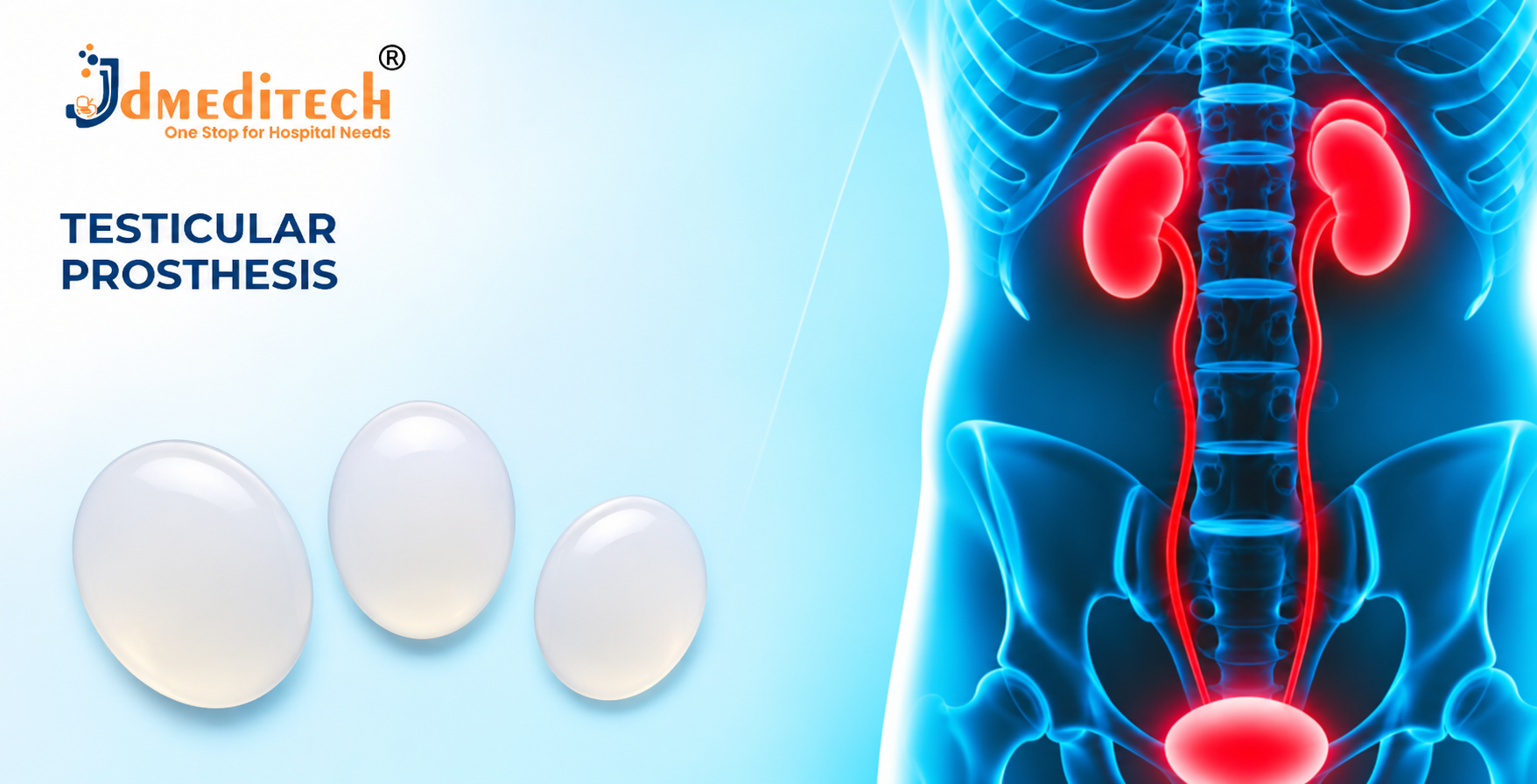
Testicular Prosthesis – Types, Features, Uses and Benefits
A Testicular Prosthesis is an implantable medical device designed to restore the appearance of a missing testicle. Urologists may recommend this option for selected patients who have lost a testicle or were born without one.
Furthermore, an artificial testicle can help improve scrotal symmetry and body image. However, the implant serves a cosmetic and reconstructive purpose. It does not produce sperm or testosterone.
JDMeditech supplies urology products and surgical equipment for hospitals, clinics and medical distributors. Additionally, our team assists customers with product inquiries and available specifications.
What Is a Testicular Prosthesis?
A testicular implant is a medical device that a qualified surgeon places inside the scrotum. Its purpose is to replace the external appearance and volume of an absent testicle.
Moreover, manufacturers offer different sizes and designs to suit individual anatomical requirements. Therefore, the surgeon selects an appropriate model after evaluating the patient’s condition.
However, the device cannot replace the biological functions of a natural testicle.
Understanding Testicular Loss
A person may have one or both testicles absent because of congenital conditions, injury, disease or previous surgery.
For example, surgical removal of a testicle may become necessary during treatment for testicular cancer or severe injury.
Additionally, certain developmental conditions may result in an absent testicle. Consequently, some patients consider reconstructive implantation to improve appearance.
What Is an Artificial Testicle?
An artificial testicle is another name for a testicular implant. It generally has an oval shape that resembles the external form of a natural testicle.
Furthermore, implant materials and internal construction vary between manufacturers. Some designs use solid silicone elastomer, while others contain saline within a silicone shell.
Therefore, healthcare facilities should verify the exact device material and approved specifications before purchasing.
Types of Testicular Prosthesis
Different implant designs are available. However, their availability and regulatory authorization vary by market.
1. Solid Silicone Testicular Implant
A solid silicone implant uses a silicone elastomer structure. Its design provides a defined shape and volume without a fluid-filled chamber.
Furthermore, manufacturers may offer different sizes and firmness characteristics.
However, the device must have appropriate regulatory authorization for the intended market.
2. Saline-Filled Testicular Implant
A saline-filled implant typically includes a silicone elastomer shell containing sterile saline.
Additionally, its design aims to provide an appropriate scrotal contour. However, implant handling and filling requirements depend on the specific device.
3. Other Manufacturer-Specific Designs
Some manufacturers offer alternative implant configurations or materials. Consequently, clinicians should review the approved labeling and clinical documentation for each model.
Main Components of a Testicular Implant
Component design depends on the implant type. For example, solid and saline-filled devices have different internal structures.
- Oval implant body
- Medical-grade implant material
- Outer shell where applicable
- Internal filling material where applicable
- Fixation feature where provided
- Manufacturer-specific accessories
However, the uploaded product image does not establish the exact material or internal construction. Therefore, customers should confirm the official datasheet.
1. Oval Implant Body
The implant body provides the external shape of the artificial testicle.
Furthermore, manufacturers may offer several dimensions to accommodate different anatomical requirements.
2. Implant Material
Manufacturers select materials according to the device’s intended implantation application.
However, material composition and biocompatibility documentation vary. Consequently, hospitals should request the appropriate technical information.
3. Fixation Feature
Selected implants include a feature that allows surgical fixation when appropriate.
Nevertheless, the surgeon must follow the manufacturer’s approved implantation instructions.
Key Features of Testicular Implants
- Oval anatomical appearance
- Different implant sizes
- Implantable medical device design
- Cosmetic and reconstructive application
- Model-specific implant materials
- Manufacturer-defined firmness
- Optional fixation features
- Specialist surgical placement
- Product-specific packaging
- Manufacturer-defined labeling
However, not every model includes every feature. Therefore, buyers should verify the product configuration.
Clinical Applications of Testicular Prosthesis
Urologists may consider an implant when a patient wishes to restore the appearance of an absent testicle.
Furthermore, implantation may be considered after selected surgical treatments or congenital conditions.
- Reconstruction after orchiectomy
- Selected cases following testicular cancer surgery
- Selected congenital absence of a testicle
- Reconstruction following severe testicular injury
- Selected cases after testicular loss from infection
- Cosmetic scrotal reconstruction
- Other specialist-approved indications
However, the decision depends on patient preferences, anatomy, medical history and clinical suitability.
Testicular Prosthesis After Orchiectomy
Orchiectomy is the surgical removal of one or both testicles. Doctors may perform this procedure for selected medical conditions.
Afterward, some patients consider an implant to restore scrotal symmetry. Furthermore, the surgeon may discuss immediate or delayed placement depending on clinical circumstances.
However, an implant does not replace the hormonal or reproductive function of the removed testicle.
Testicular Implant After Cancer Treatment
Some patients undergo orchiectomy as part of testicular cancer treatment.
Following appropriate medical assessment, a surgeon may discuss prosthetic reconstruction. Additionally, patient preferences and the cancer treatment plan influence timing.
Therefore, implant decisions should involve the treating urologist and oncology team when appropriate.
Testicular Prosthesis for Congenital Conditions
Some individuals are born with an absent testicle or have conditions that affect testicular development.
In selected cases, specialists may consider reconstructive options. However, age, growth, anatomy and informed consent require careful consideration.
How Does a Testicular Prosthesis Work?
The implant occupies space within the scrotum and provides an artificial testicular contour.
Unlike a natural testicle, it does not contain functioning reproductive tissue. Therefore, it cannot produce sperm or testosterone.
Nevertheless, the device may help selected patients achieve their desired external appearance.
Overview of Testicular Implant Surgery
First, a qualified surgeon evaluates the patient’s anatomy and medical history.
Next, the clinical team discusses implant selection, surgical risks and realistic expectations.
During surgery, the surgeon places the selected prosthesis in the scrotum using an appropriate technique.
Afterward, the team monitors recovery and provides wound care instructions.
However, implantation methods and recovery plans vary according to individual circumstances.
Importance of Implant Sizing
Appropriate sizing helps achieve a balanced scrotal appearance.
Furthermore, surgeons consider the available space, surrounding tissues and patient preferences.
However, incorrect sizing may contribute to discomfort or an unsatisfactory cosmetic result. Therefore, specialist assessment remains essential.
Potential Benefits of a Testicular Prosthesis
A suitable implant can restore the appearance of a missing testicle.
Additionally, some patients report improved body image and satisfaction after reconstructive surgery.
- Restores scrotal volume
- Supports a more symmetrical appearance
- Provides a cosmetic reconstruction option
- Offers different implant sizes
- May improve body image
- May improve patient satisfaction
- Supports selected reconstructive procedures
However, individual outcomes vary. Consequently, surgeons should discuss realistic expectations before surgery.
Technical Specifications of Testicular Prosthesis
Specifications depend on the manufacturer and model. Therefore, hospitals should verify the official technical datasheet.
| Parameter | Product Information |
|---|---|
| Product Name | Testicular Prosthesis |
| Product Category | Implantable Urology Device |
| Primary Application | Cosmetic and Reconstructive Testicular Replacement |
| Implant Shape | Oval |
| Implant Type | Confirm Available Model |
| Implant Material | Confirm Manufacturer Specifications |
| Available Sizes | Confirm Manufacturer Size Chart |
| Implant Dimensions | Confirm Product Datasheet |
| Internal Filling | Model-Dependent |
| Fixation Feature | Model-Dependent |
| Sterility | Confirm Product Labeling |
| Single-Use Status | Confirm Product Labeling |
| MRI Conditions | Confirm Model-Specific Labeling |
| Packaging | Confirm Manufacturer Specifications |
| Shelf Life | Confirm Product Labeling |
| Regulatory Documentation | Verify for Destination Market |
Testicular Prosthesis vs Natural Testicle
A prosthetic implant resembles a natural testicle in external shape. However, it does not perform the same biological functions.
| Feature | Testicular Prosthesis | Natural Testicle |
|---|---|---|
| External Shape | Designed to Resemble a Testicle | Natural Anatomy |
| Sperm Production | No | Yes, When Functioning Normally |
| Testosterone Production | No | Yes, When Functioning Normally |
| Material | Medical Device Material | Living Tissue |
| Primary Purpose | Cosmetic Reconstruction | Reproductive and Hormonal Function |
Does a Testicular Implant Restore Fertility?
No. A testicular implant does not produce sperm.
However, patients with one healthy remaining testicle may retain reproductive function. Therefore, fertility depends on the patient’s underlying condition rather than the prosthesis.
Does a Testicular Prosthesis Produce Testosterone?
No. The implant does not produce hormones.
Furthermore, patients who lack adequate natural testosterone production may require specialist evaluation and treatment.
Does a Testicular Implant Feel Natural?
Implant texture and firmness vary by device design.
Additionally, the final appearance and feel depend on implant size, surrounding tissue and surgical placement.
Therefore, patients should discuss realistic expectations with their surgeon.
Can a Testicular Implant Be Replaced?
Yes. A surgeon may remove or replace an implant when clinically appropriate.
For example, revision surgery may become necessary because of infection, displacement, discomfort or cosmetic concerns.
However, revision procedures carry additional surgical risks.
Possible Risks and Complications
Like other implant procedures, testicular prosthesis surgery carries potential risks.
- Surgical site infection
- Implant infection
- Bleeding or hematoma
- Pain and swelling
- Implant displacement
- Implant extrusion
- Scrotal tissue complications
- Persistent discomfort
- Unsatisfactory cosmetic appearance
- Need for revision or removal surgery
- Anesthesia-related complications
Furthermore, certain complications may require implant removal. Therefore, patients should discuss these possibilities before surgery.
Recovery After Testicular Implant Surgery
Recovery varies according to the patient’s health, surgical approach and implant type.
Initially, some swelling, bruising and discomfort may occur. Additionally, the surgeon provides instructions for wound care and activity restrictions.
However, patients should avoid manipulating the implant unless their surgeon specifically instructs them to do so.
Postoperative Care and Follow-Up
Follow-up appointments allow the surgeon to assess healing and implant position.
Furthermore, patients should report increasing pain, redness, fever or wound drainage promptly.
Therefore, appropriate postoperative monitoring is important.
Safety Precautions for Testicular Implants
- Confirm appropriate clinical indications
- Use qualified implant surgeons
- Evaluate patient-specific infection risks
- Verify implant dimensions
- Confirm material specifications
- Inspect sterile packaging
- Check product expiration dates
- Follow manufacturer instructions
- Maintain appropriate surgical asepsis
- Provide postoperative care instructions
- Arrange follow-up assessments
Storage and Handling Recommendations
Healthcare facilities should store implantable devices according to manufacturer instructions.
Additionally, staff should maintain appropriate product identification and traceability records.
- Follow approved storage conditions
- Protect packaging from damage
- Inspect sterile barriers
- Check expiration dates
- Maintain lot and product identification records
- Prevent unnecessary handling
- Follow applicable implant regulations
How to Choose the Right Testicular Prosthesis
First, the surgeon evaluates the patient’s anatomy and reconstructive goals.
Next, the clinical team reviews implant dimensions, materials and available designs.
Additionally, hospitals should verify regulatory documentation and manufacturer instructions.
- Approved intended use
- Patient anatomical requirements
- Available implant sizes
- Implant material
- Implant firmness
- Fixation options
- Sterility and packaging
- Manufacturer instructions
- Product traceability
- Regulatory authorization
Why Choose JDMeditech?
JDMeditech supplies urology products and medical equipment for healthcare facilities and medical distributors.
Furthermore, our team assists customers with product inquiries and available configurations.
For implantable devices, customers should request the relevant technical specifications and verify regulatory authorization before purchasing.
Related Urology Products
- Penile Prosthesis
- Urology Surgical Instrument Sets
- Silicone Foley Catheters
- Urethral Dilator Sets
- Urology Endoscopic Instruments
- Urology Surgical Accessories
Frequently Asked Questions
1. What Is a Testicular Prosthesis?
It is an implantable device designed to restore the appearance of a missing testicle.
2. What Is Another Name for a Testicular Prosthesis?
It is also called a testicular implant or artificial testicle.
3. Why Do Patients Choose Testicular Implants?
Some patients choose implantation to restore scrotal symmetry and improve body image after testicular loss.
4. Can a Testicular Implant Produce Sperm?
No. The implant does not contain functioning reproductive tissue.
5. Can a Testicular Prosthesis Produce Testosterone?
No. It cannot produce testosterone or replace natural hormonal function.
6. Is Testicular Implant Surgery Permanent?
The implant is intended for long-term placement. However, complications or patient preferences may require removal or replacement.
7. Are Different Implant Sizes Available?
Yes. Manufacturers offer different dimensions. Therefore, surgeons select a suitable size according to the patient’s anatomy.
8. Is a Testicular Implant Made of Silicone?
Some models use silicone-based materials. However, exact construction depends on the manufacturer.
9. Can a Testicular Implant Be Used After Cancer Surgery?
Selected patients may consider implantation after orchiectomy. However, the treating team determines appropriate timing and suitability.
10. Is Testicular Implant Surgery Painful?
The surgical team provides appropriate anesthesia. Additionally, postoperative pain management supports recovery.
11. Can a Testicular Prosthesis Cause Infection?
Yes. Infection is a recognized complication. Consequently, some patients may require implant removal.
12. Can a Testicular Implant Move?
Implant displacement can occur. Therefore, surgeons consider appropriate positioning and fixation when indicated.
13. How Long Does Recovery Take?
Recovery varies between patients. Therefore, the surgeon provides individualized guidance about activities and follow-up.
14. Are Testicular Implants MRI Compatible?
MRI conditions depend on the implant model. Therefore, patients should provide their device identification details before imaging.
15. Where Can Hospitals Request Product Information?
Hospitals and medical distributors can contact JDMeditech for available urology product information and quotation requests.
Conclusion
In conclusion, a Testicular Prosthesis provides a reconstructive option for selected patients with an absent testicle.
Furthermore, the implant may help restore scrotal symmetry and improve body image. However, it does not replace reproductive or hormonal function.
Therefore, surgeons and hospitals should verify implant materials, sizing, safety information and regulatory documentation before selecting a device.
JDMeditech – One Stop for Hospital Needs.
Website:
www.jdmeditech.com
Medical Information and References
For general information about testicular cancer and related treatment, visit the
National Cancer Institute – Testicular Cancer.
For information about medical devices and patient safety, visit the
U.S. Food and Drug Administration – Medical Devices.
Medical Disclaimer
This article provides general educational and product information only. It does not replace professional medical advice, specialist assessment, surgical training or manufacturer instructions. Testicular implant surgery requires qualified healthcare professionals. Customers must verify implant materials, dimensions, sterility, regulatory authorization and approved indications before clinical use.




