



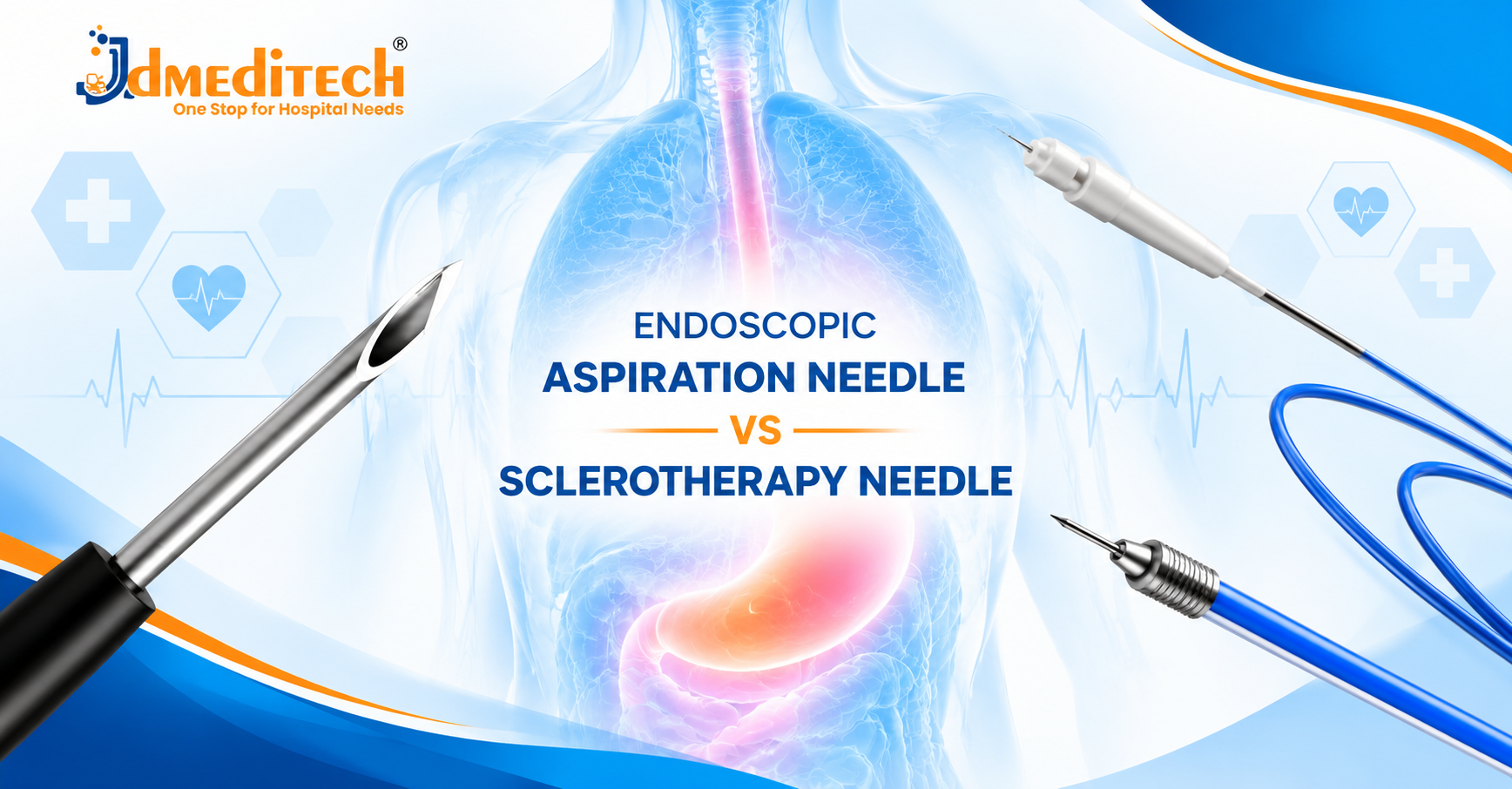
An endoscopic aspiration needle can support aspiration or sampling, depending on its intended use. In contrast, a sclerotherapy needle helps healthcare professionals deliver an appropriate injection agent during specified endoscopic procedures.
Therefore, understanding their functions, designs, applications, and compatibility can help healthcare professionals select an appropriate device for the planned procedure.
What Is an Endoscopic Aspiration Needle?
An endoscopic aspiration needle supports specified aspiration or sampling procedures. Healthcare professionals use it with a compatible endoscopic system according to the product’s intended use.
Depending on the specific product, the needle may help collect fluid, cells, or tissue from a targeted area. The operator positions the needle near the intended target and advances it according to the procedure.
However, manufacturers offer different needle designs and configurations. Therefore, healthcare professionals should check the dimensions, intended use, compatibility, and Instructions for Use before use.
Key Features of an Endoscopic Aspiration Needle
- Supports specified aspiration or sampling applications
- Works with a compatible endoscopic system
- May include a flexible catheter or sheath
- Supports controlled needle advancement
- May come in different needle sizes
- Supports specified diagnostic procedures
- May come in a sterile, single-use configuration
How Does an Endoscopic Aspiration Needle Work?
First, the healthcare professional prepares the aspiration needle and compatible endoscopic equipment according to the manufacturer’s instructions.
Next, the operator introduces the needle system through the appropriate endoscopic pathway. The healthcare professional then positions the distal end near the intended target under suitable visualization.
After confirming the position, the operator advances the needle for the specified aspiration or sampling procedure. The clinical team then handles the collected material according to its established protocol.
However, the exact technique depends on the needle type, target area, endoscopic system, and procedure.
What Is a Sclerotherapy Needle?
A sclerotherapy needle is an endoscopic injection accessory. It allows healthcare professionals to deliver an appropriate injection agent into or around targeted tissue during specified endoscopic procedures.
A typical configuration includes a flexible outer sheath, inner needle, control handle, and compatible connector. Depending on the model, the operator can extend the needle for injection and retract it into the sheath afterward.
This mechanism supports controlled needle deployment while the device passes through a compatible endoscope.
Key Features of a Sclerotherapy Needle
- Flexible sheath for endoscopic procedures
- Retractable needle configuration depending on model
- Supports controlled endoscopic injection
- Includes a compatible injection connection
- Available in different specifications depending on model
- Works with a compatible endoscopic working channel
- May come in a sterile, single-use configuration
How Does a Sclerotherapy Needle Work?
First, the healthcare professional introduces the sclerotherapy needle through a compatible endoscope. During insertion, the operator keeps the needle within its protective sheath according to the product instructions.
Next, the operator positions the distal end at the required location. The operator then extends the needle using the device mechanism.
Afterward, the healthcare professional delivers the appropriate agent according to the planned procedure and applicable clinical protocol.
Finally, the operator retracts the needle before repositioning or removing the device. The exact technique and injection requirements depend on the clinical application.
Endoscopic Aspiration Needle vs Sclerotherapy Needle
The main difference in an Endoscopic Aspiration Needle vs Sclerotherapy Needle comparison involves their intended functions.
An aspiration needle supports specified aspiration or sampling procedures. On the other hand, a sclerotherapy needle primarily supports endoscopic injection.
Although both products can use flexible needle-catheter configurations, users should not assume that they are interchangeable. Instead, healthcare professionals should select each product according to its intended use.
| Feature | Endoscopic Aspiration Needle | Sclerotherapy Needle |
|---|---|---|
| Primary Function | Supports aspiration or sampling according to intended use | Supports delivery of an appropriate injection agent |
| Main Action | Aspiration or sampling | Injection |
| Endoscopic Use | Works with a compatible endoscopic system | Works through a compatible endoscopic working channel |
| Needle Configuration | Configuration depends on the aspiration or sampling application | Often uses a retractable injection needle |
| Working Length | Varies according to model and compatible system | Varies according to model and compatible endoscope |
| Needle Size | Varies according to product specifications | Varies according to product specifications |
| Main Purpose | Collection of material where clinically indicated | Delivery of an appropriate agent where clinically indicated |
| Selection | Consider procedure, target, specifications, and compatibility | Consider procedure, specifications, and compatibility |
Key Differences Between Aspiration and Sclerotherapy Needles
Although the two products may look similar, their functions and configurations differ. Understanding these differences helps users select an appropriate endoscopic accessory.
1. Intended Function
The intended function provides the most important difference. An aspiration needle supports specified aspiration or sampling procedures. Meanwhile, a sclerotherapy needle delivers an appropriate injection agent during specified procedures.
2. Operating Mechanism
The aspiration needle mechanism depends on the specific sampling or aspiration system. In contrast, many sclerotherapy needles allow the operator to extend and retract the needle during an injection procedure.
3. Procedural Application
Healthcare professionals may choose an aspiration needle when they need to obtain material from a target area. In comparison, they may choose a sclerotherapy needle when the procedure requires an endoscopic injection.
4. Device Configuration
Manufacturers may offer different needle gauges, sheath diameters, working lengths, connectors, handles, and distal designs. Therefore, buyers should compare actual product specifications rather than relying only on appearance.
5. Endoscope Compatibility
Both devices require compatibility with the intended endoscopic system. Consequently, healthcare professionals should check the working-channel requirements and device dimensions before use.
Applications in Gastrointestinal Endoscopy
Needle-based endoscopic accessories support different diagnostic and therapeutic procedures. However, the exact application depends on the specific product and its intended use.
Healthcare professionals may use an appropriate aspiration needle when a specified procedure requires aspiration or sampling from a target area.
Meanwhile, healthcare professionals may use an appropriate sclerotherapy or injection needle when a specified endoscopic procedure requires delivery of an injection agent.
Therefore, clinicians should choose the device according to the procedure, patient requirements, product instructions, and applicable clinical protocols.
Important Specifications to Consider
Hospitals, medical professionals, and distributors should compare technical specifications before selecting an endoscopic needle.
Important specifications may include:
- Needle gauge
- Needle length
- Working length
- Outer sheath diameter
- Compatible working-channel diameter
- Needle-tip configuration
- Handle design
- Connector configuration
- Sterility status
- Single-use or reusable status where applicable
- Packaging configuration
- Intended use
Therefore, buyers should provide complete technical requirements when requesting product information or a quotation.
How to Select the Appropriate Endoscopic Needle
First, determine the purpose of the planned procedure. For example, identify whether the procedure requires aspiration, sampling, or injection.
Next, check the required needle gauge, needle length, working length, sheath diameter, and endoscopic working-channel compatibility.
Furthermore, review the product’s intended use and technical documentation. These details can help healthcare professionals select an appropriate configuration.
Most importantly, users should not substitute an aspiration needle for a sclerotherapy needle simply because the products look similar.
Aspiration Needle vs Sclerotherapy Needle: Which One Should You Choose?
Neither device offers a universal advantage because the two products serve different purposes.
When a specified procedure requires aspiration or sampling, healthcare professionals may choose a compatible aspiration needle. In contrast, an appropriate sclerotherapy needle may support procedures that require endoscopic injection.
Therefore, healthcare professionals should consider the intended procedure, needle specifications, endoscope compatibility, product instructions, and clinical requirements.
JDMeditech Endoscopic Aspiration and Sclerotherapy Needles
JDMeditech offers gastroenterology and endoscopy products for hospitals, healthcare facilities, medical device distributors, and international buyers.
Our gastroenterology portfolio includes endoscopic accessories for different diagnostic and therapeutic applications.
Customers looking for an Endoscopic Aspiration Needle or Sclerotherapy Needle can contact JDMeditech with their required specifications. For example, customers can provide the required needle gauge, working length, quantity, and destination country.
Our team can then provide information about suitable available configurations, technical specifications, packaging, and quotation requirements.
Why Choose JDMeditech for Endoscopy Accessories?
JDMeditech provides medical devices and accessories across different healthcare specialties, including gastroenterology and endoscopy.
Customers can share the required product name, size, working length, quantity, and other specifications with our team. As a result, we can discuss available product configurations according to the enquiry.
In addition, medical device distributors and international buyers can contact JDMeditech for product and export enquiries.
Frequently Asked Questions
What is an endoscopic aspiration needle?
An endoscopic aspiration needle supports specified aspiration or sampling applications. Healthcare professionals use it with a compatible endoscopic system according to the product’s intended use.
What is a sclerotherapy needle?
A sclerotherapy needle allows healthcare professionals to deliver an appropriate injection agent into or around targeted tissue during specified endoscopic procedures.
What is the difference between an aspiration needle and a sclerotherapy needle?
The main difference involves their function. An aspiration needle supports aspiration or sampling, while a sclerotherapy needle primarily supports endoscopic injection.
Can healthcare professionals use both needles interchangeably?
Users should not assume that the two needles are interchangeable. Healthcare professionals should choose each device according to its intended use, specifications, compatibility, and Instructions for Use.
Do manufacturers offer different needle gauges?
Yes. Manufacturers may offer different needle gauges and working lengths depending on the product model. Buyers should confirm the available specifications before ordering.
How do I select the correct endoscopic needle?
Consider the intended procedure, needle gauge, needle length, working length, sheath diameter, compatible working channel, device design, and intended use.
Does JDMeditech provide endoscopic needles?
Customers can contact JDMeditech with the required endoscopic needle type, gauge, length, quantity, and other specifications. Our team can then discuss available configurations and quotation requirements.
Conclusion
Overall, an Endoscopic Aspiration Needle vs Sclerotherapy Needle comparison helps healthcare professionals and medical device buyers understand the different functions of these endoscopic accessories.
An aspiration needle supports specified aspiration or sampling procedures. In contrast, a sclerotherapy needle primarily helps healthcare professionals deliver an appropriate injection agent during specified endoscopic procedures.
Moreover, individual products can differ in needle gauge, working length, sheath dimensions, handle design, and compatibility. Therefore, users should consider the intended use, procedure requirements, technical specifications, and endoscope compatibility before selecting a device.
For available configurations, product information, quantity requirements, and quotations, hospitals and medical device distributors can contact JDMeditech.
Disclaimer: JDMeditech provides this article for general educational and product-information purposes only. Healthcare professionals should use their clinical judgment and follow applicable guidelines, institutional protocols, regulatory requirements, and the manufacturer’s Instructions for Use.




