



Introduction
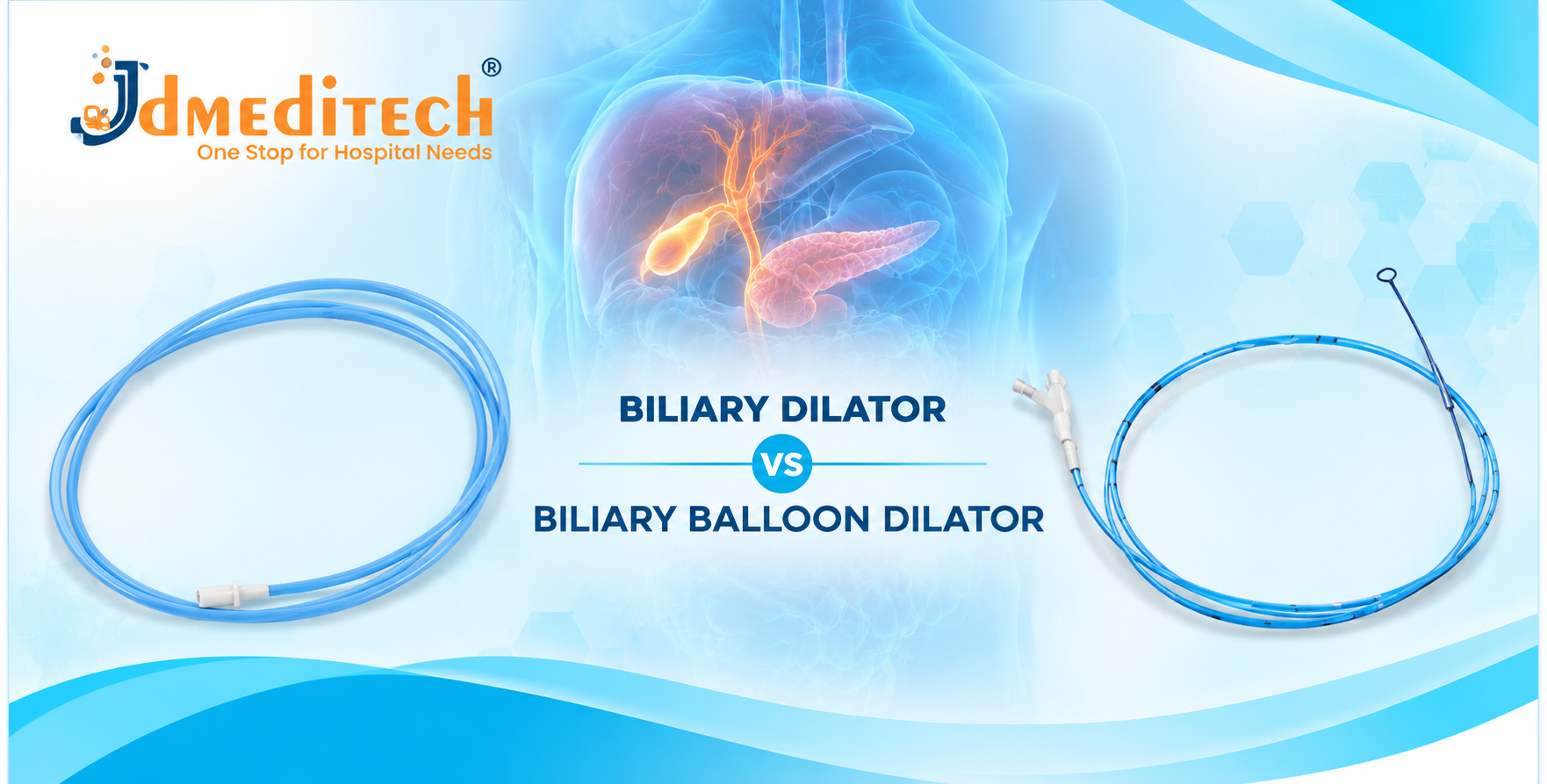
The Biliary Dilator vs Biliary Balloon Dilator comparison helps healthcare professionals understand two important devices used in biliary procedures.
Both devices can help widen narrowed sections of the bile duct. However, they use different methods to achieve dilation. Therefore, doctors select the appropriate device based on the patient’s condition, the type of narrowing, and procedural requirements.
JDMeditech offers gastroenterology devices and accessories for hospitals, healthcare institutions, and medical distributors worldwide.
What Is a Biliary Dilator?
A Biliary Dilator is a medical device that helps widen a narrowed bile duct or create a suitable passage during a biliary procedure.
A conventional tapered biliary dilator generally uses a gradually increasing catheter diameter to dilate the target area. In addition, many designs allow advancement over a compatible guidewire.
Healthcare professionals may use these devices during endoscopic retrograde cholangiopancreatography, commonly known as ERCP.
Key Features of a Biliary Dilator
- Tapered design for gradual dilation
- Guidewire-compatible configurations
- Different diameter and length options
- Designed for selected biliary procedures
- Supports access through narrowed duct segments
Applications of a Biliary Dilator
Healthcare professionals may use suitable biliary dilators for:
- Selected benign biliary strictures
- Biliary tract dilation
- ERCP procedures
- Preparation for biliary stent placement
- Management of narrowed bile duct segments
However, the device’s exact application depends on its approved design and instructions for use.
What Is a Biliary Balloon Dilator?
A Biliary Balloon Dilator is a catheter-based medical device with an inflatable balloon near its distal end.
During a suitable procedure, the clinician positions the balloon across the target narrowing. Next, the clinician inflates the balloon using the approved inflation system.
As a result, the balloon applies controlled radial pressure to the narrowed area.
Key Features of a Biliary Balloon Dilator
- Inflatable balloon for controlled radial dilation
- Guidewire-compatible designs
- Different balloon diameter and length options
- Defined inflation pressure limits
- Suitable for selected biliary stricture procedures
Applications of a Biliary Balloon Dilator
Doctors may use compatible balloon dilators during:
- ERCP procedures
- Selected benign bile duct stricture treatment
- Biliary anastomotic stricture management
- Preparation for biliary stent placement
- Other approved biliary dilation procedures
Furthermore, balloon dilation may form part of a broader treatment plan that includes stent placement.
Biliary Dilator vs Biliary Balloon Dilator: Key Differences
| Feature | Biliary Dilator | Biliary Balloon Dilator |
|---|---|---|
| Dilation method | Mechanical tapered dilation | Inflatable balloon dilation |
| Main design | Tapered catheter | Catheter with balloon |
| Dilation force | Gradual passage of the dilator | Radial balloon expansion |
| Guidewire use | Often compatible | Often compatible |
| Size selection | Catheter diameter | Balloon diameter and length |
| Inflation device | Not generally required | Required |
| Applications | Selected biliary narrowing and access procedures | Selected biliary strictures |
| Device selection | Depends on anatomy and procedure | Depends on anatomy and procedure |
Both devices serve important roles in biliary treatment. However, they are not interchangeable in every clinical situation.
How Does a Biliary Dilator Work?
A conventional biliary dilator uses its tapered profile to widen a narrowed passage.
First, the clinician establishes access using an appropriate technique. Next, the clinician advances a compatible dilator according to the procedural plan.
The dilator’s shape supports gradual mechanical dilation as it passes through the target area.
However, the clinician must avoid excessive force because biliary procedures carry risks, including duct injury and perforation.
How Does a Biliary Balloon Dilator Work?
A biliary balloon dilator uses an inflatable balloon to widen a selected narrowing.
First, the clinician advances the catheter to the intended location. Next, the clinician positions the balloon across the target area.
The clinician then inflates the balloon within its approved pressure limits. As a result, the balloon expands and applies radial force.
Finally, the clinician deflates and removes or repositions the balloon according to the treatment plan.
The appropriate inflation technique depends on the specific device and clinical situation.
Benefits of a Biliary Dilator
1. Gradual Dilation
The tapered design supports progressive widening of suitable narrowed passages.
2. Simple Mechanical Design
Conventional tapered dilators generally do not require a balloon inflation system.
3. Guidewire Compatibility
Many models work with compatible guidewires. Therefore, clinicians can incorporate them into selected wire-guided procedures.
4. Different Size Options
Various catheter diameters allow clinicians to select a suitable device for the procedure.
Benefits of a Biliary Balloon Dilator
1. Controlled Radial Expansion
Balloon inflation applies radial force to the selected area.
2. Defined Balloon Dimensions
The clinician can select a balloon with a suitable rated diameter and length.
3. Targeted Dilation
The balloon can expand across a specific narrowed section when correctly positioned.
4. Use in Stricture Management
Balloon dilation plays a role in treating selected benign biliary strictures. In addition, clinicians may combine dilation with stenting when appropriate.
How to Choose the Right Biliary Dilator
Healthcare professionals should consider several factors before choosing a dilation device.
First, they should evaluate the location and severity of the narrowing. Next, they should review the patient’s anatomy and the planned procedure.
Important selection factors include:
- Type and location of biliary stricture
- Catheter or balloon diameter
- Working length
- Guidewire compatibility
- Endoscope channel compatibility
- Balloon pressure rating, where applicable
- Sterility and approved instructions for use
Therefore, device selection should always follow the treating clinician’s judgment and the manufacturer’s approved specifications.
JDMeditech Gastroenterology Products
JDMeditech offers gastroenterology devices and accessories for hospitals, endoscopy centers, and medical distributors.
Our product range includes devices used in ERCP and other gastrointestinal procedures.
Furthermore, our team supports product inquiries, technical specification requests, and international supply requirements.
For available Biliary Dilator and Biliary Balloon Dilator configurations, please contact JDMeditech.
Website: https://www.jdmeditech.com/
Frequently Asked Questions
1. What is the main difference between a Biliary Dilator and a Biliary Balloon Dilator?
A conventional biliary dilator uses a tapered catheter for mechanical dilation. In contrast, a biliary balloon dilator uses an inflatable balloon to apply radial force.
2. Are both devices used during ERCP?
Yes. Healthcare professionals may use either device during suitable ERCP procedures, depending on the clinical requirements.
3. Which device is better for a biliary stricture?
Neither device is automatically better. Instead, the clinician selects the appropriate device based on the stricture, anatomy, and treatment plan.
4. Can a Biliary Balloon Dilator support stent placement?
Yes. Clinicians may perform balloon dilation before placing a biliary stent when the treatment plan requires it.
5. Do biliary dilators require guidewires?
Many biliary dilators and balloon dilators support guidewire-guided use. However, compatibility depends on the specific device design.
6. Where can I inquire about JDMeditech biliary dilation products?
Visit www.jdmeditech.com to contact the JDMeditech team for available product configurations and quotations.
Conclusion
The Biliary Dilator vs Biliary Balloon Dilator comparison highlights two different approaches to biliary dilation.
A conventional biliary dilator uses a tapered catheter for gradual mechanical dilation. Meanwhile, a biliary balloon dilator uses an inflatable balloon to apply radial pressure.
Both devices can support selected biliary procedures. Therefore, healthcare professionals should choose the correct device according to clinical requirements and approved product specifications.
Contact JDMeditech for gastroenterology products, technical details, and international business inquiries.
Medical Disclaimer: This article provides general educational information for healthcare professionals and purchasers. It does not replace clinical judgment or the manufacturer’s approved instructions for use.




