



Introduction
A Bipolar TURP Set includes selected surgical instruments and equipment used during transurethral resection of the prostate.
TURP is a surgical procedure used to remove prostate tissue that blocks urine flow. In many cases, doctors recommend it for suitable patients with symptoms caused by benign prostatic hyperplasia (BPH).
Moreover, bipolar TURP technology allows surgeons to perform tissue resection using compatible bipolar electrosurgical equipment and saline irrigation.
Therefore, selecting suitable instruments is important for surgical preparation and device compatibility.
What Is a Bipolar TURP Set?
A Bipolar TURP Set is a collection of compatible urology instruments used during bipolar transurethral prostate resection.
For example, a configuration may include a resectoscope sheath, working element, telescope, bipolar electrode, and suitable electrosurgical accessories.
In addition, the procedure requires compatible irrigation and electrosurgical systems.
However, the exact set contents depend on the manufacturer and approved device configuration.
Understanding Transurethral Resection of the Prostate
Transurethral resection of the prostate is a procedure used to remove selected prostate tissue through the urethra.
During TURP, the surgeon uses a resectoscope to reach the prostate without making an external abdominal incision.
Next, a suitable electrode removes obstructing tissue while the surgeon views the area through the telescope.
As a result, the procedure can help improve urine flow in appropriately selected patients.
However, TURP involves surgical risks. Therefore, treatment decisions require evaluation by a qualified urologist.
Common Components of a Bipolar TURP Set
A bipolar TURP configuration may include several specialized instruments.
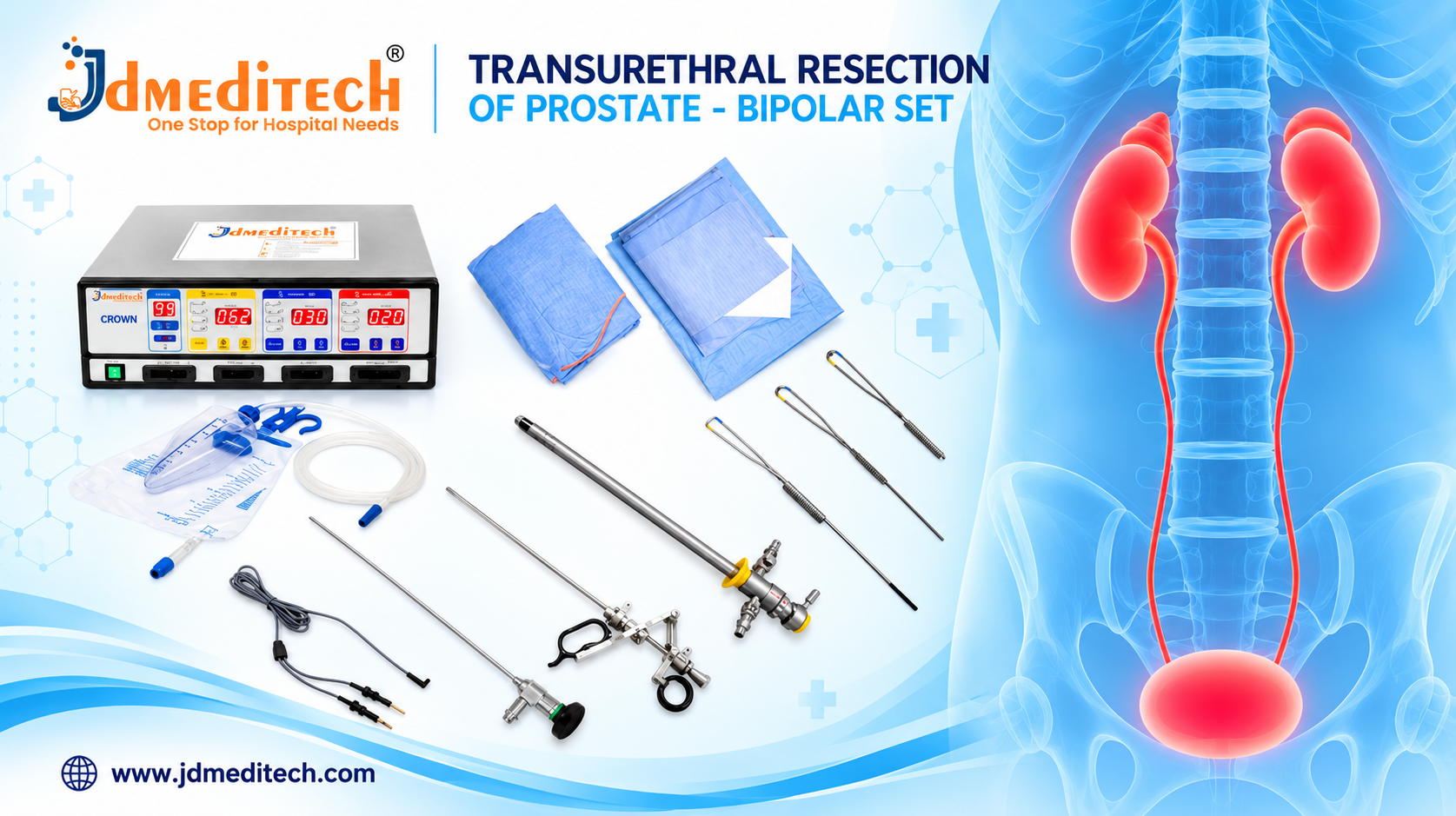
The reference image shows a control unit and selected urology accessories. However, the picture does not confirm every component name, model, or technical specification.
Therefore, the following list describes common bipolar TURP components rather than a verified JDMeditech kit inventory.
1. Bipolar Resectoscope Sheath
The resectoscope sheath provides an access pathway for compatible surgical instruments.
Moreover, suitable sheath designs support irrigation during the procedure.
2. Bipolar Working Element
A bipolar working element supports controlled movement of a compatible resection electrode.
In addition, the working element connects with the selected resectoscope system.
3. Resectoscope Telescope
A suitable telescope provides visualization of the operative area.
Therefore, clinicians must confirm compatibility with the sheath and working element.
4. Bipolar TURP Electrode
A bipolar loop electrode supports the cutting and removal of selected prostate tissue.
Meanwhile, compatible coagulation electrodes may support bleeding control during the procedure.
However, electrode selection depends on the approved surgical system.
5. Bipolar Electrosurgical Unit
A compatible electrosurgical unit supplies electrical energy to the selected bipolar instruments.
Moreover, the generator must support the specific electrode and working element configuration.
6. TURP High-Frequency Cable
A suitable high-frequency cable connects compatible instruments to the electrosurgical unit.
Therefore, the surgical team must verify connector compatibility and approved device ratings.
7. Irrigation Accessories
Irrigation accessories help maintain visualization and fluid flow during suitable TURP procedures.
For bipolar TURP, compatible normal saline irrigation is commonly used.
However, the clinical team must follow the approved instructions for the selected system.
Bipolar TURP Set: Instrument Functions
| Instrument | Main Function |
|---|---|
| Resectoscope Sheath | Provides an access pathway for compatible instruments |
| Bipolar Working Element | Supports movement of the resection electrode |
| Resectoscope Telescope | Provides visualization of the operative area |
| Bipolar Loop Electrode | Supports prostate tissue resection |
| Electrosurgical Unit | Supplies compatible bipolar electrical energy |
| High-Frequency Cable | Connects compatible instruments and generator |
| Irrigation Accessories | Support irrigation and operative visualization |
In short, each component has a different role. Therefore, the surgical team should verify the complete configuration before use.
Key Features of a Bipolar TURP Set
1. Bipolar Electrosurgical Technology
Bipolar TURP uses compatible bipolar electrosurgical instruments for prostate tissue resection.
Moreover, bipolar systems allow the use of normal saline irrigation when approved by the manufacturer.
2. Endoscopic Surgical Access
The resectoscope provides access through the urethra.
As a result, the surgeon can perform the procedure without an external abdominal incision.
3. Visualization and Irrigation Support
A compatible telescope and irrigation system support visualization during surgery.
Therefore, hospitals should confirm that the selected components work together.
4. Different Instrument Configurations
Different surgical systems require different sheath sizes, working elements, and electrodes.
Consequently, healthcare professionals should verify product specifications before ordering.
Applications of a Bipolar TURP Set
A Bipolar TURP Set supports selected transurethral prostate procedures.
- Bipolar transurethral resection of the prostate
- Selected surgical treatment of benign prostatic hyperplasia
- Resection of obstructing prostate tissue
- Compatible bipolar endoscopic prostate procedures
- Other approved urology applications
However, not every instrument is approved for every urology procedure. Therefore, clinicians must follow the intended use of each device.
How Does Bipolar TURP Work?
Bipolar TURP is performed by trained urologists using suitable endoscopic and electrosurgical equipment.
First, the surgical team prepares the patient and confirms the selected equipment configuration.
Next, the surgeon introduces a compatible resectoscope through the urethra.
During the procedure, the surgeon uses a suitable bipolar electrode to remove obstructing prostate tissue.
Meanwhile, compatible saline irrigation helps maintain visualization.
Finally, the surgical team assesses the operative area and provides appropriate postoperative care.
However, the exact technique depends on the patient’s condition and the selected surgical system.
Benefits of Bipolar TURP Technology
1. Saline Irrigation Compatibility
Bipolar TURP systems generally support the use of normal saline irrigation.
As a result, they reduce the risk of classic dilutional TUR syndrome associated with non-electrolyte irrigation fluids used in traditional monopolar TURP.
However, fluid absorption and other complications can still occur.
2. Endoscopic Tissue Resection
Bipolar TURP allows surgeons to remove selected prostate tissue through the urethra.
Therefore, no external abdominal incision is required for the standard procedure.
3. Electrosurgical Coagulation
Compatible bipolar instruments can support tissue coagulation during the procedure.
Moreover, the surgeon can select approved electrodes according to the clinical requirements.
4. Procedure-Based Instrument Selection
Hospitals can select compatible components based on the required surgical configuration.
However, compatibility must be confirmed before clinical use.
Bipolar TURP vs Monopolar TURP
| Feature | Bipolar TURP | Monopolar TURP |
|---|---|---|
| Energy system | Bipolar electrosurgery | Monopolar electrosurgery |
| Typical irrigation fluid | Normal saline | Compatible non-electrolyte solution |
| Electrode system | Bipolar-compatible electrode | Monopolar-compatible electrode |
| Classic dilutional TUR syndrome | Lower risk | Recognized risk |
| Procedure access | Through the urethra | Through the urethra |
In summary, both methods can treat suitable patients with prostate obstruction.
However, bipolar TURP uses a different energy system and typically allows saline irrigation.
How to Choose the Right Bipolar TURP Set
Choosing a suitable set requires careful review of the planned surgical procedure.
First, clinicians identify the required resectoscope system. Next, they review the compatible working element and electrode design.
In addition, hospitals should confirm electrosurgical generator compatibility.
Important Selection Factors
- Resectoscope sheath size
- Working element type
- Telescope diameter and viewing angle
- Bipolar electrode compatibility
- Electrosurgical generator compatibility
- High-frequency cable connections
- Irrigation system requirements
- Product material specifications
- Reusable or single-use labeling
- Cleaning and sterilization instructions
- Approved manufacturer’s instructions for use
Furthermore, surgeon preferences and patient requirements may affect the final configuration.
Therefore, qualified healthcare professionals should approve the selected equipment.
Safety and Maintenance Considerations
Bipolar TURP requires trained medical professionals and suitable surgical equipment.
Before use, staff should inspect the instruments and confirm compatibility.
Moreover, reusable instruments must undergo validated cleaning and sterilization according to their instructions.
Possible surgical complications include bleeding, infection, urethral stricture, urinary incontinence, and other procedure-related risks.
Therefore, appropriate patient assessment and postoperative monitoring remain essential.
JDMeditech Bipolar TURP Set
JDMeditech offers urology surgical instruments and accessories for hospitals, surgical centers, and international medical distributors.
Our urology product range includes selected TURP instruments, working elements, resectoscope accessories, and related equipment.
Furthermore, our team supports product inquiries, technical specification requests, and international supply requirements.
For available Bipolar TURP Set configurations, contact JDMeditech.
Website: www.jdmeditech.com
Frequently Asked Questions
1. What is a Bipolar TURP Set?
A Bipolar TURP Set includes selected instruments and accessories used during compatible bipolar transurethral prostate resection procedures.
2. What is bipolar TURP used for?
Bipolar TURP is used to remove obstructing prostate tissue in selected patients, commonly those with symptoms caused by benign prostatic hyperplasia.
3. What instruments are commonly included in a TURP set?
Common components include a resectoscope sheath, working element, telescope, bipolar electrode, and compatible accessories.
4. What is the difference between bipolar and monopolar TURP?
Bipolar TURP uses bipolar electrical energy and typically supports saline irrigation. In contrast, monopolar TURP uses monopolar energy and compatible non-electrolyte irrigation fluid.
5. Can bipolar TURP use normal saline?
Yes. Compatible bipolar TURP systems commonly use normal saline irrigation.
6. Are all bipolar TURP instruments interchangeable?
No. Different systems may use different connections, electrodes, and working elements.
7. Where can I inquire about JDMeditech TURP instruments?
Hospitals and medical distributors can visit JDMeditech for product information and quotations.
Conclusion
A Bipolar TURP Set supports selected prostate resection procedures through compatible endoscopic and electrosurgical instruments.
For example, a configuration may include a resectoscope sheath, working element, telescope, bipolar electrode, and suitable accessories.
Moreover, bipolar TURP technology commonly supports saline irrigation.
Therefore, hospitals should verify equipment compatibility, product specifications, and approved intended use before purchasing.
Contact JDMeditech for bipolar TURP instruments, urology surgical accessories, and international medical device inquiries.
Medical Disclaimer: This article provides general educational information. Device selection and use must follow qualified clinical judgment and approved manufacturer instructions.




