



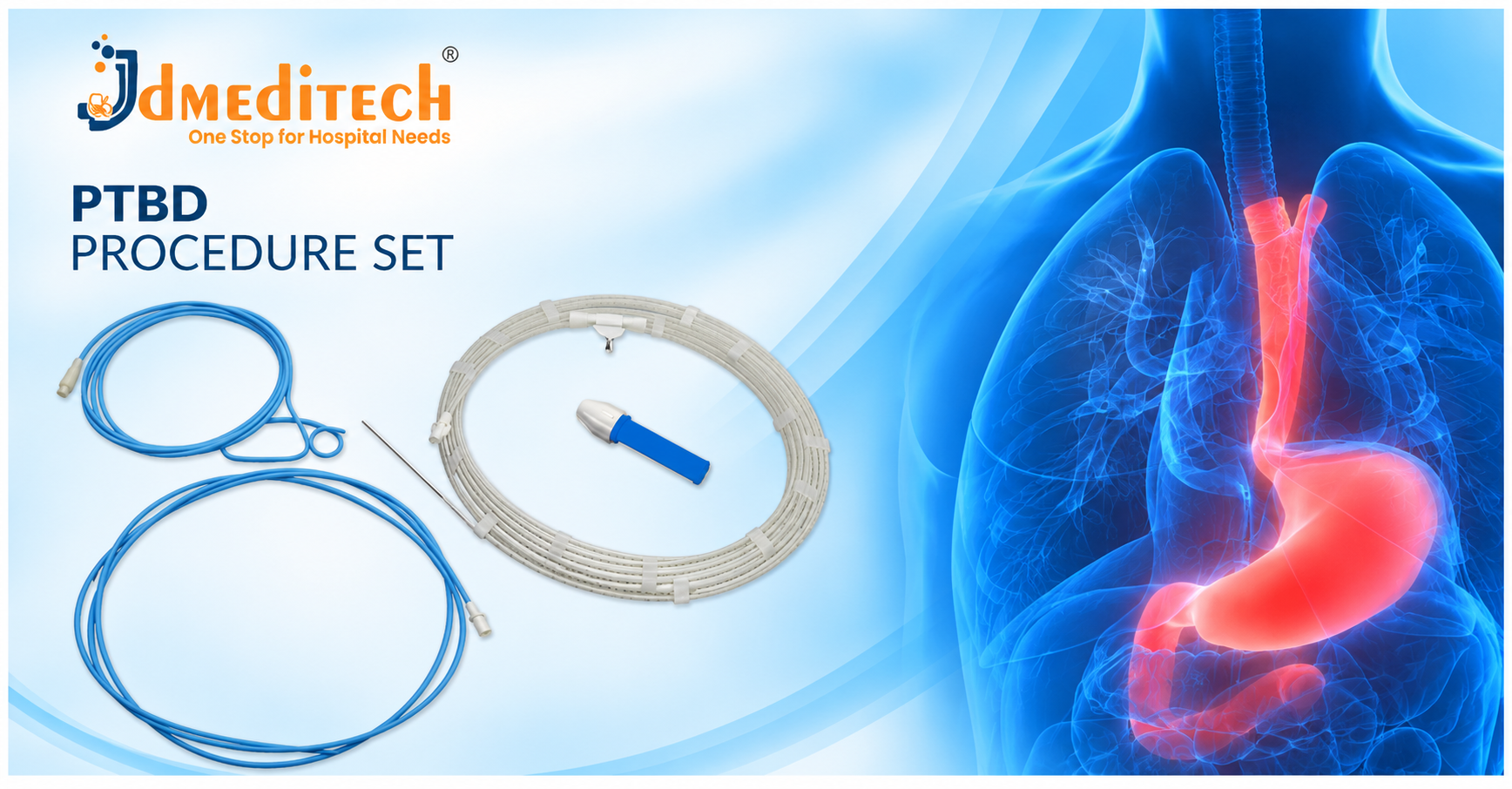
PTBD stands for Percutaneous Transhepatic Biliary Drainage. It is commonly performed by interventional radiologists using suitable imaging equipment and compatible biliary access instruments.
Normally, bile travels from the liver through the bile ducts into the small intestine. However, stones, strictures, tumors, and other conditions can obstruct this pathway. As a result, bile may accumulate within the biliary system and cause jaundice, infection, or liver dysfunction.
In selected patients, PTBD provides an alternative route for bile drainage, particularly when endoscopic drainage is unsuccessful or unsuitable.
This JDMeditech guide explains the common components, clinical applications, drainage methods, potential benefits, complications, and equipment selection considerations associated with a PTBD Procedure Set.
What Is a PTBD Procedure Set?
A PTBD Procedure Set refers to a collection of medical instruments used to support compatible percutaneous biliary access and drainage procedures.
Depending on its configuration, the set may contain a biliary drainage catheter, access needle, guide wire, dilator, and other selected accessories.
Moreover, additional equipment may be required for imaging, contrast administration, drainage collection, or stent placement.
However, not every PTBD kit contains the same components. Therefore, hospitals should confirm the manufacturer’s packing list and technical specifications before purchasing.
Understanding the Biliary System
The biliary system consists of ducts that carry bile from the liver toward the intestine.
Bile supports the digestion and absorption of dietary fats. Furthermore, it helps the body eliminate certain waste products.
When the bile ducts become obstructed, bile cannot drain normally. Consequently, patients may develop jaundice, dark urine, pale stools, itching, or abdominal discomfort.
In addition, persistent obstruction may increase the risk of biliary infection and liver injury.
What Is Percutaneous Transhepatic Biliary Drainage?
Percutaneous transhepatic biliary drainage is an image-guided procedure in which a drainage catheter is placed through the skin and liver into the biliary system.
The catheter provides a route for bile to drain when the normal pathway is obstructed.
Depending on the clinical situation, drainage may be external, internal-external, or followed by a suitable biliary stenting procedure.
However, the appropriate treatment strategy depends on the location and cause of obstruction, the patient’s condition, and available clinical expertise.
Why Is a PTBD Procedure Performed?
PTBD may be considered when a patient requires biliary decompression and a percutaneous approach is appropriate.
For example, some patients have biliary obstruction that cannot be managed successfully through conventional endoscopic access.
Moreover, selected complex or high biliary obstructions may require image-guided percutaneous drainage.
In patients with cholangitis, timely biliary drainage may be essential to control infection.
Nevertheless, PTBD is not automatically the first choice for every biliary obstruction. Clinicians must consider endoscopic, percutaneous, and other treatment options.
Common Components of a PTBD Procedure Set
Different manufacturers provide different PTBD equipment configurations. The following components are commonly associated with selected percutaneous biliary drainage procedures, but they are not a confirmed list of the items shown in the JDMeditech product photograph.
1. PTBD Drainage Catheter
A PTBD drainage catheter is designed to provide a drainage pathway within the biliary system.
Depending on its design, the catheter may have multiple drainage openings, a locking mechanism, or an internal-external configuration.
Moreover, catheters are available in different diameters and lengths for specific clinical requirements.
However, the exact design and intended use must be confirmed for each model.
2. Percutaneous Access Needle
A suitable access needle supports selected image-guided biliary access procedures.
Different needles are available in various gauges and lengths.
Therefore, the clinician must select equipment appropriate for the intended anatomy and procedure.
3. Guide Wire
A compatible guide wire may provide a pathway for selected biliary access devices and drainage catheters.
Furthermore, guide wires differ in diameter, length, flexibility, coating, and tip design.
Consequently, compatibility with the intended catheter and access system is essential.
4. Fascial or Tract Dilator
Selected PTBD procedures use compatible dilators as part of the access system.
However, dilator dimensions and intended applications vary by manufacturer.
5. Catheter Introducer Accessories
Some PTBD systems use additional compatible introducer or access accessories.
Moreover, these components may differ according to the procedure and catheter configuration.
6. Drainage Collection Bag
External biliary drainage may require a suitable collection bag connected to the drainage catheter.
However, collection bags may be supplied separately from the PTBD set.
7. Connecting Tubing and Stopcock
Selected drainage systems use compatible connecting tubes or stopcocks.
These accessories support approved fluid connections and drainage management.
Nevertheless, the actual configuration must match the manufacturer’s instructions.
8. Imaging and Contrast Accessories
PTBD procedures commonly use ultrasound and fluoroscopic imaging.
In selected cases, suitable contrast media and compatible injection accessories may support biliary assessment.
However, imaging equipment and contrast media are not normally included in a disposable PTBD kit.
PTBD Procedure Set Components and Functions
| Component | Primary Function |
|---|---|
| PTBD Drainage Catheter | Provides a pathway for selected biliary drainage |
| Access Needle | Supports image-guided percutaneous access |
| Guide Wire | Supports compatible device introduction |
| Tract Dilator | Supports selected access-system requirements |
| Introducer Accessories | Support compatible biliary access systems |
| Drainage Bag | Collects bile during external drainage |
| Connecting Tubing | Connects compatible drainage components |
| Imaging Equipment | Supports visualization and procedural assessment |
Importantly, the table describes commonly associated equipment. Customers should confirm the actual JDMeditech PTBD Procedure Set contents before ordering.
Types of Biliary Drainage Used During PTBD
1. External Biliary Drainage
External biliary drainage directs bile from the biliary system into a collection bag outside the body.
For example, this approach may be selected when internal drainage is not immediately feasible.
However, external drainage requires appropriate catheter care and monitoring of fluid losses.
2. Internal-External Biliary Drainage
An internal-external biliary drainage catheter allows bile to drain through a compatible pathway into the intestine while also providing access to external drainage when required.
Moreover, the catheter may have multiple drainage openings and a specialized retention design.
Nevertheless, the exact catheter configuration depends on the device and clinical indication.
3. Percutaneous Biliary Stenting
Some patients undergo biliary stent placement through a percutaneous access route.
A suitable stent may help maintain drainage across a selected obstruction.
However, biliary stenting is a separate intervention and is not automatically part of a basic PTBD kit.
External vs Internal-External Biliary Drainage
| Feature | External Drainage | Internal-External Drainage |
|---|---|---|
| Drainage Pathway | Bile drains into an external collection bag | Bile may drain into the intestine and externally when configured |
| Catheter Design | External biliary drainage catheter | Internal-external drainage catheter |
| Collection Bag | Generally required | May be required depending on drainage management |
| Clinical Selection | Depends on obstruction and access | Depends on anatomy and ability to establish internal drainage |
Importantly, the treating specialist determines the appropriate drainage configuration according to the patient’s clinical condition.
Clinical Applications of PTBD Procedure Sets
1. Malignant Biliary Obstruction
Certain cancers can obstruct the bile ducts and interfere with bile drainage.
For example, pancreatic cancer, cholangiocarcinoma, and other tumors may cause biliary obstruction.
In selected patients, PTBD may provide drainage when endoscopic treatment is unsuccessful or unsuitable.
2. Benign Biliary Strictures
Benign biliary strictures may develop after surgery, inflammation, or other noncancerous conditions.
Depending on the anatomy and treatment history, percutaneous drainage may form part of the management plan.
3. Acute Cholangitis
Cholangitis is an infection of the biliary system that can occur when bile drainage becomes obstructed.
Severe cholangitis is a medical emergency.
Consequently, selected patients require urgent biliary decompression alongside appropriate medical treatment.
When endoscopic drainage is not feasible, percutaneous drainage may be considered.
4. Postoperative Biliary Complications
Some patients develop bile duct narrowing or leakage following hepatobiliary surgery.
In suitable cases, percutaneous biliary intervention may support drainage or further treatment.
5. Complex Hilar Biliary Obstruction
Obstruction near the junction of the right and left hepatic ducts may create complex drainage requirements.
Therefore, selected patients may require carefully planned percutaneous drainage.
6. Selected Biliary Stone-Related Obstruction
Bile duct stones may obstruct bile flow and contribute to infection.
Although ERCP is commonly used for suitable bile duct stone cases, percutaneous drainage may be necessary when endoscopic access is unavailable or unsuccessful.
7. Selected Bile Leaks
Some postoperative or traumatic bile leaks require specialized biliary drainage.
However, treatment depends on the location of the leak and the patient’s clinical condition.
Key Features of PTBD Equipment
1. Image-Guided Biliary Access
PTBD systems are used during selected image-guided interventions.
Consequently, clinicians can evaluate the biliary anatomy and plan appropriate drainage.
2. Different Catheter Configurations
Drainage catheters are available in different diameters, lengths, and retention designs.
Therefore, hospitals should select the appropriate model for the intended application.
3. Guide Wire Compatibility
Selected drainage systems use compatible guide wires.
Moreover, the required wire diameter and length depend on the catheter and access system.
4. External and Internal-External Options
Different catheter designs support different drainage pathways.
However, not every PTBD catheter is suitable for both external and internal-external drainage.
5. Drainage Openings
Some biliary drainage catheters include multiple side openings.
These openings support the intended drainage function when the device is correctly selected and positioned by qualified clinicians.
6. Radiopaque Features
Selected catheter designs may incorporate radiopaque features that support visualization during imaging.
However, marker design and availability vary by product model.
How Is a PTBD Procedure Performed?
A qualified interventional radiologist performs PTBD in an appropriately equipped medical facility.
First, the healthcare team reviews the patient’s symptoms, laboratory findings, and relevant imaging.
Next, specialists assess the biliary anatomy and determine whether percutaneous drainage is appropriate.
During the procedure, ultrasound and fluoroscopic imaging may support assessment of the biliary system.
When indicated, compatible access and drainage equipment is used to establish the selected drainage pathway.
Afterward, the clinical team evaluates the drainage result and monitors the patient for complications.
Finally, the patient receives an individualized plan for catheter care, follow-up, and treatment of the underlying condition.
However, the exact procedure depends on the patient’s anatomy and diagnosis. This overview is not intended as procedural training.
Potential Benefits of PTBD
1. Relief of Selected Biliary Obstructions
Successful drainage may reduce bile accumulation within an obstructed biliary system.
As a result, selected patients may experience improvement in jaundice and other obstruction-related symptoms.
2. Alternative to Endoscopic Drainage
PTBD provides a treatment option when endoscopic drainage is unsuccessful or unsuitable.
Therefore, it remains important in selected complex biliary conditions.
3. Support for Infection Management
Appropriate biliary drainage can be an important part of treating cholangitis associated with obstruction.
However, drainage must be combined with suitable medical management.
4. Support for Further Treatment
In selected patients, biliary decompression may help prepare for additional treatment.
For example, clinicians may reassess suitability for surgery or other therapy after drainage.
5. Different Drainage Configurations
External and internal-external catheter options allow specialists to select suitable drainage strategies.
Nevertheless, catheter selection depends on the approved intended use and clinical circumstances.
PTBD vs ERCP: What Is the Difference?
PTBD and ERCP are established approaches for managing selected biliary conditions. However, they use different access routes.
| Feature | PTBD | ERCP |
|---|---|---|
| Full Form | Percutaneous Transhepatic Biliary Drainage | Endoscopic Retrograde Cholangiopancreatography |
| Access Route | Through the skin and liver | Through the mouth and gastrointestinal tract |
| Primary Specialty | Interventional Radiology | Therapeutic Gastroenterology |
| Imaging | Ultrasound and fluoroscopy | Endoscopy and fluoroscopy |
| Typical Role | Selected percutaneous drainage procedures | Selected endoscopic biliary interventions |
Importantly, neither procedure is universally superior for every patient. Treatment selection depends on the anatomy, underlying disease, available expertise, and clinical urgency.
Risks and Safety Considerations of PTBD
PTBD is an invasive procedure with potentially serious complications.
For example, bleeding may occur during or after percutaneous biliary access.
In addition, complications may include cholangitis, sepsis, bile leakage, and bile peritonitis.
Furthermore, drainage catheters can become blocked, displaced, or damaged.
Other possible complications include injury to nearby structures and discomfort at the access site.
Consequently, clinicians must evaluate coagulation status, infection risk, biliary anatomy, and the patient’s overall condition.
Moreover, suitable imaging, sterile technique, antibiotic management when indicated, and careful monitoring are important safety considerations.
PTBD Catheter Care and Follow-Up
Patients with biliary drainage catheters require appropriate follow-up from their healthcare team.
For example, clinicians may monitor drainage output, catheter position, symptoms, and liver-related blood tests.
Furthermore, patients may require scheduled catheter exchange or additional biliary treatment.
However, catheter flushing and dressing instructions depend on the specific device and treating team’s protocol.
Patients should not independently alter catheter connections or drainage arrangements without medical guidance.
Importantly, fever, worsening jaundice, severe abdominal pain, significant bleeding, catheter displacement, or sudden changes in drainage require prompt medical evaluation.
How to Choose a PTBD Procedure Set
Hospitals and medical distributors should confirm the intended drainage procedure before purchasing PTBD equipment.
First, determine whether the requirement involves external drainage, internal-external drainage, or another percutaneous biliary intervention.
Next, review the catheter dimensions and compatibility requirements.
Important Equipment Selection Factors
- Approved intended use
- External or internal-external drainage configuration
- Drainage catheter French size
- Catheter working length
- Catheter tip configuration
- Number and location of drainage openings
- Catheter retention mechanism
- Guide wire diameter and length
- Access needle gauge and length
- Dilator dimensions and compatibility
- Radiopaque marker availability
- Connector and drainage bag compatibility
- Sterile packaging and shelf life
- Single-use classification
- Actual number of supplied components
- Manufacturer instructions for use
- Applicable regulatory documentation
Furthermore, purchasing teams should request the product datasheet and exact packing list before placing an order.
PTBD Procedure Set by JDMeditech
JDMeditech welcomes inquiries from hospitals, interventional radiology departments, gastroenterology centers, and international medical distributors regarding PTBD procedure equipment.
Customers can contact JDMeditech to request information about available biliary drainage catheters, compatible guide wires, access accessories, and procedure-set configurations.
Moreover, the team can confirm product specifications, availability, and applicable documentation for individual inquiries.
For further details, visit www.jdmeditech.com.
Frequently Asked Questions About PTBD Procedure Set
1. What is a PTBD Procedure Set?
A PTBD Procedure Set refers to selected instruments used to support percutaneous transhepatic biliary drainage. Exact contents vary by manufacturer.
2. What does PTBD stand for?
PTBD stands for Percutaneous Transhepatic Biliary Drainage.
3. What is the purpose of PTBD?
PTBD provides a drainage pathway for bile when the biliary system is obstructed and a percutaneous approach is clinically appropriate.
4. What is a PTBD catheter?
A PTBD catheter is a specialized drainage catheter used during selected percutaneous biliary drainage procedures.
5. What is the difference between external and internal-external biliary drainage?
External drainage directs bile into an external collection bag. Internal-external drainage uses a catheter configuration that may allow bile to drain into the intestine as well as externally when required.
6. Is PTBD the same as ERCP?
No. PTBD uses a percutaneous transhepatic access route, while ERCP uses an endoscope introduced through the gastrointestinal tract.
7. Is PTBD used for malignant biliary obstruction?
Yes. PTBD may be considered in selected patients with malignant biliary obstruction, particularly when endoscopic drainage is unsuccessful or unsuitable.
8. Does every PTBD kit include a drainage bag?
No. Product configurations vary, and drainage collection bags may be supplied separately.
9. What are the main risks of PTBD?
Potential complications include bleeding, infection, bile leakage, catheter blockage, catheter displacement, and injury to nearby structures.
10. Where can hospitals inquire about JDMeditech PTBD equipment?
Hospitals and medical distributors can visit JDMeditech to request product details and quotations.
Conclusion
A PTBD Procedure Set may support selected image-guided biliary drainage procedures used to manage obstructed bile ducts.
Moreover, compatible drainage catheters, access needles, guide wires, and related accessories are important components of certain percutaneous biliary interventions.
However, successful treatment requires appropriate patient selection, specialist expertise, suitable equipment, and careful follow-up.
Therefore, hospitals should choose devices according to clinical requirements, professional guidelines, and approved manufacturer specifications.
Contact JDMeditech for PTBD equipment inquiries, biliary drainage accessories, and international medical device requirements.
Medical Disclaimer: This article provides general educational information and is not a procedural training guide or individual treatment recommendation. Qualified healthcare professionals must make all treatment and device-selection decisions according to clinical judgment, applicable guidelines, and approved manufacturer instructions.




