



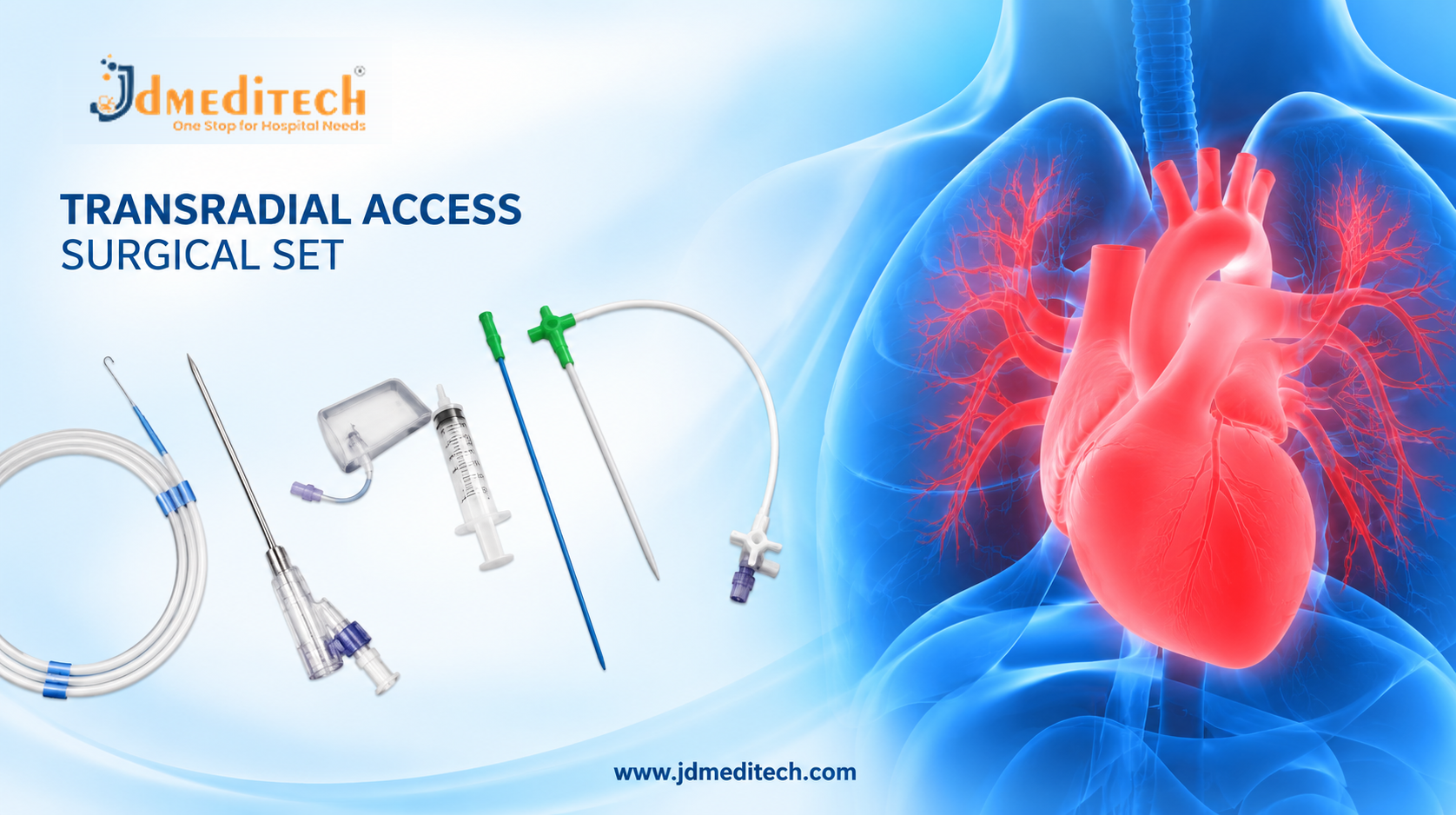
Modern cardiac catheterization requires appropriate vascular access equipment to introduce diagnostic and interventional catheters. Consequently, radial introducer sheaths, access needles, guide wires, and related accessories are important components of many catheterization workflows.
Moreover, radial access has become a preferred approach for many coronary interventions because it can reduce access-site bleeding and vascular complications compared with femoral access.
This JDMeditech guide explains the components, clinical applications, features, potential benefits, procedural overview, risks, and purchasing considerations associated with a Transradial Access Surgical Set.
What Is a Transradial Access Surgical Set?
A Transradial Access Surgical Set refers to selected instruments designed to support compatible arterial access procedures through the radial artery.
Depending on the manufacturer and product configuration, a set may contain a radial introducer sheath, dilator, access needle, guide wire, syringe, and connecting accessories.
However, not every commercial set includes the same devices. Therefore, hospitals should verify the exact product packing list and intended use before ordering.
Understanding Transradial Vascular Access
Transradial access involves using the radial artery as a vascular entry route for selected catheter-based procedures.
The radial artery runs along the thumb side of the wrist and contributes to the blood supply of the hand.
Because the artery is relatively superficial, it can be accessed using suitable clinical techniques and equipment.
Furthermore, its anatomical location allows effective compression after many procedures.
However, radial artery size and anatomy vary between patients. Consequently, the clinical team must assess whether radial access is suitable.
Why Is Transradial Access Used?
Transradial access provides a pathway for selected cardiovascular diagnostic and therapeutic devices.
For example, cardiologists commonly use radial access during coronary angiography and PCI.
Moreover, radial access may offer advantages in reducing access-site bleeding and facilitating earlier mobilization after suitable procedures.
In patients with acute coronary syndromes undergoing PCI, the 2025 ACC/AHA guideline recommends radial rather than femoral access when feasible to reduce bleeding, vascular complications, and mortality.
Nevertheless, radial access is not appropriate for every patient or every procedure.
Common Components of a Transradial Access Surgical Set
The following devices are commonly associated with radial vascular access systems. However, they do not represent a confirmed packing list for the pictured JDMeditech product.
1. Radial Introducer Sheath
A radial introducer sheath provides a pathway for compatible diagnostic or interventional catheters.
Depending on its design, the sheath may include a hemostatic valve and sidearm tubing.
Moreover, different sheath sizes and lengths are available for selected applications.
Therefore, clinicians must verify the sheath dimensions and approved intended use.
2. Vascular Access Needle
A vascular access needle supports selected radial artery access procedures.
Different needles are available in various gauges and configurations.
Consequently, the appropriate needle depends on the access system and clinical requirements.
3. Radial Guide Wire
A compatible guide wire supports the introduction of selected vascular access devices.
Moreover, guide wires may differ in diameter, length, coating, and tip configuration.
However, the guide wire must match the selected needle, sheath, and dilator.
4. Vessel Dilator
A dilator is commonly supplied with certain introducer sheath systems.
It is designed to work with a specified sheath configuration.
Therefore, dilators should not be assumed interchangeable between different manufacturers or product models.
5. Hemostatic Valve
Some radial introducer sheaths include a hemostatic valve designed to help limit blood loss during compatible procedures.
However, valve designs and performance characteristics vary.
6. Sheath Sidearm and Extension Tubing
Selected radial sheath systems include sidearm tubing or related connecting accessories.
These components may support approved fluid management requirements.
Nevertheless, their exact functions depend on the manufacturer’s specifications.
7. Syringe
Some radial access kits include a syringe for compatible procedural use.
However, syringe capacity and intended use must be verified for each set.
8. Radial Compression Device
Following radial catheterization, clinicians may use a suitable compression device to manage access-site bleeding.
Moreover, maintaining radial artery patency during hemostasis is an important safety consideration.
However, radial compression devices are commonly separate products and should not be assumed included in the access set.
Transradial Access Surgical Set Components and Functions
| Component | Primary Function |
|---|---|
| Radial Introducer Sheath | Provides access for compatible vascular catheters |
| Access Needle | Supports selected radial artery access procedures |
| Guide Wire | Supports compatible device introduction |
| Dilator | Works with the specified introducer sheath system |
| Hemostatic Valve | Helps limit blood loss during selected procedures |
| Sidearm Tubing | Supports approved fluid connections |
| Syringe | Supports its specified procedural application |
| Radial Compression Device | Supports access-site hemostasis after catheterization |
Importantly, the actual supplied components must be confirmed against the JDMeditech product datasheet.
Types of Radial Access Equipment
1. Standard Radial Introducer Sheath
Standard radial introducer sheaths support compatible diagnostic and interventional procedures.
Moreover, they are available in different dimensions and configurations.
2. Hydrophilic-Coated Radial Sheath
Some radial introducer sheaths feature a hydrophilic coating designed to reduce friction during compatible use.
However, coating availability and performance depend on the specific product.
3. Slender or Thin-Walled Sheath Systems
Selected thin-walled sheath systems are designed to provide a specified internal lumen while limiting outer diameter.
Consequently, these systems may be considered when minimizing the sheath-to-artery size ratio is important.
4. Specialized Radial Access Systems
Some procedures require specialized sheath or catheter configurations.
Therefore, hospitals should verify the exact clinical application before selecting equipment.
Clinical Applications of Transradial Access Surgical Sets
1. Coronary Angiography
Coronary angiography uses catheter-based imaging to evaluate coronary artery anatomy.
During selected procedures, radial access provides a route for compatible diagnostic catheters.
Moreover, the radial approach can reduce access-site complications compared with femoral access in appropriate patients.
2. Percutaneous Coronary Intervention
PCI is a catheter-based treatment used for selected coronary artery narrowings or blockages.
Transradial access is commonly used during suitable PCI procedures.
Furthermore, current professional guidelines favor radial access for patients with acute coronary syndromes undergoing PCI when feasible.
3. Diagnostic Cardiac Catheterization
Selected diagnostic cardiac catheterization procedures use radial arterial access.
However, the appropriate route depends on the investigation and required equipment.
4. Selected Peripheral Angiography
Some peripheral vascular imaging procedures may use radial arterial access.
Nevertheless, catheter length, vascular anatomy, and equipment compatibility must be considered.
5. Selected Peripheral Interventions
In suitable cases, radial access may provide an alternative pathway for certain peripheral vascular interventions.
However, this approach is not appropriate for every peripheral procedure.
Key Features of Transradial Access Equipment
1. Compatible Catheter Introduction
Radial introducer sheaths provide a pathway for specified diagnostic and interventional catheters.
Therefore, sheath compatibility is an important purchasing consideration.
2. Different Sheath Sizes
Manufacturers offer radial sheaths in different French sizes and working lengths.
Moreover, sheath selection should account for the patient’s artery size and intended devices.
3. Guide Wire Compatibility
Selected radial access systems use specified guide wire diameters and lengths.
Consequently, guide wire compatibility must be confirmed.
4. Hemostatic Valve Options
Some sheath designs include a valve intended to help limit blood loss.
However, the valve configuration varies by product model.
5. Sidearm Connection Options
Selected radial sheath systems include a sidearm or extension line.
Nevertheless, hospitals should verify the approved functions of these components.
6. Specialized Surface Coatings
Some introducer sheaths incorporate surface coatings designed for specific performance characteristics.
However, coating type and availability must be verified for the exact device.
How Is Transradial Access Performed?
A qualified healthcare professional performs transradial access in an appropriately equipped medical facility.
First, the clinical team evaluates the patient’s condition, vascular anatomy, and intended procedure.
Next, specialists determine whether the radial artery is suitable for the planned intervention.
During the procedure, compatible vascular access equipment is used according to the approved device instructions and established clinical protocols.
After access is established, the specialist performs the planned diagnostic or therapeutic procedure using suitable catheters.
Following the intervention, the healthcare team manages access-site hemostasis and assesses radial artery patency.
Finally, the patient receives appropriate monitoring and follow-up instructions.
However, the exact clinical technique depends on patient anatomy and procedural requirements. This overview is not intended as procedural training.
Why Is Ultrasound Guidance Useful for Radial Access?
Ultrasound can help clinicians assess the radial artery and surrounding anatomy.
Moreover, ultrasound guidance may improve access success and reduce repeated puncture attempts in selected patients.
For example, ultrasound can be particularly useful when the radial pulse is difficult to identify or the artery is small.
However, equipment selection and clinical technique remain important.
Potential Benefits of Transradial Access
1. Lower Access-Site Bleeding Risk
Compared with femoral access, transradial PCI is associated with lower access-site bleeding risk in suitable patients.
Consequently, radial access is preferred in many contemporary coronary intervention settings.
2. Reduced Vascular Complications
Appropriate radial access can reduce certain vascular complications compared with femoral access.
However, radial artery-specific complications remain possible.
3. Earlier Mobilization
Patients undergoing suitable radial procedures may be able to mobilize earlier than patients undergoing femoral access procedures.
Nevertheless, discharge and activity instructions depend on the patient’s overall condition.
4. Alternative to Femoral Access
Radial access provides another route for compatible cardiovascular procedures.
However, femoral access may still be required when radial access is unsuitable.
5. Established Use in Coronary Intervention
Transradial access is widely used in contemporary coronary angiography and PCI.
Moreover, professional consensus statements provide guidance on safe radial access practices.
Transradial Access vs Femoral Access
| Feature | Transradial Access | Femoral Access |
|---|---|---|
| Access Location | Wrist | Groin |
| Common Vessel | Radial artery | Femoral artery |
| Bleeding Risk in ACS PCI | Generally lower | Generally higher |
| Patient Mobilization | Often earlier | May require more access-site precautions |
| Large-Bore Devices | Limited by artery size | Specialized large-bore systems available |
| Preferred Use | Many coronary PCI procedures when feasible | Selected alternative and large-bore procedures |
Importantly, the 2025 ACC/AHA acute coronary syndrome guideline recommends radial rather than femoral access for patients undergoing PCI when feasible.
However, the treating specialist must select the access route according to the patient’s anatomy and clinical requirements.
What Is Radial Artery Occlusion?
Radial artery occlusion occurs when blood flow through the radial artery becomes blocked after a procedure.
It is a recognized complication of transradial catheterization.
Although many cases do not cause major hand symptoms, radial artery occlusion may prevent future use of the vessel.
Consequently, preventing this complication is an important part of transradial access practice.
Professional guidance emphasizes appropriate equipment selection, suitable anticoagulation when indicated, and hemostasis techniques that preserve arterial flow.
Risks and Safety Considerations
Transradial access is an invasive procedure with potential complications.
For example, patients may develop access-site bleeding, bruising, hematoma, or radial artery spasm.
In addition, radial artery occlusion, dissection, perforation, or thrombosis may occur.
Rare but serious complications can include significant vascular injury or impaired hand circulation.
Furthermore, the procedure may require conversion to another vascular access route if radial access is unsuccessful.
Consequently, clinicians must assess patient anatomy, device compatibility, and procedural risks.
Recovery After Transradial Procedures
Recovery depends on the type of cardiac procedure and the patient’s clinical condition.
After catheterization, the healthcare team monitors the wrist access site and evaluates circulation.
Moreover, clinicians provide individualized instructions regarding wrist movement, activity, medications, and follow-up.
Some patients can mobilize relatively soon after a suitable radial procedure.
However, persistent bleeding, severe wrist pain, increasing swelling, or signs of reduced hand circulation require urgent medical assessment.
How to Choose a Transradial Access Surgical Set
Hospitals and medical distributors should confirm the intended clinical application before purchasing radial access equipment.
First, identify the required catheterization procedure and sheath configuration.
Next, review the product dimensions, compatibility requirements, and actual packing list.
Important Equipment Selection Factors
- Approved intended use
- Introducer sheath French size
- Sheath working length
- Sheath inner and outer diameters
- Access needle gauge and length
- Guide wire diameter and length
- Guide wire tip configuration
- Dilator compatibility
- Hemostatic valve design
- Sidearm tubing configuration
- Connector compatibility
- Hydrophilic coating availability, if applicable
- Syringe capacity, if included
- Sterile packaging and shelf life
- Single-use or reusable classification
- Actual number of supplied components
- Manufacturer instructions for use
- Applicable regulatory documentation
Furthermore, purchasing teams should request the technical datasheet and exact packing list before ordering.
Transradial Access Surgical Set by JDMeditech
JDMeditech welcomes inquiries from hospitals, cardiac catheterization laboratories, interventional cardiologists, and international medical distributors regarding transradial access equipment.
Customers can request information about available radial introducer sheaths, guide wires, access needles, and compatible vascular accessories.
Moreover, JDMeditech can confirm available configurations, technical specifications, and applicable documentation for individual inquiries.
For more information, visit www.jdmeditech.com.
Frequently Asked Questions About Transradial Access Surgical Set
1. What is a Transradial Access Surgical Set?
A Transradial Access Surgical Set refers to selected medical instruments used during compatible radial artery access procedures. Exact contents vary by manufacturer.
2. What is transradial access?
Transradial access involves using the radial artery at the wrist as an entry route for selected catheter-based procedures.
3. What is a radial introducer sheath?
A radial introducer sheath is a medical device that provides a pathway for compatible vascular catheters.
4. What is the function of a radial guide wire?
A radial guide wire supports the introduction of compatible vascular access devices.
5. Is radial access used for coronary angiography?
Yes. Radial access is commonly used during coronary angiography and selected coronary interventions.
6. Why is radial access preferred for many PCI procedures?
In suitable patients, radial access reduces bleeding and vascular complications compared with femoral access.
7. What is radial artery spasm?
Radial artery spasm is a contraction of the artery that can occur during transradial catheterization and may complicate device movement.
8. What is radial artery occlusion?
Radial artery occlusion is a blockage of the radial artery that may occur after catheterization.
9. Does every transradial access set include a compression device?
No. Radial compression devices are often supplied separately from introducer sheath kits.
10. Where can hospitals inquire about JDMeditech transradial access equipment?
Hospitals and medical distributors can visit JDMeditech to request available product details and quotations.
Conclusion
A Transradial Access Surgical Set may support selected cardiovascular procedures performed through the radial artery.
Moreover, compatible radial introducer sheaths, guide wires, access needles, and dilators are important components of modern catheterization workflows.
However, successful radial access requires appropriate patient selection, specialist expertise, suitable equipment, and careful monitoring.
Therefore, hospitals should select devices according to clinical requirements, professional guidelines, and approved manufacturer specifications.
Contact JDMeditech for transradial access equipment inquiries, cardiology accessories, and international medical device requirements.
Medical Disclaimer: This article provides general educational information and is not a procedural training guide or individual treatment recommendation. Qualified healthcare professionals must make treatment and device-selection decisions according to clinical judgment, applicable guidelines, and approved manufacturer instructions.




