



Cystocele Repair Surgery is a gynecological and urogynecological procedure used to treat selected patients with bladder prolapse, also known as anterior vaginal wall prolapse. The operation aims to restore support to weakened tissues between the bladder and vagina.
A cystocele develops when pelvic floor muscles and connective tissues can no longer adequately support the bladder. As a result, the bladder may bulge into the front wall of the vagina.
Some patients experience pelvic pressure, vaginal bulging, or difficulty emptying the bladder. However, others have mild prolapse without significant symptoms.
Therefore, healthcare professionals usually recommend treatment based on symptom severity, physical examination findings, and individual patient preferences.
This JDMeditech guide explains cystocele repair surgery, anterior colporrhaphy, treatment options, surgical instruments, benefits, risks, recovery, and equipment selection.
What Is Cystocele Repair Surgery?
Cystocele Repair Surgery is a procedure that corrects selected forms of anterior vaginal wall prolapse.
During a traditional anterior colporrhaphy, the surgeon repairs weakened supporting tissues using sutures.
The objective is to improve support beneath the bladder and reduce the vaginal bulge.
However, cystocele repair does not necessarily treat every urinary symptom.
Therefore, the specialist must evaluate bladder function and other pelvic floor disorders before surgery.
Understanding Cystocele and Bladder Prolapse
The bladder sits in front of the vagina and stores urine until urination.
Normally, pelvic floor muscles and connective tissues help maintain bladder support.
However, childbirth, aging, and other factors may weaken these structures.
Consequently, the bladder can descend toward the vaginal wall.
This condition is called a cystocele or anterior vaginal wall prolapse.
Common Symptoms of Cystocele
- Feeling of a bulge in the vagina
- Pelvic pressure or heaviness
- Discomfort during certain activities
- Difficulty emptying the bladder completely
- Changes in urinary frequency
- Urinary leakage in some patients
- Discomfort during sexual intercourse
- Symptoms that become more noticeable after prolonged standing
However, these symptoms can also occur with other pelvic or urinary conditions.
Therefore, an appropriate medical examination is necessary.
What Causes Cystocele?
Several factors can contribute to weakening of pelvic support structures.
1. Pregnancy and Childbirth
Pregnancy and vaginal childbirth can place significant pressure on pelvic floor muscles and connective tissues.
Consequently, some patients develop pelvic organ prolapse later in life.
2. Aging
Pelvic tissues may become less supportive with age.
Therefore, the risk of prolapse generally increases over time.
3. Menopause
Hormonal changes after menopause can affect vaginal and pelvic tissues.
However, menopause is only one of several contributing factors.
4. Obesity
Excess body weight may increase pressure on pelvic floor structures.
Consequently, it can contribute to prolapse symptoms.
5. Chronic Constipation
Repeated straining during bowel movements may increase pressure within the abdomen.
Therefore, managing constipation is an important part of pelvic floor care.
6. Chronic Coughing
Persistent coughing can repeatedly increase abdominal pressure.
For example, some chronic respiratory conditions may contribute to pelvic floor strain.
7. Previous Pelvic Surgery
Previous operations may change pelvic support structures.
However, the relationship depends on the procedure and individual anatomy.
How Is Cystocele Diagnosed?
A qualified gynecologist or urogynecologist evaluates symptoms and performs a pelvic examination.
During the examination, the specialist assesses vaginal wall support and other pelvic structures.
Furthermore, the healthcare team may use the Pelvic Organ Prolapse Quantification system, commonly called POP-Q, to describe prolapse severity.
Additional bladder testing may be appropriate when urinary symptoms are present.
Therefore, treatment planning should reflect both anatomical findings and patient symptoms.
Stages of Cystocele
The POP-Q system classifies pelvic organ prolapse according to the position of the leading edge of the prolapse relative to the hymen.
| POP-Q Stage | General Description |
|---|---|
| Stage 0 | No demonstrable prolapse |
| Stage I | Leading edge remains more than 1 cm above the hymen |
| Stage II | Leading edge lies within 1 cm above or below the hymen |
| Stage III | Leading edge extends more than 1 cm beyond the hymen but does not reach complete vaginal eversion |
| Stage IV | Essentially complete vaginal eversion |
Importantly, the stage does not always correspond directly to symptom severity.
Therefore, treatment decisions should not rely on anatomical stage alone.
When Is Cystocele Repair Surgery Recommended?
Doctors may recommend surgery when bladder prolapse causes significant symptoms and conservative treatment is insufficient or unsuitable.
For example, patients may experience a persistent vaginal bulge that interferes with daily activities.
Some patients also experience bothersome urinary difficulties related to the prolapse.
However, surgery is not automatically necessary for mild or asymptomatic prolapse.
Therefore, specialists discuss the expected benefits, alternatives, and possible complications before recommending an operation.
Non-Surgical Treatments for Cystocele
1. Pelvic Floor Muscle Training
Supervised pelvic floor muscle training may improve symptoms in selected patients.
For example, a pelvic health physiotherapist can provide individualized exercises.
2. Vaginal Pessary
A vaginal pessary is a removable device that supports prolapsed pelvic organs.
Different pessary designs are available for different anatomical requirements.
However, patients require suitable fitting, follow-up, and maintenance instructions.
3. Lifestyle Management
Weight management and treatment of constipation may help reduce pelvic floor strain.
Furthermore, managing chronic coughing may improve symptoms in selected patients.
4. Vaginal Estrogen
Local vaginal estrogen may help manage selected menopausal vaginal symptoms.
However, it does not directly repair a significant anatomical prolapse.
Therefore, clinicians determine whether this treatment is appropriate for the individual patient.
Types of Cystocele Repair Surgery
1. Anterior Colporrhaphy
Anterior Colporrhaphy is a commonly performed native tissue repair for anterior vaginal wall prolapse.
The surgeon reinforces weakened supporting tissues using sutures.
Furthermore, the procedure usually avoids permanent synthetic mesh implantation.
2. Native Tissue Anterior Repair
Native tissue repair uses the patient’s own supporting tissues to correct the prolapse.
For many patients, this is the preferred surgical approach.
However, recurrence remains possible after surgery.
3. Paravaginal Repair
Selected patients may have a lateral support defect involving the anterior vaginal wall.
In suitable circumstances, a specialist may consider a paravaginal repair.
However, this is not the standard approach for every cystocele.
4. Anterior Repair With Apical Support
Some patients have both anterior vaginal wall prolapse and prolapse of the vaginal apex.
Therefore, surgeons may need to address apical support to achieve an appropriate repair.
For example, a specialist may recommend a suitable suspension procedure.
5. Recurrent Cystocele Repair
Some patients experience recurrent prolapse after a previous operation.
Consequently, treatment planning may require specialist assessment of the remaining support structures.
However, repeat surgery may carry additional risks.
6. Abdominal or Laparoscopic Prolapse Reconstruction
Selected patients with significant apical prolapse may undergo abdominal or laparoscopic reconstructive surgery.
For example, sacrocolpopexy supports the vaginal apex and may also address associated anterior compartment prolapse.
However, sacrocolpopexy is not the same procedure as isolated anterior colporrhaphy.
Types of Cystocele Repair Surgery Comparison
| Procedure | Approach | Typical Purpose |
|---|---|---|
| Anterior Colporrhaphy | Vaginal | Native tissue repair of anterior vaginal wall prolapse |
| Paravaginal Repair | Procedure-specific | Selected lateral support defects |
| Anterior Repair With Apical Suspension | Vaginal or abdominal | Combined anterior and apical prolapse |
| Sacrocolpopexy | Abdominal or minimally invasive | Primarily apical prolapse with possible associated anterior repair |
Importantly, the appropriate procedure depends on prolapse anatomy, symptoms, previous surgery, and patient preferences.
Common Instruments Used in Cystocele Repair Surgery
Cystocele repair surgery requires instruments for vaginal exposure, tissue handling, dissection, bleeding control, and suturing.
Furthermore, some procedures require urinary catheters or additional urological instruments.
The following list describes common instrument categories. However, it is not a verified JDMeditech cystocele repair surgical-set packing list.
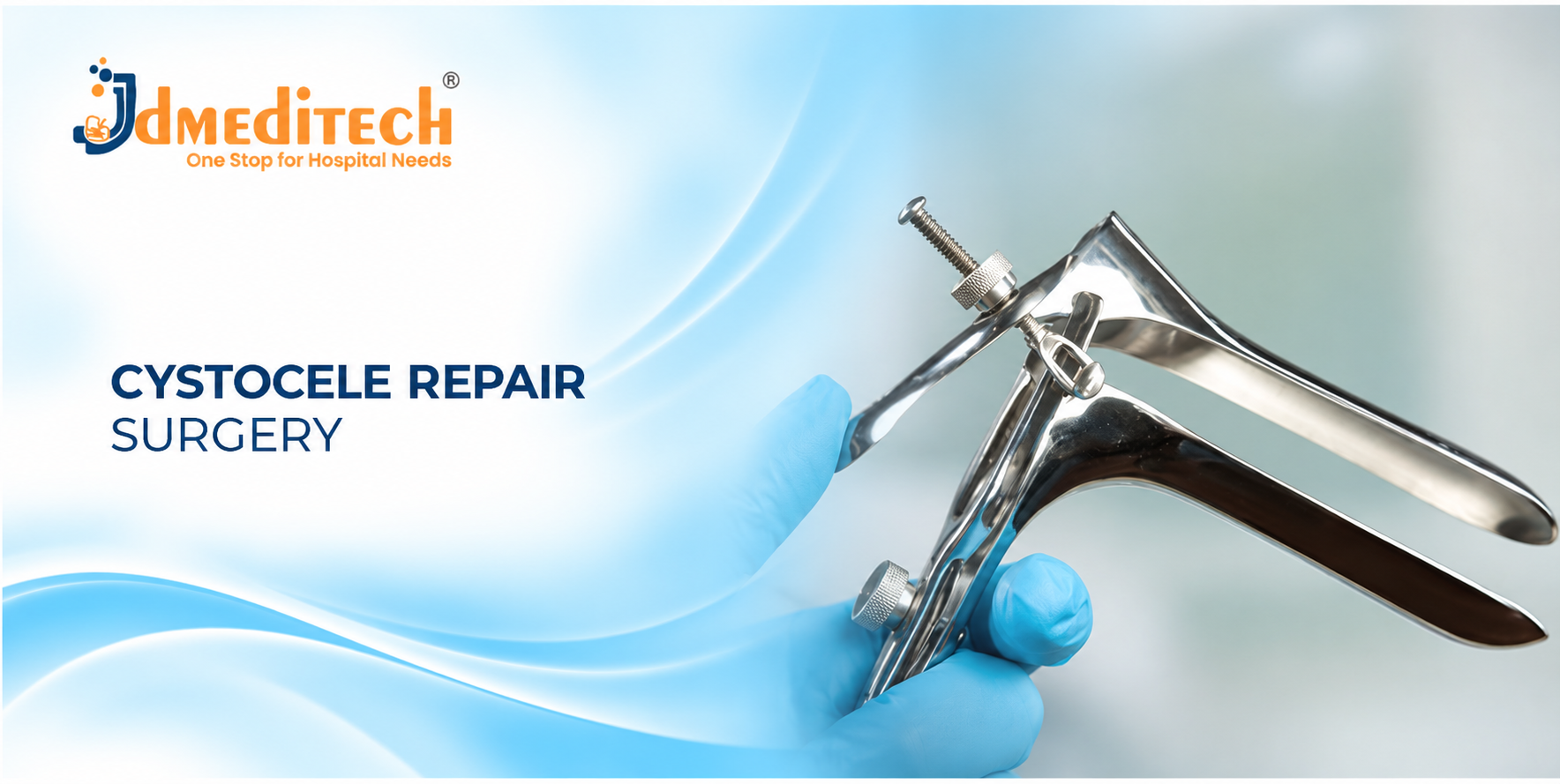
1. Vaginal Speculum
A vaginal speculum supports visualization and access during selected gynecological procedures.
Different designs and dimensions suit different clinical requirements.
2. Sims Vaginal Speculum
A Sims vaginal speculum supports retraction of the vaginal wall.
Therefore, it may help provide appropriate surgical exposure.
3. Vaginal Retractors
Vaginal retractors help maintain exposure of the operative field.
Furthermore, the surgeon selects a suitable shape and size.
4. Allis Tissue Forceps
Allis forceps support secure handling of suitable tissues.
However, their toothed jaws require careful handling.
5. Dissecting Forceps
Dissecting forceps help manipulate selected tissues.
In addition, toothed and non-toothed designs support different applications.
6. Metzenbaum Scissors
Metzenbaum scissors support delicate tissue dissection.
Therefore, surgeons may select suitable designs for soft tissue procedures.
7. Mayo Scissors
Mayo scissors support cutting appropriate tissues and surgical materials.
Furthermore, different configurations provide different handling characteristics.
8. Artery Forceps
Artery forceps help clamp selected vessels and tissues.
Consequently, they may support temporary bleeding control.
9. Mosquito Forceps
Mosquito forceps are small hemostatic instruments used for selected delicate clamping tasks.
However, instrument selection depends on tissue characteristics.
10. Needle Holder
A needle holder supports suturing with compatible surgical needles.
Different sizes and jaw designs suit different operative requirements.
11. Surgical Scalpel
A surgical scalpel supports appropriate tissue incisions.
Therefore, surgeons select compatible blades and handles.
12. Sponge Holding Forceps
Sponge holding forceps support handling of suitable surgical sponges.
Furthermore, they may assist during selected gynecological procedures.
13. Foley Catheter
A Foley catheter may provide bladder drainage during or after selected cystocele repair procedures.
However, catheter duration depends on the surgical plan and postoperative bladder function.
14. Cystoscope
A cystoscope provides visualization of the bladder and urethra.
For example, a surgeon may use cystoscopy when clinically indicated to assess urinary tract integrity.
15. Electrosurgical Instruments
Compatible electrosurgical instruments may support selected tissue management and bleeding control tasks.
However, the team must verify the device’s approved intended use.
16. Suction Instruments
Suction instruments may help remove suitable fluids from the operative field.
Therefore, they can support visibility during selected procedures.
17. Surgical Sutures
Suitable sutures support tissue reinforcement and wound closure.
However, the surgeon must select appropriate materials and configurations.
18. Surgical Drapes
Appropriate sterile surgical drapes support infection prevention practices.
Furthermore, hospitals must verify compatibility with the planned procedure.
19. Irrigation Accessories
Suitable irrigation accessories may support selected surgical requirements.
However, their use depends on the operative technique.
20. Additional Surgical Accessories
Hospitals may require compatible surgical sponges, sterile tubing, dressings, and other accessories.
Consequently, purchasing teams should verify the complete instrument and consumable requirements.
Cystocele Repair Surgical Instruments and Functions
| Instrument | Primary Function |
|---|---|
| Vaginal Speculum | Supports vaginal visualization and access |
| Sims Vaginal Speculum | Supports vaginal wall retraction |
| Vaginal Retractors | Maintain operative exposure |
| Allis Forceps | Support secure tissue handling |
| Dissecting Forceps | Support tissue manipulation |
| Metzenbaum Scissors | Support delicate tissue dissection |
| Mayo Scissors | Support tissue and material cutting |
| Artery Forceps | Support selected vessel clamping |
| Mosquito Forceps | Support delicate clamping tasks |
| Needle Holder | Supports surgical suturing |
| Surgical Scalpel | Supports appropriate incisions |
| Sponge Holding Forceps | Support handling of surgical sponges |
| Foley Catheter | Supports selected bladder drainage requirements |
| Cystoscope | Supports urinary tract visualization |
| Electrosurgical Instruments | Support compatible tissue management |
| Surgical Sutures | Support tissue reinforcement and closure |
Importantly, instrument selection depends on the surgical approach, clinical requirements, and manufacturer instructions.
How Is Cystocele Repair Surgery Performed?
A qualified gynecologist or urogynecologist performs cystocele repair surgery in an appropriately equipped healthcare facility.
First, the specialist reviews the patient’s symptoms, pelvic examination findings, and medical history.
Next, the healthcare team determines the appropriate repair technique.
During surgery, the surgeon reinforces selected supporting tissues to improve anterior vaginal wall support.
When necessary, the team also addresses associated apical prolapse or other pelvic floor disorders.
Afterward, the surgeon completes the planned closure and assesses postoperative bladder function.
Finally, the healthcare team provides recovery instructions and arranges follow-up.
However, surgical techniques vary considerably. This overview does not replace professional surgical training.
Potential Benefits of Cystocele Repair Surgery
1. Improved Bladder Support
Cystocele repair aims to restore support beneath the bladder.
Consequently, the vaginal bulge may become less noticeable.
2. Reduced Pelvic Pressure
Successful repair may reduce the sensation of heaviness or pressure.
However, outcomes depend on the individual patient’s condition.
3. Improved Daily Comfort
Some patients experience greater comfort during routine activities.
For example, reduced bulging may make walking or prolonged standing more comfortable.
4. Improved Quality of Life
Symptomatic prolapse can affect daily activities and emotional well-being.
Therefore, successful treatment may improve patient-reported quality of life.
5. Native Tissue Repair Options
Anterior colporrhaphy generally uses the patient’s own tissues.
Consequently, many patients can undergo repair without permanent synthetic mesh.
6. Combined Pelvic Floor Treatment
Selected patients require treatment of more than one prolapse compartment.
Therefore, surgeons may develop an individualized reconstructive plan.
Anterior Colporrhaphy vs Vaginal Pessary
| Feature | Anterior Colporrhaphy | Vaginal Pessary |
|---|---|---|
| Treatment Type | Surgical | Non-surgical |
| Main Purpose | Repair weakened supporting tissues | Provide mechanical support to prolapsed organs |
| Anesthesia | Usually required | Not routinely required |
| Recovery | Postoperative healing period | Usually minimal recovery after fitting |
| Ongoing Care | Surgical follow-up | Regular pessary maintenance and review |
| Suitability | Selected symptomatic patients | Many patients seeking non-surgical management |
Therefore, treatment selection should reflect symptoms, preferences, and specialist recommendations.
Does Cystocele Repair Surgery Require Mesh?
Traditional anterior colporrhaphy does not require permanent synthetic mesh.
In fact, native tissue repair is an established approach for anterior vaginal wall prolapse.
However, some historical procedures used synthetic mesh placed through the vagina.
These implants have been associated with complications such as mesh exposure, pain, infection, and injury to nearby organs.
In the United States, the FDA ordered manufacturers to stop selling surgical mesh intended for transvaginal pelvic organ prolapse repair in 2019.
Importantly, this restriction is different from the regulatory treatment of mesh used in abdominal sacrocolpopexy or selected stress urinary incontinence sling procedures.
Therefore, hospitals must verify local regulatory requirements and avoid assuming that different mesh procedures are equivalent.
Risks and Complications of Cystocele Repair Surgery
Cystocele repair is an invasive procedure with potential complications.
For example, patients may experience bleeding, infection, wound problems, or postoperative pain.
In addition, surgery may cause temporary difficulty emptying the bladder.
Some patients develop urinary tract infections or new urinary symptoms.
Furthermore, injury to the bladder, urethra, or nearby structures is possible.
Other complications may include painful intercourse, persistent pelvic discomfort, or recurrent prolapse.
Therefore, patients should discuss expected benefits and potential complications with their surgeon.
Can Cystocele Return After Surgery?
Yes. Pelvic organ prolapse can recur after surgical repair.
For example, ongoing pelvic floor weakness may contribute to recurrent symptoms.
Other factors include the severity of the original prolapse, obesity, constipation, and repeated abdominal straining.
However, recurrence risk varies considerably between patients.
Therefore, long-term follow-up and appropriate pelvic floor care remain important.
Recovery After Cystocele Repair Surgery
Recovery depends on the surgical approach, patient health, and any additional procedures.
For example, patients undergoing uncomplicated vaginal anterior repair may return gradually to normal activities over several weeks.
However, complete healing and return to unrestricted activities often take approximately six weeks or longer.
During recovery, patients may experience temporary vaginal discomfort, spotting, or changes in bladder emptying.
Furthermore, surgeons commonly recommend avoiding heavy lifting, straining, and vaginal intercourse during the initial healing period.
Therefore, patients should follow their healthcare team’s individualized recovery instructions.
Patients should seek prompt medical assessment for fever, severe pain, heavy bleeding, inability to pass urine, or other concerning symptoms.
Life After Cystocele Repair Surgery
Long-term outcomes depend on the prolapse severity, surgical technique, and individual patient factors.
For example, some patients experience sustained improvement in vaginal bulging and pelvic pressure.
However, urinary symptoms may persist or develop independently of the prolapse.
Furthermore, some patients require additional pelvic floor treatment or repeat surgery.
Therefore, appropriate follow-up helps clinicians assess recovery and identify recurrent symptoms.
How to Choose Cystocele Repair Surgical Instruments
Hospitals and urogynecology departments should identify their clinical requirements before purchasing cystocele repair instruments.
First, determine whether the planned operation involves native tissue anterior repair or another reconstructive procedure.
Next, review the required vaginal retractors, forceps, scissors, needle holders, and urological accessories.
Moreover, purchasing teams should confirm instrument dimensions, materials, sterilization instructions, and approved intended use.
Important Equipment Selection Factors
- Approved intended use
- Complete instrument-set packing list
- Vaginal speculum type and dimensions
- Sims vaginal speculum specifications
- Vaginal retractor configuration
- Allis forceps design
- Dissecting forceps specifications
- Metzenbaum scissors dimensions
- Mayo scissors configuration
- Artery and mosquito forceps requirements
- Needle holder size
- Surgical scalpel compatibility
- Sponge holding forceps dimensions
- Foley catheter requirements
- Cystoscope compatibility
- Electrosurgical system compatibility
- Suture material specifications
- Reusable or single-use classification
- Cleaning and sterilization instructions
- Manufacturer technical datasheet
- Applicable regulatory documentation
Furthermore, hospitals should verify the exact supplied instruments before placing an order.
Gynecology and Urology Surgical Instruments by JDMeditech
JDMeditech welcomes inquiries from hospitals, gynecology departments, urogynecology specialists, urology departments, surgical centers, and international medical distributors regarding surgical instruments and related medical accessories.
For example, customers can inquire about available vaginal speculums, surgical forceps, scissors, needle holders, cystoscopy instruments, urinary catheters, and compatible accessories.
In addition, the JDMeditech team can confirm available configurations, technical specifications, and applicable documentation for individual inquiries.
For product information and quotations, visit www.jdmeditech.com.
Frequently Asked Questions About Cystocele Repair Surgery
1. What is cystocele repair surgery?
Cystocele repair surgery is a procedure that improves support of the anterior vaginal wall when the bladder has prolapsed toward the vagina.
2. What is anterior colporrhaphy?
Anterior colporrhaphy is a vaginal operation that reinforces weakened supporting tissues using sutures.
3. What causes cystocele?
Common contributing factors include childbirth, aging, pelvic floor weakness, obesity, and repeated abdominal straining.
4. Is cystocele repair surgery always necessary?
No. Patients with mild or asymptomatic prolapse may not need surgery. Conservative treatments are often appropriate.
5. Can a vaginal pessary treat cystocele?
Yes. A properly fitted vaginal pessary can provide mechanical support and reduce symptoms in many patients.
6. Does cystocele repair require surgical mesh?
No. Traditional anterior colporrhaphy generally uses native tissues and sutures without permanent synthetic mesh.
7. What instruments are used during cystocele repair?
Common instrument categories include vaginal speculums, retractors, forceps, scissors, needle holders, and selected urological accessories.
8. What are the risks of cystocele repair surgery?
Potential complications include bleeding, infection, bladder injury, urinary problems, pain, and recurrent prolapse.
9. How long does recovery take?
Many patients gradually return to normal activities over several weeks, although full recovery may take six weeks or longer.
10. Where can hospitals inquire about JDMeditech surgical instruments?
Hospitals and medical distributors can visit JDMeditech to request information about available gynecology and urology instruments.
Conclusion
Cystocele Repair Surgery is an established treatment option for selected patients with symptomatic bladder prolapse.
Moreover, anterior colporrhaphy can restore support using the patient’s own tissues.
However, successful treatment requires appropriate diagnosis, informed patient consent, suitable surgical instruments, and qualified specialist care.
Therefore, hospitals should select equipment according to clinical requirements, professional guidelines, and approved manufacturer instructions.
Contact JDMeditech for gynecology and urology surgical instrument inquiries, compatible medical accessories, and international business requirements.
Medical Disclaimer: This article provides general educational information only. It does not replace professional medical advice, patient-specific treatment planning, or surgical training. Qualified healthcare professionals must make treatment and equipment decisions according to current clinical guidelines, local regulations, and approved manufacturer instructions.




