



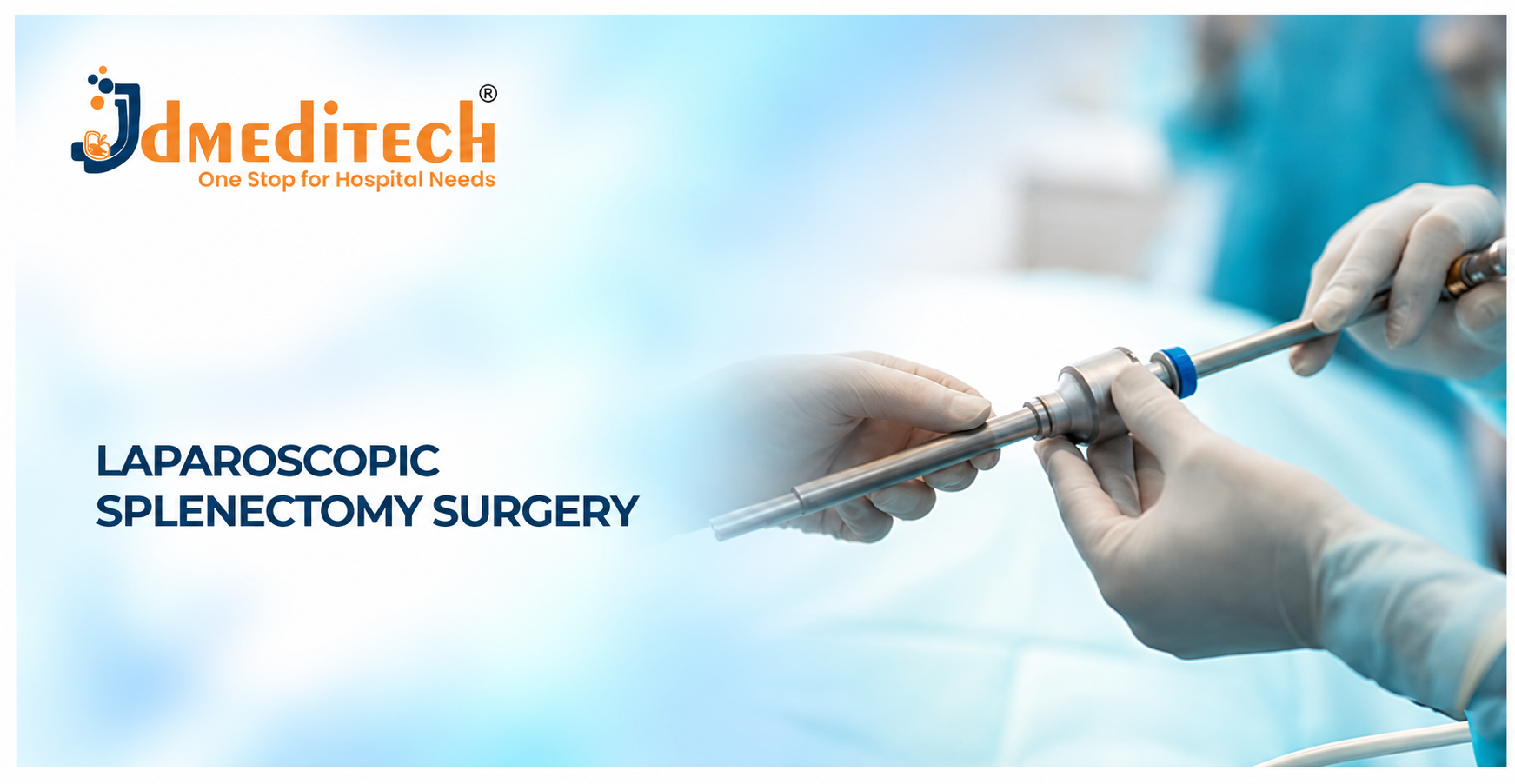
Introduction to Laparoscopic Splenectomy Surgery
Laparoscopic Splenectomy Surgery is a minimally invasive surgical procedure used to remove the spleen through small abdominal incisions. It may be recommended for selected blood disorders, splenic diseases, and other medical conditions when spleen removal is considered necessary.
The spleen is an important organ located in the upper left abdomen, beneath the rib cage. It helps filter blood, remove damaged blood cells, and support immune defense against infections.
During laparoscopic splenectomy, surgeons use a laparoscope, camera system, and specialized instruments to visualize and remove the spleen.
Compared with conventional open surgery, laparoscopic techniques may offer smaller incisions, reduced postoperative discomfort, and faster early recovery in suitable patients.
However, splenectomy permanently affects the body’s immune defenses. Therefore, vaccination planning, infection prevention, and long-term medical follow-up are essential.
In this guide, JDMeditech explains laparoscopic splenectomy surgery, its indications, techniques, instruments, benefits, risks, recovery, and frequently asked questions.
What Is Laparoscopic Splenectomy Surgery?
Laparoscopic splenectomy is an operation in which the spleen is removed using minimally invasive surgical techniques.
Instead of a large abdominal incision, surgeons use several small access openings to introduce a laparoscope and compatible surgical instruments.
The laparoscope provides magnified images of the abdominal cavity, allowing the surgical team to examine the spleen and surrounding structures.
During the operation, the surgical team carefully manages the blood vessels supplying the spleen before removing the organ.
However, the exact approach depends on spleen size, the underlying disease, vascular anatomy, and surgical expertise.
Understanding the Spleen and Its Functions
The spleen is a soft, highly vascular organ located near the stomach, pancreas, and left kidney.
It performs several important functions within the body.
- Filters blood and removes damaged red blood cells
- Helps fight certain bacterial infections
- Supports immune responses
- Participates in platelet and blood cell regulation
- Helps remove some microorganisms from circulation
Although a person can live without a spleen, its removal increases susceptibility to certain serious infections.
Why Is Laparoscopic Splenectomy Performed?
Laparoscopic splenectomy may be recommended when a splenic disorder cannot be adequately managed using less invasive treatment.
For example, selected patients with immune thrombocytopenia may require splenectomy after other therapies have failed or are unsuitable.
Additionally, certain hereditary blood disorders can cause the spleen to destroy blood cells excessively.
Furthermore, selected splenic masses, cysts, or other abnormalities may require surgery.
However, an enlarged spleen alone does not automatically require removal.
Common Conditions That May Require Splenectomy
1. Immune Thrombocytopenia (ITP)
Immune thrombocytopenia is an autoimmune disorder associated with low platelet counts.
In selected patients with persistent disease, splenectomy may be considered after specialist evaluation and discussion of other treatments.
2. Hereditary Spherocytosis
Hereditary spherocytosis is an inherited red blood cell disorder.
In selected patients with significant symptoms or complications, splenectomy may reduce excessive red blood cell destruction.
3. Selected Thalassemia Cases
Some patients with thalassemia develop significant splenic enlargement or hypersplenism.
However, splenectomy is reserved for carefully selected cases because of infection and thrombosis risks.
4. Splenic Cysts
Selected large, symptomatic, or complex splenic cysts may require surgical treatment.
When possible, spleen-preserving procedures may be considered.
5. Selected Splenic Tumors
Some benign or malignant splenic lesions require removal after appropriate specialist evaluation.
6. Hypersplenism
Hypersplenism occurs when an enlarged or overactive spleen contributes to reduced circulating blood cell counts.
However, treatment depends on the underlying cause and clinical severity.
7. Splenic Trauma
Severe splenic injury may require surgery when bleeding cannot be controlled through other approaches.
However, many stable patients with splenic trauma are managed without spleen removal, sometimes using embolization.
8. Selected Hematological Disorders
Splenectomy may be considered for certain blood-related conditions after evaluation by a hematologist and surgeon.
Symptoms Associated With Splenic Disorders
- Discomfort in the upper left abdomen
- Early fullness after meals
- Abdominal swelling
- Fatigue
- Anemia-related symptoms
- Easy bruising or bleeding
- Low blood cell counts
- Recurrent infections in selected conditions
However, these symptoms may have many causes. Therefore, appropriate medical evaluation is necessary.
How Are Splenic Disorders Diagnosed?
Diagnosis begins with a medical history and physical examination.
First, the healthcare professional reviews symptoms, blood disorders, and previous medical treatment.
Next, blood tests may help evaluate hemoglobin, platelets, white blood cells, and other relevant findings.
Additionally, abdominal ultrasound or CT imaging may help assess spleen size and anatomy.
In selected cases, MRI or specialized hematological investigations may be required.
Therefore, diagnosis and treatment planning depend on the underlying condition.
Who May Be Suitable for Laparoscopic Splenectomy?
Laparoscopic splenectomy may be considered for selected patients requiring elective spleen removal.
Suitability depends on:
- The underlying diagnosis
- Spleen size
- Blood cell counts
- Bleeding risk
- Previous abdominal surgery
- Associated liver disease or portal hypertension
- General health and anesthesia suitability
- Availability of experienced surgical care
However, severe bleeding or certain complex conditions may require open surgery.
How Should Patients Prepare for Laparoscopic Splenectomy?
Preparation is especially important because splenectomy affects both surgical bleeding risk and long-term infection risk.
First, the surgical team reviews imaging, blood tests, and the underlying disease.
Next, the anesthesia team evaluates relevant medical conditions and medications.
Additionally, the surgeon and hematologist may plan treatment for anemia, thrombocytopenia, or other blood abnormalities.
Patients should also receive a vaccination assessment before elective splenectomy.
When feasible, indicated vaccines are generally administered before surgery according to local immunization guidance.
Finally, the surgical team discusses the procedure, alternatives, complications, and lifelong infection-prevention requirements before obtaining informed consent.
Vaccination Before Splenectomy
Patients without a functioning spleen have an increased risk of serious infections caused by certain bacteria.
Therefore, vaccination planning is a key part of splenectomy preparation.
Recommended vaccines may include:
- Pneumococcal vaccines
- Meningococcal ACWY vaccines
- Meningococcal B vaccines
- Haemophilus influenzae type b (Hib) vaccine
- Annual influenza vaccination
- Other routine or risk-based vaccines
However, exact vaccine products, schedules, and booster requirements vary by age, previous vaccination history, country, and current public health guidance.
Therefore, the treating clinician must provide an individualized vaccination plan.
How Is Laparoscopic Splenectomy Surgery Performed?
Laparoscopic splenectomy is performed by a qualified surgical team under general anesthesia.
First, the surgeon establishes laparoscopic access through small abdominal incisions.
Next, carbon dioxide insufflation creates a suitable working space, while a laparoscope provides visualization of the spleen and surrounding anatomy.
Subsequently, the surgical team carefully assesses the spleen, its attachments, and nearby structures.
The blood vessels supplying the spleen are managed using an appropriate surgical technique.
Special care is required because the spleen is highly vascular and lies near the pancreas, stomach, and diaphragm.
After the necessary structures are safely managed, the spleen is removed using a suitable specimen extraction approach.
Finally, the surgical team assesses the operative field and closes the incisions.
However, the exact operation varies according to spleen size, vascular anatomy, disease severity, and surgical findings.
Types of Splenectomy Surgery
1. Total Laparoscopic Splenectomy
Total laparoscopic splenectomy involves removing the entire spleen through a minimally invasive approach.
2. Partial Splenectomy
Partial splenectomy removes only part of the spleen while attempting to preserve some splenic function.
It may be considered in selected patients with appropriate anatomy and disease characteristics.
3. Open Splenectomy
Open splenectomy uses a conventional abdominal incision.
It may be required for major trauma, severe bleeding, or selected complex conditions.
4. Hand-Assisted Laparoscopic Splenectomy
Hand-assisted laparoscopy uses a specialized access device that allows the surgeon to assist with selected operative tasks.
It may be considered for some enlarged spleens or technically complex cases.
5. Robot-Assisted Splenectomy
Robot-assisted splenectomy uses a surgeon-controlled robotic platform.
However, robotic surgery is not automatically superior to conventional laparoscopic or open approaches.
What Is Splenomegaly?
Splenomegaly is the medical term for an enlarged spleen.
It may occur in association with liver disease, infections, hematological disorders, or other conditions.
An enlarged spleen can make surgery more complex because of changes in organ size, blood flow, and surrounding anatomy.
However, splenomegaly alone does not necessarily require splenectomy.
Essential Instruments Used in Laparoscopic Splenectomy Surgery
Laparoscopic splenectomy instruments support visualization, tissue handling, dissection, vascular control, hemostasis, and specimen retrieval.
Instrument selection depends on spleen size, patient anatomy, surgical approach, and the surgeon’s requirements.
The following equipment categories are examples rather than a verified JDMeditech splenectomy surgical kit.
1. Laparoscope Telescope
A laparoscope provides visualization of the abdominal cavity and spleen.
2. Laparoscopic Camera System
A compatible camera system transfers images to a surgical monitor.
3. Medical Light Source
A medical light source provides illumination during surgery.
4. Fiber-Optic Light Cable
A compatible light cable transfers illumination to the laparoscope.
5. Laparoscopic Trocar and Cannula
Trocars and cannulas provide access for laparoscopic instruments.
6. Veress Needle
A Veress needle may be used during selected laparoscopic access techniques.
7. Laparoscopic Grasping Forceps
Grasping forceps support controlled tissue handling.
8. Atraumatic Laparoscopic Grasper
An atraumatic grasper supports delicate tissue manipulation.
9. Laparoscopic Maryland Dissector
A Maryland dissector supports fine dissection and anatomical exposure.
10. Laparoscopic Scissors
Laparoscopic scissors support selected tissue cutting tasks.
11. Laparoscopic Electrosurgical Hook
A compatible electrosurgical hook may support selected dissection and coagulation tasks.
12. Laparoscopic Bipolar Forceps
Bipolar forceps may support selected hemostasis tasks.
13. Advanced Vessel Sealing Instrument
A suitable vessel sealing instrument may support management of selected blood vessels within its approved size and intended-use limits.
14. Laparoscopic Vascular Stapler
A compatible vascular stapler may be used for selected vascular control tasks, including splenic hilar management.
15. Laparoscopic Clip Applicator
A compatible clip applicator may support selected vessel ligation tasks when clinically appropriate.
16. Laparoscopic Needle Holder
A needle holder supports intracorporeal suturing when required.
17. Laparoscopic Suction and Irrigation Instrument
A suction and irrigation instrument helps manage fluid and maintain visibility.
18. CO2 Insufflator
A carbon dioxide insufflator supports creation of the laparoscopic working space.
19. Insufflation Tubing
Compatible tubing connects the insufflator to the access system.
20. Laparoscopic Specimen Retrieval Bag
A suitable retrieval bag supports contained removal of splenic tissue.
21. Hand-Assisted Laparoscopic Access Device
A specialized hand-access device may be used in selected hand-assisted procedures.
22. Electrosurgical Generator
An electrosurgical generator supplies energy to compatible instruments.
23. Surgical Monitor
A medical-grade monitor displays laparoscopic images.
24. Surgical Sutures
Suitable sutures support selected closure or operative tasks.
25. Surgical Drain
A surgical drain may be used in selected circumstances. However, routine drain placement is generally not recommended after elective minimally invasive splenectomy.
26. Sterile Surgical Drapes
Sterile drapes support preparation of the operative field.
27. Sterile Surgical Accessories
Compatible gloves, tubing, dressings, and other accessories support the surgical setup.
Laparoscopic Splenectomy Instruments and Their Functions
| Instrument | Primary Function |
|---|---|
| Laparoscope Telescope | Provides abdominal visualization |
| Camera System | Displays operative images |
| Light Source | Illuminates the surgical field |
| Trocar and Cannula | Provide laparoscopic access |
| Veress Needle | Supports selected access techniques |
| Grasping Forceps | Support tissue handling |
| Maryland Dissector | Supports fine dissection |
| Laparoscopic Scissors | Support tissue cutting |
| Electrosurgical Hook | Supports selected dissection tasks |
| Bipolar Forceps | Support selected hemostasis tasks |
| Vessel Sealing Instrument | Supports management of suitable vessels |
| Vascular Stapler | Supports selected vascular control tasks |
| Clip Applicator | Supports selected vessel ligation |
| Needle Holder | Supports suturing |
| Suction and Irrigation Instrument | Helps maintain visibility |
| CO2 Insufflator | Creates the laparoscopic working space |
| Specimen Retrieval Bag | Supports splenic tissue retrieval |
| Hand-Access Device | Supports selected hand-assisted procedures |
| Electrosurgical Generator | Supplies compatible surgical energy |
Why Is Vascular Control Important During Splenectomy?
The spleen receives a substantial blood supply through the splenic artery and associated vessels.
Consequently, bleeding is an important risk during splenectomy.
Therefore, careful anatomical assessment and appropriate vascular control are essential.
Current SAGES guidance conditionally favors mechanical devices for splenic hilar control during elective minimally invasive splenectomy, although the certainty of supporting evidence is very low.
Furthermore, surgical devices must be used according to their approved intended uses and vessel-size limitations.
What Are Accessory Spleens?
Accessory spleens are small areas of additional splenic tissue separate from the main spleen.
They occur naturally in some individuals.
In selected hematological disorders, identifying accessory splenic tissue may be relevant to treatment planning.
Therefore, imaging and intraoperative assessment may be considered according to the underlying diagnosis.
Potential Benefits of Laparoscopic Splenectomy Surgery
1. Smaller Surgical Incisions
Laparoscopic splenectomy generally uses smaller abdominal incisions than conventional open surgery.
2. Reduced Postoperative Discomfort
Selected patients may experience less postoperative discomfort compared with open surgery.
3. Shorter Hospital Stay
Many patients undergoing uncomplicated laparoscopic splenectomy have a shorter hospital stay than patients undergoing open surgery.
4. Faster Early Recovery
Patients may return to routine activities sooner after an uncomplicated minimally invasive procedure.
5. Magnified Surgical Visualization
The laparoscope provides magnified images of the operative anatomy.
6. Treatment of Selected Blood Disorders
Splenectomy may improve blood cell counts or reduce disease-related symptoms in appropriately selected patients.
7. Treatment of Selected Splenic Lesions
Removal may provide definitive treatment for selected splenic abnormalities.
Risks and Complications of Laparoscopic Splenectomy
Although laparoscopic splenectomy is an established procedure, complications can occur.
- Bleeding
- Blood transfusion requirements
- Wound infection
- Injury to nearby organs
- Pancreatic injury or postoperative pancreatic leak
- Blood clots
- Portal or splenic vein thrombosis
- Intra-abdominal infection
- Conversion to open surgery
- Anesthesia-related complications
- Need for additional procedures
- Increased lifelong risk of serious infections
Importantly, overwhelming post-splenectomy infection is uncommon but potentially life-threatening.
Therefore, vaccination, prompt evaluation of fever, and long-term infection prevention are essential.
Laparoscopic vs Open Splenectomy
| Feature | Laparoscopic Splenectomy | Open Splenectomy |
|---|---|---|
| Access | Small abdominal incisions | Larger abdominal incision |
| Visualization | Camera-based magnification | Direct surgical exposure |
| Postoperative Pain | Often lower | May be higher |
| Hospital Stay | Often shorter | Often longer |
| Recovery | Often faster in uncomplicated cases | May take longer |
| Suitability | Selected patients and experienced centers | May be needed for trauma or complex cases |
| Long-Term Infection Risk | Increased after total spleen removal | Increased after total spleen removal |
Recovery After Laparoscopic Splenectomy Surgery
Recovery depends on the patient’s general health, the underlying disease, and surgical complexity.
Initially, patients may experience abdominal discomfort, temporary bloating, fatigue, or shoulder pain associated with laparoscopic gas.
Many patients gradually return to routine activities over several weeks after an uncomplicated operation.
However, recovery may take longer after major splenomegaly, bleeding, or other complications.
Furthermore, long-term care is necessary because the absence of the spleen increases infection risk.
Therefore, patients should follow individualized surgical and hematology instructions.
Postoperative Care After Splenectomy
- Take prescribed medicines as directed
- Follow wound-care instructions
- Gradually resume walking and routine activities
- Follow recommended lifting restrictions
- Attend scheduled follow-up appointments
- Complete the recommended vaccination schedule
- Follow the clinician’s antibiotic prevention plan
- Monitor for fever and signs of infection
- Discuss travel-related infection precautions
- Carry medical information indicating that the spleen has been removed
Living Without a Spleen
Most people can live an active life without a spleen.
However, the spleen helps protect against certain bacterial infections.
Therefore, patients who have undergone total splenectomy have an increased lifelong risk of serious infection.
Vaccination and infection-prevention measures can help reduce this risk.
Additionally, some patients may require preventive antibiotics or an emergency antibiotic plan according to their age, health, and local clinical guidelines.
Furthermore, fever or other signs of infection require urgent medical evaluation.
Long-Term Infection Prevention After Splenectomy
Long-term infection prevention should be discussed with the patient’s treating clinician.
- Maintain recommended vaccinations and boosters
- Follow prescribed preventive antibiotic instructions
- Seek urgent medical care for fever
- Inform healthcare professionals about the absence of a spleen
- Discuss precautions for animal bites
- Discuss travel-related infections, including malaria where relevant
- Keep emergency medical contact information available
- Attend regular medical follow-up
Importantly, patients should not delay emergency assessment of fever while waiting to see whether symptoms improve.
Warning Signs After Laparoscopic Splenectomy
Patients should seek prompt medical assessment if concerning symptoms develop.
- Fever or chills
- Severe or worsening abdominal pain
- Persistent vomiting
- Increasing abdominal swelling
- Heavy bleeding
- Increasing wound redness or discharge
- New leg swelling or pain
- Chest pain or breathing difficulty
- Confusion or sudden severe illness
Because serious infection can progress rapidly after splenectomy, fever requires urgent medical attention.
How to Choose Laparoscopic Splenectomy Instruments
Hospitals and surgical departments should evaluate their procedural requirements before purchasing laparoscopic splenectomy instruments.
First, purchasing teams should identify the intended surgical techniques and patient population.
Next, they should review laparoscope diameter, trocar compatibility, and instrument working lengths.
Furthermore, hospitals should assess graspers, dissectors, scissors, vascular control devices, and compatible specimen retrieval systems.
Additionally, surgical teams should verify camera, light source, electrosurgical generator, and CO2 insufflator compatibility.
Finally, purchasing departments should confirm approved intended uses, cleaning and sterilization instructions, and applicable regulatory documentation.
Important Equipment Selection Factors
- Approved intended use
- Laparoscope diameter and viewing angle
- Trocar and cannula dimensions
- Instrument working length
- Grasper design
- Dissector specifications
- Scissors compatibility
- Vascular stapler specifications
- Vessel sealing device limitations
- Clip applicator compatibility
- Specimen retrieval bag capacity
- Camera system specifications
- Light source compatibility
- CO2 insufflator capabilities
- Reusable or single-use classification
- Cleaning and sterilization instructions
- Manufacturer technical documentation
- Applicable regulatory documentation
Laparoscopic Splenectomy Instruments – JDMeditech
JDMeditech welcomes inquiries from hospitals, general surgery departments, hematology centers, surgical institutions, and international medical distributors regarding laparoscopic surgical instruments and related accessories.
For example, customers can inquire about available laparoscopic grasping forceps, scissors, trocars, needle holders, dissectors, and compatible surgical equipment.
Furthermore, the JDMeditech team can discuss available product configurations, technical specifications, intended uses, and applicable documentation.
Therefore, hospitals and medical distributors can contact JDMeditech to discuss their laparoscopic surgery equipment requirements.
For product information and international business inquiries, visit www.jdmeditech.com.
Frequently Asked Questions About Laparoscopic Splenectomy Surgery
1. What is laparoscopic splenectomy surgery?
It is a minimally invasive procedure used to remove the spleen through small abdominal incisions.
2. What is the function of the spleen?
The spleen helps filter blood, remove damaged blood cells, and support immune defense.
3. Why is splenectomy performed?
It may be performed for selected blood disorders, splenic lesions, or other conditions requiring spleen removal.
4. Is laparoscopic splenectomy minimally invasive?
Yes. It uses small abdominal incisions and specialized laparoscopic instruments.
5. Does splenectomy require general anesthesia?
Yes. Laparoscopic splenectomy is generally performed under general anesthesia.
6. What instruments are used in laparoscopic splenectomy?
Common instruments include laparoscopes, trocars, graspers, dissectors, scissors, vascular control devices, and specimen retrieval accessories.
7. What is a laparoscopic splenectomy set?
It is a collection of compatible instruments and accessories used for selected laparoscopic spleen removal procedures.
8. How long does laparoscopic splenectomy take?
Operation time varies according to spleen size, anatomy, the underlying disease, and surgical complexity.
9. Can a person live without a spleen?
Yes. Most people can live normally without a spleen, but lifelong infection precautions are important.
10. What is splenomegaly?
Splenomegaly is the medical term for an enlarged spleen.
11. Does an enlarged spleen always require surgery?
No. Treatment depends on the cause, symptoms, and associated complications.
12. What is partial splenectomy?
Partial splenectomy removes part of the spleen while attempting to preserve some splenic function.
13. Is laparoscopic splenectomy painful?
Anesthesia prevents pain during surgery. Temporary abdominal discomfort may occur afterward.
14. What is the difference between laparoscopic and open splenectomy?
Laparoscopic surgery uses small incisions, while open splenectomy uses a conventional abdominal incision.
15. What are the risks of laparoscopic splenectomy?
Risks include bleeding, infection, injury to nearby organs, blood clots, and long-term susceptibility to serious infections.
16. Are vaccinations necessary before splenectomy?
Recommended vaccinations are an essential part of care, ideally planned before elective surgery when feasible.
17. How long is recovery after laparoscopic splenectomy?
Many patients recover over several weeks, although recovery varies according to health and surgical complexity.
18. Can splenectomy affect immunity?
Yes. Total splenectomy increases lifelong susceptibility to certain serious infections.
19. What should a patient do if fever develops after splenectomy?
Seek urgent medical evaluation because serious infections can progress rapidly in people without a spleen.
20. Where can hospitals inquire about JDMeditech laparoscopic instruments?
Hospitals and medical distributors can visit JDMeditech to inquire about available laparoscopic instruments and accessories.
Conclusion
Laparoscopic Splenectomy Surgery is an established minimally invasive treatment option for selected splenic and hematological conditions.
Furthermore, laparoscopic techniques may provide smaller incisions, reduced postoperative discomfort, and faster early recovery compared with conventional open surgery.
However, spleen removal has important long-term implications for immune defense.
Therefore, appropriate patient selection, surgical expertise, vaccination, infection prevention, and follow-up are essential.
For laparoscopic splenectomy instrument inquiries and international business requirements, contact JDMeditech – One Stop for Hospital Needs.
Website: www.jdmeditech.com
Medical Disclaimer: This article provides general educational information only. It does not replace professional medical advice, diagnosis, or surgical training. Qualified healthcare professionals must make treatment and equipment decisions according to current clinical guidance, applicable regulations, and approved manufacturer instructions.




