



<article class=”jdmeditech-ureteroscopy-blog”>
<h5>Ureteroscopy Surgery: Procedure, Instruments, Benefits and Recovery</h5>
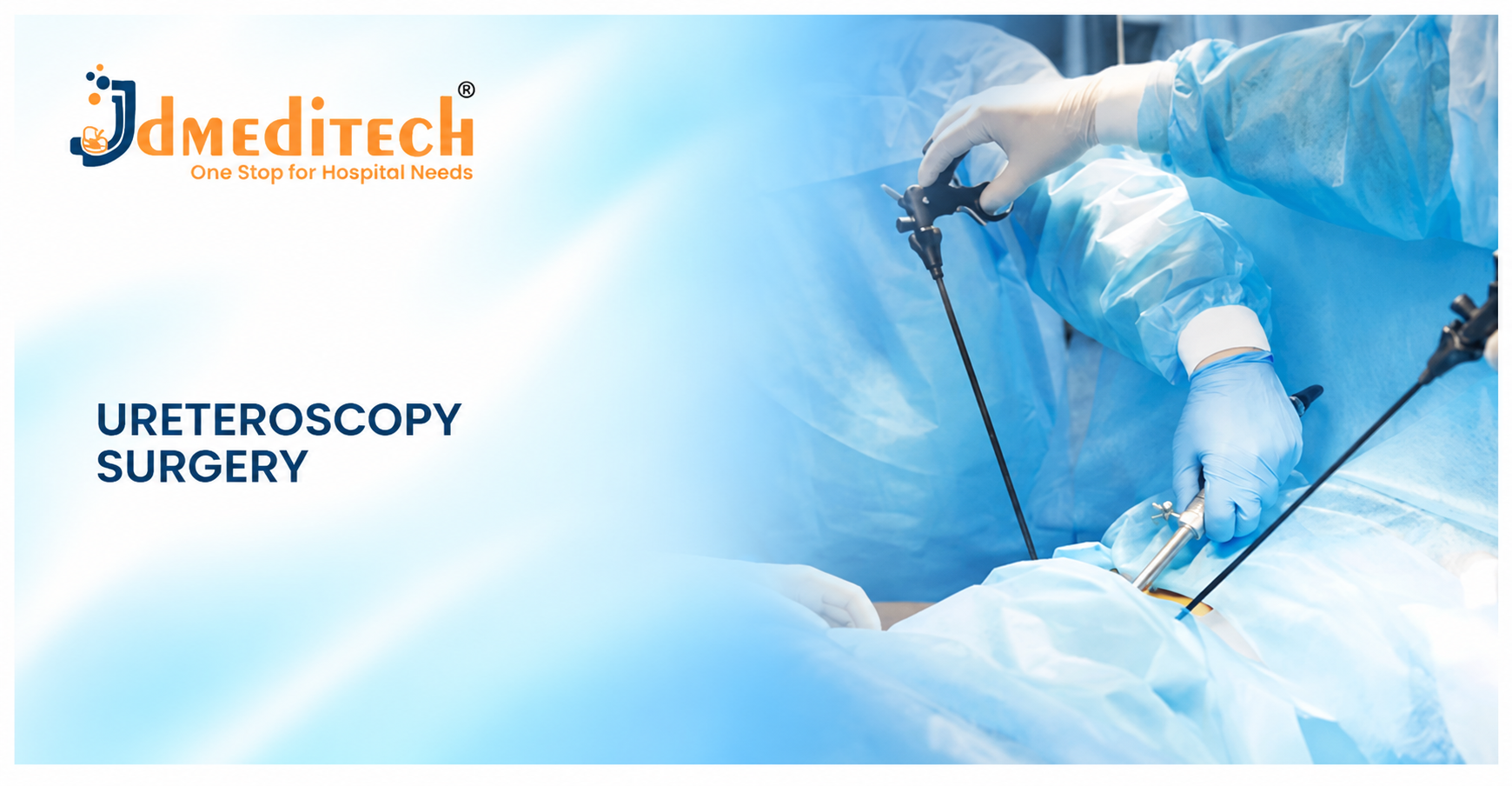
<p><strong>Ureteroscopy Surgery</strong>, commonly called <strong>URS Surgery</strong>, is a minimally invasive endoscopic procedure used to examine and treat selected conditions of the ureter and upper urinary tract. Urologists commonly use this technique to manage ureteral stones.</p>
<p>During ureteroscopy, the surgeon introduces a compatible ureteroscope through the natural urinary passage. Therefore, the procedure usually does not require an external surgical incision.</p>
<p>Furthermore, ureteroscopy allows direct visualization of the ureter. When necessary, the surgeon may use compatible laser fibers, stone retrieval baskets, or other instruments to treat the identified condition.</p>
<p>However, ureteroscopy is not suitable for every patient. Therefore, doctors evaluate stone size, location, infection status, anatomy, and overall health before recommending treatment.</p>
<p><strong>JDMeditech</strong> supplies urology and endourology instruments for hospitals, medical facilities, and international distributors.</p>
<h5>What Is Ureteroscopy Surgery?</h5>
<p>Ureteroscopy is an endoscopic procedure that allows a urologist to inspect the ureter using a specialized instrument called a ureteroscope.</p>
<p>Additionally, flexible ureteroscopes can reach selected areas inside the kidney. Therefore, the procedure may support both diagnostic and therapeutic applications.</p>
<p>However, the selected instrument and treatment technique depend on the patient’s clinical requirements.</p>
<h5>What Is the Full Form of URS?</h5>
<p>URS commonly stands for <strong>Ureteroscopy</strong> or <strong>Ureteroscopic Surgery</strong>.</p>
<p>Furthermore, the term URSL often refers to <strong>Ureteroscopic Lithotripsy</strong>, a procedure used to fragment ureteral stones.</p>
<h5>Why Is Ureteroscopy Surgery Performed?</h5>
<p>Doctors perform ureteroscopy to investigate or treat selected upper urinary tract conditions.</p>
<ul>
<li>Ureteral stones requiring active treatment</li>
<li>Selected kidney stones</li>
<li>Unexplained upper urinary tract findings</li>
<li>Selected ureteral narrowing</li>
<li>Assessment of suspected upper urinary tract lesions</li>
<li>Selected diagnostic biopsy procedures</li>
<li>Removal of certain urinary tract foreign bodies</li>
</ul>
<p>However, treatment selection depends on the underlying condition and clinical findings.</p>
<h5>What Are Ureteral Stones?</h5>
<p>Ureteral stones are urinary calculi located within the ureter, the tube that carries urine from the kidney to the bladder.</p>
<p>Most ureteral stones originate in the kidney and then move into the ureter.</p>
<p>Consequently, stones may obstruct urine flow and cause significant pain.</p>
<h5>Common Causes of Urinary Stones</h5>
<p>Several factors can increase the likelihood of urinary stone formation.</p>
<ul>
<li>Low fluid intake</li>
<li>High urinary concentrations of stone-forming substances</li>
<li>Family history of urinary stones</li>
<li>Selected metabolic disorders</li>
<li>Recurrent urinary infections</li>
<li>Certain medications</li>
<li>Selected anatomical abnormalities</li>
<li>Dietary factors in susceptible individuals</li>
</ul>
<p>However, stone formation often involves multiple factors. Therefore, doctors may recommend metabolic evaluation for recurrent stone disease.</p>
<h5>Common Symptoms of Ureteral Stones</h5>
<p>Ureteral stones may cause severe pain or urinary symptoms. However, some stones produce few symptoms.</p>
<ul>
<li>Severe pain in the side or back</li>
<li>Pain extending toward the groin</li>
<li>Blood in the urine</li>
<li>Nausea or vomiting</li>
<li>Frequent urination</li>
<li>Urgency to urinate</li>
<li>Painful urination</li>
<li>Fever or chills when infection occurs</li>
</ul>
<p><strong>Important:</strong> Fever or chills with suspected urinary obstruction may indicate a medical emergency. Therefore, patients should seek urgent medical care.</p>
<h5>When Is Ureteroscopy Recommended?</h5>
<p>Urologists may recommend ureteroscopy when a ureteral stone requires intervention and endoscopic treatment is appropriate.</p>
<p>For example, persistent obstruction, uncontrolled pain, or failure of spontaneous stone passage may influence the decision.</p>
<p>Furthermore, stone location and size affect treatment selection.</p>
<p>However, some small ureteral stones pass naturally. Therefore, not every patient requires surgery.</p>
<h5>Ureteroscopy for Upper Ureteral Stones</h5>
<p>Ureteroscopy can treat selected stones in the upper ureter.</p>
<p>However, the surgeon chooses a suitable rigid, semi-rigid, or flexible ureteroscope according to anatomy and stone characteristics.</p>
<h5>Ureteroscopy for Middle Ureteral Stones</h5>
<p>Ureteroscopy is commonly used to manage selected middle ureteral stones.</p>
<p>Additionally, compatible lithotripsy instruments can support stone fragmentation when necessary.</p>
<h5>Ureteroscopy for Lower Ureteral Stones</h5>
<p>Ureteroscopy is an established treatment option for distal ureteral stones.</p>
<p>Furthermore, direct endoscopic visualization allows the surgeon to assess the stone and surrounding ureter.</p>
<h5>Ureteroscopy for Kidney Stones</h5>
<p>Flexible ureteroscopy can treat selected kidney stones.</p>
<p>When the procedure focuses on the kidney’s collecting system, clinicians may describe it as Retrograde Intrarenal Surgery, or RIRS.</p>
<p>However, large or complex kidney stones may require another treatment approach.</p>
<h5>Types of Ureteroscopes Used in URS Surgery</h5>
<p>Ureteroscopes differ in design, flexibility, imaging technology, and working channel dimensions.</p>
<h5>1. Rigid Ureteroscope</h5>
<p>A rigid ureteroscope has a relatively fixed shaft and provides endoscopic visualization.</p>
<p>Surgeons may use it for selected lower urinary tract and ureteral applications.</p>
<h5>2. Semi-Rigid Ureteroscope</h5>
<p>A semi-rigid ureteroscope offers limited shaft flexibility compared with a rigid model.</p>
<p>Furthermore, it commonly supports treatment of selected ureteral stones.</p>
<h5>3. Flexible Ureteroscope</h5>
<p>A flexible ureteroscope can navigate selected bends within the upper urinary tract.</p>
<p>Consequently, it supports treatment in different regions of the kidney and ureter.</p>
<h5>4. Digital Ureteroscope</h5>
<p>A digital ureteroscope uses compatible digital imaging technology.</p>
<p>However, image quality and system requirements vary between models.</p>
<h5>5. Single-Use Ureteroscope</h5>
<p>A single-use ureteroscope is intended for one procedure according to its labeling.</p>
<p>Therefore, hospitals must follow the manufacturer’s disposal instructions.</p>
<h5>6. Reusable Ureteroscope</h5>
<p>A reusable ureteroscope supports repeated use when the manufacturer permits reprocessing.</p>
<p>However, hospitals must follow validated cleaning, inspection, and sterilization or high-level disinfection instructions, as applicable.</p>
<h5>Ureteroscopy vs. RIRS Surgery</h5>
<p>Ureteroscopy and RIRS use related endoscopic techniques. However, their treatment targets may differ.</p>
<table border=”1″ cellpadding=”8″ cellspacing=”0″ style=”width:100%;border-collapse:collapse;”>
<thead>
<tr><th>Feature</th><th>Ureteroscopy</th><th>RIRS</th></tr>
</thead>
<tbody>
<tr><td>Main Target</td><td>Commonly the ureter</td><td>Kidney collecting system</td></tr>
<tr><td>Typical Endoscope</td><td>Semi-rigid or flexible ureteroscope</td><td>Flexible ureteroscope</td></tr>
<tr><td>Common Application</td><td>Ureteral stone treatment</td><td>Selected kidney stone treatment</td></tr>
<tr><td>External Incision</td><td>Usually not required</td><td>Usually not required</td></tr>
<tr><td>Lithotripsy</td><td>Compatible laser or other systems</td><td>Commonly laser lithotripsy</td></tr>
</tbody>
</table>
<h5>Ureteroscopy vs. ESWL</h5>
<p>Extracorporeal Shock Wave Lithotripsy, or ESWL, uses externally generated shock waves to fragment selected urinary stones.</p>
<p>In contrast, ureteroscopy uses direct endoscopic visualization and compatible treatment instruments.</p>
<p>Therefore, doctors compare stone characteristics and patient factors before selecting treatment.</p>
<h5>Ureteroscopy vs. PCNL</h5>
<p>Percutaneous Nephrolithotomy, or PCNL, accesses the kidney through a small percutaneous tract.</p>
<p>In contrast, ureteroscopy reaches the urinary tract through the natural urinary passage.</p>
<p>However, PCNL is generally preferred for many large or complex kidney stones.</p>
<h5>Diagnostic Tests Before Ureteroscopy</h5>
<p>Before surgery, the healthcare team evaluates the patient’s condition and urinary anatomy.</p>
<h5>Ultrasound Examination</h5>
<p>Ultrasound may identify hydronephrosis and selected urinary stones.</p>
<h5>CT Scan</h5>
<p>CT imaging provides detailed information about stone size, location, and urinary anatomy.</p>
<p>Furthermore, it helps the surgeon plan treatment.</p>
<h5>Urine Examination and Culture</h5>
<p>Urine testing helps identify infection. Therefore, clinicians assess infection status before elective surgery.</p>
<h5>Blood Tests</h5>
<p>Blood tests may assess kidney function, blood counts, and other relevant factors.</p>
<h5>Anesthesia Assessment</h5>
<p>The anesthesia team evaluates medical fitness and plans appropriate monitoring.</p>
<h5>How Does Ureteroscopy Surgery Work?</h5>
<p>Ureteroscopy uses a specialized endoscope to examine the ureter and selected areas of the upper urinary tract.</p>
<p>During treatment, the surgeon introduces a compatible ureteroscope through the urinary passage.</p>
<p>Next, the endoscope provides visualization of the targeted area.</p>
<p>When necessary, the surgeon uses compatible laser fibers, retrieval baskets, or other instruments to manage the identified condition.</p>
<p>Finally, the surgeon evaluates the operative findings and determines whether temporary urinary drainage is necessary.</p>
<h5>General Steps of Ureteroscopy Surgery</h5>
<p>The following overview explains the broad stages of care. However, it does not provide instructions for performing surgery.</p>
<h5>Step 1: Preoperative Assessment</h5>
<p>First, the urologist reviews imaging, urine tests, kidney function, and medical history.</p>
<h5>Step 2: Patient Preparation</h5>
<p>Next, the healthcare team prepares the patient according to established surgical and anesthesia protocols.</p>
<h5>Step 3: Endoscopic Access</h5>
<p>The surgeon establishes suitable access through the natural urinary passage.</p>
<h5>Step 4: Ureteroscope Examination</h5>
<p>The ureteroscope provides visualization of the targeted urinary structures.</p>
<h5>Step 5: Stone Treatment</h5>
<p>When necessary, compatible lithotripsy instruments fragment the stone.</p>
<h5>Step 6: Stone Fragment Management</h5>
<p>The surgeon manages selected fragments using appropriate endoscopic techniques.</p>
<h5>Step 7: Final Assessment</h5>
<p>Next, the surgical team evaluates the operative findings and checks for additional concerns.</p>
<h5>Step 8: Drainage and Recovery</h5>
<p>Finally, the surgeon determines whether a temporary DJ stent or another drainage device is necessary.</p>
<p><strong>Important:</strong> Only appropriately trained healthcare professionals should perform ureteroscopy.</p>
<h5>Surgical Instruments Used in Ureteroscopy Surgery</h5>
<p>Ureteroscopy requires specialized endourology instruments. However, the exact equipment list depends on the planned procedure.</p>
<ul>
<li><strong>Ureteroscope:</strong> Provides visualization of the ureter.</li>
<li><strong>Cystoscope:</strong> Supports selected lower urinary tract access tasks.</li>
<li><strong>Guide Wire:</strong> Supports selected instrument access and placement tasks.</li>
<li><strong>Ureteral Access Sheath:</strong> May facilitate repeated instrument access in selected cases.</li>
<li><strong>Laser Lithotripsy System:</strong> Supports fragmentation of selected urinary stones.</li>
<li><strong>Laser Fiber:</strong> Delivers energy through a compatible endoscope.</li>
<li><strong>Stone Retrieval Basket:</strong> Supports removal of selected stone fragments.</li>
<li><strong>Stone Grasping Forceps:</strong> May support retrieval in selected procedures.</li>
<li><strong>Ureteral Catheter:</strong> Supports selected access or drainage tasks.</li>
<li><strong>DJ Ureteral Stent:</strong> May provide temporary internal urinary drainage.</li>
<li><strong>Endoscopic Camera System:</strong> Displays images from compatible equipment.</li>
<li><strong>Medical Light Source:</strong> Provides illumination when required.</li>
<li><strong>Irrigation System:</strong> Helps maintain endoscopic visibility.</li>
<li><strong>Imaging Equipment:</strong> Supports selected guidance tasks.</li>
</ul>
<p>Furthermore, all instruments must be compatible with the selected endoscopic system.</p>
<h5>Ureteroscope for URS Surgery</h5>
<p>A ureteroscope is the primary instrument used during ureteroscopy.</p>
<p>Additionally, different models provide different shaft dimensions, imaging systems, and working channels.</p>
<p>Therefore, hospitals should confirm the selected model’s specifications before use.</p>
<h5>Guide Wire for Ureteroscopy</h5>
<p>A guide wire supports selected access and instrument placement tasks.</p>
<p>Furthermore, guide wires vary in diameter, length, tip design, and coating.</p>
<p>Therefore, clinicians must confirm compatibility with the planned procedure.</p>
<h5>Ureteral Access Sheath</h5>
<p>A ureteral access sheath may support repeated passage of compatible instruments during selected procedures.</p>
<p>However, access sheath placement is not necessary or suitable in every case.</p>
<p>Therefore, the surgeon must consider ureteral anatomy and injury risk.</p>
<h5>Laser Lithotripsy System</h5>
<p>Laser lithotripsy systems deliver energy through compatible fibers to fragment urinary stones.</p>
<p>For example, holmium laser systems and thulium fiber laser systems may support selected stone procedures.</p>
<p>However, compatibility and intended use depend on the selected equipment.</p>
<h5>Laser Fiber for Ureteroscopy</h5>
<p>A laser fiber delivers energy from a compatible laser system to the treatment area.</p>
<p>Additionally, fiber diameter and handling requirements vary by model.</p>
<p>Therefore, users must follow manufacturer instructions for use.</p>
<h5>Stone Retrieval Basket</h5>
<p>A stone retrieval basket may help remove selected stone fragments during ureteroscopy.</p>
<p>Furthermore, basket dimensions must match the endoscope’s working channel.</p>
<h5>Stone Grasping Forceps</h5>
<p>Stone grasping forceps may support retrieval of selected fragments.</p>
<p>However, the surgeon must choose a compatible instrument according to the clinical situation.</p>
<h5>Ureteral Catheter</h5>
<p>A ureteral catheter supports selected urinary access, assessment, or drainage tasks.</p>
<p>Furthermore, catheter dimensions vary according to the selected product.</p>
<h5>DJ Ureteral Stent</h5>
<p>A Double J ureteral stent may provide temporary internal urinary drainage after ureteroscopy.</p>
<p>However, not every patient requires a postoperative stent.</p>
<p>Therefore, the surgeon evaluates operative findings before deciding.</p>
<h5>Irrigation System</h5>
<p>An irrigation system helps maintain visibility during ureteroscopy.</p>
<p>However, excessive irrigation pressure can increase complications.</p>
<p>Therefore, the surgical team manages irrigation according to appropriate clinical protocols.</p>
<h5>Technical Specifications of Ureteroscopy Instruments</h5>
<p>Instrument specifications vary between manufacturers and models. Therefore, customers should request verified product datasheets before purchasing.</p>
<table border=”1″ cellpadding=”8″ cellspacing=”0″ style=”width:100%;border-collapse:collapse;”>
<thead>
<tr><th>Parameter</th><th>Specification</th></tr>
</thead>
<tbody>
<tr><td>Procedure Name</td><td>Ureteroscopy Surgery</td></tr>
<tr><td>Short Name</td><td>URS</td></tr>
<tr><td>Medical Specialty</td><td>Urology / Endourology</td></tr>
<tr><td>Primary Application</td><td>Diagnosis and treatment of selected upper urinary tract conditions</td></tr>
<tr><td>Main Endoscope</td><td>Rigid, semi-rigid, or flexible ureteroscope</td></tr>
<tr><td>Ureteroscope Diameter</td><td>According to selected model</td></tr>
<tr><td>Working Channel</td><td>Confirm manufacturer specifications</td></tr>
<tr><td>Guide Wire Diameter</td><td>According to selected device</td></tr>
<tr><td>Guide Wire Length</td><td>Confirm manufacturer specifications</td></tr>
<tr><td>Access Sheath Size</td><td>According to selected model</td></tr>
<tr><td>Laser Technology</td><td>Compatible lithotripsy system</td></tr>
<tr><td>Laser Fiber Diameter</td><td>According to system compatibility</td></tr>
<tr><td>Stone Basket Configuration</td><td>According to working channel compatibility</td></tr>
<tr><td>Ureteral Catheter Size</td><td>According to clinical requirements</td></tr>
<tr><td>DJ Stent Size</td><td>According to patient requirements</td></tr>
<tr><td>Instrument Material</td><td>Confirm manufacturer specifications</td></tr>
<tr><td>Sterility</td><td>According to product labeling</td></tr>
<tr><td>Reusable or Single Use</td><td>According to manufacturer instructions</td></tr>
<tr><td>Cleaning and Reprocessing</td><td>According to validated manufacturer instructions</td></tr>
<tr><td>Supplier</td><td>JDMeditech, subject to product availability</td></tr>
</tbody>
</table>
<h5>Benefits of Ureteroscopy Surgery</h5>
<p>Ureteroscopy offers several potential benefits for appropriately selected patients.</p>
<ul>
<li>Usually avoids an external surgical incision</li>
<li>Provides direct endoscopic visualization</li>
<li>Supports treatment of selected ureteral stones</li>
<li>Allows compatible laser lithotripsy</li>
<li>May support retrieval of selected stone fragments</li>
<li>Often involves a relatively short hospital stay</li>
<li>May support faster recovery than open surgery</li>
<li>Offers an alternative to shock wave treatment in selected cases</li>
</ul>
<p>However, outcomes depend on stone characteristics, anatomy, and surgical expertise.</p>
<h5>Advantages of Endoscopic Stone Treatment</h5>
<p>Endoscopic treatment allows the surgeon to visualize the targeted urinary structures.</p>
<p>Furthermore, compatible instruments support stone fragmentation and retrieval.</p>
<p>However, difficult anatomy or large stone burdens may limit treatment effectiveness.</p>
<h5>Possible Risks and Complications</h5>
<p>Ureteroscopy is a surgical procedure with potential risks. Therefore, patients should discuss complications with their urologist.</p>
<ul>
<li>Urinary tract infection</li>
<li>Fever</li>
<li>Sepsis</li>
<li>Bleeding or blood in the urine</li>
<li>Ureteral injury</li>
<li>Ureteral perforation</li>
<li>Ureteral stricture</li>
<li>Postoperative discomfort</li>
<li>Residual stone fragments</li>
<li>Need for additional treatment</li>
<li>Anesthesia-related complications</li>
</ul>
<p>Furthermore, complication risks depend on infection status, stone complexity, and patient health.</p>
<h5>Who Is a Suitable Candidate?</h5>
<p>Ureteroscopy may suit patients with selected ureteral stones or other upper urinary tract conditions.</p>
<p>However, the urologist must evaluate stone location, anatomy, infection status, and treatment alternatives.</p>
<p>Therefore, suitability requires an individualized clinical assessment.</p>
<h5>Recovery After Ureteroscopy Surgery</h5>
<p>Recovery varies according to the procedure and patient condition.</p>
<p>After surgery, the healthcare team monitors pain, urinary symptoms, bleeding, and signs of infection.</p>
<p>Additionally, follow-up imaging may help assess residual stones when appropriate.</p>
<h5>Postoperative Care After URS</h5>
<p>Appropriate postoperative care supports recovery and helps identify complications.</p>
<ul>
<li>Take prescribed medications as directed.</li>
<li>Maintain fluid intake according to medical advice.</li>
<li>Follow activity restrictions provided by the surgeon.</li>
<li>Attend scheduled follow-up appointments.</li>
<li>Follow DJ stent instructions when applicable.</li>
<li>Report fever or worsening pain.</li>
<li>Seek urgent care for severe symptoms or inability to urinate.</li>
</ul>
<h5>How Long Does Ureteroscopy Take?</h5>
<p>Operating time depends on stone size, location, number, and complexity.</p>
<p>Furthermore, the selected instruments and treatment technique may influence duration.</p>
<p>Therefore, the surgical team provides an individualized estimate.</p>
<h5>How Long Does Recovery Take?</h5>
<p>Many patients resume light activities within several days. However, recovery varies.</p>
<p>Therefore, patients should follow their surgeon’s instructions before returning to strenuous activity.</p>
<h5>Is a DJ Stent Required After Ureteroscopy?</h5>
<p>Not every patient requires a DJ stent after uncomplicated ureteroscopy.</p>
<p>However, surgeons may place a temporary stent when clinically indicated.</p>
<p>Additionally, patients with a stent may experience urinary frequency, discomfort, or blood in the urine.</p>
<h5>Can Ureteral Stones Return After Surgery?</h5>
<p>Yes. Ureteroscopy treats existing stones but does not eliminate every cause of urinary stone formation.</p>
<p>Therefore, doctors may recommend stone analysis, metabolic evaluation, and preventive care.</p>
<h5>How to Prevent Urinary Stone Recurrence</h5>
<p>Prevention depends on stone composition and individual risk factors.</p>
<ul>
<li>Maintain appropriate hydration according to medical advice.</li>
<li>Follow a balanced diet.</li>
<li>Limit excessive sodium intake when recommended.</li>
<li>Follow individualized dietary guidance.</li>
<li>Complete recommended metabolic testing.</li>
<li>Take prescribed preventive medications when indicated.</li>
<li>Attend follow-up appointments.</li>
</ul>
<p>Furthermore, patients should consult their healthcare team before making major dietary changes.</p>
<h5>How to Select Ureteroscopy Instruments</h5>
<p>Hospitals should evaluate several factors before purchasing ureteroscopy equipment.</p>
<ul>
<li>Planned surgical technique</li>
<li>Ureteroscope type and diameter</li>
<li>Working channel dimensions</li>
<li>Image quality and system compatibility</li>
<li>Guide wire compatibility</li>
<li>Ureteral access sheath dimensions</li>
<li>Laser system compatibility</li>
<li>Laser fiber compatibility</li>
<li>Stone basket compatibility</li>
<li>DJ stent specifications</li>
<li>Sterility and reuse requirements</li>
<li>Cleaning and reprocessing instructions</li>
<li>Technical documentation</li>
</ul>
<p>Additionally, hospitals should confirm the complete equipment list with the operating surgeon.</p>
<h5>Why Choose JDMeditech for Ureteroscopy Instruments?</h5>
<p><strong>JDMeditech</strong> supplies urology and endourology instruments for hospitals, healthcare facilities, and medical distributors.</p>
<p>Furthermore, customers can contact JDMeditech to inquire about available ureteroscopy instruments and accessories.</p>
<ul>
<li>Ureteroscope inquiries</li>
<li>URS surgery set inquiries</li>
<li>Guide wire inquiries</li>
<li>Ureteral access sheath inquiries</li>
<li>Laser lithotripsy accessory inquiries</li>
<li>Stone retrieval basket inquiries</li>
<li>Ureteral catheter inquiries</li>
<li>DJ stent inquiries</li>
<li>International export inquiries</li>
<li>Technical specifications upon request</li>
</ul>
<p>However, product availability and compatibility vary. Therefore, customers should confirm specifications before ordering.</p>
<h5>Frequently Asked Questions About Ureteroscopy Surgery</h5>
<h5>1. What Is Ureteroscopy Surgery?</h5>
<p>Ureteroscopy is a minimally invasive procedure that uses a ureteroscope to examine and treat selected upper urinary tract conditions.</p>
<h5>2. What Is the Full Form of URS?</h5>
<p>URS commonly stands for Ureteroscopy or Ureteroscopic Surgery.</p>
<h5>3. Why Is Ureteroscopy Performed?</h5>
<p>Doctors commonly perform it to treat selected ureteral stones and investigate certain urinary tract conditions.</p>
<h5>4. Is Ureteroscopy Major Surgery?</h5>
<p>Ureteroscopy is a surgical procedure that requires appropriate anesthesia and monitoring. However, it is less invasive than open surgery.</p>
<h5>5. Is Ureteroscopy Painful?</h5>
<p>Patients receive anesthesia during surgery. However, postoperative discomfort may occur.</p>
<h5>6. How Long Does Ureteroscopy Take?</h5>
<p>Operating time depends on the condition and selected treatment technique.</p>
<h5>7. How Long Is the Hospital Stay?</h5>
<p>Many patients have a short hospital stay. However, duration depends on recovery and clinical findings.</p>
<h5>8. How Long Does Recovery Take?</h5>
<p>Many patients resume light activities within several days, although recovery varies.</p>
<h5>9. What Is the Difference Between Ureteroscopy and RIRS?</h5>
<p>Ureteroscopy commonly treats ureteral conditions, while RIRS focuses on selected conditions inside the kidney.</p>
<h5>10. What Is the Difference Between Ureteroscopy and ESWL?</h5>
<p>Ureteroscopy uses endoscopic instruments, while ESWL uses externally generated shock waves.</p>
<h5>11. What Instruments Are Used in URS?</h5>
<p>Surgeons may use ureteroscopes, guide wires, laser fibers, retrieval baskets, and other compatible accessories.</p>
<h5>12. What Is a Semi-Rigid Ureteroscope?</h5>
<p>A semi-rigid ureteroscope is an endoscope commonly used for selected ureteral procedures.</p>
<h5>13. Is Laser Lithotripsy Used?</h5>
<p>Yes. Compatible laser systems commonly support ureteral stone fragmentation.</p>
<h5>14. Is a DJ Stent Required?</h5>
<p>Not always. The surgeon determines whether a temporary stent is necessary.</p>
<h5>15. Can Ureteroscopy Treat Kidney Stones?</h5>
<p>Yes. Flexible ureteroscopy can treat selected kidney stones.</p>
<h5>16. Can Urinary Stones Return?</h5>
<p>Yes. Stone recurrence remains possible, so preventive care and follow-up are important.</p>
<h5>17. Is Ureteroscopy Suitable for Children?</h5>
<p>Specialists may use appropriately sized ureteroscopes for selected pediatric patients.</p>
<h5>18. Who Performs Ureteroscopy?</h5>
<p>Appropriately trained urologists perform the procedure.</p>
<h5>19. Does Ureteroscopy Require an External Incision?</h5>
<p>Usually not. The surgeon commonly accesses the ureter through the natural urinary passage.</p>
<h5>20. Where Can I Inquire About Ureteroscopy Instruments?</h5>
<p>Hospitals and medical distributors can contact JDMeditech for information about available endourology equipment.</p>
<h5>Conclusion</h5>
<p><strong>Ureteroscopy Surgery</strong> is a minimally invasive endoscopic procedure used to diagnose and treat selected upper urinary tract conditions.</p>
<p>Furthermore, modern ureteroscopes and compatible lithotripsy instruments support effective treatment of selected urinary stones.</p>
<p>However, successful treatment requires careful patient selection, appropriate equipment, and experienced healthcare professionals.</p>
<p>Therefore, hospitals should verify instrument specifications and compatibility before selecting a ureteroscopy surgical instrument set.</p>
<p><strong>JDMeditech – One Stop for Hospital Needs</strong></p>
<p>Explore our range of urology instruments, endourology equipment, and related medical devices.</p>
<p><strong>Website:</strong>
<a href=”https://www.jdmeditech.com/” target=”_blank” rel=”noopener noreferrer”>www.jdmeditech.com</a>
</p>
<h5>Medical References</h5>
<ul>
<li><a href=”https://uroweb.org/guidelines/urolithiasis” target=”_blank” rel=”noopener noreferrer”>European Association of Urology – Urolithiasis Guidelines</a></li>
<li><a href=”https://www.niddk.nih.gov/health-information/urologic-diseases/kidney-stones” target=”_blank” rel=”noopener noreferrer”>NIDDK – Kidney Stones</a></li>
<li><a href=”https://medlineplus.gov/kidneystones.html” target=”_blank” rel=”noopener noreferrer”>MedlinePlus – Kidney Stones</a></li>
</ul>
<h5>Medical Disclaimer</h5>
<p><em>This article provides general educational and product information only. It does not replace professional medical advice, surgical training, or manufacturer instructions for use. Qualified healthcare professionals must select treatment and medical equipment according to individual clinical requirements.</em></p>
</article>




