



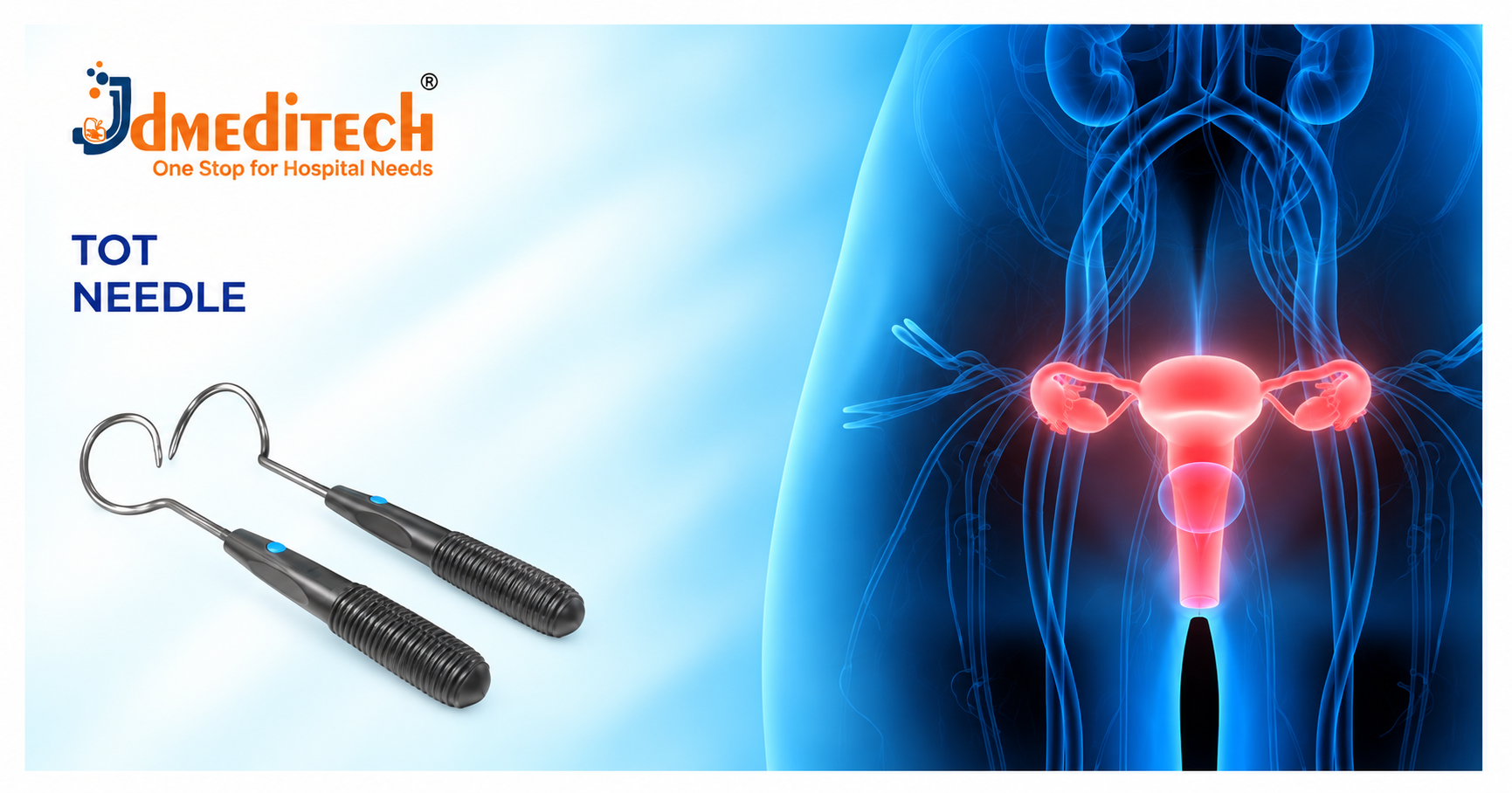
TOT Needle: Complete Guide to Uses, Features, Benefits and Surgical Applications
The TOT Needle, also known as a Transobturator Tape Needle, is a specialized surgical instrument associated with transobturator mid-urethral sling procedures. Surgeons use compatible instruments to guide sling placement during selected operations for female stress urinary incontinence.
For example, a transobturator sling procedure may use specially curved needle passers to establish the intended route for a compatible sling system. However, the exact instruments and technique depend on the selected surgical system.
Furthermore, instrument compatibility and surgeon training are essential. Therefore, healthcare facilities should verify the needle design, intended use and manufacturer instructions before selecting a product.
JDMeditech supplies medical instruments and gynecology products for hospitals, surgical centers and medical distributors. Additionally, customers can inquire about available TOT needle configurations and product specifications.
What Is a TOT Needle?
A TOT needle is a surgical needle passer designed for use with selected transobturator sling systems.
Unlike a conventional injection needle, this instrument has a specialized curved shape and a handle that supports controlled surgical handling.
Consequently, the instrument serves a specific purpose within a compatible operative system rather than functioning as a general-purpose needle.
What Does TOT Stand For?
TOT stands for Transobturator Tape.
The term describes a type of mid-urethral sling procedure that uses a transobturator route.
However, TOT may refer to the procedure, sling system or associated surgical instruments. Therefore, buyers should specify whether they require the needle passer, sling implant or a complete surgical kit.
What Is the Purpose of a TOT Needle?
The primary purpose of a TOT needle is to support the placement of a compatible transobturator sling system during surgery.
For example, surgeons use specialized passers that match the selected implant and operative technique.
Nevertheless, instrument design and passage direction vary between systems. Therefore, surgeons must follow the relevant instructions for use.
What Is Stress Urinary Incontinence?
Stress urinary incontinence involves involuntary urine leakage during activities that increase abdominal pressure.
For example, some patients experience leakage while coughing, sneezing, exercising or lifting objects.
However, several conditions can cause urinary leakage. Consequently, clinicians must establish the correct diagnosis before recommending treatment.
Common Symptoms of Stress Urinary Incontinence
Patients with stress urinary incontinence may experience several symptoms.
- Urine leakage during coughing
- Leakage while sneezing
- Leakage during physical exercise
- Urine leakage when lifting objects
- Leakage during activities that increase abdominal pressure
- Reduced confidence during daily activities
However, symptom severity varies. Therefore, patients should seek professional assessment.
What Is Transobturator Tape Surgery?
Transobturator tape surgery is a type of mid-urethral sling operation used for selected patients with stress urinary incontinence.
During the procedure, a surgeon places a compatible sling beneath the mid-urethra to provide support.
However, permanent synthetic mesh slings carry important risks and are subject to different regulatory requirements across countries. Therefore, patients need informed counseling about benefits, complications and available alternatives.
Role of the TOT Needle in Sling Surgery
The TOT needle supports the passage of a compatible sling system through the intended transobturator route.
Furthermore, its curved profile and handle design help surgeons manipulate the instrument during the procedure.
Nevertheless, the surgeon must use the needle only with an approved compatible system and the appropriate technique.
Types of TOT Needle Instruments
TOT needle instruments vary according to surgical system design.
For example, manufacturers may offer different curvature profiles, handle configurations and needle orientations.
- Curved TOT Needle Passer
- Right-Side TOT Needle Passer
- Left-Side TOT Needle Passer
- Inside-Out System Needle Passer
- Outside-In System Needle Passer
- Other manufacturer-specific configurations
However, these instruments are not automatically interchangeable. Therefore, customers must confirm system compatibility.
Inside-Out Transobturator Systems
Some transobturator sling systems use an inside-out approach.
Accordingly, these systems require instruments designed for their specified passage direction.
However, the surgical team must follow the system-specific operative instructions.
Outside-In Transobturator Systems
Other transobturator sling systems use an outside-in approach.
Consequently, they may require a different needle passer design.
Therefore, hospitals should not substitute instruments without verifying compatibility.
Key Features of TOT Needles
Different TOT needles offer different technical features.
- Specialized curved needle profile
- Ergonomic handle, depending on model
- System-specific needle geometry
- Selected right- and left-side configurations
- Compatible sling attachment interface
- Rigid surgical instrument construction
- Manufacturer-specified reusable or single-use design
Furthermore, buyers should verify the actual features against the product datasheet.
Curved Needle Design
The curved design distinguishes many TOT needle passers from conventional straight surgical instruments.
For example, manufacturers shape the needle according to the intended operative route.
However, curvature and overall dimensions vary. Therefore, instrument selection must follow the selected sling system.
Handle Design
The handle provides a gripping surface for the surgeon.
Additionally, some models include textured or contoured surfaces.
Nevertheless, buyers should confirm the handle material, dimensions and design before purchasing.
Needle Tip and Attachment Interface
The distal portion of a TOT needle passer may include a system-specific tip or attachment mechanism.
For example, selected designs connect with a compatible sling component.
However, connection mechanisms differ. Consequently, the instrument must match the intended implant system.
Materials Used in TOT Needles
Many surgical needle passers use metal construction, while handles may incorporate other materials.
For example, some designs use stainless steel components.
However, the uploaded image does not establish the exact material grade. Therefore, customers should request verified manufacturer specifications.
Components of a TOT Needle Instrument
A typical TOT needle passer may contain several structural elements.
- Curved needle shaft
- Distal tip
- Needle-to-handle connection
- Handgrip
- System-specific attachment feature, where applicable
However, the exact configuration depends on the manufacturer.
What Does a TOT Needle Set Include?
A TOT needle set may contain one or more compatible surgical passers.
For example, some configurations include instruments for different sides or passage directions.
However, a needle set does not necessarily include the sling implant. Therefore, buyers must confirm the complete packing list.
Technical Specifications of TOT Needles
Technical specifications vary by product model. Therefore, hospitals and distributors should request an official datasheet.
| Parameter | Specification |
|---|---|
| Product Name | TOT Needle |
| Full Form | Transobturator Tape Needle |
| Product Category | Urogynecology Surgical Instrument |
| Primary Application | Compatible transobturator sling procedures |
| Instrument Type | Curved Surgical Needle Passer |
| Needle Curvature | According to selected model |
| Overall Length | Confirm manufacturer datasheet |
| Shaft Diameter | Confirm manufacturer datasheet |
| Material | According to selected model |
| Handle Type | Model-dependent |
| Right / Left Configuration | Confirm selected set |
| Sling Compatibility | Manufacturer-specified systems only |
| Reusable / Single Use | According to product labeling |
| Sterility | According to manufacturer labeling |
| Reprocessing Method | Follow validated manufacturer instructions |
| Packaging | According to selected configuration |
Clinical Applications of TOT Needle Instruments
TOT needles have a specific role in selected urogynecology procedures.
- Compatible transobturator sling procedures
- Selected surgical treatment of female stress urinary incontinence
- System-specific mid-urethral sling placement
- Other applications explicitly permitted by the manufacturer
However, surgeons must not assume that every TOT needle suits every sling system.
How Does a TOT Needle Work?
A TOT needle acts as a specialized surgical passer within a compatible sling placement system.
During surgery, the surgeon follows the selected system’s operative technique to position the sling.
Meanwhile, the instrument’s shape supports controlled handling along the intended route.
However, this article does not replace surgical training or system-specific instructions.
General Overview of a TOT Sling Procedure
Before surgery, the clinical team confirms the diagnosis, reviews treatment alternatives and discusses potential risks.
Next, the surgeon selects a suitable sling system and compatible instruments.
During the operation, the surgeon places the sling according to the approved technique.
Afterward, the healthcare team monitors recovery, urinary function and potential complications.
Importance of Instrument Compatibility
Instrument compatibility is essential in transobturator sling surgery.
For example, a needle passer designed for one sling system may not suit another.
Furthermore, differences in attachment mechanisms and curvature can affect intended use.
Therefore, hospitals should verify compatibility before preparing the surgical set.
Benefits of a Purpose-Designed TOT Needle
A purpose-designed TOT needle supports the intended surgical workflow when used with its compatible system.
- Provides a system-specific needle profile
- Supports compatible sling placement techniques
- Offers a dedicated surgical handling design
- May provide side-specific configurations
- Supports standardized instrument selection within a validated system
However, the instrument alone does not determine surgical success or patient outcomes.
Potential Benefits of Transobturator Sling Surgery
Transobturator mid-urethral sling surgery may improve stress urinary incontinence symptoms in appropriately selected patients.
However, outcomes vary, and complications can occur.
Furthermore, clinicians must explain non-surgical and surgical alternatives before obtaining informed consent.
Risks Associated With Transobturator Sling Surgery
Transobturator sling procedures carry potential complications.
- Bleeding
- Infection
- Urinary retention or difficulty voiding
- Bladder or urethral injury
- Groin or thigh pain
- Persistent or recurrent urinary incontinence
- Mesh exposure or erosion when synthetic mesh is used
- Chronic pain
- Need for additional treatment or surgery
Consequently, patients should receive clear information about risks and long-term follow-up.
Important Considerations About Surgical Mesh
Many transobturator sling systems use permanent synthetic mesh.
However, mesh-related complications can be serious and may require additional surgery.
Furthermore, regulatory requirements and clinical recommendations differ across countries.
Therefore, healthcare professionals should follow current local guidance and provide informed counseling.
TOT Needle Versus TVT Needle
TOT and TVT instruments support different mid-urethral sling approaches.
For example, TOT refers to a transobturator route. In contrast, TVT commonly refers to a retropubic tension-free vaginal tape approach.
However, instruments from these systems are not necessarily interchangeable.
| Feature | TOT | TVT |
|---|---|---|
| Common Meaning | Transobturator Tape | Tension-Free Vaginal Tape |
| Typical Route | Transobturator | Retropubic |
| Needle Design | System-specific | System-specific |
| Primary Clinical Context | Selected stress urinary incontinence procedures | Selected stress urinary incontinence procedures |
| Instrument Interchangeability | Not assumed | Not assumed |
TOT Needle Versus Conventional Surgical Needle
A TOT needle has a specialized design for compatible sling procedures.
In contrast, conventional surgical needles serve different tissue-handling or suturing purposes.
Therefore, hospitals should classify TOT needle passers as procedure-specific instruments.
Patient Selection for TOT Surgery
Patient selection requires a complete clinical assessment.
For example, the clinician should evaluate the type of urinary incontinence, previous treatments and relevant medical history.
Furthermore, the patient should understand potential benefits, limitations and alternatives.
Consequently, the final treatment decision should reflect informed shared decision-making.
Non-Surgical Alternatives for Stress Urinary Incontinence
Not every patient requires sling surgery.
For example, clinicians may recommend pelvic floor muscle training or other conservative measures.
- Supervised pelvic floor muscle training
- Selected lifestyle changes
- Bladder and continence assessment
- Appropriate continence support devices
- Other clinician-recommended treatment options
Therefore, patients should discuss available alternatives before considering surgery.
Other Surgical Options for Stress Urinary Incontinence
Different surgical treatments may suit different patients.
For example, clinicians may discuss colposuspension, autologous fascial sling surgery or selected urethral bulking procedures.
However, each option has distinct benefits and risks. Consequently, treatment selection requires individualized counseling.
Safety Precautions for TOT Needle Instruments
Healthcare professionals should follow established surgical safety practices.
- Verify the intended use
- Confirm sling system compatibility
- Inspect instrument condition
- Check product labeling
- Follow approved sterilization or reprocessing instructions
- Use the instrument only with appropriate surgical training
- Follow the system-specific operative technique
- Document relevant device information
Furthermore, the surgical team should follow institutional protocols.
Cleaning and Sterilization of TOT Needles
Cleaning and sterilization requirements depend on the instrument’s labeling.
For example, reusable instruments require validated reprocessing procedures.
However, single-use instruments must not undergo unauthorized reprocessing.
Therefore, healthcare facilities should follow the manufacturer’s instructions.
Inspection Before Surgical Use
Instrument inspection supports safe surgical preparation.
For example, staff should examine the shaft, tip and handle for visible damage.
Additionally, the team should confirm compatibility with the selected surgical system.
Consequently, damaged or unsuitable instruments should not enter the operative field.
Storage and Handling of TOT Needle Instruments
Proper storage helps protect surgical instruments.
For example, hospitals should keep instruments in appropriate protective storage systems.
Furthermore, staff should avoid conditions that may damage the needle profile or tip.
However, the manufacturer may specify additional storage requirements.
Applications in Hospitals and Surgical Centers
TOT needle instruments may be used in appropriately equipped facilities offering selected urogynecology procedures.
- Gynecology Departments
- Urogynecology Departments
- Hospitals
- Specialized Surgical Centers
- Female Pelvic Medicine Services
However, facilities must maintain suitable training, equipment and clinical governance.
How to Select a TOT Needle for Hospital Procurement
Hospitals should review technical requirements before purchasing a TOT needle.
- Intended sling system
- Needle curvature
- Instrument length
- Shaft diameter
- Handle configuration
- Attachment interface
- Right- or left-side requirements
- Material specifications
- Sterility or reprocessing requirements
- Manufacturer documentation
Furthermore, procurement teams should consult the operating surgeon.
Why Choose JDMeditech for TOT Needle Inquiries?
JDMeditech supplies medical instruments and gynecology products for hospitals and medical distributors.
Additionally, customers can contact our team to discuss available TOT needle configurations and product requirements.
- TOT Needle inquiries
- Transobturator Needle Passer inquiries
- Urogynecology Instrument inquiries
- Gynecology Surgical Instrument inquiries
- Product Specification requests
- Instrument Configuration inquiries
- Quotation requests
- International Export inquiries
However, product availability and specifications require confirmation. Therefore, buyers should request a detailed quotation.
Frequently Asked Questions About TOT Needles
1. What Is a TOT Needle?
A TOT needle is a specialized surgical passer associated with compatible transobturator sling procedures. However, its use requires appropriate surgical training.
2. What Is the Full Form of TOT?
TOT stands for Transobturator Tape. The term refers to a specific mid-urethral sling approach.
3. What Is the Main Use of a TOT Needle?
A TOT needle supports placement of a compatible transobturator sling system. Therefore, the instrument must match the intended operative technique.
4. Is a TOT Needle Used in Gynecology?
Yes. TOT needle passers are associated with selected urogynecology procedures. However, their use depends on the clinical indication.
5. What Is Stress Urinary Incontinence?
Stress urinary incontinence involves urine leakage during activities that increase abdominal pressure. For example, coughing or sneezing may trigger leakage.
6. What Is Transobturator Tape Surgery?
Transobturator tape surgery is a mid-urethral sling procedure for selected patients with stress urinary incontinence. However, it carries potential complications.
7. Are TOT Needles Available in Different Designs?
Yes. Different systems may use different needle shapes and handle configurations. Therefore, customers should confirm the required model.
8. Are TOT Needles Available as Right and Left Instruments?
Some systems use side-specific needle passers. However, the exact configuration depends on the manufacturer.
9. What Is the Difference Between TOT and TVT?
TOT generally uses a transobturator route, while conventional retropubic TVT uses a different route. Consequently, the surgical instruments and risk profiles differ.
10. Can TOT and TVT Needles Be Interchanged?
No interchangeability should be assumed. Therefore, surgeons must follow the selected system’s instructions.
11. Does a TOT Needle Include the Sling Implant?
Not necessarily. Some products contain only the surgical instrument. Therefore, customers should verify the packing list.
12. What Material Is Used in TOT Needles?
Many surgical needle passers use metal components. However, customers should confirm the exact material grade from the manufacturer.
13. Are TOT Needles Reusable?
Reusability depends on the product labeling. Therefore, healthcare facilities must follow the approved instructions.
14. Are TOT Needles Supplied Sterile?
Sterility depends on the product configuration. Consequently, buyers should verify the packaging and labeling.
15. What Is the Purpose of the Curved Needle Shape?
The curved shape supports the intended passage route of a compatible system. However, geometry varies between products.
16. What Are the Risks of TOT Sling Surgery?
Potential complications include pain, bleeding, infection, voiding problems and mesh-related complications. Therefore, informed counseling is essential.
17. Can TOT Surgery Cause Groin Pain?
Yes. Groin or thigh pain is a recognized potential complication. Consequently, patients should discuss this risk before surgery.
18. Can TOT Surgery Cause Mesh Complications?
Yes. Synthetic mesh slings can cause exposure, erosion, pain and other complications. Therefore, patients require informed consent and appropriate follow-up.
19. Is TOT Surgery Suitable for Every Patient?
No. Suitability depends on clinical assessment, patient preferences and available treatment options.
20. Are There Alternatives to TOT Surgery?
Yes. Alternatives may include pelvic floor muscle training and other surgical or non-surgical treatments. Therefore, patients should discuss the available options with their clinician.
21. How Should TOT Needles Be Cleaned?
Cleaning depends on the product’s approved reprocessing instructions. Furthermore, staff must distinguish reusable devices from single-use instruments.
22. What Should Hospitals Check Before Purchasing TOT Needles?
Hospitals should verify instrument design, compatibility, dimensions and labeling. Additionally, they should review the manufacturer’s documentation.
23. Can a TOT Needle Be Used Without Surgical Training?
No. TOT needle passers require appropriate professional training. Therefore, only qualified surgical teams should use them.
24. What Is an Inside-Out TOT System?
An inside-out system uses a specific transobturator sling placement approach. However, surgeons must follow its system-specific instructions.
25. What Is an Outside-In TOT System?
An outside-in system uses a different passage direction. Consequently, it may require different instruments.
26. What Is the Difference Between a TOT Needle and a Sling?
The TOT needle is a surgical instrument. In contrast, the sling is the support material placed during the operation.
27. Are TOT Needles Used in Urogynecology Departments?
Yes. Urogynecology teams may use compatible TOT instruments for selected procedures. However, institutional and regulatory requirements apply.
28. Can a TOT Needle Be Purchased Separately?
Some suppliers may offer separate instruments. However, availability depends on the product configuration.
29. What Information Is Required for a TOT Needle Quotation?
Customers should provide the required instrument type, compatible sling system, quantity and destination. Furthermore, they should specify any technical requirements.
30. Where Can I Inquire About TOT Needles?
Hospitals and medical distributors can contact JDMeditech for information about available TOT needle products and technical specifications.
Conclusion
In conclusion, the TOT Needle is a specialized surgical instrument used with compatible transobturator sling systems.
Furthermore, its design supports the intended surgical technique when qualified professionals use it appropriately.
However, sling surgery carries important risks, including potential mesh-related complications. Therefore, clinicians must prioritize patient selection, informed consent, instrument compatibility and applicable regulatory guidance.
JDMeditech – One Stop for Hospital Needs
Website:
www.jdmeditech.com
Medical References
- American Urological Association
- American College of Obstetricians and Gynecologists
- National Institute for Health and Care Excellence
- U.S. FDA – Medical Devices
Medical Disclaimer
This article provides general educational and product information only. It does not replace professional medical advice, surgical training, manufacturer instructions or informed consent. Transobturator sling procedures, particularly those involving permanent synthetic mesh, carry potentially serious complications. Qualified healthcare professionals must assess patients individually and follow current clinical guidance and local regulations.




