



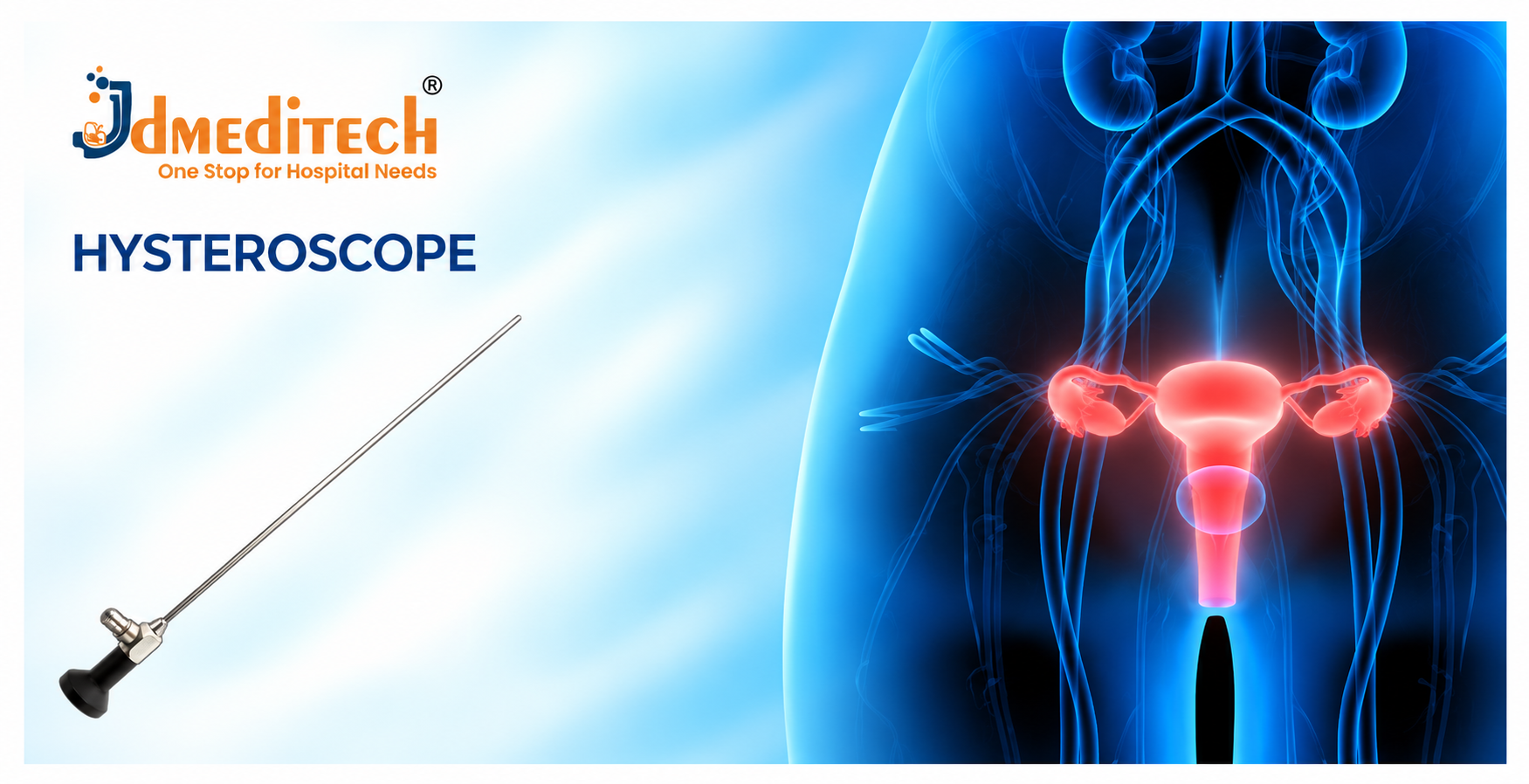
Hysteroscope: Complete Guide to Types, Uses, Features, Components and Benefits
A Hysteroscope is a specialized medical endoscope that helps gynecologists examine the inside of the uterus. During hysteroscopy, the clinician introduces a suitable instrument through the cervix to visualize the uterine cavity.
For example, healthcare professionals may use a hysteroscope to investigate abnormal uterine bleeding, assess selected uterine abnormalities or perform certain minimally invasive procedures.
Furthermore, modern hysteroscopy systems may support diagnostic and operative applications. However, the available functions depend on the instrument and compatible accessories.
JDMeditech supplies medical instruments and gynecology products for hospitals, surgical centers and medical distributors. Additionally, customers can inquire about available hysteroscope models, accessories and technical specifications.
What Is a Hysteroscope?
A hysteroscope is a slender endoscopic instrument designed to provide direct visualization of the uterine cavity.
Typically, the instrument includes an optical or digital visualization system. Additionally, many hysteroscopes work with a light source, camera and fluid management equipment.
However, the exact configuration varies. Therefore, buyers should verify the selected product’s specifications.
What Is Hysteroscopy?
Hysteroscopy is a gynecological procedure that allows a clinician to examine the uterine cavity using a hysteroscope.
For example, the procedure may help evaluate abnormal bleeding or investigate certain uterine conditions.
Furthermore, operative hysteroscopy may allow treatment of selected abnormalities during the same procedure.
Purpose of a Hysteroscope
The primary purpose of a hysteroscope is to provide direct visualization of the uterine cavity.
Additionally, selected hysteroscopy systems support compatible surgical instruments.
Therefore, clinicians may use the equipment for diagnosis, treatment or follow-up examinations.
Importance of Hysteroscopy in Gynecology
Hysteroscopy provides a direct view of the uterine cavity.
Consequently, clinicians can assess certain abnormalities that may require further investigation.
Furthermore, selected conditions can be treated using appropriate operative hysteroscopy equipment.
However, patient selection and procedural planning remain essential.
Types of Hysteroscopes
Hysteroscopes are available in different designs for diagnostic and operative applications.
- Diagnostic Hysteroscope
- Operative Hysteroscope
- Rigid Hysteroscope
- Flexible Hysteroscope
- Continuous-Flow Hysteroscope
- Digital Hysteroscope
- Other manufacturer-specific configurations
However, each instrument has different technical requirements. Therefore, healthcare facilities should select the appropriate model.
1. Diagnostic Hysteroscope
A diagnostic hysteroscope helps clinicians examine the uterine cavity.
For example, gynecologists may use it to investigate abnormal uterine bleeding or selected fertility-related concerns.
Additionally, some diagnostic systems support limited compatible procedures.
2. Operative Hysteroscope
An operative hysteroscope supports selected surgical procedures inside the uterine cavity.
For example, compatible systems may allow the use of instruments for polyp removal or other indicated treatments.
However, the available procedures depend on the instrument’s working channel and accessories.
3. Rigid Hysteroscope
A rigid hysteroscope uses a firm shaft designed for endoscopic visualization.
Furthermore, rigid models may offer different viewing angles and outer diameters.
Therefore, buyers should verify the optical specifications and compatible sheaths.
4. Flexible Hysteroscope
A flexible hysteroscope has a flexible insertion section.
Consequently, clinicians may use selected models for diagnostic examinations.
However, flexibility, imaging capability and working-channel options vary by product.
5. Continuous-Flow Hysteroscope
Some hysteroscopy systems provide continuous fluid inflow and outflow.
For example, a compatible sheath may support uterine cavity distension and fluid circulation.
However, clinicians must monitor fluid balance and follow established safety protocols.
6. Digital Hysteroscope
Digital hysteroscopes incorporate electronic imaging technology.
Additionally, selected models may connect with compatible video processing systems.
However, image resolution and system requirements vary by manufacturer.
Key Features of a Hysteroscope
Hysteroscope features depend on the selected instrument model.
- Slender insertion shaft
- Optical or digital imaging system
- Compatible illumination system
- Different viewing-angle options
- Selected irrigation or fluid channels
- Optional working channel
- Compatible outer sheath
- Different shaft diameter options
- Manufacturer-specified reprocessing requirements
Furthermore, customers should confirm the actual product configuration before purchasing.
High-Quality Visualization
A hysteroscope helps clinicians visualize the uterine cavity.
For example, suitable optics and illumination can support examination of the endometrial surface.
However, image quality depends on the instrument, camera system, lighting and operating conditions.
Slender Instrument Design
Many hysteroscopes use a slender shaft.
Consequently, clinicians can select an appropriate instrument for the planned procedure.
However, shaft diameter varies by model and must suit the clinical application.
Viewing Angle Options
Rigid hysteroscopes may offer different viewing angles.
For example, manufacturers may provide forward-viewing or angled-viewing optics.
Therefore, buyers should verify the exact viewing angle in the product datasheet.
Light Transmission System
Many hysteroscopes require a compatible light source.
Additionally, selected rigid models use a fiber-optic light transmission system.
However, the illumination method depends on the device design.
Working Channel
Some hysteroscopy systems include a working channel.
For example, compatible channels may support selected biopsy or operative instruments.
However, channel dimensions and accessory compatibility vary.
Irrigation and Distension System
Hysteroscopy often requires controlled uterine cavity distension.
For example, clinicians commonly use appropriate fluid management equipment.
Furthermore, the team must monitor fluid use and patient safety throughout the procedure.
Components of a Hysteroscope System
A complete hysteroscopy system may include several instruments and accessories.
- Hysteroscope Telescope
- Compatible Outer Sheath
- Camera Head
- Camera Control Unit
- Light Source
- Fiber-Optic Light Cable
- Fluid Management Equipment
- Video Monitor
- Compatible Working Instruments
- Other model-specific accessories
However, the hysteroscope itself does not necessarily include all these components. Therefore, buyers should confirm the packing list.
Hysteroscope Telescope
The telescope provides visualization of the uterine cavity.
For example, a rigid telescope may contain an optical system within a metal shaft.
However, dimensions and viewing angles vary.
Outer Sheath
The outer sheath supports the selected hysteroscopy configuration.
Additionally, some sheaths include fluid inflow and outflow channels.
Therefore, the sheath must match the intended telescope and procedure.
Camera System
A compatible camera system can display hysteroscopic images on a monitor.
Furthermore, selected systems may support image or video documentation.
However, camera compatibility depends on the instrument design.
Light Source
A light source illuminates the examination area.
For example, some systems use an external LED or other compatible endoscopy light source.
However, buyers must verify the required light cable and connection type.
Fluid Management Equipment
Fluid management equipment helps maintain appropriate uterine cavity distension.
Additionally, selected systems monitor fluid delivery and collection.
However, clinicians must follow fluid safety limits and institutional protocols.
Operative Instruments
Operative hysteroscopy may require additional instruments.
- Hysteroscopic Biopsy Forceps
- Hysteroscopic Scissors
- Hysteroscopic Graspers
- Compatible Polyp Removal Instruments
- Other approved operative accessories
However, each accessory must match the selected hysteroscopy system.
Technical Specifications of a Hysteroscope
Hysteroscope specifications vary by manufacturer and product model. Therefore, customers should request a verified technical datasheet.
| Parameter | Specification |
|---|---|
| Product Name | Hysteroscope |
| Product Category | Gynecology Endoscopy Instrument |
| Primary Application | Diagnostic and selected operative hysteroscopy |
| Instrument Type | Rigid or Flexible, according to model |
| Optical System | According to selected model |
| Viewing Angle | Confirm manufacturer datasheet |
| Outer Diameter | Confirm manufacturer specifications |
| Working Length | Confirm manufacturer specifications |
| Working Channel | Model-dependent |
| Sheath Compatibility | Manufacturer-specified |
| Camera Compatibility | According to selected model |
| Light Source Compatibility | According to selected model |
| Material | Confirm product datasheet |
| Reusable / Single Use | According to product labeling |
| Sterility | According to manufacturer labeling |
| Reprocessing Requirements | Follow manufacturer instructions |
| Packaging | According to selected configuration |
Clinical Applications of a Hysteroscope
Hysteroscopes support several diagnostic and operative gynecological applications.
- Abnormal Uterine Bleeding Assessment
- Endometrial Polyp Evaluation
- Selected Uterine Fibroid Assessment
- Uterine Cavity Examination
- Selected Infertility Investigations
- Assessment of Intrauterine Adhesions
- Selected Endometrial Sampling Procedures
- Compatible Operative Hysteroscopy Procedures
However, clinicians must select the appropriate procedure for each patient.
Hysteroscope for Abnormal Uterine Bleeding
Abnormal uterine bleeding can have several causes.
For example, endometrial polyps or other uterine conditions may contribute to symptoms.
Therefore, clinicians may recommend hysteroscopy when direct visualization is appropriate.
Hysteroscope for Endometrial Polyps
Endometrial polyps are growths that develop from the uterine lining.
For example, some patients experience abnormal bleeding.
Furthermore, operative hysteroscopy may allow removal of selected polyps using compatible instruments.
Hysteroscope for Uterine Fibroids
Some uterine fibroids extend into the uterine cavity.
Consequently, clinicians may use hysteroscopy to assess selected submucosal fibroids.
However, treatment suitability depends on fibroid size, location and patient needs.
Hysteroscope for Infertility Evaluation
Selected infertility investigations may include uterine cavity assessment.
For example, clinicians may investigate suspected polyps, adhesions or other structural abnormalities.
However, hysteroscopy is not necessary for every infertility evaluation.
Hysteroscope for Intrauterine Adhesions
Intrauterine adhesions involve scar tissue within the uterine cavity.
For example, some patients experience menstrual changes or fertility-related concerns.
Therefore, clinicians may use hysteroscopy for diagnosis and selected treatment.
Hysteroscope for Endometrial Assessment
Hysteroscopy allows direct examination of the uterine lining.
Additionally, clinicians may collect tissue samples when clinically indicated.
However, visual findings alone do not replace necessary laboratory examination.
Diagnostic Hysteroscopy Procedure Overview
Before hysteroscopy, the clinician reviews the patient’s symptoms and medical history.
Next, the healthcare team explains the procedure and discusses pain management options.
During the examination, the hysteroscope provides visualization of the uterine cavity.
Afterward, the clinician explains relevant findings and follow-up recommendations.
Operative Hysteroscopy Procedure Overview
Operative hysteroscopy allows selected treatments within the uterine cavity.
For example, the surgeon may remove an indicated polyp using compatible equipment.
However, the procedure requires appropriate training, patient selection and safety monitoring.
Office Hysteroscopy
Some diagnostic hysteroscopy procedures take place in outpatient or office settings.
For example, suitable small-diameter instruments may support selected office examinations.
However, pain management and patient preferences should guide procedural planning.
Operating Room Hysteroscopy
Some hysteroscopy procedures require an operating room.
For example, selected operative procedures may need additional instruments or anesthesia.
Therefore, the healthcare team should choose an appropriate clinical setting.
Benefits of Hysteroscopy
Hysteroscopy offers several potential benefits in selected gynecological applications.
- Direct visualization of the uterine cavity
- Assessment of selected endometrial abnormalities
- Targeted tissue sampling when indicated
- Selected minimally invasive treatment options
- Compatibility with diagnostic and operative systems
- Potential outpatient use in suitable cases
However, the benefits depend on the patient’s condition and planned procedure.
Advantages of Diagnostic Hysteroscopy
Diagnostic hysteroscopy allows clinicians to inspect the uterine cavity directly.
Consequently, it may help identify selected structural abnormalities.
Furthermore, clinicians can recommend additional tests when necessary.
Advantages of Operative Hysteroscopy
Operative hysteroscopy can treat selected conditions through a transcervical approach.
For example, surgeons may remove appropriate endometrial polyps without an abdominal incision.
However, not every uterine condition can be treated hysteroscopically.
Hysteroscopy Versus Laparoscopy
Hysteroscopy and laparoscopy examine different anatomical areas.
For example, hysteroscopy provides visualization inside the uterine cavity.
In contrast, laparoscopy allows examination of abdominal and pelvic structures through small abdominal incisions.
| Feature | Hysteroscopy | Laparoscopy |
|---|---|---|
| Primary Area | Uterine cavity | Abdominal and pelvic cavity |
| Typical Access | Through cervix | Through abdominal incisions |
| Instrument | Hysteroscope | Laparoscope |
| Common Applications | Selected uterine cavity conditions | Selected abdominal and pelvic conditions |
| Operative Capability | Depends on system | Depends on system |
Hysteroscopy Versus Ultrasound
Ultrasound and hysteroscopy provide different forms of clinical information.
For example, ultrasound uses sound waves to create images of internal structures.
Meanwhile, hysteroscopy provides direct visual examination of the uterine cavity.
Therefore, clinicians may use these methods separately or together.
Hysteroscopy Versus Dilation and Curettage
Hysteroscopy allows direct visualization of the uterine cavity.
In contrast, dilation and curettage involves cervical dilation and removal of tissue from the uterine lining.
However, the procedures may be combined when clinically appropriate.
Patient Preparation for Hysteroscopy
Preparation depends on the planned procedure and patient needs.
For example, clinicians may review medications, pregnancy status and relevant medical conditions.
Additionally, the healthcare team should discuss pain management and informed consent.
Patient Comfort During Hysteroscopy
Patient comfort is an important part of hysteroscopy care.
For example, clinicians should explain the procedure and discuss available pain management options.
Furthermore, patients should have an opportunity to ask questions and express preferences.
Potential Risks of Hysteroscopy
Hysteroscopy carries potential risks, although many procedures occur without serious complications.
- Temporary discomfort or cramping
- Vaginal bleeding
- Infection
- Uterine perforation
- Cervical injury
- Fluid overload or electrolyte disturbances
- Complications related to anesthesia when used
Therefore, clinicians should explain relevant risks before the procedure.
Importance of Fluid Management
Fluid management is essential during many hysteroscopy procedures.
For example, the surgical team may use an appropriate distension medium to visualize the uterine cavity.
However, excessive fluid absorption can cause serious complications.
Consequently, trained staff must monitor fluid balance and follow established safety limits.
Safety Precautions for Hysteroscope Use
Healthcare professionals should follow established endoscopy safety practices.
- Verify the instrument’s intended use
- Inspect the hysteroscope before use
- Confirm accessory compatibility
- Follow infection prevention protocols
- Use appropriate fluid management equipment
- Monitor patient safety
- Follow manufacturer instructions
- Use validated reprocessing procedures
- Maintain appropriate surgical training
Furthermore, facilities should follow institutional clinical protocols.
Cleaning and Sterilization of Hysteroscopes
Reusable hysteroscopes require appropriate reprocessing according to manufacturer instructions.
For example, facilities must use validated cleaning and sterilization or high-level disinfection methods as specified for the device and its intended use.
However, different models have different reprocessing requirements.
Therefore, staff should never assume that one method suits every hysteroscope.
Inspection Before Use
Instrument inspection helps identify visible damage or compatibility concerns.
For example, staff should examine the shaft, optical surfaces and connections.
Additionally, the team should confirm the compatibility of required accessories.
Storage and Handling of Hysteroscopes
Proper storage helps protect delicate endoscopic equipment.
For example, facilities should use appropriate protective storage systems.
Furthermore, staff should avoid excessive bending, impact or other damaging conditions.
How to Select a Hysteroscope
Hospitals should review technical and clinical requirements before purchasing a hysteroscope.
- Diagnostic or operative application
- Rigid or flexible design
- Outer diameter
- Working length
- Viewing angle
- Optical or digital imaging system
- Sheath compatibility
- Working channel requirements
- Camera compatibility
- Light source compatibility
- Fluid management requirements
- Reprocessing instructions
- Manufacturer documentation
Furthermore, procurement teams should consult the gynecology department.
Hysteroscopes for Hospitals
Hospitals use hysteroscopes for selected diagnostic and operative gynecological procedures.
For example, gynecology departments may require different instrument configurations.
Therefore, equipment selection should reflect clinical needs and existing system compatibility.
Hysteroscopes for Gynecology Clinics
Gynecology clinics may use suitable hysteroscopes for selected outpatient procedures.
Additionally, smaller-diameter instruments may suit certain office hysteroscopy programs.
However, patient comfort and clinical requirements remain important.
Hysteroscopes for Medical Distributors
Medical distributors should confirm the product’s technical specifications and compatibility.
For example, customers may require specific viewing angles or working-channel configurations.
Furthermore, distributors should verify applicable regulatory documentation.
Why Choose JDMeditech for Hysteroscope Inquiries?
JDMeditech supplies medical instruments and gynecology products for hospitals, clinics and medical distributors.
Additionally, customers can contact our team to discuss available hysteroscope models and technical requirements.
- Hysteroscope inquiries
- Diagnostic Hysteroscope inquiries
- Operative Hysteroscope inquiries
- Rigid Hysteroscope inquiries
- Gynecology Endoscopy Instrument inquiries
- Hysteroscopy Accessory inquiries
- Product Specification requests
- Quotation requests
- International Export inquiries
However, product availability and specifications require confirmation. Therefore, buyers should request a detailed quotation.
Frequently Asked Questions About Hysteroscopes
1. What Is a Hysteroscope?
A hysteroscope is an endoscopic instrument used to examine the uterine cavity. Additionally, selected systems support operative procedures.
2. What Is Hysteroscopy?
Hysteroscopy is a procedure that allows direct visualization of the uterine cavity. Therefore, clinicians may use it for selected diagnostic and treatment purposes.
3. What Is the Main Use of a Hysteroscope?
The main use is to examine the inside of the uterus. Furthermore, operative systems may support selected treatments.
4. What Is a Diagnostic Hysteroscope?
A diagnostic hysteroscope helps clinicians inspect the uterine cavity. For example, it may support investigation of abnormal uterine bleeding.
5. What Is an Operative Hysteroscope?
An operative hysteroscope supports selected surgical procedures inside the uterus. However, accessory compatibility varies.
6. What Is a Rigid Hysteroscope?
A rigid hysteroscope has a firm insertion shaft. Additionally, manufacturers may offer different viewing angles.
7. What Is a Flexible Hysteroscope?
A flexible hysteroscope has a flexible insertion section. However, specifications vary by manufacturer.
8. Are Hysteroscopes Available in Different Sizes?
Yes. Manufacturers offer different diameters and working lengths. Therefore, buyers should confirm the exact dimensions.
9. What Is the Difference Between Diagnostic and Operative Hysteroscopy?
Diagnostic hysteroscopy focuses on examination. In contrast, operative hysteroscopy supports selected treatments.
10. Can a Hysteroscope Be Used for Endometrial Polyps?
Yes. Hysteroscopy may help diagnose and remove selected endometrial polyps. However, treatment suitability depends on clinical assessment.
11. Can a Hysteroscope Be Used for Fibroids?
Yes. Clinicians may use hysteroscopy for selected submucosal fibroids. However, not every fibroid is suitable for hysteroscopic treatment.
12. Is Hysteroscopy Used for Infertility Evaluation?
Sometimes. Clinicians may recommend hysteroscopy when they suspect selected uterine cavity abnormalities.
13. Does Hysteroscopy Require an Abdominal Incision?
Typically, no. Hysteroscopy uses a transcervical approach. However, additional procedures may require different access methods.
14. Can Hysteroscopy Be Performed in an Outpatient Clinic?
Yes. Selected diagnostic procedures may take place in outpatient settings. However, suitability depends on the patient and planned procedure.
15. Does Hysteroscopy Require Anesthesia?
Not always. Pain management options vary according to the procedure and patient needs. Therefore, clinicians should discuss available choices.
16. Is Hysteroscopy Painful?
Some patients experience discomfort or cramping. Consequently, clinicians should discuss pain management and patient preferences.
17. What Is the Purpose of the Hysteroscope Sheath?
A compatible sheath supports the selected instrument configuration. Additionally, some models provide fluid channels.
18. What Is the Purpose of a Hysteroscope Light Source?
The light source illuminates the uterine cavity. Therefore, it supports endoscopic visualization.
19. Can a Hysteroscope Connect to a Camera?
Many models connect with compatible camera systems. However, buyers should verify the required connection type.
20. What Is a Continuous-Flow Hysteroscope?
A continuous-flow hysteroscope system supports controlled fluid inflow and outflow. However, fluid safety monitoring remains essential.
21. What Are the Risks of Hysteroscopy?
Potential risks include bleeding, infection, uterine injury and fluid-related complications. Therefore, appropriate clinical precautions are important.
22. Can Hysteroscopy Detect Uterine Adhesions?
Yes. Hysteroscopy can help identify intrauterine adhesions. Additionally, selected operative systems may support treatment.
23. What Is the Difference Between Hysteroscopy and Laparoscopy?
Hysteroscopy examines the uterine cavity. In contrast, laparoscopy examines abdominal and pelvic structures.
24. What Is the Difference Between Hysteroscopy and Ultrasound?
Ultrasound creates images using sound waves. Meanwhile, hysteroscopy provides direct visual examination.
25. Are Hysteroscopes Reusable?
Many hysteroscopes are reusable. However, some systems may be single use. Therefore, customers should verify product labeling.
26. How Are Hysteroscopes Reprocessed?
Reprocessing depends on the manufacturer’s validated instructions. Consequently, facilities must follow the approved method for each device.
27. What Accessories Are Required for a Hysteroscope?
Requirements may include a sheath, camera, light source and fluid management equipment. However, the exact configuration varies.
28. What Should Hospitals Check Before Purchasing a Hysteroscope?
Hospitals should verify dimensions, imaging specifications, compatibility and reprocessing requirements. Furthermore, they should review technical documentation.
29. What Information Is Required for a Hysteroscope Quotation?
Customers should provide the required instrument type, dimensions, viewing angle, accessories, quantity and delivery destination.
30. Where Can I Inquire About Hysteroscopes?
Hospitals, gynecology clinics and medical distributors can contact JDMeditech for available hysteroscope product information and quotation inquiries.
Conclusion
In conclusion, the Hysteroscope is an important instrument for diagnostic and operative gynecology.
Furthermore, it supports direct visualization of the uterine cavity and selected minimally invasive treatments.
Meanwhile, appropriate instrument selection, fluid management and patient safety practices remain essential.
Therefore, healthcare facilities should review product specifications and clinical requirements before purchasing hysteroscopy equipment.
JDMeditech – One Stop for Hospital Needs
Website:
www.jdmeditech.com
Medical References
- American College of Obstetricians and Gynecologists
- National Health Service
- Royal College of Obstetricians and Gynaecologists
- U.S. FDA – Medical Devices
Medical Disclaimer
This article provides general educational and product information only. It does not replace professional medical advice, clinical training, surgical protocols or manufacturer instructions. Qualified healthcare professionals must select and use hysteroscopy equipment according to patient needs, applicable safety requirements and clinical guidance.




