



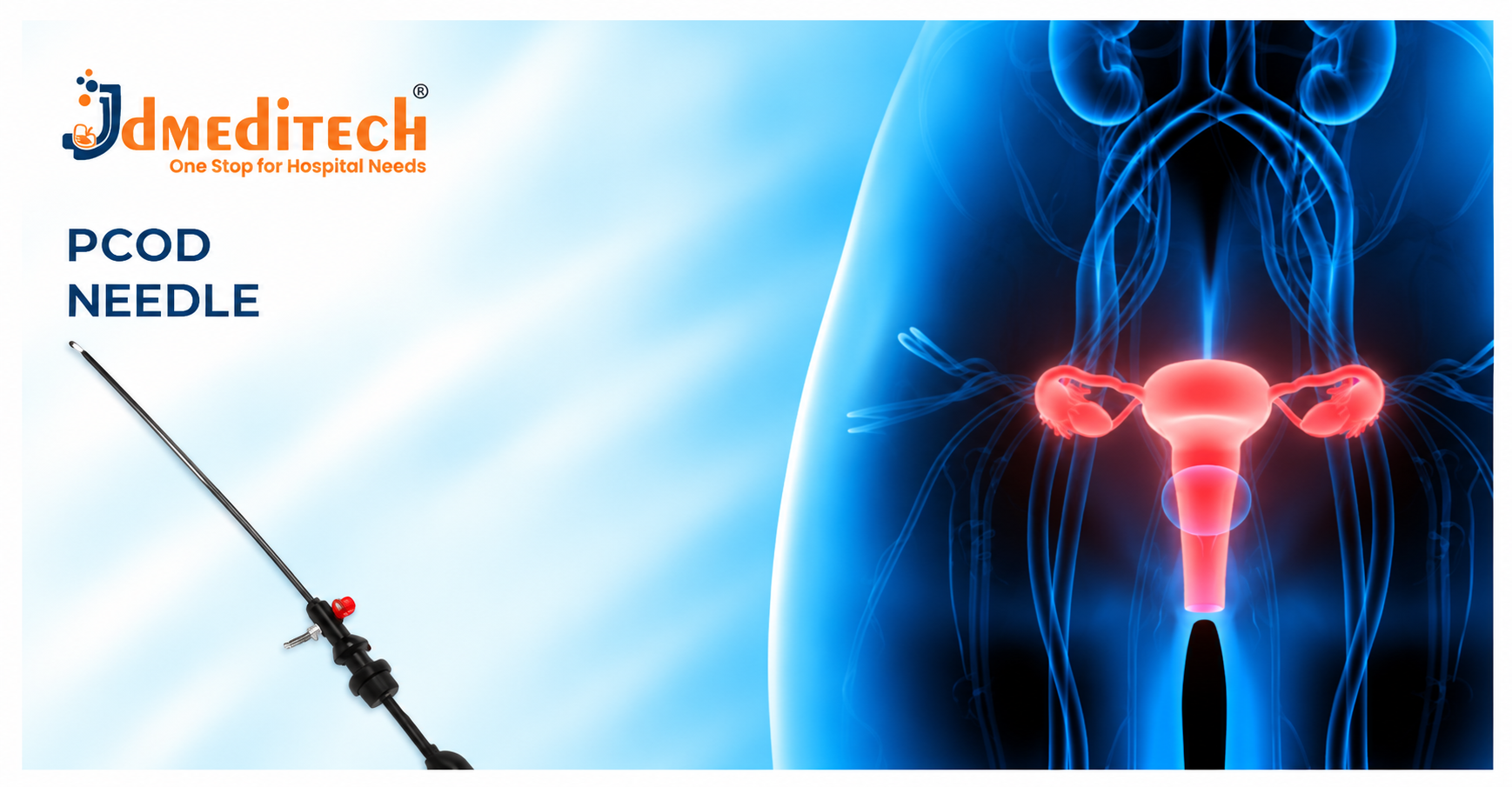
PCOD Needle: Uses, Features and Ovarian Drilling Applications
PCOD Needle is a specialized gynecology instrument that may support laparoscopic ovarian drilling in selected patients with polycystic ovary syndrome (PCOS). Depending on its design, the instrument may work with compatible electrosurgical equipment.
Furthermore, laparoscopic ovarian drilling is a surgical option for certain patients with PCOS-related anovulatory infertility. However, clinicians do not recommend it routinely for everyone with PCOS. Instead, specialists consider individual fertility needs, previous treatment and potential risks.
JDMeditech supplies gynecology and laparoscopic instruments for hospitals, clinics and medical distributors. Additionally, customers can contact our team for available configurations, technical specifications and quotation information.
What Is a PCOD Needle?
A PCOD needle is a surgical instrument associated with selected laparoscopic ovarian drilling procedures.
Typically, the instrument features an elongated shaft and a specialized distal working tip. However, the exact design depends on the manufacturer.
Therefore, healthcare facilities should confirm the intended use and technical specifications before ordering.
What Is Polycystic Ovary Syndrome?
Polycystic ovary syndrome, commonly called PCOS, is a hormonal condition that can affect ovulation, menstrual cycles and metabolic health.
For example, some patients experience irregular periods, acne or increased facial hair growth. Additionally, PCOS may contribute to difficulty conceiving.
However, symptoms vary considerably. Therefore, diagnosis and treatment require professional medical assessment.
Understanding PCOD and PCOS Terminology
PCOD is a term that some markets use when discussing polycystic ovarian conditions. However, PCOS is the standard medical term for polycystic ovary syndrome.
Furthermore, having polycystic-appearing ovaries on an ultrasound does not automatically confirm PCOS.
Therefore, clinicians use established diagnostic criteria rather than relying on ovarian appearance alone.
What Is Laparoscopic Ovarian Drilling?
Laparoscopic ovarian drilling is a surgical treatment that may help restore ovulation in selected patients with PCOS-related infertility.
During the procedure, a qualified surgeon uses suitable laparoscopic instruments to create limited controlled treatment points on the ovarian surface.
However, the procedure carries risks, including ovarian tissue damage and adhesions. Consequently, specialists reserve it for appropriate clinical situations.
Purpose of an Ovarian Drilling Instrument
The instrument supports controlled surgical treatment during an indicated laparoscopic procedure.
For example, a compatible electrosurgical needle may deliver energy to selected ovarian tissue.
However, surgeons must use the instrument only according to its approved intended use and manufacturer instructions.
Key Features of the Instrument
Different ovarian drilling instruments may offer different design features.
- Elongated surgical shaft
- Specialized distal working tip
- Compatible proximal connection
- Model-specific insulation
- Electrosurgical compatibility, where specified
- Different shaft dimensions
- Manufacturer-defined reusable or single-use design
- Suitable handling and connection components
Furthermore, buyers should verify these features against the official product datasheet.
Elongated Shaft Design
The elongated shaft allows the instrument to work within a compatible laparoscopic system.
Additionally, the shaft diameter and working length affect trocar compatibility.
Therefore, hospitals should confirm the required dimensions.
Specialized Distal Tip
The distal tip performs the instrument’s intended surgical function.
For example, certain electrosurgical designs support controlled energy delivery to selected tissue.
However, tip shape and electrical characteristics vary by model.
Proximal Connection Design
The proximal connection joins the instrument with compatible accessories or equipment.
For example, some devices require a manufacturer-specified electrosurgical cable.
Consequently, users should verify connection compatibility before clinical use.
Insulated Shaft Configuration
Some electrosurgical needle designs include shaft insulation.
Furthermore, insulation helps restrict energy delivery to the intended working region when the device operates correctly.
However, damaged insulation can create safety risks. Therefore, clinicians must inspect the instrument before use.
Components of a PCOD Needle
The exact component arrangement depends on the manufacturer and selected product.
- Distal Working Tip
- Instrument Shaft
- Insulation, if applicable
- Proximal Connector
- Handle or Control Assembly
- Model-Specific Accessories
Additionally, certain designs may contain specialized connection components.
Distal Working Tip
The distal tip is the functional end of the instrument.
For example, a suitable electrosurgical design may support energy delivery during an indicated procedure.
However, the surgeon must follow the manufacturer’s intended-use instructions.
Instrument Shaft
The shaft connects the working tip with the proximal assembly.
Furthermore, its dimensions influence compatibility with laparoscopic access equipment.
Therefore, procurement teams should verify the outer diameter and length.
Handle and Connection Assembly
The proximal assembly allows the clinician to handle or connect the device.
Additionally, some models contain specific electrosurgical connection features.
However, the exact configuration depends on the manufacturer.
Technical Specifications
Technical specifications vary by manufacturer. Consequently, buyers should request the official product datasheet before purchasing.
| Parameter | Product Details |
|---|---|
| Product Name | PCOD Needle |
| Product Category | Gynecology / Laparoscopic Instruments |
| Associated Procedure | Laparoscopic Ovarian Drilling |
| Instrument Type | Manufacturer-specified surgical needle |
| Working Tip | Confirm selected model |
| Shaft Diameter | Confirm manufacturer datasheet |
| Working Length | Confirm manufacturer datasheet |
| Material | Confirm product specifications |
| Insulation | Model-dependent |
| Electrosurgical Compatibility | Confirm manufacturer instructions |
| Connector Type | Manufacturer-specified |
| Reusable or Single Use | According to product labeling |
| Sterility | According to product labeling |
| Packaging | According to selected configuration |
Clinical Applications
Appropriate ovarian drilling instruments support selected laparoscopic gynecology procedures.
- Selected Laparoscopic Ovarian Drilling Procedures
- Specialist-Directed PCOS Infertility Treatment
- Other Applications Explicitly Approved by the Manufacturer
However, the clinical indication must guide instrument selection.
Use in PCOS-Related Infertility Care
PCOS can affect regular ovulation and fertility.
For example, clinicians often consider lifestyle measures and ovulation-induction medications before surgery.
However, selected patients may benefit from specialist evaluation for laparoscopic ovarian drilling.
Use in Laparoscopic Ovarian Drilling
During an indicated procedure, the surgeon uses suitable laparoscopic equipment to access and visualize the ovaries.
Additionally, a compatible working instrument supports the planned treatment.
However, clinicians must avoid unnecessary ovarian tissue injury and follow established surgical safety protocols.
Who May Be Considered for Ovarian Drilling?
Specialists may consider ovarian drilling for selected patients with anovulatory infertility associated with PCOS.
For example, treatment history and response to ovulation-induction therapy influence the decision.
However, surgery is not a routine first-line treatment for PCOS.
Who May Not Need Surgical Treatment?
Many patients with PCOS do not require ovarian surgery.
For example, patients seeking menstrual cycle management may benefit from non-surgical treatment options.
Furthermore, fertility care often includes medical treatments before surgical approaches.
General Surgical Procedure Overview
First, a qualified specialist evaluates the patient and confirms the treatment indication.
Next, the surgical team selects appropriate laparoscopic instruments and verifies equipment compatibility.
During surgery, the clinician performs the planned treatment according to established protocols.
Finally, the healthcare team monitors recovery and arranges appropriate follow-up.
Importance of Controlled Energy Delivery
Electrosurgical instruments require careful energy management.
For example, excessive energy may damage healthy ovarian tissue.
Consequently, trained surgeons must follow device instructions and appropriate surgical practices.
Potential Clinical Benefits
In selected patients, laparoscopic ovarian drilling may improve ovulation.
Furthermore, some patients may achieve pregnancy after suitable treatment.
However, results vary, and the procedure does not guarantee pregnancy or cure PCOS.
Potential Advantages of the Instrument
A compatible ovarian drilling instrument may offer practical functions during an indicated procedure.
- Specialized distal working tip
- Compatibility with selected laparoscopic systems
- Model-specific energy delivery capability
- Different shaft and connector configurations
- Support for specialist-directed surgical treatment
However, the actual advantages depend on the product design and clinical application.
Ovarian Drilling Versus Medical Treatment
Medical and surgical approaches have different roles in PCOS-related infertility care.
For example, letrozole is commonly recommended as a first-line ovulation-induction medicine for suitable patients with anovulatory PCOS infertility.
In contrast, laparoscopic ovarian drilling is generally a second-line option in selected cases.
| Feature | Medical Ovulation Induction | Laparoscopic Ovarian Drilling |
|---|---|---|
| Treatment Approach | Medication-based | Surgical |
| Typical Role | Often first-line | Selected second-line cases |
| Requires Surgery | No | Yes |
| Requires Anesthesia | Not generally for medication alone | Yes |
| Suitability | Individual clinical assessment | Individual clinical assessment |
Potential Risks of Ovarian Drilling
Laparoscopic ovarian drilling carries surgical risks.
- Bleeding
- Infection
- Injury to nearby structures
- Adhesion formation
- Ovarian tissue damage
- Possible reduction in ovarian reserve
- Anesthesia-related complications
Therefore, specialists must carefully assess the expected benefits and potential risks.
How to Select the Right Instrument
Hospitals should review several factors before purchasing a surgical needle.
- Manufacturer’s intended use
- Working tip design
- Shaft diameter
- Working length
- Trocar compatibility
- Electrical insulation
- Connector configuration
- Electrosurgical generator compatibility
- Reusable or single-use labeling
- Sterility requirements
- Manufacturer documentation
Furthermore, procurement teams should consult the gynecology department.
Importance of Electrosurgical Compatibility
Electrosurgical devices require compatible equipment.
For example, the instrument connector must match the approved cable and generator system.
Additionally, users must follow the manufacturer-specified operating limits.
Safety Precautions
Healthcare professionals must follow appropriate laparoscopic and electrosurgical safety practices.
- Confirm the clinical indication
- Inspect the instrument before use
- Check shaft insulation, if applicable
- Verify generator compatibility
- Confirm cable connections
- Follow infection prevention protocols
- Use the instrument only for its intended purpose
- Follow manufacturer instructions
- Monitor patient safety
Furthermore, only appropriately trained clinicians should perform ovarian drilling procedures.
Cleaning and Reprocessing
Reusable instruments require validated cleaning and sterilization.
For example, facilities should follow the manufacturer’s instructions for cleaning, inspection and reprocessing.
However, single-use devices must not undergo unauthorized reuse.
Inspection Before Use
Staff should inspect the surgical instrument before each procedure.
For example, they should check the distal tip, shaft and proximal connection.
Additionally, they should inspect any insulation for visible damage.
Storage and Handling
Proper storage helps protect surgical instruments.
For example, hospitals should use suitable protective storage systems.
Furthermore, staff should follow manufacturer handling instructions.
Applications in Hospitals
Hospitals may use appropriate ovarian drilling instruments during selected gynecology procedures.
However, clinicians must confirm patient suitability and equipment compatibility.
Therefore, instrument selection should follow clinical requirements.
Applications for Medical Distributors
Medical distributors should verify the exact product specifications before supplying laparoscopic instruments.
For example, buyers may request a specific shaft diameter, connector or working length.
Consequently, distributors should confirm the selected model.
Why Choose JDMeditech?
JDMeditech supplies gynecology instruments and laparoscopic medical equipment for hospitals, clinics and medical distributors.
Furthermore, customers can contact our team for available configurations, technical details and quotation inquiries.
- PCOD Needle inquiries
- Ovarian Drilling Instrument inquiries
- Gynecology Instrument inquiries
- Laparoscopic Equipment inquiries
- Technical Specification requests
- Product Compatibility inquiries
- International Export inquiries
However, product availability and specifications require confirmation.
Frequently Asked Questions
1. What Is a PCOD Needle?
It is a surgical instrument associated with selected laparoscopic ovarian drilling procedures. However, its exact design depends on the manufacturer.
2. What Is Ovarian Drilling?
Ovarian drilling is a laparoscopic surgical treatment that may support ovulation in selected patients with PCOS-related infertility.
3. Is Ovarian Drilling Recommended for Everyone With PCOS?
No. Specialists consider surgery only in appropriate cases. Furthermore, many patients benefit from non-surgical treatments.
4. Does Ovarian Drilling Cure PCOS?
No. The procedure does not cure PCOS. However, it may improve ovulation in selected patients.
5. Can Ovarian Drilling Improve Fertility?
It may improve ovulation and fertility outcomes in some patients. Nevertheless, pregnancy is not guaranteed.
6. Does the Instrument Require Electrosurgical Equipment?
Some designs require compatible electrosurgical equipment. Therefore, buyers should confirm the manufacturer’s specifications.
7. Are Different Needle Sizes Available?
Manufacturers may offer different instrument dimensions. However, availability depends on the selected model.
8. What Is the Importance of Shaft Diameter?
Shaft diameter affects trocar compatibility. Consequently, buyers should verify the required measurement.
9. What Is the Importance of Working Length?
Working length affects compatibility with the laparoscopic system. Therefore, hospitals should confirm the dimensions.
10. Are These Instruments Reusable?
Some models may be reusable, while others are single use. However, the product labeling determines the correct handling.
11. Are These Instruments Supplied Sterile?
Sterility depends on the product configuration. Therefore, customers should verify the packaging information.
12. What Materials Are Used?
Materials vary by manufacturer and model. Consequently, buyers should request the official datasheet.
13. Is Ovarian Drilling a First-Line PCOS Treatment?
Generally, no. Medical ovulation induction is often preferred first. However, specialists may consider surgery in selected cases.
14. What Are the Risks of Ovarian Drilling?
Potential risks include bleeding, infection, adhesions and ovarian tissue damage. Therefore, clinical assessment is essential.
15. Can Ovarian Drilling Affect Ovarian Reserve?
Yes. Excessive tissue damage may affect ovarian reserve. Consequently, surgeons must follow appropriate clinical protocols.
16. Who Performs Ovarian Drilling?
Qualified gynecological surgeons perform the procedure. Additionally, the clinical team provides appropriate anesthesia and monitoring.
17. Can the Instrument Be Used With Every Generator?
No. Electrosurgical compatibility depends on the selected model. Therefore, users must verify the manufacturer’s instructions.
18. How Are Reusable Instruments Cleaned?
Facilities must follow validated manufacturer reprocessing instructions. Furthermore, staff should inspect the instrument before reuse.
19. What Should Buyers Check Before Ordering?
Buyers should confirm the tip design, shaft dimensions, connector and electrical compatibility. Additionally, they should review product documentation.
20. Where Can I Inquire About Ovarian Drilling Instruments?
Hospitals, gynecology clinics and medical distributors can contact JDMeditech for product details and quotation inquiries.
Conclusion
In conclusion, the PCOD Needle is associated with selected laparoscopic ovarian drilling procedures for appropriate patients with PCOS-related infertility.
Furthermore, compatible instrument design and careful surgical technique are essential.
However, ovarian drilling is not a routine treatment for every patient with PCOS.
Therefore, healthcare facilities should confirm product specifications, intended use and clinical suitability before purchasing.
JDMeditech – One Stop for Hospital Needs
Website:
www.jdmeditech.com
Related Gynecology Products
Explore more gynecology and laparoscopic instruments through the JDMeditech website.
- Gynecology Laparoscopic Instruments
- Laparoscopic Electrosurgical Instruments
- Hysteroscope
- Hysteroscopy Forceps
- Gynecology Surgical Instruments
Medical References
- International Evidence-Based PCOS Guidelines
- American Society for Reproductive Medicine
- American College of Obstetricians and Gynecologists
- World Health Organization
Medical Disclaimer
This article provides general educational and product information only. It does not replace professional medical advice, clinical training, manufacturer instructions or established surgical protocols. Qualified healthcare professionals must determine the suitability of ovarian drilling and select instruments according to clinical indications, patient needs and applicable safety requirements.




