



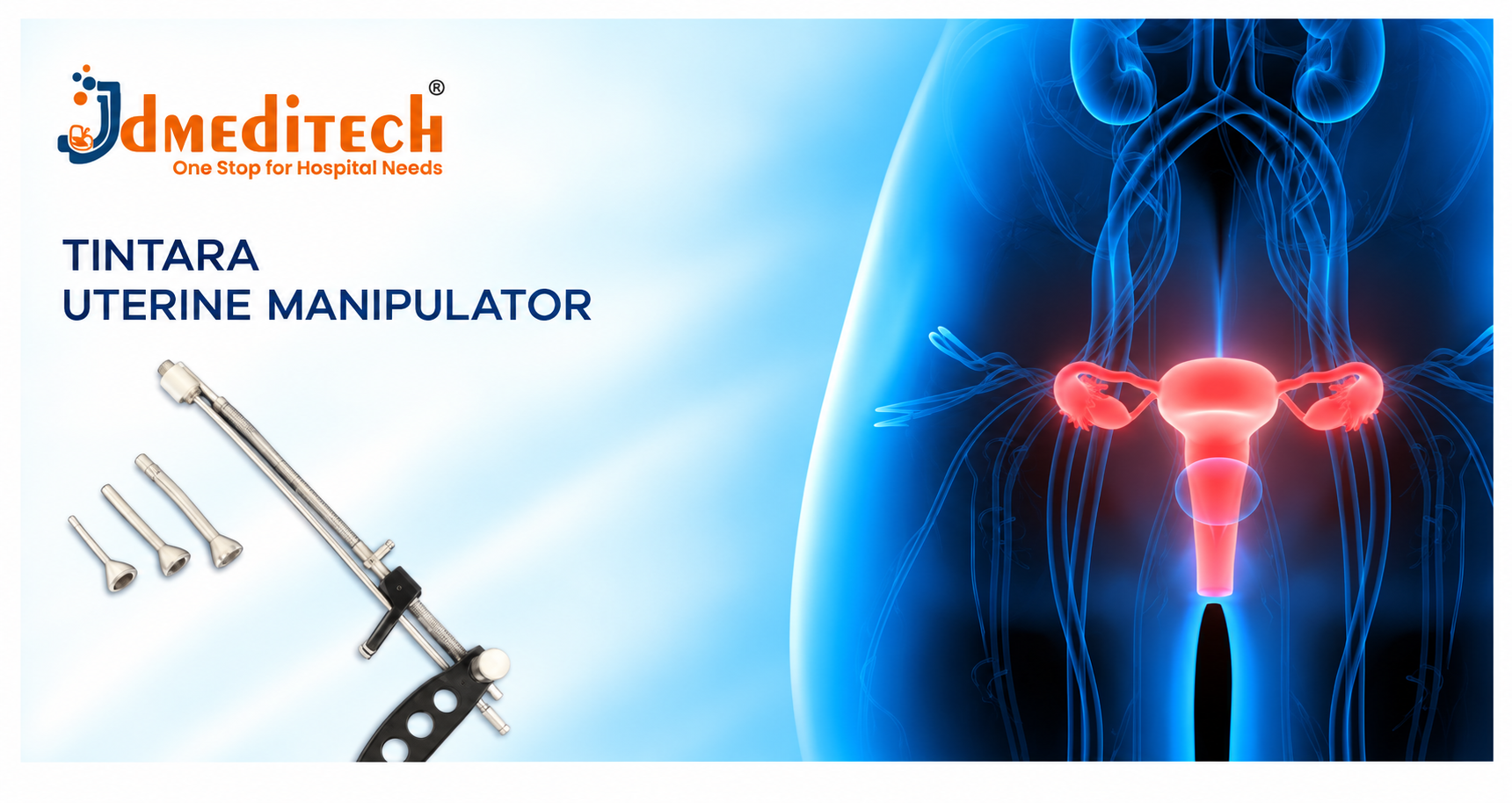
Tintara Uterine Manipulator: Features, Uses and Specifications
The Tintara Uterine Manipulator is a specialized gynecology surgical instrument associated with uterine positioning during selected laparoscopic procedures. Its elongated design and compatible accessories may help a trained surgeon move the uterus to improve access to pelvic structures.
Furthermore, controlled uterine movement can support visualization during appropriate gynecological surgery. However, clinical suitability depends on the patient, procedure and instrument configuration.
JDMeditech supplies gynecology instruments for hospitals, clinics and medical distributors. Additionally, customers can contact our team to request available product configurations, technical details and quotations.
What Is a Tintara Uterine Manipulator?
A Tintara uterine manipulator is a surgical instrument designed to assist with uterine positioning during selected gynecology procedures.
Typically, this style of device features an elongated shaft, a proximal handle and interchangeable distal components.
However, the exact design depends on the manufacturer. Therefore, buyers should verify the official product specifications.
Purpose of the Instrument
The primary purpose of a uterine manipulator is to support controlled uterine positioning.
Additionally, suitable positioning may improve surgical access to pelvic anatomy.
Consequently, surgeons can use the instrument as part of an appropriate surgical technique.
Understanding Uterine Manipulation
Uterine manipulation involves controlled movement of the uterus during a clinical procedure.
For example, a surgeon may adjust uterine position to improve visualization.
However, excessive movement can cause tissue injury. Therefore, only qualified healthcare professionals should operate the instrument.
Key Features of the Tintara Design
Different models may offer different design features.
- Elongated surgical shaft
- Proximal operating handle
- Interchangeable distal tips, where supplied
- Model-specific adjustment mechanism
- Specialized uterine positioning design
- Different accessory configurations
- Manufacturer-defined reusable or single-use components
- Suitable instrument handling features
Furthermore, customers should confirm each feature against the manufacturer’s datasheet.
Elongated Shaft Design
The shaft connects the distal working section with the proximal operating assembly.
Additionally, its dimensions affect instrument handling and clinical compatibility.
Therefore, hospitals should verify the required working length and diameter.
Interchangeable Distal Tips
Some uterine manipulator systems include interchangeable distal tips.
For example, different tip configurations may support different anatomical or procedural requirements.
However, the manufacturer must specify which tips are compatible with the instrument.
Proximal Operating Handle
The handle allows a clinician to control the instrument.
Furthermore, selected models may include mechanical adjustment or positioning features.
Therefore, users should review the official operating instructions.
Mechanical Adjustment Mechanism
Some manipulator designs include an adjustment mechanism.
Additionally, the mechanism may help control the position of the distal section.
However, the exact function depends on the selected model.
Components of a Tintara Uterine Manipulator
The image shows an elongated instrument and several separate tip-like accessories. However, the exact supplied kit contents require confirmation.
Common components may include:
- Main Instrument Shaft
- Proximal Operating Handle
- Distal Working Tip
- Interchangeable Tips, if included
- Mechanical Control Assembly
- Model-Specific Accessories
Therefore, buyers should request the complete packing list before ordering.
Main Instrument Shaft
The main shaft connects the distal section with the handle.
Furthermore, its dimensions influence compatibility with the intended procedure.
Consequently, procurement teams should confirm the manufacturer’s specifications.
Distal Working Tip
The distal tip supports the instrument’s intended uterine positioning function.
Additionally, its shape may vary between compatible configurations.
However, clinicians must use only approved tips for the selected model.
Interchangeable Tip Accessories
Interchangeable accessories may allow different instrument configurations.
For example, certain systems provide tips with different dimensions.
However, the available options depend on the manufacturer and product package.
Operating Handle
The handle provides a means of controlling the instrument.
Additionally, some models contain mechanical controls or adjustment features.
Therefore, users should inspect the handle before clinical use.
Technical Specifications
Technical specifications vary by manufacturer. Consequently, buyers should confirm the official product datasheet before placing an order.
| Parameter | Product Details |
|---|---|
| Product Name | Tintara Uterine Manipulator |
| Product Category | Gynecology Surgical Instruments |
| Primary Function | Selected Uterine Positioning Applications |
| Instrument Type | Mechanical Uterine Manipulator |
| Main Shaft | Elongated Surgical Shaft |
| Working Length | Confirm manufacturer datasheet |
| Shaft Diameter | Confirm manufacturer datasheet |
| Tip Configuration | Model-specific |
| Interchangeable Tips | Confirm supplied configuration |
| Material | Confirm product specifications |
| Handle Type | Manufacturer-specified |
| Adjustment Mechanism | Model-dependent |
| Reusable or Single Use | According to product labeling |
| Sterility | According to product labeling |
| Packaging | Confirm supplier packing list |
| Reprocessing Requirements | Follow manufacturer instructions |
Types of Uterine Manipulators
Different gynecology procedures may require different uterine manipulation instruments.
- Tintara Uterine Manipulator
- V Type Uterine Manipulator
- Cohen Uterine Manipulator
- Storz Type Uterine Manipulator
- Mangeshikar Uterine Manipulator
However, each instrument has a different design and intended application.
V Type Uterine Manipulator
A V type manipulator uses a specialized mechanical design.
Additionally, its working section and controls depend on the manufacturer.
Therefore, clinicians should select the appropriate model for the procedure.
Cohen Uterine Manipulator
A Cohen manipulator is another instrument associated with uterine positioning.
However, its design differs from other manipulation systems.
Consequently, buyers should confirm the required configuration.
Storz Type Uterine Manipulator
A Storz type manipulator refers to a particular style of uterine manipulation instrument.
Furthermore, compatible accessories may vary by product.
Therefore, users should review the manufacturer’s specifications.
Mangeshikar Uterine Manipulator
A Mangeshikar manipulator supports selected gynecology procedures.
Additionally, its configuration may differ from simpler uterine manipulation instruments.
However, users must follow the manufacturer-defined intended use.
Clinical Applications
Suitable uterine manipulation instruments may support selected gynecological procedures.
- Laparoscopic Gynecology Procedures
- Selected Pelvic Surgical Procedures
- Uterine Positioning During Surgery
- Other Manufacturer-Approved Applications
However, the exact device labeling determines the approved clinical applications.
Application in Laparoscopic Gynecology
Laparoscopic gynecology involves specialized surgical instruments and visualization equipment.
For example, controlled uterine movement may improve access to selected pelvic structures.
However, the surgeon must confirm that the device is appropriate for the planned procedure.
Application in Pelvic Surgery
Uterine positioning may support selected pelvic surgical techniques.
Additionally, appropriate movement can help the clinician visualize relevant anatomy.
Therefore, trained healthcare professionals should select the correct instrument.
Application in Gynecology Hospitals
Hospitals may use compatible uterine manipulators during selected gynecology procedures.
However, clinical teams must confirm patient suitability and instrument compatibility.
Consequently, product selection should follow clinical requirements.
General Surgical Procedure Overview
First, a qualified clinician evaluates the patient and confirms the planned procedure.
Next, the surgical team selects a suitable manipulator and verifies the instrument configuration.
During surgery, trained personnel use the instrument according to the established clinical protocol.
Finally, the healthcare team provides appropriate monitoring and postoperative care.
Importance of Controlled Uterine Positioning
Controlled positioning is essential during uterine manipulation.
For example, excessive force may cause cervical or uterine injury.
Therefore, surgeons should follow appropriate safety practices and manufacturer instructions.
Potential Benefits of Uterine Manipulation
Appropriate uterine manipulation may support surgical visualization and access.
Additionally, suitable positioning can help clinicians work around selected pelvic structures.
However, actual clinical benefits depend on the patient, procedure and surgical technique.
Practical Features of the Instrument
A suitable manipulator may provide several practical characteristics.
- Specialized uterine positioning design
- Elongated surgical shaft
- Model-specific operating handle
- Compatible tip configurations
- Mechanical adjustment features
- Support for selected gynecology procedures
However, the actual performance depends on the instrument design.
Tintara Versus V Type Uterine Manipulator
Different uterine manipulator designs may offer different configurations.
For example, a Tintara-style system may include interchangeable distal accessories.
In contrast, a V type instrument may use a different working section and control mechanism.
| Feature | Tintara Manipulator | V Type Manipulator |
|---|---|---|
| Product Category | Gynecology Instrument | Gynecology Instrument |
| Primary Function | Uterine Positioning | Uterine Positioning |
| Design | Model-specific Tintara configuration | Model-specific V type configuration |
| Accessory Options | Confirm compatible tips | Confirm product configuration |
| Clinical Suitability | Procedure-dependent | Procedure-dependent |
How to Select the Right Uterine Manipulator
Hospitals and medical distributors should review several factors before purchasing.
- Manufacturer’s intended use
- Main shaft dimensions
- Working length
- Distal tip configuration
- Accessory compatibility
- Handle design
- Adjustment mechanism
- Reusable or single-use labeling
- Sterility requirements
- Manufacturer documentation
Furthermore, procurement teams should consult the gynecology department.
Importance of Tip Compatibility
Tip compatibility is important for proper instrument operation.
For example, certain accessories may fit only a particular manipulator model.
Consequently, users must verify compatibility before use.
Importance of Instrument Dimensions
Instrument dimensions affect handling and clinical compatibility.
Additionally, the working length and shaft diameter may influence the selected procedure.
Therefore, buyers should confirm the manufacturer’s specifications.
Potential Procedure-Related Risks
Uterine manipulation carries potential risks.
- Cervical injury
- Uterine perforation
- Bleeding
- Infection
- Trauma to nearby structures
- Device-related complications
Therefore, trained clinicians must follow appropriate surgical safety protocols.
Safety Precautions
Healthcare professionals should follow established gynecology safety practices.
- Confirm the clinical indication
- Assess patient suitability
- Inspect the instrument before use
- Verify tip compatibility
- Check mechanical function
- Follow infection prevention protocols
- Avoid excessive manipulation force
- Follow manufacturer instructions
- Provide appropriate patient monitoring
Furthermore, only appropriately trained clinicians should operate uterine manipulation instruments.
Cleaning and Reprocessing
Reusable instruments require validated cleaning and sterilization.
For example, healthcare facilities should follow the manufacturer’s instructions for disassembly, cleaning and reprocessing.
However, single-use devices must not undergo unauthorized reuse.
Inspection Before Use
Staff should inspect the instrument before each procedure.
For example, they should examine the shaft, distal tip and operating handle.
Additionally, they should check the mechanical controls for proper operation.
Storage and Handling
Proper storage helps protect the instrument and accessories.
For example, hospitals should use suitable protective storage systems.
Furthermore, staff should follow the manufacturer’s handling instructions.
Applications for Medical Distributors
Medical distributors should verify product specifications before supplying uterine manipulators.
For example, customers may request specific tip configurations or working lengths.
Consequently, distributors should confirm the available options.
Why Choose JDMeditech?
JDMeditech supplies gynecology and laparoscopic instruments for hospitals, clinics and medical distributors.
Furthermore, customers can contact our team for available product details, technical specifications and quotation inquiries.
- Tintara Uterine Manipulator inquiries
- Gynecology Instrument inquiries
- Laparoscopic Equipment inquiries
- Technical Specification requests
- Accessory Compatibility inquiries
- International Export inquiries
However, product availability and technical specifications require confirmation.
Frequently Asked Questions
1. What Is a Tintara Uterine Manipulator?
It is a gynecology surgical instrument associated with uterine positioning during selected procedures.
2. What Is the Main Purpose of the Instrument?
The instrument supports controlled uterine positioning. Additionally, suitable movement may improve surgical visualization.
3. Is It Used in Laparoscopic Surgery?
Some uterine manipulators support laparoscopic gynecology procedures. However, the manufacturer’s intended use determines the approved applications.
4. Does the Instrument Include Interchangeable Tips?
Some configurations may include interchangeable tips. Therefore, buyers should confirm the complete packing list.
5. Are Different Tip Sizes Available?
Manufacturers may offer different tip dimensions. However, availability depends on the selected model.
6. What Is the Importance of Working Length?
Working length affects instrument handling and compatibility. Consequently, hospitals should confirm the required measurement.
7. What Is the Importance of Shaft Diameter?
Shaft diameter affects the instrument’s physical dimensions. Therefore, buyers should review the official datasheet.
8. Are These Instruments Reusable?
Some models may be reusable, while others are single use. However, the product labeling determines the correct handling.
9. Are Uterine Manipulators Supplied Sterile?
Sterility depends on the product configuration. Therefore, customers should confirm the packaging details.
10. What Materials Are Used?
Materials vary by manufacturer and model. Consequently, buyers should request the official specifications.
11. Can the Instrument Improve Surgical Visualization?
Appropriate uterine positioning may improve access to selected pelvic structures. However, the benefit depends on the procedure.
12. Can the Instrument Be Used in Every Gynecology Procedure?
No. Clinicians must follow the device’s intended use and select the instrument according to the planned procedure.
13. What Are the Possible Risks?
Potential risks include bleeding, cervical injury and uterine perforation. Therefore, trained clinicians must follow appropriate safety practices.
14. How Are Reusable Manipulators Cleaned?
Healthcare facilities must follow validated manufacturer reprocessing instructions. Additionally, staff should inspect the instrument before reuse.
15. What Should Buyers Check Before Ordering?
Buyers should confirm the shaft dimensions, tip configurations, intended use and packaging. Furthermore, they should review the manufacturer’s documentation.
16. Where Can I Inquire About Uterine Manipulators?
Hospitals, gynecology clinics and medical distributors can contact JDMeditech for product details and quotation inquiries.
Conclusion
In conclusion, the Tintara Uterine Manipulator is a specialized instrument associated with uterine positioning during selected gynecology procedures.
Furthermore, its elongated design and compatible accessories may support controlled movement and surgical visualization.
However, correct instrument selection, patient assessment and appropriate surgical technique remain essential.
Therefore, healthcare facilities should confirm the intended use, available tip configurations and technical specifications before purchasing.
JDMeditech – One Stop for Hospital Needs
Website:
www.jdmeditech.com
Related Gynecology Products
Explore additional gynecology instruments through the JDMeditech website.
- V Type Uterine Manipulator
- Cohen Uterine Manipulator
- Storz Type Uterine Manipulator
- Mangeshikar Uterine Manipulator
- Hysteroscope
- Hysteroscopy Forceps
Medical References
- American College of Obstetricians and Gynecologists
- Royal College of Obstetricians and Gynaecologists
- World Health Organization
Medical Disclaimer
This article provides general educational and product information only. It does not replace professional medical advice, clinical training, manufacturer instructions or established surgical protocols. Qualified healthcare professionals must select and use uterine manipulation instruments according to patient needs, clinical indications and applicable safety requirements.




