



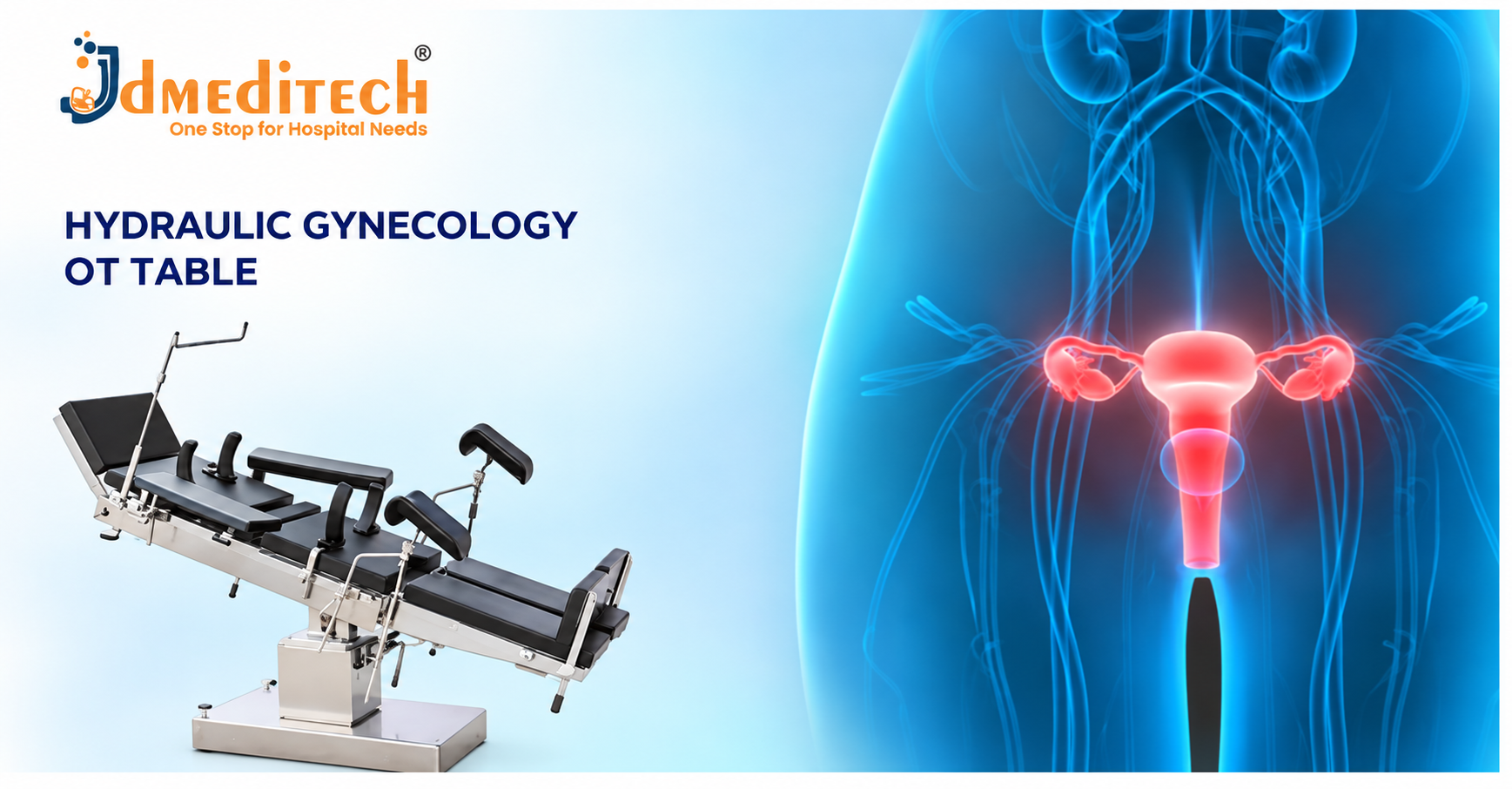
Hydraulic Gynecology OT Table – Features, Uses and Benefits
A Hydraulic Gynecology Table is specialized operating room equipment designed to support patient positioning during selected gynecological procedures. Its patient-support platform and hydraulic positioning system help healthcare professionals prepare appropriate clinical positions.
Furthermore, compatible adjustment mechanisms may support different surgical requirements. As a result, the equipment can assist clinical teams during selected gynecology procedures.
JDMeditech supplies gynecology equipment and surgical accessories for hospitals, healthcare centers and medical distributors. Additionally, our team can assist customers with available product configurations, technical specifications and quotation inquiries.
What Is a Hydraulic Gynecology OT Table?
A hydraulic gynecology operating table provides a dedicated patient-support platform for selected surgical and examination procedures.
Typically, hydraulic systems support one or more positioning adjustments. However, the exact functions depend on the selected model.
Therefore, hospitals should verify the available movements, adjustment ranges and patient load capacity before purchasing.
Purpose of a Hydraulic Gynecology Operating Table
The main purpose of the equipment is to support appropriate patient positioning during approved gynecology procedures.
For example, suitable positioning accessories may assist clinicians during selected pelvic examinations and operations.
Additionally, hydraulic adjustment may help staff change the operating height or another supported position.
Consequently, the table can support organized surgical workflows.
Importance of Proper Patient Positioning
Patient positioning plays an important role in gynecological surgery.
For example, selected procedures require appropriate access to the pelvic region.
Furthermore, healthcare professionals must protect pressure areas and monitor patient safety.
Therefore, trained clinical staff should supervise all positioning adjustments.
Key Features of the Hydraulic Gynecology OT Table
Different models offer different features and adjustment mechanisms. Common configurations may include:
- Hydraulic positioning system
- Patient-support platform
- Adjustable operating height, where specified
- Gynecology positioning accessories
- Leg support attachments
- Sectional patient-support design
- Supporting base and column
- Mechanical locking components
- Model-specific adjustment controls
- Manufacturer-defined cleaning requirements
Furthermore, buyers should verify the exact features against the manufacturer’s datasheet.
Hydraulic Adjustment System
The hydraulic system supports selected table movements.
For example, some models use hydraulic mechanisms for height adjustment.
However, the supported movements and operating method vary by manufacturer.
Therefore, users should follow the official operating instructions.
Patient Support Platform
The main platform provides a designated surface for patient positioning.
Additionally, its dimensions influence suitability for different procedures.
Therefore, hospitals should confirm the working dimensions and rated load capacity.
Adjustable Patient Positioning Sections
Some gynecology tables include adjustable patient-support sections.
For example, compatible models may support selected backrest or leg section movements.
However, adjustment capabilities depend on the manufacturer.
Leg Support Accessories
Leg supports may assist with selected gynecology positions.
Additionally, suitable accessories can help staff maintain the required clinical setup.
However, incorrect positioning may cause pressure-related injuries.
Therefore, trained professionals should supervise accessory adjustments.
Supporting Base and Column
The supporting base and column provide structural support for the operating table.
Furthermore, their construction influences stability and load capacity.
Therefore, buyers should verify the manufacturer’s structural specifications.
Mechanical Locking System
Suitable locking mechanisms help maintain the selected table position.
For example, some models include mechanical controls for securing adjustable sections.
However, the exact locking design varies between products.
Components of the Hydraulic Gynecology OT Table
The reference image shows a sectional operating table with a central support base, leg positioning accessories and multiple adjustment components.
Depending on the manufacturer, the supplied configuration may include:
- Main Patient Support Platform
- Hydraulic Support Column
- Operating Table Base
- Adjustable Backrest Section
- Leg Support Accessories
- Accessory Mounting Points
- Mechanical Adjustment Controls
- Position Locking Components
- Other Model-Specific Accessories
Therefore, customers should request the official packing list.
Main Patient Support Platform
The main platform supports the patient during approved procedures.
Additionally, its surface must suit the intended clinical application.
Therefore, users should inspect the platform before each procedure.
Hydraulic Support Column
The hydraulic column supports the table’s designated adjustment functions.
Furthermore, its operating system may help staff change the supported position.
However, the adjustment range depends on the selected model.
Operating Table Base
The base provides structural support for the equipment.
Additionally, it contributes to table stability.
Therefore, staff should inspect the base and associated components regularly.
Backrest Section
Some models include an adjustable backrest section.
For example, the backrest may support selected patient positions.
However, the available angle range requires manufacturer confirmation.
Leg Positioning Supports
Compatible leg supports help clinicians position patients during selected gynecology procedures.
Additionally, suitable padding and alignment may help protect pressure areas.
Therefore, clinical teams must follow safe positioning protocols.
Technical Specifications
Technical specifications vary by manufacturer and model. Consequently, buyers should verify the official product datasheet before ordering.
| Parameter | Product Details |
|---|---|
| Product Name | Hydraulic Gynecology OT Table |
| Product Category | Gynecology Operation Theatre Equipment |
| Primary Application | Selected Gynecology Procedures |
| Operating System | Hydraulic |
| Table Length | Confirm manufacturer datasheet |
| Table Width | Confirm manufacturer datasheet |
| Minimum Height | Confirm manufacturer datasheet |
| Maximum Height | Confirm manufacturer datasheet |
| Height Adjustment | Model-dependent |
| Backrest Adjustment | Confirm available range |
| Trendelenburg Position | Confirm manufacturer specifications |
| Reverse Trendelenburg | Confirm manufacturer specifications |
| Leg Supports | According to selected model |
| Tabletop Material | Confirm manufacturer datasheet |
| Base Material | Confirm manufacturer datasheet |
| Mattress or Padding | Confirm supplied configuration |
| Safe Working Load | Confirm manufacturer rating |
| Mobility | Confirm fixed or mobile configuration |
| Cleaning Requirements | Follow manufacturer instructions |
| Packaging | Confirm supplier packing list |
Applications of the Hydraulic Gynecology Table
Compatible operating tables may support selected clinical procedures.
- Gynecology Surgery
- Selected Pelvic Procedures
- Gynecology Examinations
- Selected Hysteroscopy Procedures
- Selected Obstetric Procedures, where approved
- Operating Room Patient Positioning
- Other Manufacturer-Approved Applications
However, the manufacturer’s intended use determines the appropriate applications.
Application in Gynecology Surgery
Gynecology surgery requires appropriate patient positioning and access.
For example, a suitable operating table may support selected pelvic procedures.
Additionally, compatible positioning accessories may assist clinical staff.
Therefore, hospitals should select equipment that matches procedural requirements.
Application in Pelvic Procedures
Selected pelvic procedures require specific patient positions.
For example, clinicians may need suitable leg support and table adjustment.
Furthermore, staff must monitor pressure areas and patient alignment.
Therefore, safe positioning remains essential.
Application in Hysteroscopy
Hysteroscopy involves examination or treatment within the uterine cavity using a hysteroscope.
For example, an appropriate operating table may support the required clinical position.
However, table suitability depends on the manufacturer’s intended use.
Application in Gynecology Examinations
Gynecology examinations require appropriate patient support.
Additionally, compatible accessories may help staff maintain suitable positioning.
However, healthcare professionals must consider patient comfort and safety.
Application in Operating Rooms
Operating rooms require reliable patient-support equipment.
For example, suitable tables may assist with selected surgical positioning requirements.
Furthermore, accessible adjustment controls may support clinical workflows.
Therefore, staff should understand the manufacturer’s operating instructions.
Potential Benefits of the Hydraulic Gynecology OT Table
A suitable hydraulic operating table may offer several practical benefits.
- Dedicated patient-support platform
- Hydraulic adjustment capability
- Compatibility with selected gynecology procedures
- Model-specific patient positioning options
- Support for selected pelvic examinations
- Compatible accessory attachments
- Structured operating room equipment setup
However, actual benefits depend on the product configuration and correct use.
Hydraulic Versus Manual Gynecology OT Table
Hydraulic tables use fluid-powered mechanisms for selected adjustments.
In contrast, conventional manual tables use mechanical controls.
However, both categories include different configurations and features.
| Feature | Hydraulic OT Table | Manual OT Table |
|---|---|---|
| Adjustment System | Hydraulic Mechanism | Mechanical Mechanism |
| Height Adjustment | Model-dependent | Model-dependent |
| Positioning Controls | Hydraulic and Mechanical | Mechanical |
| Maintenance | Hydraulic and Mechanical Components | Mechanical Components |
| Clinical Applications | Manufacturer-Approved Procedures | Manufacturer-Approved Procedures |
Hydraulic Versus Electric Gynecology OT Table
Hydraulic tables use hydraulic mechanisms for selected movements.
Meanwhile, electric models use powered controls for designated adjustments.
However, the available movements depend on each product.
| Feature | Hydraulic Table | Electric Table |
|---|---|---|
| Adjustment Method | Hydraulic Controls | Powered Controls |
| Electrical Power | Depends on Configuration | Generally Required or Battery Powered |
| Positioning Functions | Model-dependent | Model-dependent |
| Maintenance | Hydraulic System Maintenance | Electrical and Mechanical Maintenance |
| Clinical Applications | Manufacturer-Approved Procedures | Manufacturer-Approved Procedures |
How to Choose the Right Gynecology OT Table
Hospitals and procurement teams should review several factors before purchasing.
- Manufacturer’s intended use
- Patient support dimensions
- Safe working load
- Hydraulic adjustment functions
- Height adjustment range
- Backrest adjustment range
- Leg support configuration
- Table stability
- Surface material
- Cleaning compatibility
- Accessory requirements
- Official product documentation
Furthermore, procurement teams should consult the gynecology department.
Importance of Patient Positioning
Appropriate positioning supports safe surgical care.
For example, some procedures require specific pelvic access.
Additionally, clinical teams must protect pressure areas and monitor patient alignment.
Therefore, trained staff should supervise every adjustment.
Importance of Safe Working Load
The safe working load identifies the manufacturer’s permitted load limit.
Furthermore, the rating may account for the patient and additional applied loads.
Therefore, users must confirm and follow the official limit.
Importance of Table Stability
Stable equipment supports safer clinical handling.
For example, loose components or damaged supports may create hazards.
Consequently, staff should inspect the table regularly.
Cleaning and Infection Prevention
Operating tables require appropriate cleaning between patients.
Additionally, staff should follow facility infection prevention protocols.
However, cleaning chemicals must remain compatible with the manufacturer’s recommended materials.
Therefore, healthcare facilities should follow the official cleaning instructions.
Routine Maintenance of the Hydraulic System
Regular maintenance helps identify equipment problems.
For example, trained maintenance personnel should inspect the hydraulic mechanism and associated components.
Furthermore, staff should report unusual movement or fluid leakage.
Therefore, hospitals should follow the manufacturer’s maintenance schedule.
Inspection Before Use
Healthcare staff should inspect the equipment before patient use.
- Check base stability
- Inspect the patient platform
- Verify hydraulic controls
- Check locking mechanisms
- Inspect leg support attachments
- Confirm accessory security
- Check the safe working load
- Examine surfaces for damage
- Confirm cleaning status
Additionally, staff should remove damaged equipment from service.
Safety Precautions
Safe operation requires suitable training and patient assessment.
For example, staff should confirm that adjustment mechanisms operate correctly.
Furthermore, patients may require assistance during positioning.
Therefore, healthcare professionals should follow institutional safety procedures.
Potential Safety Risks
Improper equipment use may create safety hazards.
- Patient falls
- Unintended table movement
- Hydraulic mechanism failure
- Unstable accessories
- Pressure-related discomfort
- Pinch injuries
- Inadequate cleaning
- Exceeding the rated load
However, appropriate maintenance and safe handling can help reduce preventable risks.
Storage and Handling
Proper handling helps maintain equipment condition.
For example, hospitals should avoid damaging the hydraulic mechanism or supporting frame.
Additionally, staff should store removable accessories appropriately.
Therefore, facilities should follow manufacturer storage recommendations.
Applications for Hospitals and Healthcare Centers
Hospitals and healthcare centers may require hydraulic gynecology equipment for selected clinical services.
Additionally, suitable configurations can support departmental workflows.
However, procurement teams must confirm clinical suitability.
Applications for Medical Distributors
Medical distributors should verify product specifications before supplying operating tables.
For example, customers may request specific dimensions, adjustment functions or accessories.
Consequently, distributors should confirm the available configurations.
Why Choose JDMeditech?
JDMeditech supplies gynecology equipment and surgical accessories for hospitals, healthcare centers and medical distributors.
Furthermore, our team can assist customers with available product information, technical specifications and quotation inquiries.
- Gynecology Equipment Inquiries
- Hydraulic OT Table Product Information
- Available Configuration Requests
- Technical Specification Inquiries
- Medical Distributor Requirements
- International Export Inquiries
However, product availability and specifications require confirmation.
Frequently Asked Questions
1. What Is a Hydraulic Gynecology OT Table?
It is operating room equipment that supports patient positioning during selected gynecology procedures.
2. What Is the Main Purpose of the Table?
The table provides a patient-support platform. Additionally, compatible adjustments may assist selected clinical positions.
3. Where Is the Table Commonly Used?
Hospitals may use suitable models in gynecology departments and operating rooms.
4. How Does the Hydraulic System Work?
A hydraulic mechanism uses fluid pressure to support designated adjustments. However, the operating method depends on the selected model.
5. Does the Table Require Electricity?
Some hydraulic tables operate without electricity for their primary adjustments. However, buyers should confirm the exact configuration.
6. Can the Table Height Be Adjusted?
Height adjustment depends on the selected model. Consequently, customers should verify the official specifications.
7. Does It Include Leg Supports?
The reference image shows leg positioning accessories. However, customers should confirm the supplied components.
8. Can the Backrest Be Adjusted?
Some models include adjustable backrest sections. Therefore, buyers should confirm the available adjustment range.
9. What Materials Are Used?
Materials vary by manufacturer. Therefore, customers should request the official datasheet.
10. What Is the Safe Working Load?
The permitted load depends on the manufacturer and model. Therefore, users must follow the official rating.
11. Can the Table Be Used for Hysteroscopy?
Compatible models may support selected hysteroscopy procedures. However, the intended use determines suitability.
12. How Should the Table Be Cleaned?
Healthcare facilities should follow manufacturer cleaning instructions and infection prevention protocols.
13. Does the Hydraulic System Require Maintenance?
Yes. Routine inspection and manufacturer-recommended maintenance help identify hydraulic and mechanical problems.
14. What Should Buyers Check Before Ordering?
Buyers should verify dimensions, safe working load, adjustment mechanisms and supplied accessories. Additionally, they should review the product documentation.
15. Where Can Hospitals Request Product Information?
Hospitals and medical distributors can contact JDMeditech for available product information and quotations.
Conclusion
In conclusion, the Hydraulic Gynecology OT Table is specialized operating room equipment that supports patient positioning during selected gynecology procedures.
Furthermore, compatible hydraulic adjustments and positioning accessories may support clinical workflows.
However, patient safety, equipment stability and correct operation remain essential.
Therefore, hospitals should confirm the manufacturer’s technical specifications and intended use before purchasing.
JDMeditech – One Stop for Hospital Needs
Website:
www.jdmeditech.com
Related Gynecology Equipment
- Manual Delivery Table
- Electric Gynecology OT Table
- Gynecology Examination Table
- Digital Video Colposcope
- Hysteroscope
- Hysteroscopy Forceps
- Gynecology Surgical Instruments
Medical Disclaimer
This article provides general educational and product information only. It does not replace manufacturer instructions, clinical training or professional medical guidance. Qualified healthcare professionals must select and use operating tables according to patient needs, manufacturer specifications and applicable safety requirements.




