



Urology Equipment – Types, Features, Applications and Benefits
Urology Equipment includes specialized medical devices that support the diagnosis, evaluation and treatment of conditions affecting the urinary system. Hospitals and urology departments use different equipment for urinary stone treatment, urine flow assessment and selected endoscopic procedures.
Furthermore, modern urology devices can support clinical workflows when trained professionals use them correctly. However, each system has specific indications, operating requirements and safety considerations.
JDMeditech supplies medical devices and surgical instruments for hospitals, healthcare facilities and medical distributors. Additionally, our team can assist customers with product information, available configurations and technical specification requests.
What Is Urology Equipment?
Urology equipment refers to devices and instruments used in the medical specialty of urology.
For example, diagnostic systems help clinicians evaluate urinary function. Meanwhile, surgical equipment supports selected procedures involving the bladder, urethra, ureters, kidneys and prostate.
Therefore, healthcare facilities should choose devices according to their intended clinical applications.
Importance of Modern Urology Devices
Urology departments require equipment for diagnosis, procedural planning and treatment.
For instance, a uroflowmetry system measures urine flow during voiding. In contrast, a lithotripter helps fragment urinary stones during an appropriate procedure.
Additionally, electrosurgical systems support selected endoscopic interventions.
Consequently, equipment selection should reflect the hospital’s clinical services and staff training.
Types of Urology Equipment
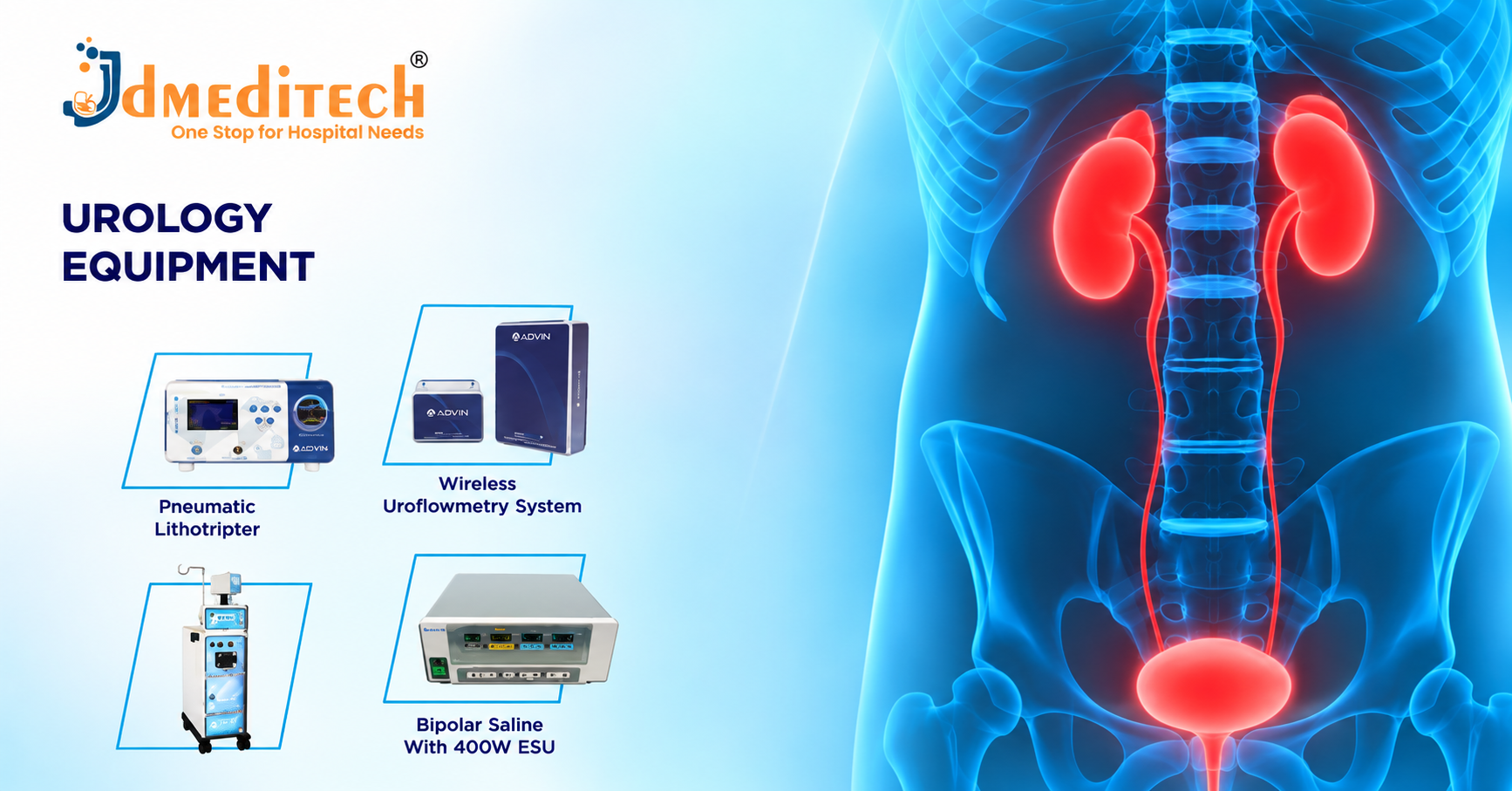
The reference image presents four equipment categories:
- Pneumatic Lithotripter
- Wireless Uroflowmetry System
- Bipolar Saline TURP Equipment
- 400W Electrosurgical Unit
Each category serves a different clinical purpose. Therefore, buyers should review individual product specifications before ordering.
1. Pneumatic Lithotripter
A pneumatic lithotripter is a medical device used to fragment selected urinary stones during endoscopic stone treatment.
Typically, the system generates mechanical impulses that travel through a compatible probe. These impulses help break a stone into smaller fragments.
However, the system requires appropriate instruments, trained operators and manufacturer-approved settings.
Features of a Pneumatic Lithotripter
- Mechanical stone fragmentation technology
- Compatible lithotripsy probe options
- Model-specific operating controls
- Designed for selected endoscopic stone procedures
- Compatible handpiece and connection components
- Manufacturer-defined power or pressure requirements
- System-specific maintenance procedures
Furthermore, exact features depend on the selected model.
Applications of a Pneumatic Lithotripter
Clinicians may use compatible pneumatic lithotripsy systems during selected procedures.
- Ureteroscopic stone fragmentation
- Selected bladder stone procedures
- Selected percutaneous kidney stone procedures
- Other manufacturer-approved stone treatment applications
However, the procedure and instrument combination must match the manufacturer’s intended use.
Benefits of Pneumatic Lithotripsy
Pneumatic lithotripsy provides a mechanical method for urinary stone fragmentation.
Additionally, compatible systems can integrate with selected endoscopic instruments.
Nevertheless, stone movement, incomplete fragmentation and tissue injury remain possible. Therefore, trained specialists must select the appropriate technique.
2. Wireless Uroflowmetry System
A wireless uroflowmetry system measures urine flow during urination and transfers measurement data through a supported wireless connection.
For example, the system may record urine flow rate and voided volume, depending on its configuration.
Furthermore, these measurements can help clinicians evaluate lower urinary tract symptoms.
Features of a Wireless Uroflowmetry System
- Urine flow measurement
- Model-specific wireless data transfer
- Flow rate analysis
- Voided volume measurement
- Urine flow curve generation
- Compatible software interface
- Patient test record functions, where supported
- Manufacturer-defined reporting options
However, customers should verify the actual software functions and wireless connectivity specifications.
Applications of Uroflowmetry
Clinicians may use uroflowmetry as part of an evaluation for urinary symptoms.
- Weak urinary stream
- Difficulty starting urination
- Interrupted urine flow
- Suspected bladder outlet obstruction
- Selected voiding dysfunction assessments
- Monitoring urinary function over time
However, uroflowmetry alone cannot establish every diagnosis. Therefore, clinicians must interpret the results alongside other findings.
Common Uroflowmetry Parameters
Uroflowmetry systems may report several measurements.
- Qmax: Maximum measured urine flow rate
- Qavg: Average urine flow rate
- Voided Volume: Total measured urine volume
- Voiding Time: Duration of the voiding event
- Flow Curve: Graphical representation of urine flow
Additionally, some systems provide other calculated parameters.
Therefore, clinicians should review the device’s measurement definitions and reporting specifications.
Benefits of Wireless Uroflowmetry
Wireless systems may support convenient transfer of measurement data.
Furthermore, compatible software can help clinicians review test results.
However, wireless performance depends on the product, operating environment and software compatibility.
3. Bipolar Saline TURP Equipment
Bipolar saline TURP equipment supports selected transurethral resection procedures involving the prostate.
During bipolar TURP, a compatible electrosurgical system delivers energy through a designated electrode arrangement. The procedure generally uses normal saline irrigation.
However, the exact equipment configuration and operating parameters depend on the manufacturer.
What Is Bipolar TURP?
Bipolar transurethral resection of the prostate is an endoscopic surgical technique used to treat selected patients with urinary obstruction associated with benign prostatic enlargement.
For example, surgeons may remove obstructing prostate tissue using compatible resection instruments.
Furthermore, the system requires appropriate visualization, irrigation and electrosurgical equipment.
Features of Bipolar TURP Systems
- Bipolar electrosurgical energy delivery
- Compatibility with designated resection electrodes
- Normal saline irrigation during the approved procedure
- Model-specific cutting and coagulation modes
- Compatible resectoscope components
- Manufacturer-defined operating settings
- Electrical safety requirements
Additionally, the equipment must match the selected surgical system.
Applications of Bipolar TURP Equipment
Specialists may use approved bipolar TURP systems during selected endoscopic prostate procedures.
For example, the equipment may support surgical management of bladder outlet obstruction caused by benign prostatic enlargement.
However, treatment selection depends on patient assessment, prostate characteristics and clinical guidance.
Potential Benefits of Bipolar TURP
Bipolar TURP allows the use of saline irrigation with compatible equipment.
Furthermore, clinical studies have reported differences in certain perioperative outcomes compared with traditional monopolar techniques.
Nevertheless, bleeding, infection, urinary symptoms and other surgical complications remain possible.
Therefore, surgeons must consider the patient’s individual risks.
4. 400W Electrosurgical Unit
An electrosurgical unit generates controlled electrical energy for compatible surgical cutting and coagulation applications.
The reference image identifies an equipment category labeled 400W ESU. However, this label alone does not establish the exact model, available modes or rated output under each operating condition.
Therefore, hospitals should request the manufacturer’s official technical specifications.
Features of an Electrosurgical Unit
- Model-specific electrosurgical output modes
- Compatible cutting functions
- Compatible coagulation functions
- Operator controls and display
- Electrode and cable connections
- Electrical safety monitoring functions, where provided
- Manufacturer-defined output limits
- Compatible surgical accessory requirements
Furthermore, the actual system functions depend on the selected model.
Applications of Electrosurgical Units
Compatible electrosurgical systems may support selected surgical procedures.
- Endoscopic urology procedures
- Selected tissue cutting applications
- Selected coagulation applications
- Other manufacturer-approved surgical procedures
However, users must confirm that the unit supports the intended electrode and surgical technique.
Importance of Electrosurgical Safety
Electrosurgical systems require careful handling and appropriate training.
For example, incorrect settings or incompatible accessories can cause tissue injury.
Additionally, electrical faults may create hazards for patients and staff.
Therefore, hospitals should follow the manufacturer’s operating and maintenance instructions.
Technical Specifications of Urology Equipment
Exact technical specifications vary by product and manufacturer. Consequently, the following table summarizes the information buyers should verify.
| Equipment | Main Function | Specifications to Verify |
|---|---|---|
| Pneumatic Lithotripter | Mechanical urinary stone fragmentation | Operating pressure, pulse modes, probe compatibility and power requirements |
| Wireless Uroflowmetry System | Urine flow measurement | Flow measurement range, accuracy, connectivity and software functions |
| Bipolar Saline TURP Equipment | Selected endoscopic prostate resection | Energy modes, electrode compatibility, irrigation requirements and system configuration |
| 400W Electrosurgical Unit | Compatible surgical cutting and coagulation | Rated output, operating modes, electrical requirements and accessory compatibility |
Additional Specifications for Procurement
Hospitals should also verify the following details.
- Manufacturer and model number
- Power supply requirements
- Electrical safety classification
- Dimensions and equipment weight
- Available operating modes
- Supplied accessories
- Cleaning and disinfection requirements
- Maintenance schedule
- Warranty and service terms
- Regulatory documentation
- Packaging and shipping details
Furthermore, procurement teams should compare the information with the hospital’s clinical requirements.
Diagnostic Versus Surgical Urology Equipment
Diagnostic devices and surgical systems serve different purposes.
For example, uroflowmetry provides measurements that support urinary function assessment.
In contrast, lithotripsy and electrosurgical systems support selected treatment procedures.
Therefore, equipment selection should reflect the intended clinical service.
| Equipment Type | Example | Primary Purpose |
|---|---|---|
| Diagnostic | Wireless Uroflowmetry System | Urine Flow Assessment |
| Stone Treatment | Pneumatic Lithotripter | Stone Fragmentation |
| Endoscopic Surgery | Bipolar TURP System | Selected Prostate Resection |
| Electrosurgery | Electrosurgical Unit | Compatible Cutting and Coagulation |
How to Choose the Right Urology Equipment
Hospitals should evaluate clinical requirements before purchasing new equipment.
For example, a stone treatment center may need a compatible lithotripsy system.
Meanwhile, a diagnostic urology clinic may prioritize uroflowmetry equipment.
Additionally, operating rooms may require approved electrosurgical systems.
Therefore, buyers should consult clinical and biomedical engineering teams.
Importance of Equipment Compatibility
Compatible instruments help support safe clinical operation.
For example, lithotripsy probes must match the approved handpiece and generator.
Similarly, electrosurgical accessories must match the intended system.
Consequently, hospitals should avoid combining incompatible components.
Importance of Operator Training
Healthcare professionals require appropriate training before operating specialized devices.
For example, staff must understand the equipment controls, safety warnings and operating limitations.
Additionally, clinical teams should follow institutional protocols.
Therefore, hospitals should maintain suitable training records.
Cleaning and Infection Prevention
Urology instruments and equipment require appropriate cleaning practices.
Furthermore, reusable patient-contact accessories may require validated reprocessing procedures.
However, different components have different cleaning requirements.
Therefore, facilities should follow the manufacturer’s instructions for each item.
Routine Equipment Maintenance
Preventive maintenance helps identify equipment problems.
For example, biomedical engineering staff may inspect power connections, cables and control functions.
Additionally, facilities should follow the manufacturer’s calibration and service schedule.
Consequently, defective equipment should remain out of clinical service until appropriately evaluated.
Pre-Use Equipment Inspection
Healthcare staff should inspect equipment before each procedure.
- Check the device’s physical condition
- Inspect power cables and connectors
- Confirm compatible accessories
- Review device warnings and indicators
- Verify cleaning or reprocessing status
- Check the required operating settings
- Confirm applicable safety checks
- Report unusual operation
Furthermore, staff should follow the official pre-use checklist.
Safety Precautions for Urology Devices
Specialized urology equipment requires careful clinical operation.
For example, incorrect instrument handling may cause patient injury.
Additionally, improper electrical connections may create equipment hazards.
Therefore, trained professionals must follow the manufacturer’s instructions and clinical safety protocols.
Potential Risks of Urology Procedures
Different procedures involve different risks.
- Bleeding
- Infection
- Urinary tract injury
- Incomplete stone treatment
- Urinary symptoms after surgery
- Thermal injury during electrosurgery
- Equipment-related complications
However, the risk profile depends on the procedure, patient condition and equipment.
Applications in Hospitals
Hospitals use urology devices across diagnostic and surgical departments.
For example, uroflowmetry supports outpatient urinary assessment.
Meanwhile, compatible surgical systems support selected operating room procedures.
Therefore, hospitals should align procurement with their clinical workload.
Applications in Urology Clinics
Urology clinics may use diagnostic equipment to evaluate urinary symptoms.
Additionally, suitable devices may support follow-up assessments.
However, the equipment must match the clinic’s approved scope of practice.
Applications in Surgical Centers
Surgical centers may require lithotripsy and electrosurgical equipment for selected procedures.
Furthermore, suitable accessories support the approved clinical setup.
Therefore, staff should verify instrument compatibility and safety requirements.
Applications for Medical Distributors
Medical distributors should verify equipment specifications before supplying hospitals.
For example, customers may require particular power configurations or accessory sets.
Additionally, local regulatory requirements may affect product selection.
Consequently, distributors should obtain complete technical documentation.
Why Choose JDMeditech?
JDMeditech supplies medical devices and surgical instruments for urology departments, hospitals and healthcare distributors.
Furthermore, our team can assist customers with product inquiries, available configurations and quotation requests.
- Urology Equipment Inquiries
- Pneumatic Lithotripter Product Information
- Uroflowmetry System Inquiries
- Bipolar TURP Equipment Requests
- Electrosurgical Unit Information
- Technical Specification Support
- International Distributor Inquiries
However, equipment availability, exact specifications and regulatory status require confirmation for the selected model.
Frequently Asked Questions
1. What Is Urology Equipment?
It includes medical devices used to evaluate and treat selected conditions affecting the urinary system.
2. What Is a Pneumatic Lithotripter?
A pneumatic lithotripter uses mechanical impulses to fragment selected urinary stones during an appropriate procedure.
3. What Is Wireless Uroflowmetry?
Wireless uroflowmetry measures urine flow and transfers data through a supported wireless connection.
4. What Does Uroflowmetry Measure?
It measures urine flow parameters, including maximum flow rate and voided volume, depending on the system.
5. What Is Bipolar TURP?
Bipolar TURP is an endoscopic surgical technique used to treat selected patients with obstruction caused by benign prostatic enlargement.
6. Why Does Bipolar TURP Use Saline?
Compatible bipolar systems allow normal saline irrigation during the approved procedure.
7. What Is an Electrosurgical Unit?
An electrosurgical unit delivers controlled electrical energy for compatible surgical cutting and coagulation.
8. Does a 400W Label Confirm Every Output Mode?
No. Buyers must verify the manufacturer’s rated output and available operating modes.
9. Are All Urology Devices Used for Surgery?
No. Some devices support diagnosis, while others support selected surgical procedures.
10. Can Different Accessories Be Interchanged?
Only manufacturer-approved compatible accessories should be used.
11. Does Urology Equipment Require Maintenance?
Yes. Facilities should follow manufacturer-recommended inspection, maintenance and calibration schedules.
12. How Should Urology Equipment Be Cleaned?
Staff should follow the manufacturer’s cleaning and reprocessing instructions for each component.
13. Who Can Operate Urology Equipment?
Appropriately trained healthcare professionals should operate specialized clinical devices.
14. What Should Hospitals Check Before Ordering?
Hospitals should verify clinical compatibility, technical specifications, accessories, power requirements and regulatory documentation.
15. Where Can Customers Request Product Information?
Hospitals and distributors can contact JDMeditech for available product information and quotations.
Conclusion
In conclusion, Urology Equipment supports a wide range of diagnostic and surgical activities.
For example, pneumatic lithotripters support selected stone treatment procedures, while uroflowmetry systems help evaluate urine flow.
Additionally, bipolar TURP systems and electrosurgical units support compatible surgical applications.
Therefore, hospitals should select equipment based on clinical requirements, manufacturer specifications and appropriate safety standards.
JDMeditech – One Stop for Hospital Needs
Website:
www.jdmeditech.com
Related Urology Products
- Pneumatic Lithotripter
- Wireless Uroflowmetry System
- Bipolar TURP System
- Electrosurgical Unit
- Ureteroscope
- Resectoscope
- Urology Surgical Instruments
- PCNL Instruments
- RIRS Instruments
Medical Disclaimer
This article provides general educational and product information only. It does not replace professional medical advice, clinical training or manufacturer instructions. Qualified healthcare professionals must select and operate medical equipment according to approved indications, device specifications and applicable safety requirements.




