



Urology Instruments – Types, Features, Uses and Applications
Urology Instruments are specialized medical tools that support the examination, diagnosis and treatment of conditions affecting the urinary system. Urologists use different instruments during procedures involving the urethra, bladder, ureters, kidneys and prostate.
Furthermore, modern endourology instruments help clinicians perform selected minimally invasive procedures through natural passages or small surgical access routes. However, safe clinical use requires appropriate equipment selection, specialist training and strict adherence to manufacturer instructions.
JDMeditech supplies urology surgical instruments and medical devices for hospitals, urology departments and medical distributors. Additionally, our team can assist customers with product configurations, technical specifications and quotation inquiries.
What Are Urology Instruments?
Urology instruments include endoscopes, surgical sheaths, working elements, forceps, electrodes and other specialized devices.
For example, a cystoscope allows clinicians to examine the urethra and bladder. Meanwhile, a nephroscope provides visualization during selected kidney procedures.
Similarly, a resectoscope supports selected transurethral surgical procedures.
Therefore, hospitals should select instruments according to the intended procedure and system compatibility.
Importance of Urology Surgical Instruments
Specialized instruments support diagnostic and therapeutic procedures in urology.
For instance, endoscopic instruments allow clinicians to visualize internal urinary structures.
Additionally, compatible accessories may support tissue treatment, stone removal or sample collection.
Consequently, the correct instrument configuration plays an important role in procedural planning.
Types of Urology Instruments
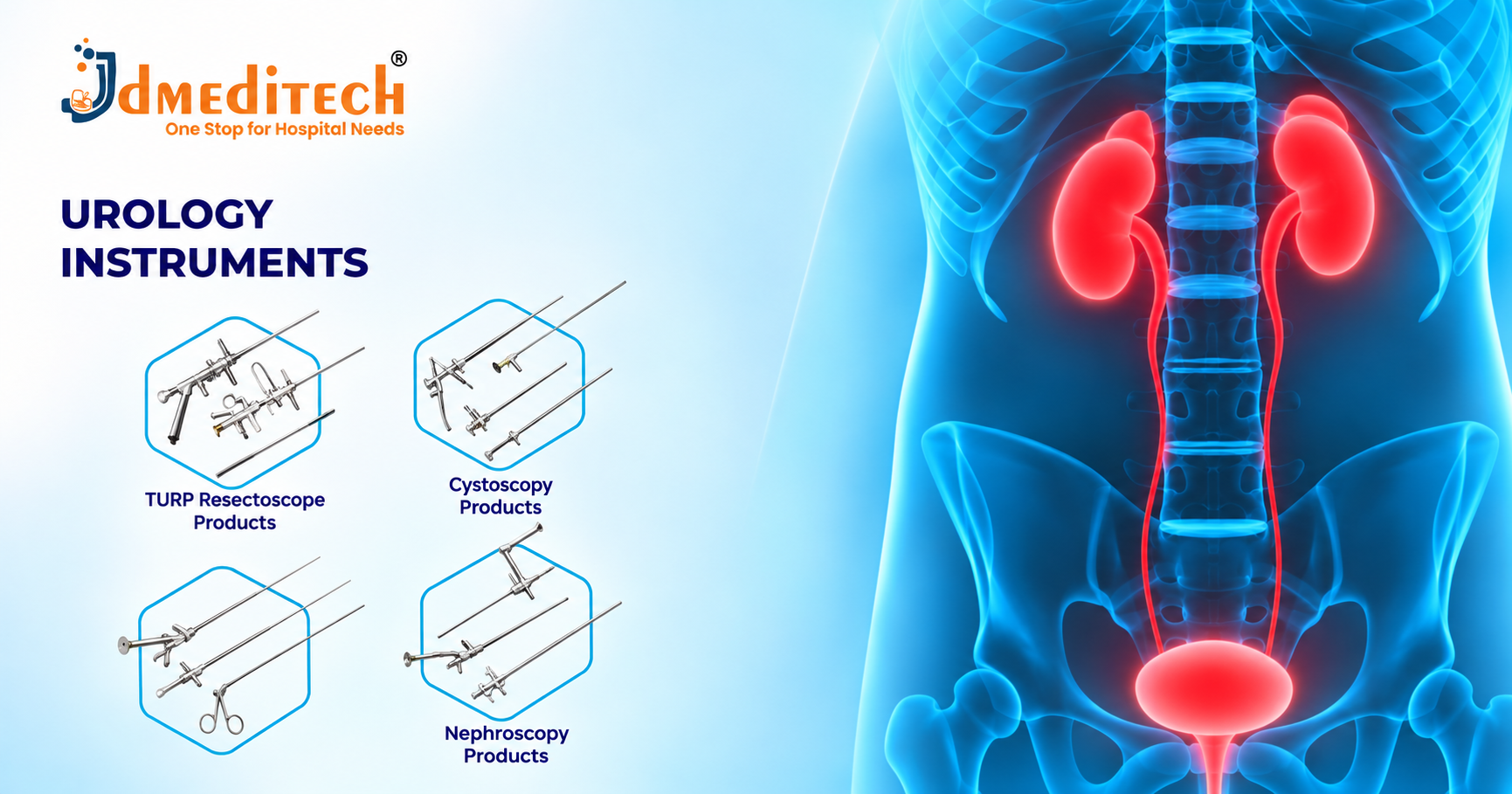
The reference image highlights three main product categories:
- TURP Resectoscope Products
- Cystoscopy Products
- Nephroscopy Products
Each category includes specialized instruments designed for different clinical applications.
1. TURP Resectoscope Products
A TURP resectoscope is an endoscopic surgical instrument used during selected transurethral procedures involving the prostate.
For example, surgeons may use compatible resectoscope systems during transurethral resection of the prostate.
Furthermore, the instrument provides a working channel for designated surgical components.
However, its exact configuration depends on the manufacturer and selected surgical technique.
What Is a TURP Resectoscope?
A resectoscope is a specialized endoscopic instrument that combines visualization with compatible surgical accessories.
Typically, the system includes an outer sheath, optical telescope and working element.
Additionally, compatible electrodes may support cutting or coagulation when connected to an approved energy system.
Components of a TURP Resectoscope System
Depending on the manufacturer, a resectoscope system may include:
- Resectoscope Sheath
- Optical Telescope
- Working Element
- Compatible Cutting Electrode
- Compatible Coagulation Electrode
- Obturator
- Irrigation Connections
- Light Cable Connection
- Manufacturer-Specified Accessories
However, the supplied components vary by product. Therefore, customers should confirm the official packing list.
Resectoscope Sheath
The resectoscope sheath provides an access channel for compatible endoscopic components.
Furthermore, some configurations include irrigation connections.
However, sheath diameter, length and design depend on the selected model.
Optical Telescope
The optical telescope provides visualization during the approved procedure.
Additionally, compatible light and camera systems may support image display.
Therefore, buyers should verify telescope diameter, viewing angle and system compatibility.
Working Element
The working element supports the movement of compatible surgical accessories.
For example, a designated electrode may attach to the working element during an approved procedure.
However, the component must match the selected resectoscope system.
Resectoscope Electrodes
Compatible electrodes may support selected cutting or coagulation applications.
Additionally, different electrode designs serve different clinical purposes.
However, the surgical team must verify energy-system compatibility before use.
Applications of TURP Resectoscope Instruments
Qualified urologists may use compatible resectoscope systems during selected procedures.
- Transurethral Resection of the Prostate
- Selected Endoscopic Bladder Procedures
- Other Manufacturer-Approved Transurethral Procedures
However, each application requires the correct instrument configuration.
Potential Benefits of Resectoscope Systems
Resectoscope systems support endoscopic visualization and selected surgical functions.
Furthermore, compatible accessories allow surgeons to perform designated procedures.
Nevertheless, bleeding, infection, urinary injury and other complications remain possible.
Therefore, clinical teams must follow approved safety protocols.
2. Cystoscopy Products
Cystoscopy products include specialized instruments used to examine the urethra and bladder.
For example, a cystoscope provides direct visualization of the lower urinary tract.
Additionally, compatible working channels may allow selected diagnostic or therapeutic accessories.
What Is a Cystoscope?
A cystoscope is an endoscopic instrument designed for examination of the urethra and bladder.
Depending on the model, clinicians may use a rigid or flexible cystoscope.
Furthermore, compatible light and imaging systems support visualization.
Types of Cystoscopes
Common cystoscope categories include:
- Rigid Cystoscope
- Flexible Cystoscope
- Diagnostic Cystoscope
- Compatible Operative Cystoscopy Systems
However, each instrument has different specifications and approved applications.
Rigid Cystoscope
A rigid cystoscope uses a firm shaft and compatible optical components.
For example, clinicians may select this instrument for designated diagnostic or operative procedures.
Additionally, compatible accessories may support selected interventions.
Flexible Cystoscope
A flexible cystoscope uses a bendable insertion section.
Furthermore, the flexible design may support visualization in selected clinical situations.
However, handling requirements and accessory compatibility depend on the manufacturer.
Components of a Cystoscopy System
A compatible cystoscopy system may include:
- Cystoscope Telescope or Flexible Scope
- Cystoscopy Sheath, where applicable
- Obturator
- Bridge or Working Channel Component
- Irrigation Connections
- Light Cable
- Camera Connection
- Compatible Biopsy Forceps
- Compatible Grasping Forceps
- Other Approved Accessories
Therefore, hospitals should confirm the exact supplied configuration.
Applications of Cystoscopy Instruments
Clinicians may use cystoscopy instruments for selected urinary tract evaluations.
- Assessment of Hematuria
- Evaluation of Selected Bladder Symptoms
- Examination of the Urethra
- Visualization of Bladder Abnormalities
- Selected Biopsy Procedures
- Selected Ureteric Stent Procedures
- Other Approved Endoscopic Applications
However, clinical indications depend on the patient’s condition and specialist assessment.
Potential Benefits of Cystoscopy
Cystoscopy provides direct visualization of the lower urinary tract.
Additionally, compatible accessories may support selected diagnostic and treatment procedures.
Nevertheless, discomfort, infection, bleeding and urinary injury remain possible.
3. Nephroscopy Products
Nephroscopy products include instruments used for visualization and selected procedures within the kidney collecting system.
For example, a nephroscope may support percutaneous kidney stone treatment.
Furthermore, compatible accessories may assist with stone fragmentation and removal.
However, the procedure requires specialized training and appropriate imaging guidance.
What Is a Nephroscope?
A nephroscope is an endoscopic instrument designed for visualization within the kidney collecting system during selected procedures.
Depending on the system, nephroscopes may use rigid or flexible designs.
Additionally, compatible working channels may support designated surgical accessories.
Types of Nephroscopes
Nephroscope categories may include:
- Rigid Nephroscope
- Flexible Nephroscope
- Mini Nephroscope
- Other Manufacturer-Specified Nephroscopy Systems
However, exact classifications and dimensions vary by manufacturer.
Components of a Nephroscopy System
Depending on the selected model, a nephroscopy system may include:
- Nephroscope
- Compatible Access Sheath
- Obturator
- Optical Components
- Irrigation Connections
- Light Cable Connection
- Compatible Grasping Forceps
- Compatible Stone Retrieval Accessories
- Other Manufacturer-Approved Components
Furthermore, separately supplied equipment may be required for the complete procedure.
Applications of Nephroscopy Instruments
Qualified specialists may use nephroscopy instruments during selected kidney procedures.
- Percutaneous Nephrolithotomy
- Selected Kidney Stone Procedures
- Visualization of the Renal Collecting System
- Selected Stone Retrieval Procedures
- Other Manufacturer-Approved Applications
However, procedural suitability depends on the patient’s condition and clinical assessment.
Potential Benefits of Nephroscopy
Nephroscopy supports direct visualization during selected kidney procedures.
Additionally, compatible instruments may assist with stone treatment.
However, bleeding, infection and injury to surrounding structures remain possible.
Therefore, experienced specialists should perform these procedures.
Technical Specifications of Urology Instruments
Technical specifications vary by instrument type and manufacturer. Consequently, buyers should verify the official datasheet for each product.
| Parameter | Details to Verify |
|---|---|
| Product Category | Urology Surgical Instruments |
| Instrument Type | Resectoscope, Cystoscope or Nephroscope |
| Instrument Diameter | Confirm manufacturer datasheet |
| Working Length | Confirm manufacturer datasheet |
| Optical Viewing Angle | Confirm selected telescope specifications |
| Working Channel | Confirm instrument configuration |
| Sheath Diameter | Confirm manufacturer datasheet |
| Instrument Material | Confirm manufacturer specifications |
| Light Source Compatibility | Confirm approved system |
| Camera Compatibility | Confirm approved system |
| Irrigation Compatibility | Confirm manufacturer instructions |
| Electrode Compatibility | Applicable to selected resectoscope systems |
| Reusable or Single-Use | Confirm device labeling |
| Cleaning and Sterilization | Follow validated manufacturer instructions |
| Packaging | Confirm official packing list |
| Regulatory Documentation | Verify for the destination market |
Comparison of Urology Instrument Categories
Different instruments serve different anatomical and procedural applications.
| Instrument | Primary Area | Common Application |
|---|---|---|
| TURP Resectoscope | Prostate and Lower Urinary Tract | Selected Transurethral Resection Procedures |
| Cystoscope | Urethra and Bladder | Lower Urinary Tract Visualization |
| Nephroscope | Kidney Collecting System | Selected Percutaneous Kidney Procedures |
Rigid Versus Flexible Urology Instruments
Rigid and flexible endoscopes offer different design characteristics.
For example, rigid instruments use a firm insertion shaft.
In contrast, flexible instruments include a bendable insertion section.
However, the best option depends on the clinical procedure, anatomy and equipment configuration.
Importance of Optical Quality
Clear visualization supports endoscopic assessment.
For example, compatible optics and illumination help clinicians observe the target anatomy.
Additionally, appropriate camera integration may support image display.
Therefore, hospitals should verify optical and imaging compatibility.
Importance of Instrument Compatibility
Compatible components support proper instrument operation.
For example, a working element must match its designated resectoscope sheath and telescope.
Similarly, nephroscopy accessories must fit the approved working channel.
Consequently, hospitals should avoid mixing incompatible components.
Importance of Correct Instrument Selection
Instrument selection depends on the procedure and patient requirements.
For example, a cystoscopy examination requires a suitable cystoscope.
Meanwhile, selected kidney stone procedures may require nephroscopy instruments.
Therefore, procurement teams should consult qualified urologists.
Cleaning and Reprocessing
Reusable urology instruments require appropriate cleaning and reprocessing.
Furthermore, devices with internal channels may require specific cleaning procedures.
However, reprocessing requirements vary by manufacturer and device design.
Therefore, facilities must follow validated instructions for each instrument.
Inspection Before Use
Healthcare professionals should inspect instruments before clinical use.
- Check the instrument shaft
- Inspect optical components
- Examine working channels
- Verify sheath compatibility
- Inspect connection points
- Check accessory movement
- Confirm reprocessing status
- Review device labeling
- Remove damaged instruments from service
Additionally, staff should follow the manufacturer’s pre-use checklist.
Handling and Storage
Proper handling helps protect delicate instruments.
For example, staff should avoid unnecessary bending or impact.
Additionally, suitable trays and holders may help protect compatible instruments during storage and transport.
Therefore, hospitals should follow manufacturer storage recommendations.
Safety Precautions
Qualified healthcare professionals must use urology instruments only for approved indications.
Furthermore, the clinical team should verify accessory compatibility and instrument condition.
Therefore, staff must follow institutional safety protocols and manufacturer instructions.
Potential Risks of Endourology Procedures
Endoscopic urology procedures may involve several risks.
- Bleeding
- Infection
- Urinary Tract Injury
- Perforation
- Postoperative Discomfort
- Instrument-Related Complications
- Incomplete Treatment
However, the risk profile depends on the procedure, patient condition and instrument configuration.
Applications in Hospitals
Hospitals use specialized instruments for diagnostic and surgical urology procedures.
For example, cystoscopy systems support selected lower urinary tract examinations.
Additionally, resectoscope and nephroscope systems support designated surgical applications.
Therefore, equipment selection should reflect departmental requirements.
Applications in Urology Departments
Urology departments may require multiple endoscopic instrument systems.
Furthermore, compatible accessories support different procedural workflows.
However, clinicians must verify the intended use of each instrument.
Applications in Surgical Centers
Surgical centers may use approved resectoscope and nephroscope systems for selected procedures.
Additionally, appropriate instrument preparation supports operating room organization.
Therefore, staff should verify instrument condition and reprocessing status.
Applications for Medical Distributors
Medical distributors should verify instrument specifications before supplying healthcare facilities.
For example, buyers may request specific sheath diameters, telescope angles or accessory configurations.
Consequently, distributors should obtain the official datasheet and packing list.
How to Choose Urology Surgical Instruments
Hospitals and procurement teams should consider several factors before purchasing.
- Manufacturer’s intended use
- Instrument dimensions
- Optical specifications
- Working channel size
- Sheath compatibility
- Accessory compatibility
- Material specifications
- Cleaning and sterilization requirements
- Reusable or single-use designation
- Official product documentation
- Regulatory status
- Service and replacement component availability
Furthermore, clinicians should confirm the complete procedural configuration.
Why Choose JDMeditech?
JDMeditech supplies urology surgical instruments and medical devices for hospitals, specialist departments and medical distributors.
Furthermore, our team can assist customers with product information, available configurations and technical inquiries.
- TURP Resectoscope Product Inquiries
- Cystoscopy Instrument Requests
- Nephroscopy Instrument Information
- Technical Specification Support
- Available Accessory Configuration Requests
- Medical Distributor Inquiries
- International Export Inquiries
However, exact product specifications, availability and regulatory documentation require confirmation.
Frequently Asked Questions
1. What Are Urology Instruments?
They are specialized medical tools used during selected diagnostic and surgical procedures involving the urinary system.
2. What Is a TURP Resectoscope?
A TURP resectoscope is an endoscopic instrument used during selected transurethral prostate procedures.
3. What Is a Cystoscope?
A cystoscope allows clinicians to examine the urethra and bladder.
4. What Is a Nephroscope?
A nephroscope supports visualization during selected kidney collecting system procedures.
5. What Is the Difference Between a Cystoscope and Nephroscope?
A cystoscope primarily supports lower urinary tract visualization. In contrast, a nephroscope supports selected kidney procedures.
6. Are Urology Instruments Reusable?
Some instruments are reusable, while others are single-use. Therefore, customers should check the device labeling.
7. Are All Resectoscope Components Interchangeable?
No. Components must match the manufacturer’s approved system configuration.
8. What Sizes Are Available?
Available sizes vary by instrument and manufacturer. Therefore, buyers should request the official datasheet.
9. Can Cystoscopes Support Biopsy Procedures?
Compatible operative cystoscopy systems may support selected biopsy accessories. However, the intended use determines suitability.
10. What Is the Purpose of a Nephroscope in PCNL?
A nephroscope provides visualization and may support compatible stone treatment accessories during selected PCNL procedures.
11. Do Urology Instruments Require Sterilization?
Reusable instruments require manufacturer-validated reprocessing. Therefore, facilities must follow the applicable instructions.
12. How Should Instruments Be Stored?
Facilities should follow manufacturer storage recommendations and protect delicate components from damage.
13. Who Can Use Urology Instruments?
Appropriately trained healthcare professionals should use specialized clinical instruments.
14. What Should Hospitals Verify Before Ordering?
Hospitals should confirm dimensions, compatibility, intended use, reprocessing requirements and regulatory documentation.
15. Where Can Customers Request Product Information?
Hospitals and medical distributors can contact JDMeditech for available product information and quotations.
Conclusion
In conclusion, Urology Instruments support a wide range of diagnostic and surgical procedures.
For example, TURP resectoscopes support selected transurethral operations, while cystoscopes provide lower urinary tract visualization.
Additionally, nephroscopes support selected kidney procedures.
Therefore, hospitals should select compatible instruments based on clinical requirements, manufacturer specifications and appropriate safety standards.
JDMeditech – One Stop for Hospital Needs
Website:
www.jdmeditech.com
Related Urology Products
- TURP Resectoscope
- Resectoscope Sheath
- Resectoscope Working Element
- Cystoscope
- Cystoscopy Sheath
- Nephroscope
- Mini Nephroscope
- Urology Grasping Forceps
- Urology Biopsy Forceps
- Ureteroscope
Medical Disclaimer
This article provides general educational and product information only. It does not replace professional medical advice, clinical training or manufacturer instructions. Qualified healthcare professionals must select and use instruments according to approved indications, device specifications and applicable safety requirements.




