



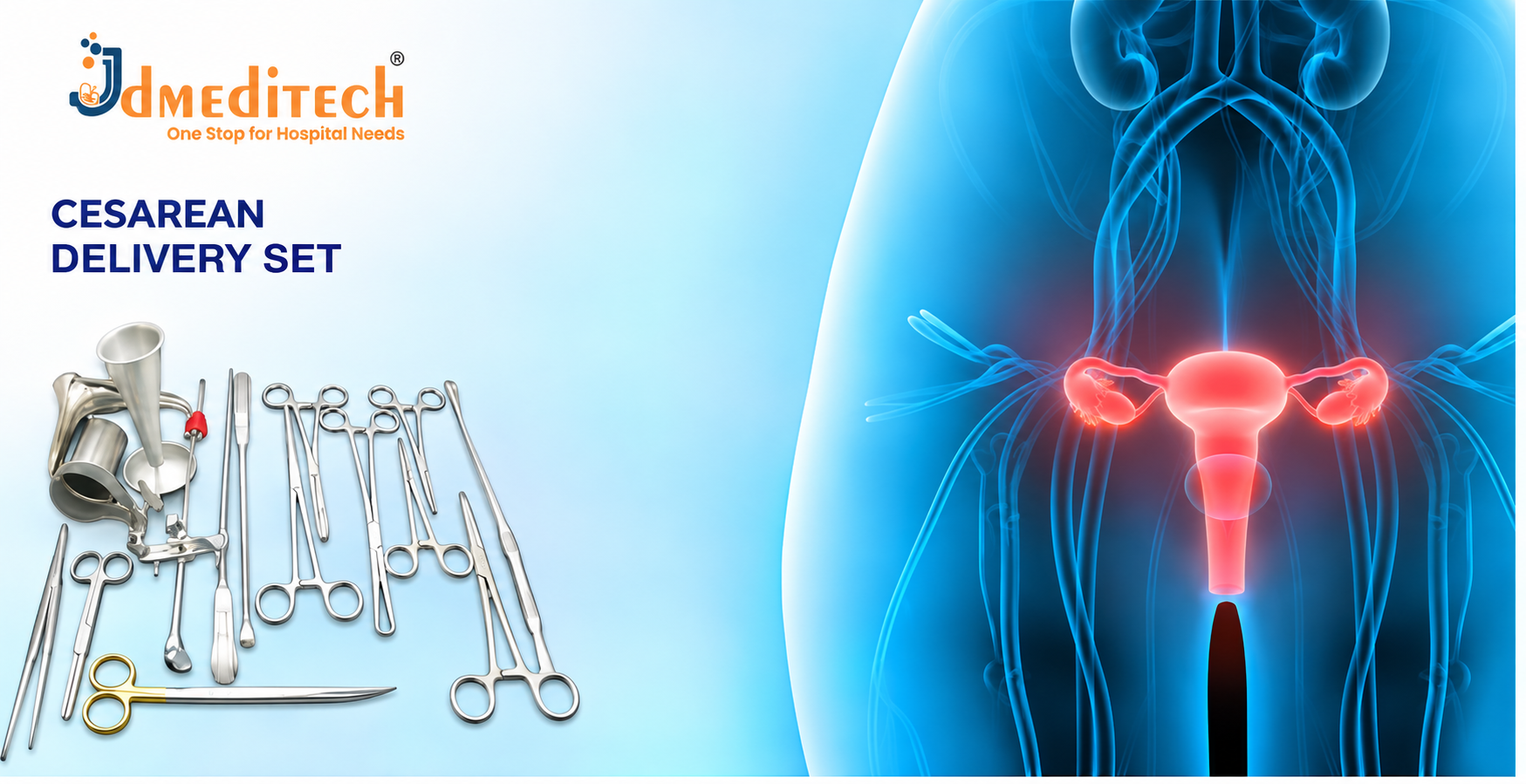
Cesarean Delivery Set – Instruments, Features, Uses and Benefits
A Cesarean Delivery Set is a collection of surgical instruments used during cesarean section procedures. Obstetric surgeons use suitable instruments for surgical exposure, tissue handling, dissection, hemostasis and suturing during childbirth through abdominal and uterine incisions.
Furthermore, a well-organized surgical instrument set supports operating room preparation. As a result, hospitals can maintain a defined inventory of instruments for planned and emergency cesarean procedures.
JDMeditech supplies obstetric and gynecology surgical instruments for hospitals, maternity centers and medical distributors. Additionally, customers can contact our team for available configurations, technical specifications and quotation inquiries.
What Is a Cesarean Delivery Set?
A cesarean delivery instrument set contains surgical tools selected for operative childbirth.
For example, the set may include artery forceps, tissue forceps, retractors, surgical scissors, needle holders and other procedure-specific instruments.
Additionally, some configurations include specialized obstetric instruments and instrument trays.
However, the exact instrument list depends on the manufacturer, surgeon preferences and hospital requirements.
What Is a Cesarean Section?
A cesarean section, also called a C-section, is a surgical procedure in which an obstetric surgeon delivers a baby through incisions in the mother’s abdomen and uterus.
Clinicians may recommend this procedure when vaginal birth presents particular risks or when other medical indications arise.
Furthermore, the operation requires coordinated care from obstetric, anesthesia, nursing and newborn care teams.
However, the decision to perform a cesarean section depends on the patient’s clinical circumstances.
Importance of a Complete Cesarean Instrument Set
Cesarean surgery requires instruments for several surgical tasks.
For instance, retractors help expose the operative field, while forceps support controlled tissue handling.
Additionally, scissors and needle holders assist with selected cutting and suturing activities.
Therefore, operating room teams should confirm the required instruments before surgery.
Common Instruments in a Cesarean Delivery Set
Depending on the selected configuration, a cesarean surgical instrument set may include:
- Artery Forceps
- Dissecting Forceps
- Allis Tissue Forceps
- Kocher Forceps
- Sponge Holding Forceps
- Surgical Scissors
- Needle Holders
- Abdominal Retractors
- Bladder Retractors
- Hemostatic Forceps
- Scalpel Handle
- Instrument Bowl
- Kidney Tray
- Other Hospital-Specified Instruments
However, this list describes common instrument categories rather than the confirmed packing list of the pictured set.
1. Artery Forceps
Artery forceps are locking surgical instruments used to grasp and clamp selected vessels or tissues.
For example, surgeons may use appropriate hemostatic forceps during selected stages of an operation.
Additionally, straight and curved patterns offer different handling characteristics.
Therefore, hospitals should verify the required forceps models and sizes.
2. Dissecting Forceps
Dissecting forceps support controlled tissue handling during surgical procedures.
Furthermore, toothed and non-toothed patterns suit different applications.
For instance, surgeons select the tip design according to the tissue and intended task.
However, the exact instrument choice depends on clinical requirements.
3. Allis Tissue Forceps
Allis forceps provide a firm grip on selected tissues.
Additionally, their jaw design supports tissue handling during appropriate surgical applications.
However, unsuitable use may cause tissue trauma.
Therefore, trained surgeons should select them carefully.
4. Kocher Forceps
Kocher forceps are locking instruments with a specialized toothed gripping design.
For example, they may support selected firm-tissue handling tasks.
However, the jaw design is not appropriate for every tissue type.
5. Sponge Holding Forceps
Sponge holding forceps hold compatible surgical sponges.
Furthermore, healthcare teams may use them during selected preparation and operative tasks.
Additionally, different patterns and lengths are available.
6. Surgical Scissors
Surgical scissors support cutting and dissection during operations.
For example, different scissors may suit delicate tissue or heavier surgical tasks.
Furthermore, straight and curved designs provide different handling options.
However, clinicians must use the correct instrument for each application.
7. Needle Holders
Needle holders support controlled handling of surgical needles during suturing.
Additionally, different jaw patterns and lengths are available.
Therefore, the selected holder must suit the needle and suture material.
8. Abdominal Retractors
Abdominal retractors help maintain surgical exposure.
For example, an appropriate retractor may hold selected tissues away from the operative field.
Furthermore, different designs suit different anatomical requirements.
However, excessive retraction may cause tissue injury.
9. Bladder Retractors
Bladder retractors are specialized instruments used during selected pelvic and abdominal procedures.
Additionally, they may help protect or retract adjacent tissues during appropriate surgical techniques.
However, surgeons must select and position them according to the planned operation.
10. Hemostatic Forceps
Hemostatic forceps assist with selected vessel or tissue clamping tasks.
Furthermore, manufacturers offer different jaw patterns and instrument lengths.
Therefore, instrument selection must match the intended surgical application.
11. Scalpel Handle
A scalpel handle holds a compatible surgical blade.
For example, surgeons use appropriate blade and handle combinations during selected incision procedures.
Additionally, blade compatibility depends on the handle design.
Therefore, operating teams should verify the required configuration.
12. Instrument Bowl and Kidney Tray
Instrument bowls and kidney trays support the organization of compatible surgical materials.
Furthermore, different sizes and materials are available.
However, buyers should confirm whether these accessories form part of the selected set.
Features of Cesarean Surgical Instruments
Individual instruments may offer the following characteristics, depending on their design and manufacturer.
- Specialized Obstetric Instrument Patterns
- Manufacturer-Specified Surgical Metal
- Different Instrument Lengths
- Straight and Curved Configurations
- Different Jaw and Tip Designs
- Locking Mechanisms, Where Applicable
- Reusable Options, Where Specified
- Compatibility With Validated Reprocessing Methods
- Hospital-Specific Instrument Configurations
However, buyers should verify the actual features against the official product documentation.
Clinical Applications of Cesarean Instruments
Qualified healthcare professionals use suitable instruments during selected obstetric surgical procedures.
- Planned Cesarean Section
- Emergency Cesarean Section
- Selected Obstetric Surgical Procedures
- Other Manufacturer-Approved Surgical Applications
However, the required equipment depends on the patient’s condition and the planned surgical technique.
Application in Planned Cesarean Section
Some patients undergo a planned cesarean delivery for an established medical indication.
Furthermore, the surgical team prepares suitable instruments and equipment before the procedure.
Additionally, clinicians coordinate anesthesia, obstetric and newborn care.
Application in Emergency Cesarean Section
Emergency cesarean delivery may become necessary when urgent maternal or fetal concerns arise.
For example, certain labor complications may require prompt operative delivery.
Therefore, maternity hospitals should maintain appropriate emergency surgical readiness.
However, instrument availability represents only one part of emergency care preparation.
Common Clinical Indications for Cesarean Delivery
Clinicians may recommend cesarean delivery for selected maternal or fetal conditions.
- Selected Abnormal Fetal Presentations
- Placenta Previa
- Some Cases of Labor Arrest
- Selected Fetal Heart Rate Concerns
- Certain Previous Uterine Surgeries
- Other Maternal or Fetal Medical Indications
However, the decision depends on individual clinical assessment and available treatment options.
Overview of the Cesarean Delivery Procedure
A qualified obstetric surgeon performs cesarean delivery in an appropriately equipped operating room.
First, the clinical team completes the necessary patient checks and prepares the operating environment.
Next, the anesthesia team provides the selected anesthetic care.
During surgery, the obstetric team follows the planned technique for operative childbirth.
Afterward, healthcare professionals monitor the mother and newborn.
However, the exact procedure varies according to the clinical situation.
Importance of Operating Room Preparation
Appropriate preparation supports safe obstetric surgical care.
For example, operating room staff verify the instrument set and sterile supplies.
Additionally, the team confirms the availability of anesthesia and newborn care equipment.
Furthermore, hospitals follow established surgical safety and infection prevention protocols.
Technical Specifications of a Cesarean Delivery Set
Exact instrument specifications vary by manufacturer. Therefore, customers should request the official packing list and technical datasheet.
| Parameter | Details to Verify |
|---|---|
| Product Name | Cesarean Delivery Set |
| Alternative Name | C-Section Surgical Instrument Set |
| Medical Specialty | Obstetrics and Gynecology |
| Intended Application | Cesarean Section Procedures |
| Instrument Quantity | Confirm Official Packing List |
| Instrument Patterns | Confirm Selected Configuration |
| Instrument Lengths | Confirm Manufacturer Datasheet |
| Material | Confirm Manufacturer Specifications |
| Jaw and Tip Designs | Depend on Individual Instruments |
| Locking Mechanisms | Verify Where Applicable |
| Reusable Status | Confirm Product Labeling |
| Cleaning Requirements | Follow Manufacturer Instructions |
| Sterilization Compatibility | Confirm Validated Reprocessing Method |
| Instrument Tray | Verify Whether Included |
| Packaging | Confirm Official Packing List |
| Regulatory Documentation | Verify for Destination Market |
Instrument Categories and Their Functions
Different surgical instruments support different tasks during cesarean procedures.
| Instrument Category | General Function |
|---|---|
| Artery Forceps | Selected Vessel and Tissue Clamping |
| Dissecting Forceps | Controlled Tissue Handling |
| Allis Forceps | Grasping Selected Tissues |
| Surgical Scissors | Cutting and Dissection |
| Needle Holders | Handling Surgical Needles |
| Abdominal Retractors | Supporting Surgical Exposure |
| Bladder Retractors | Selected Tissue Retraction |
| Scalpel Handle | Holding Compatible Surgical Blades |
Potential Benefits of an Organized Cesarean Instrument Set
An organized surgical set helps operating teams prepare for cesarean delivery.
For example, a defined instrument list supports inventory verification.
Additionally, standardized instrument organization may simplify preparation.
Furthermore, procurement teams can review instrument requirements before ordering.
However, the instrument set alone does not determine surgical outcomes.
Cesarean Delivery Set Versus Normal Delivery Set
A cesarean instrument set contains tools selected for abdominal and uterine surgery.
In contrast, a normal vaginal delivery set contains instruments for vaginal childbirth and related care.
Furthermore, the two sets differ in their surgical requirements and intended applications.
Therefore, hospitals should maintain appropriate equipment for both services when offered.
Cesarean Delivery Set Versus Gynecology Surgery Set
A cesarean set focuses on instruments selected for operative childbirth.
Meanwhile, a general gynecology surgery set may support other pelvic or reproductive system procedures.
Additionally, some instrument categories overlap.
However, hospitals should verify the required configuration for each operation.
Importance of Instrument Quality
Obstetric surgical instruments require suitable construction and reliable function.
For example, forceps should provide the intended gripping action.
Similarly, scissors should maintain appropriate cutting performance.
Therefore, hospitals should inspect instruments and follow maintenance recommendations.
Importance of Correct Instrument Selection
Different surgical tasks require different instrument designs.
For instance, retractors must suit the required exposure.
Additionally, forceps and clamps must match the intended tissue handling application.
Consequently, the surgical team should confirm the instrument configuration before use.
Cleaning and Decontamination
Reusable cesarean instruments require appropriate cleaning after use.
Furthermore, cleaning removes contamination before further reprocessing.
However, different instruments may require different cleaning methods.
Therefore, staff must follow validated manufacturer instructions.
Sterilization Requirements
Reusable surgical instruments require validated sterilization when their intended use requires sterility.
For example, some reusable metal instruments support steam sterilization.
However, sterilization compatibility depends on the instrument material and design.
Therefore, facilities must follow the manufacturer’s approved reprocessing instructions.
Instrument Inspection Before Surgery
Operating room teams should inspect surgical instruments before use.
- Confirm Instrument Identification
- Inspect Surfaces for Damage
- Verify Jaw Alignment
- Check Locking Mechanisms
- Inspect Cutting Edges
- Confirm Instrument Cleanliness
- Verify Sterilization Status
- Confirm Required Instrument Quantities
Furthermore, staff should remove damaged instruments from clinical use.
Storage and Handling
Proper storage helps protect reusable surgical instruments.
For example, facilities should use suitable instrument trays and containers.
Additionally, staff should avoid conditions that promote corrosion or mechanical damage.
Consequently, correct handling supports instrument maintenance and traceability.
Potential Risks of Cesarean Delivery
Cesarean delivery is a major surgical procedure with potential complications.
- Bleeding and Hemorrhage
- Infection
- Bladder or Bowel Injury
- Blood Clots
- Anesthesia-Related Complications
- Postoperative Pain
- Wound Complications
- Risks in Future Pregnancies
- Other Maternal or Newborn Complications
However, individual risks depend on the patient’s condition and clinical circumstances.
Safety Precautions During Cesarean Surgery
Qualified obstetric surgeons should perform cesarean delivery according to established clinical protocols.
Furthermore, operating teams must verify instrument availability and sterile status.
Additionally, appropriate anesthesia, infection prevention and newborn care remain essential.
Therefore, hospitals should follow institutional surgical safety procedures.
Applications in Maternity Hospitals
Maternity hospitals maintain suitable equipment for planned and emergency childbirth procedures.
Furthermore, surgical teams may use selected instruments during cesarean delivery.
However, the required configuration depends on hospital protocols.
Applications in Obstetrics Departments
Obstetrics departments require specialized instruments for operative childbirth.
For example, surgeons may request particular retractors, forceps and scissors.
Additionally, emergency readiness requires suitable equipment and trained personnel.
Applications in Surgical Centers
Appropriately equipped surgical centers may maintain dedicated obstetric instrument sets.
Furthermore, standardized sets can support preparation and instrument counting.
However, facilities must verify the complete instrument list and clinical capabilities.
Applications for Medical Distributors
Medical distributors should confirm instrument patterns and quantities before supplying healthcare facilities.
For example, buyers may request specific instruments or customized configurations.
Additionally, destination-market regulations may affect documentation requirements.
Consequently, distributors should request the official technical specifications.
How to Choose a Cesarean Delivery Instrument Set
Hospitals and procurement teams should review several factors before purchasing.
- Intended Surgical Application
- Complete Instrument Packing List
- Instrument Quantities
- Required Instrument Patterns
- Instrument Lengths
- Material Specifications
- Jaw and Tip Designs
- Reusable Status
- Cleaning Requirements
- Sterilization Compatibility
- Instrument Tray Requirements
- Packaging
- Regulatory Documentation
Furthermore, the operating surgeon should confirm the selected configuration.
Why Choose JDMeditech?
JDMeditech supplies gynecology and obstetric surgical instruments for hospitals, maternity centers and medical distributors.
Furthermore, our team can assist customers with available configurations, technical information and quotation requests.
- Cesarean Delivery Instrument Set Inquiries
- Obstetric Surgical Instrument Information
- Gynecology Instrument Requests
- Instrument Configuration Support
- Technical Specification Assistance
- Medical Distributor Inquiries
- International Export Inquiries
However, exact instrument quantities, product availability and regulatory documentation require confirmation.
Frequently Asked Questions
1. What Is a Cesarean Delivery Set?
It is a collection of surgical instruments used during cesarean section procedures.
2. What Is a Cesarean Section?
It is a surgical procedure in which an obstetric surgeon delivers a baby through abdominal and uterine incisions.
3. What Instruments Are Commonly Included?
Common categories include forceps, scissors, retractors, needle holders and other surgical instruments. However, exact contents vary.
4. Are All Cesarean Instrument Sets the Same?
No. Instrument patterns and quantities vary according to manufacturer and hospital requirements.
5. What Is the Purpose of Abdominal Retractors?
They help maintain surgical exposure during selected abdominal procedures.
6. What Are Artery Forceps Used For?
They support selected tissue or vessel clamping tasks.
7. What Is the Purpose of Needle Holders?
They support controlled handling of surgical needles during suturing.
8. Are Cesarean Instruments Reusable?
Many surgical instruments are reusable. However, buyers should confirm the labeling of each product.
9. Can These Instruments Be Steam Sterilized?
Some reusable metal instruments support steam sterilization. Nevertheless, facilities must verify the validated method.
10. What Materials Are Used?
Material specifications vary by manufacturer and instrument model.
11. Can Hospitals Request a Customized Set?
Configuration options depend on the supplier. Therefore, customers should confirm available choices.
12. Does the Set Include an Instrument Tray?
Not necessarily. Buyers should verify the official packing list.
13. Who Can Use These Instruments?
Appropriately trained surgical healthcare professionals should use the instruments according to their intended purpose.
14. What Should Hospitals Check Before Ordering?
Hospitals should confirm instrument patterns, quantities, material, reprocessing requirements and regulatory documentation.
15. Where Can Customers Request Product Information?
Hospitals, maternity centers and medical distributors can contact JDMeditech for available product information and quotations.
Conclusion
In conclusion, a Cesarean Delivery Set provides specialized instruments for operative childbirth.
For example, retractors support exposure, while forceps and scissors assist with selected surgical tasks.
Additionally, needle holders support suturing during appropriate procedures.
Therefore, hospitals should select instrument sets according to surgical requirements, manufacturer specifications and established safety protocols.
JDMeditech – One Stop for Hospital Needs
Website:
www.jdmeditech.com
Related Obstetric and Gynecology Products
- Normal Delivery Set
- Vaginal Hysterectomy Set
- Gynecology Surgical Instruments
- Artery Forceps
- Dissecting Forceps
- Surgical Scissors
- Needle Holders
- Abdominal Retractors
- Delivery Table
- Gynecology Operation Table
Medical Disclaimer
This article provides general educational and product information only. It does not replace professional medical advice, obstetric training or manufacturer instructions. Qualified healthcare professionals must select and use surgical instruments according to approved indications, product specifications and applicable safety requirements.




