



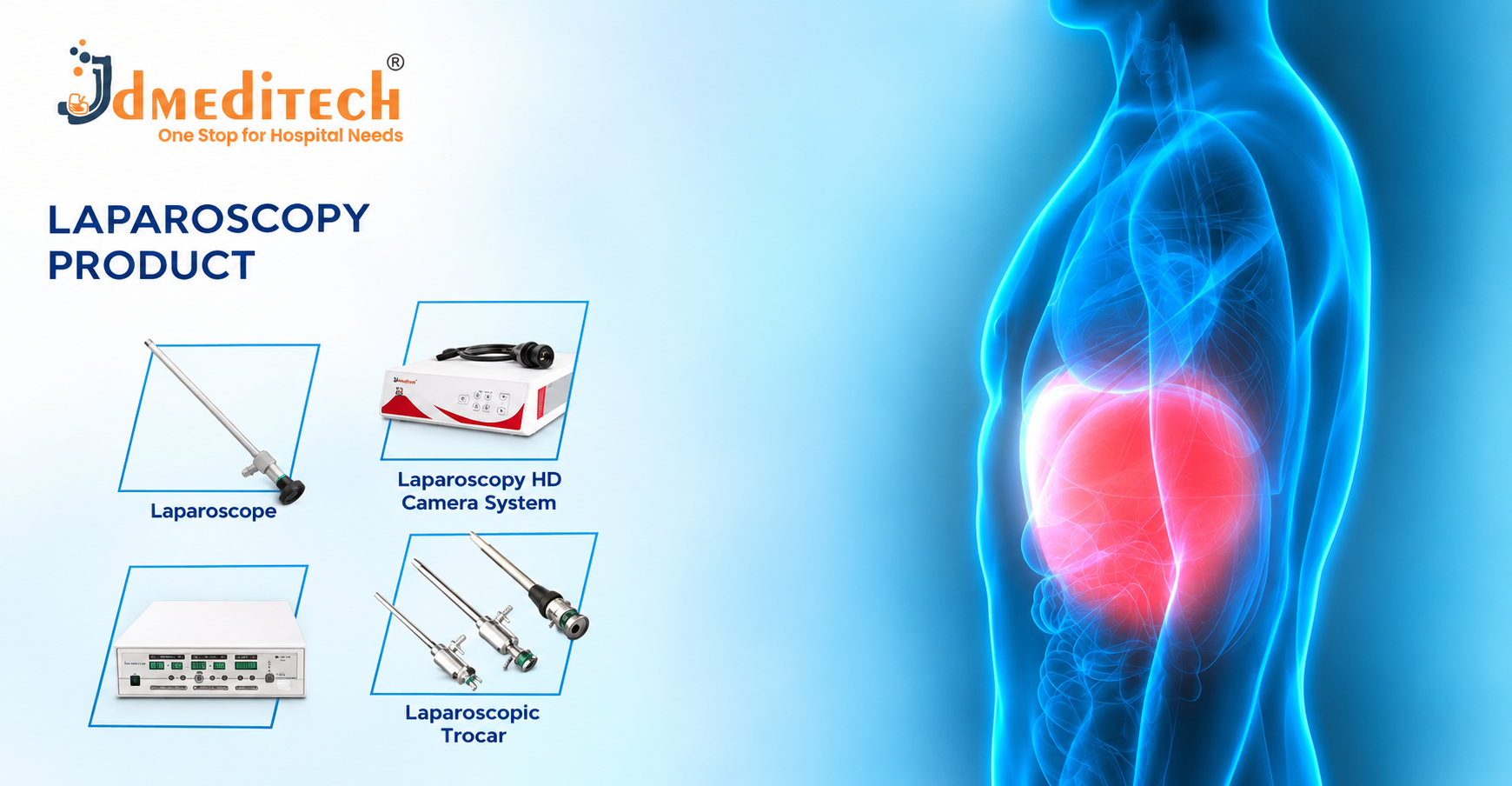
Laparoscopy Products – Instruments, Equipment, Features and Applications
Laparoscopy Products include specialized instruments and equipment used during minimally invasive surgical procedures. Surgeons use these devices to view internal anatomy, access the operative area and perform selected surgical tasks through small incisions.
Furthermore, modern laparoscopic systems combine visualization equipment with compatible access instruments. As a result, surgical teams can perform many procedures without a large traditional abdominal incision.
JDMeditech supplies laparoscopy instruments and surgical equipment for hospitals, surgical centers and medical distributors. Additionally, customers can contact our team for available configurations, technical information and quotation requests.
What Is Laparoscopy?
Laparoscopy is a minimally invasive surgical technique that allows surgeons to examine or operate inside the abdomen or pelvis using specialized instruments.
During the procedure, a laparoscope provides images of internal structures. Meanwhile, suitable access devices allow the surgical team to introduce compatible instruments.
However, not every patient or surgical condition is suitable for laparoscopy. Therefore, surgeons evaluate the clinical indication before choosing the approach.
What Are Laparoscopic Surgical Instruments?
Laparoscopic surgical instruments are devices designed for use during minimally invasive operations.
For example, a laparoscope supports visualization, while trocars provide controlled access through the abdominal wall.
Additionally, camera systems, light sources and other compatible equipment support the surgical workflow.
Therefore, hospitals should select instruments according to the intended procedure and equipment compatibility.
Major Categories of Laparoscopy Equipment
A laparoscopic surgical system may include several product categories.
- Laparoscope
- Laparoscopic HD Camera System
- Laparoscopic Trocars
- Camera Control Unit
- Compatible Surgical Monitor
- Endoscopic Light Source
- Fiber Optic Light Cable
- CO2 Insufflator
- Laparoscopic Hand Instruments
- Suction and Irrigation Instruments
- Electrosurgical Equipment
- Other Procedure-Specific Accessories
However, the exact equipment supplied depends on the selected product configuration.
1. Laparoscope
A laparoscope is an optical instrument used to visualize internal anatomy during minimally invasive surgery.
Furthermore, the instrument connects to compatible visualization equipment to display the operative field.
For example, surgeons use laparoscopes during selected abdominal and pelvic procedures.
However, laparoscope diameter, viewing angle and length vary by model.
Features of a Laparoscope
- Specialized Optical Design
- Different Available Viewing Angles
- Different Instrument Diameters
- Compatibility With Selected Camera Systems
- Compatibility With Appropriate Light Sources
- Manufacturer-Specified Reprocessing Requirements
Additionally, hospitals should verify the exact optical and mechanical specifications before ordering.
Applications of a Laparoscope
Surgeons use compatible laparoscopes in selected minimally invasive procedures.
- Diagnostic Laparoscopy
- Laparoscopic Cholecystectomy
- Laparoscopic Appendectomy
- Selected Gynecological Procedures
- Selected Urological Procedures
- Other Approved Laparoscopic Applications
However, the appropriate instrument depends on the procedure and surgeon preference.
2. Laparoscopic HD Camera System
A laparoscopic HD camera system captures and processes images from a compatible laparoscope.
Furthermore, the system helps display the surgical field on an appropriate monitor.
As a result, the operating team can view anatomical structures during selected procedures.
However, image quality depends on the camera, optics, light source, monitor and system settings.
Features of a Laparoscopic Camera System
- Manufacturer-Specified Video Resolution
- Compatible Camera Head
- Camera Control Functions
- Connection to Compatible Surgical Monitors
- Image Adjustment Options, Where Available
- Compatible Optical Interfaces
- Model-Specific Video Output Options
Therefore, customers should request the official technical datasheet for the selected camera model.
Applications of Laparoscopic Camera Systems
Healthcare facilities use compatible camera systems for visualization during selected endoscopic procedures.
For example, surgeons may use the system during laparoscopic abdominal operations.
Additionally, suitable configurations may support selected pelvic procedures.
However, equipment compatibility must be confirmed before clinical use.
3. Laparoscopic Trocars
Laparoscopic trocars are access devices used to create or maintain instrument entry ports during selected minimally invasive procedures.
Furthermore, compatible cannulas allow surgeons to introduce appropriate laparoscopic instruments.
However, trocar design, diameter and length vary according to the manufacturer.
Features of Laparoscopic Trocars
- Different Available Diameters
- Different Cannula Lengths
- Manufacturer-Specified Tip Designs
- Compatible Instrument Access Channels
- Selected Valve and Seal Configurations
- Reusable or Single-Use Options, Where Available
Additionally, hospitals should confirm the intended application and compatible instrument sizes.
Applications of Laparoscopic Trocars
Surgeons use appropriate trocars during selected minimally invasive procedures.
For instance, a compatible trocar may provide access for a laparoscope.
Similarly, additional ports may accommodate approved surgical instruments.
However, trocar placement and selection require surgical training and clinical judgment.
4. Laparoscopic Camera Control Unit
A camera control unit processes image signals from a compatible endoscopic camera head.
Furthermore, certain models provide image adjustment and video output functions.
However, available controls depend on the selected equipment.
Therefore, buyers should verify supported camera heads and monitor interfaces.
5. Endoscopic Light Source
An endoscopic light source provides illumination for compatible laparoscopic visualization systems.
Additionally, a suitable light cable transfers illumination to the laparoscope.
However, excessive light intensity or inappropriate equipment handling can create safety risks.
Therefore, surgical teams must follow the manufacturer’s instructions.
6. Fiber Optic Light Cable
A fiber optic light cable connects compatible illumination equipment to an endoscope.
Furthermore, different cable designs and connectors are available.
However, compatibility varies between equipment models.
Consequently, hospitals should verify the required connector configuration.
7. CO2 Insufflator
A CO2 insufflator is used to deliver controlled carbon dioxide insufflation during appropriate laparoscopic procedures.
Furthermore, the device helps the surgical team maintain the required operative space.
However, operating parameters and safety features depend on the equipment model.
Therefore, trained professionals must follow approved clinical protocols and manufacturer instructions.
8. Laparoscopic Hand Instruments
Laparoscopic hand instruments support selected tissue handling, cutting and dissection tasks.
For example, different instrument categories include graspers, dissectors and scissors.
Additionally, specialized designs support procedure-specific requirements.
However, exact specifications and intended uses vary by instrument.
9. Laparoscopic Suction and Irrigation Instruments
Suction and irrigation instruments support selected fluid management tasks during surgery.
Furthermore, compatible equipment may help remove fluids from the operative field.
However, instrument selection depends on the procedure and clinical requirements.
10. Electrosurgical Equipment
Compatible electrosurgical systems support selected tissue cutting and coagulation tasks.
Additionally, different energy modalities may be available.
However, these systems require appropriate training and compatible accessories.
Therefore, facilities should follow manufacturer instructions and established electrosurgical safety protocols.
How Does a Laparoscopic System Work?
A laparoscopic system combines visualization, access and procedure-specific surgical instruments.
First, the clinical team prepares the required equipment and verifies compatibility.
Next, the surgeon establishes appropriate surgical access according to the planned technique.
During the operation, the laparoscope and camera system provide images of the operative field.
Meanwhile, the surgeon uses compatible instruments to perform the indicated procedure.
Afterward, the clinical team follows the required postoperative care and equipment reprocessing protocols.
Clinical Applications of Laparoscopy Equipment
Surgeons use laparoscopic equipment in several surgical specialties.
- General Surgery
- Gynecology
- Urology
- Selected Colorectal Surgery
- Selected Bariatric Surgery
- Other Approved Minimally Invasive Procedures
However, each specialty requires suitable instruments and clinical expertise.
Laparoscopy in General Surgery
General surgeons use laparoscopy for selected abdominal procedures.
For example, laparoscopic cholecystectomy and appendectomy are common applications.
Additionally, certain hernia procedures may use minimally invasive techniques.
However, surgical approach selection depends on patient factors.
Laparoscopy in Gynecology
Gynecological surgeons use laparoscopic instruments during selected pelvic operations.
For example, suitable equipment may support diagnostic procedures and treatment of certain gynecological conditions.
Furthermore, the surgical team selects instruments according to the planned technique.
Laparoscopy in Urology
Urological surgeons may use laparoscopic equipment during selected kidney and urinary tract procedures.
For instance, some nephrectomy and reconstructive operations use minimally invasive approaches.
However, not every patient is suitable for laparoscopic surgery.
Advantages of Laparoscopic Surgery
Compared with some traditional open procedures, appropriately selected laparoscopic operations may offer several patient benefits.
- Smaller Surgical Incisions
- Potentially Less Postoperative Pain
- Potentially Shorter Hospital Stay
- Potentially Faster Recovery
- Smaller External Scars
- Potentially Reduced Wound-Related Complications
However, these outcomes vary by procedure, patient and surgical technique.
Benefits of Modern Laparoscopic Equipment
Suitable equipment supports minimally invasive surgical workflows.
For example, compatible visualization systems help display the operative field.
Additionally, specialized access devices accommodate selected instruments.
Furthermore, procedure-specific tools support different surgical tasks.
Therefore, hospitals should select equipment based on clinical requirements and technical compatibility.
Technical Specifications of Laparoscopy Products
Exact specifications depend on the selected device. Therefore, customers should request official product datasheets before purchasing.
| Parameter | Details to Verify |
|---|---|
| Product Category | Laparoscopy Products |
| Medical Specialty | Minimally Invasive Surgery |
| Laparoscope Diameter | Confirm Selected Model |
| Laparoscope Viewing Angle | Confirm Manufacturer Datasheet |
| Laparoscope Working Length | Confirm Selected Configuration |
| Camera Resolution | Confirm Manufacturer Specifications |
| Camera Head Compatibility | Verify Selected System |
| Video Output | Confirm Available Interfaces |
| Light Source Compatibility | Verify Connector and Equipment Model |
| Trocar Diameter | Confirm Available Sizes |
| Trocar Length | Confirm Selected Model |
| Reusable Status | Verify Each Component |
| Sterilization Requirements | Follow Manufacturer Instructions |
| Power Requirements | Confirm Equipment Datasheet |
| Packaging | Confirm Official Packing List |
| Regulatory Documentation | Verify for Destination Market |
Laparoscopy Instruments and Their Functions
| Product | General Function |
|---|---|
| Laparoscope | Visualization of Internal Anatomy |
| HD Camera System | Capture and Display of Endoscopic Images |
| Camera Control Unit | Processing of Compatible Video Signals |
| Laparoscopic Trocar | Instrument Access During Selected Procedures |
| Light Source | Illumination for Endoscopic Visualization |
| CO2 Insufflator | Controlled Gas Insufflation |
| Laparoscopic Grasper | Selected Tissue Handling |
| Laparoscopic Scissors | Selected Cutting Tasks |
| Suction and Irrigation Instrument | Selected Fluid Management Tasks |
Laparoscopy Versus Open Surgery
Laparoscopic surgery uses specialized instruments through small incisions.
In contrast, open surgery typically uses a larger incision for direct access.
Furthermore, recovery requirements and potential complications may differ between approaches.
However, surgeons must assess each patient’s condition before selecting the appropriate technique.
Laparoscopy Versus Endoscopy
Laparoscopy is a form of endoscopic surgery that accesses the abdominal or pelvic cavity through surgical ports.
Meanwhile, other endoscopic procedures may use natural body openings.
For example, gastrointestinal endoscopy commonly uses a flexible endoscope.
Therefore, instrument requirements differ between procedures.
Importance of Equipment Compatibility
Laparoscopic systems often combine devices from several equipment categories.
For example, a camera head must connect correctly to the selected control unit.
Similarly, the light cable must suit the compatible light source and laparoscope.
Therefore, hospitals should verify all equipment interfaces before purchasing.
Importance of Image Quality
Clear visualization supports the surgeon’s assessment of the operative field.
Furthermore, camera resolution, optical quality and illumination influence the displayed image.
However, a high-resolution camera alone does not guarantee optimal visualization.
Therefore, buyers should evaluate the complete imaging system.
Cleaning and Reprocessing
Reusable laparoscopic instruments require appropriate cleaning after use.
Furthermore, some devices contain delicate optical or mechanical components.
Therefore, healthcare facilities must follow the manufacturer’s validated cleaning instructions.
However, single-use components must not be reprocessed unless expressly permitted by applicable labeling and regulations.
Sterilization Requirements
Reusable surgical instruments require validated sterilization when their intended use requires sterility.
For example, some compatible devices support specified steam or low-temperature sterilization methods.
However, optical and electronic components may have different reprocessing restrictions.
Therefore, facilities must follow each manufacturer’s instructions.
Equipment Inspection Before Surgery
The operating team should inspect laparoscopic instruments and equipment before use.
- Verify Product Identification
- Inspect the Laparoscope
- Check Optical Surfaces
- Confirm Camera Connections
- Inspect Light Cable Condition
- Verify Monitor Function
- Check Trocar Integrity
- Confirm Equipment Compatibility
- Verify Sterilization Status
- Check Required Accessories
Additionally, staff should remove damaged or malfunctioning equipment from clinical use.
Storage and Maintenance
Proper storage helps protect surgical instruments and electronic equipment.
For example, optical instruments require suitable handling to avoid damage.
Additionally, electronic systems should remain within the manufacturer’s environmental limits.
Consequently, regular inspection and maintenance support equipment reliability.
Potential Risks of Laparoscopic Surgery
Laparoscopic surgery involves potential complications.
- Bleeding
- Infection
- Injury to Internal Organs
- Vascular Injury
- Anesthesia-Related Complications
- Gas-Related Complications
- Need for Conversion to Open Surgery
- Other Procedure-Specific Complications
However, individual risks depend on the patient’s condition and surgical circumstances.
Safety Precautions
Qualified surgeons should use laparoscopic instruments according to approved indications and clinical protocols.
Furthermore, operating teams must verify equipment compatibility and sterile status.
Additionally, facilities should follow electrical, optical and insufflation safety requirements.
Therefore, hospitals must maintain appropriate training and equipment maintenance programs.
Applications in Hospitals
Hospitals use suitable laparoscopy systems during selected minimally invasive procedures.
Furthermore, operating departments may maintain dedicated equipment configurations.
However, the required devices depend on the procedures performed.
Applications in Surgical Centers
Appropriately equipped surgical centers may use laparoscopy systems for selected procedures.
Additionally, standardized equipment configurations can support preparation.
However, facilities must maintain appropriate staffing and emergency capabilities.
Applications for Medical Distributors
Medical distributors should verify device specifications and compatibility before supplying customers.
For example, hospitals may request specific laparoscope diameters or camera interfaces.
Additionally, destination-market regulations may affect documentation requirements.
Consequently, distributors should request official technical proposals.
How to Choose Laparoscopy Products
Hospitals and procurement teams should review several factors before purchasing.
- Intended Surgical Application
- Laparoscope Diameter and Viewing Angle
- Camera System Resolution
- Camera Head Compatibility
- Monitor Compatibility
- Light Source Compatibility
- Trocar Sizes and Designs
- Insufflator Requirements
- Reusable or Single-Use Status
- Cleaning and Sterilization Requirements
- Maintenance Requirements
- Packaging and Accessories
- Regulatory Documentation
Furthermore, the surgical team should confirm the selected configuration.
Why Choose JDMeditech?
JDMeditech supplies surgical instruments and medical equipment for hospitals, surgical centers and medical distributors.
Furthermore, our team can assist customers with available laparoscopy equipment configurations, technical information and quotation requests.
- Laparoscope Product Inquiries
- Laparoscopic Camera System Information
- Laparoscopic Trocar Requests
- Surgical Equipment Configuration Support
- Technical Specification Assistance
- Medical Distributor Inquiries
- International Export Inquiries
However, exact product availability, equipment specifications and regulatory documentation require confirmation.
Frequently Asked Questions About Laparoscopy Equipment
1. What Are Laparoscopy Products?
They include instruments and equipment used during selected minimally invasive abdominal and pelvic procedures.
2. What Is a Laparoscope?
It is an optical instrument used to visualize internal anatomy during laparoscopic procedures.
3. What Is an HD Camera System?
It is a compatible imaging system that captures and displays endoscopic images.
4. What Are Laparoscopic Trocars?
They are access devices used during selected minimally invasive procedures.
5. What Is a CO2 Insufflator?
It is equipment used to deliver controlled carbon dioxide insufflation during appropriate laparoscopic surgery.
6. Are All Laparoscopic Instruments Reusable?
No. Reusable and single-use options exist. Therefore, customers should verify each product’s labeling.
7. Are Different Laparoscope Sizes Available?
Yes, different models are available in the market. However, exact availability depends on the manufacturer.
8. Can Laparoscopic Instruments Be Sterilized?
Reusable instruments require validated reprocessing. However, the approved method depends on the device.
9. Is Laparoscopy Used in Gynecology?
Yes. Surgeons use suitable laparoscopic systems during selected gynecological procedures.
10. Is Laparoscopy Used in Urology?
Yes. Selected urological procedures use laparoscopic techniques and compatible equipment.
11. What Is the Main Benefit of an HD Camera System?
It supports visualization of the operative field when connected to compatible equipment.
12. Can Hospitals Request Different Equipment Configurations?
Configuration options depend on the supplier. Therefore, buyers should confirm available choices.
13. Does a Laparoscopy Set Include Every Required Device?
Not necessarily. Buyers should verify the complete packing list and equipment requirements.
14. Who Can Use Laparoscopic Instruments?
Appropriately trained surgical healthcare professionals should use the equipment according to its intended purpose.
15. Where Can Customers Request Product Information?
Hospitals, surgical centers and medical distributors can contact JDMeditech for available product information and quotations.
Conclusion
In conclusion, Laparoscopy Products include specialized instruments and equipment for selected minimally invasive procedures.
For example, laparoscopes provide visualization, while camera systems display images of the operative field.
Additionally, trocars and compatible surgical instruments support appropriate access and operative tasks.
Therefore, healthcare facilities should select equipment according to clinical requirements, manufacturer specifications and established safety protocols.
JDMeditech – One Stop for Hospital Needs
Website:
www.jdmeditech.com
Related Laparoscopy and Surgical Products
- Laparoscope
- Laparoscopic HD Camera System
- Laparoscopic Trocars
- CO2 Insufflator
- Endoscopic Light Source
- Fiber Optic Light Cable
- Laparoscopic Graspers
- Laparoscopic Scissors
- Laparoscopic Suction and Irrigation Instruments
- Laparoscopic Surgical Instrument Set
Medical Disclaimer
This article provides general educational and product information only. It does not replace professional medical advice, surgical training or manufacturer instructions. Qualified healthcare professionals must select and use laparoscopic instruments according to approved indications, product specifications and applicable safety requirements.




