



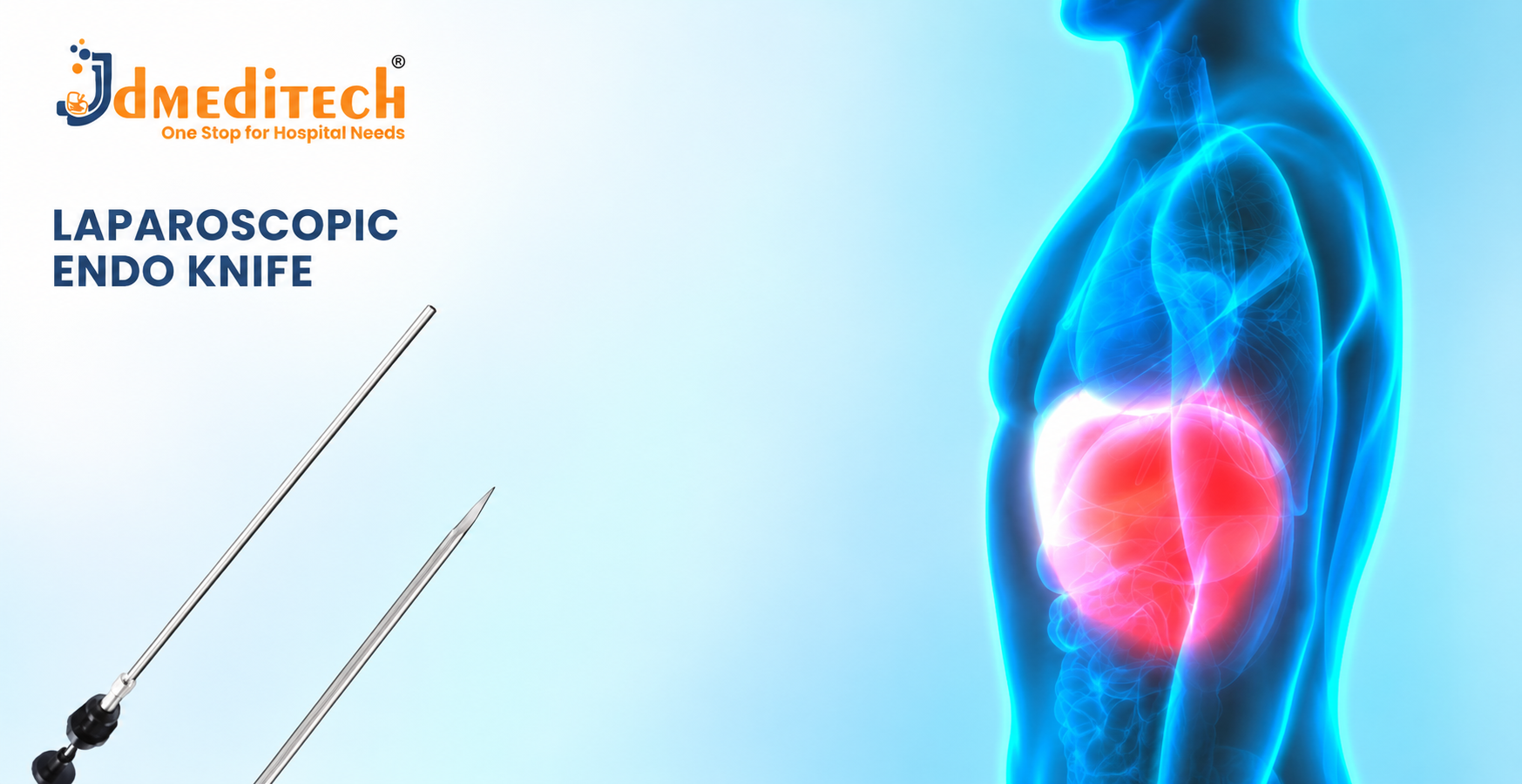
Laparoscopic Knife Instrument: Design, Surgical Uses and Selection Guide
A laparoscopic knife instrument is a specialized cutting tool for selected minimally invasive procedures. Surgeons use suitable designs to perform controlled tissue incisions or dissection through compatible surgical access ports.
Furthermore, a laparoscopic endo knife features an elongated working section that supports access to the operative area. Different tip configurations serve different surgical requirements. Therefore, the surgeon must choose the instrument according to its intended use.
JDMeditech supplies laparoscopic surgical instruments for hospitals, surgical centers and medical distributors. In addition, our team can assist with product inquiries, available configurations and technical information.
What Is a Laparoscopic Endo Knife?
A laparoscopic endo knife is an instrument used for selected surgical cutting tasks under endoscopic visualization.
Unlike a conventional handheld scalpel, its elongated design allows access through a compatible minimally invasive port.
Moreover, different knife patterns may feature different distal cutting tips. Consequently, the exact clinical application depends on the selected model.
Why Do Surgeons Use Specialized Laparoscopic Knives?
Minimally invasive procedures require instruments that can reach the operative field through limited access points.
For example, a suitable cutting instrument allows a surgeon to perform a selected tissue incision while viewing the operative area through a laparoscope.
Additionally, different shaft lengths and tip designs support different access requirements.
However, proper visualization, instrument compatibility and surgical training remain essential.
Main Components of a Laparoscopic Cutting Instrument
The exact construction varies by model. Nevertheless, a typical mechanical laparoscopic knife may contain the following elements:
- Elongated instrument shaft
- Distal cutting tip or blade
- Proximal handle or connector
- Blade support or attachment structure
- Optional protective accessories
Before ordering, customers should verify the manufacturer’s component list and product drawing.
Instrument Shaft
The shaft connects the proximal instrument section with the distal working tip.
Furthermore, its dimensions influence compatibility with surgical access ports. For this reason, hospitals should confirm the shaft diameter and working length before purchase.
Distal Cutting Tip
The distal tip performs the intended cutting function.
For instance, certain models use a mechanically sharpened blade. Other endoscopic cutting devices may use a different mechanism.
Therefore, the product’s actual cutting design must match the surgeon’s requirements.
Proximal Handle or Connector
The proximal section supports instrument handling and control.
Additionally, some designs incorporate model-specific attachments or mechanisms.
However, the exact handle construction depends on the selected product.
Important Product Features
Depending on the manufacturer and model, laparoscopic knives may offer the following characteristics:
- Long, narrow surgical instrument design
- Specialized cutting tip
- Different shaft lengths across available models
- Different shaft diameters
- Procedure-specific blade configurations
- Compatibility with selected laparoscopic ports
- Manufacturer-specified instrument materials
- Reusable or single-use options, where available
Additionally, customers should confirm the actual features through the official technical datasheet rather than relying on product images alone.
Clinical Applications of Laparoscopic Knives
Qualified surgeons use suitable cutting instruments during selected minimally invasive procedures.
Potential applications, subject to the specific device’s approved intended use, include:
- Selected general surgical procedures
- Selected gynecological operations
- Selected urological procedures
- Selected abdominal surgical procedures
- Other manufacturer-approved applications
However, not every knife design suits every procedure. Consequently, clinicians must verify the selected instrument’s indications.
Use in General Surgery
General surgeons may use specialized laparoscopic cutting instruments during selected abdominal operations.
For example, a compatible device may support a particular tissue incision or dissection task.
Nevertheless, the surgeon selects the cutting tool according to the planned technique and tissue characteristics.
Use in Gynecological Surgery
Gynecological procedures sometimes require specialized cutting instruments for minimally invasive pelvic surgery.
Furthermore, instrument selection depends on the anatomical site and intended task.
Therefore, clinicians should confirm the device’s approved applications before use.
Use in Urological Surgery
Selected urological operations use laparoscopic instruments for tissue handling and dissection.
For instance, certain reconstructive procedures require appropriate cutting tools.
However, the surgical team must select an instrument that suits the operative plan.
Working Principle of a Mechanical Laparoscopic Knife
A mechanical laparoscopic knife uses its cutting edge to perform selected surgical cutting tasks.
First, the surgical team verifies the device’s compatibility and sterile status.
During the operation, the surgeon uses the instrument under appropriate visualization and according to the approved surgical technique.
Afterward, staff handle the device according to its reusable or single-use labeling.
Importantly, the precise working mechanism varies between products.
Technical Specifications and Product Details
Technical specifications depend on the selected model. Therefore, buyers should request the manufacturer’s current product datasheet.
| Specification | Product Information |
|---|---|
| Product Name | Laparoscopic Endo Knife |
| Product Type | Endoscopic Surgical Cutting Instrument |
| Specialty | Minimally Invasive Surgery |
| Blade Design | Confirm Selected Model |
| Cutting Mechanism | Confirm Manufacturer Documentation |
| Shaft Diameter | Confirm Available Dimensions |
| Working Length | Confirm Technical Datasheet |
| Handle Type | Model-Specific |
| Material | Confirm Manufacturer Specification |
| Trocar Compatibility | Verify Access Port Dimensions |
| Reusable or Disposable | Confirm Product Labeling |
| Sterilization Method | Follow Validated Manufacturer Instructions |
| Packaging | Confirm Supplied Configuration |
| Regulatory Documentation | Verify for Intended Market |
Potential Benefits of a Laparoscopic Knife
A suitable instrument can support selected minimally invasive surgical tasks.
- Access through compatible laparoscopic ports
- Specialized tip designs for selected cutting tasks
- Different configurations for different surgical requirements
- Integration into an appropriate laparoscopic instrument setup
- Use under endoscopic visualization
However, these characteristics do not guarantee a particular clinical outcome. Surgical results depend on patient factors, procedure selection and professional technique.
Laparoscopic Knife Versus Conventional Scalpel
A conventional scalpel is commonly used for direct cutting in an open operative field.
In contrast, a laparoscopic knife has an elongated structure designed for appropriate minimally invasive access.
Furthermore, each instrument has different handling and visibility requirements.
Therefore, surgeons select the appropriate tool for the planned procedure.
Laparoscopic Knife Versus Laparoscopic Scissors
A surgical knife generally uses a cutting edge for selected incision tasks.
Meanwhile, laparoscopic scissors use opposing blades to cut suitable tissue.
Although both instruments support surgical cutting, their handling characteristics differ.
Consequently, the surgeon must choose the correct instrument for the intended application.
Mechanical Knife Versus Electrosurgical Cutting Instrument
A mechanical knife cuts tissue through a physical cutting edge.
By comparison, an electrosurgical instrument uses electrical energy for approved cutting or coagulation tasks.
Furthermore, energy-based instruments require additional compatibility and safety considerations.
However, customers must verify the mechanism of the particular endo knife being purchased.
Importance of Trocar Compatibility
Different laparoscopic instruments have different shaft dimensions.
For example, an instrument that exceeds the working channel of a selected port may not fit properly.
Therefore, buyers should confirm the manufacturer’s recommended port compatibility.
Instrument Inspection Before Use
Operating room personnel should inspect surgical instruments before clinical use.
- Verify the product model
- Inspect the cutting tip
- Check shaft integrity
- Examine the handle or connector
- Confirm accessory compatibility
- Verify the required sterile condition
- Remove damaged instruments from use
Additionally, staff should follow the manufacturer’s pre-use inspection instructions.
Cleaning and Reprocessing
Reusable surgical instruments require validated cleaning and reprocessing.
Furthermore, sharp cutting tips may require additional handling precautions.
However, cleaning methods differ between products. Therefore, facilities must follow the manufacturer’s instructions for use.
Single-use devices should not be reused or reprocessed contrary to their labeling and applicable regulations.
Sterilization Requirements
Instruments used in sterile surgical procedures require the appropriate sterile condition.
For reusable devices, healthcare facilities must use a validated sterilization process compatible with the instrument.
However, not every product supports steam sterilization. Consequently, hospitals should verify the approved method before processing.
Storage and Handling
Correct storage helps protect surgical cutting instruments from avoidable damage.
For example, sharp tips should remain protected according to the manufacturer’s recommendations.
Additionally, appropriate trays or containers can support organized instrument handling.
Therefore, facilities should follow established storage and inventory procedures.
Potential Risks and Safety Considerations
Sharp laparoscopic instruments may cause complications when used incorrectly.
- Unintended tissue injury
- Bleeding
- Injury to adjacent structures
- Instrument damage
- Contamination or infection
- Accidental injury during handling
However, actual risks depend on the device, procedure and clinical circumstances.
Therefore, only appropriately trained healthcare professionals should use these instruments.
How to Select a Suitable Endoscopic Knife
Hospitals and procurement teams should evaluate the intended clinical application before ordering.
In addition, buyers should review the following factors:
- Blade configuration
- Cutting mechanism
- Shaft diameter
- Working length
- Handle design
- Instrument material
- Trocar compatibility
- Reusable or single-use status
- Cleaning and sterilization requirements
- Packaging configuration
- Required regulatory documentation
Finally, the operating surgeon should confirm that the selected model meets the intended surgical requirements.
Applications in Hospitals and Surgical Centers
Hospitals may maintain different laparoscopic cutting instruments for selected minimally invasive procedures.
Furthermore, surgical centers should confirm equipment compatibility before introducing a new instrument model.
Additionally, staff training and reprocessing capabilities are important procurement considerations.
Product Considerations for Medical Distributors
Medical distributors should request accurate product specifications before preparing quotations.
For example, customers may require a particular shaft diameter, working length or blade configuration.
Moreover, regulatory documentation requirements may differ between destination markets.
Therefore, distributors should confirm the official product details before supplying customers.
Why Choose JDMeditech for Laparoscopy Instruments?
JDMeditech supplies surgical instruments and medical equipment for hospitals, surgical centers and international medical distributors.
Furthermore, our team can assist with product inquiries, technical specifications and available configurations.
Customers can contact JDMeditech regarding:
- Laparoscopic cutting instrument inquiries
- Endoscopic knife product information
- Laparoscopy instrument requirements
- Available technical documentation
- Medical equipment quotations
- International distributor inquiries
However, exact product specifications, availability and certifications require confirmation for the selected model.
Frequently Asked Questions
1. What Is a Laparoscopic Endo Knife?
It is a specialized surgical cutting instrument used during selected minimally invasive procedures.
2. What Is Its Main Function?
Its primary function is to support appropriate cutting or dissection tasks during surgery.
3. Is a Laparoscopic Knife Used in General Surgery?
Some models support selected general surgical procedures. However, the approved applications depend on the device.
4. Can Surgeons Use It in Gynecology?
Suitable cutting instruments may support selected gynecological procedures. Nevertheless, clinicians must confirm the intended use.
5. Is It Suitable for Urological Procedures?
Certain designs may support selected urological operations. However, suitability depends on the model and planned procedure.
6. Are Different Working Lengths Available?
Different models may offer different dimensions. Therefore, buyers should check the available product range.
7. Does Every Model Have the Same Blade?
No. Cutting tip designs vary between manufacturers and models.
8. Is the Instrument Reusable?
Reusable status depends on the specific device. Consequently, customers should check its labeling.
9. Can the Knife Be Steam Sterilized?
Some reusable instruments may support steam sterilization. However, the validated method must be confirmed.
10. What Material Is Used?
Materials vary by product model. Therefore, customers should request the manufacturer’s specifications.
11. Is It Compatible With Every Laparoscopic Trocar?
No. Compatibility depends on the instrument dimensions and access port design.
12. Does the Knife Require Electrical Energy?
Some cutting instruments operate mechanically, while others use energy-based mechanisms. Therefore, the selected product’s working principle must be verified.
13. Who Should Use This Instrument?
Only appropriately trained surgical healthcare professionals should use it according to the approved intended purpose.
14. What Should Buyers Confirm Before Purchasing?
Buyers should confirm the cutting tip, dimensions, compatibility, labeling, reprocessing requirements and documentation.
15. Where Can Customers Request Product Information?
Hospitals, surgical centers and distributors can contact JDMeditech for available product information and quotations.
Conclusion
In conclusion, a laparoscopic knife instrument supports selected cutting and dissection tasks during minimally invasive surgery.
Furthermore, its elongated design provides access through compatible surgical ports.
However, blade design, dimensions and intended applications vary between models.
Therefore, healthcare facilities should select instruments according to clinical requirements and verified manufacturer specifications.
JDMeditech – One Stop for Hospital Needs
Website:
www.jdmeditech.com
Related Laparoscopy Products
- Laparoscope
- Laparoscopic Trocar
- Laparoscopic Scissors
- Laparoscopic Grasper
- Laparoscopic Dissector
- Laparoscopic Camera System
- Laparoscopic Instrument Set
Medical Disclaimer
This article provides general product and educational information only. It does not replace professional medical advice, surgical training or manufacturer instructions. Qualified healthcare professionals must select and use surgical instruments according to their approved intended use, technical specifications and applicable safety requirements.




