



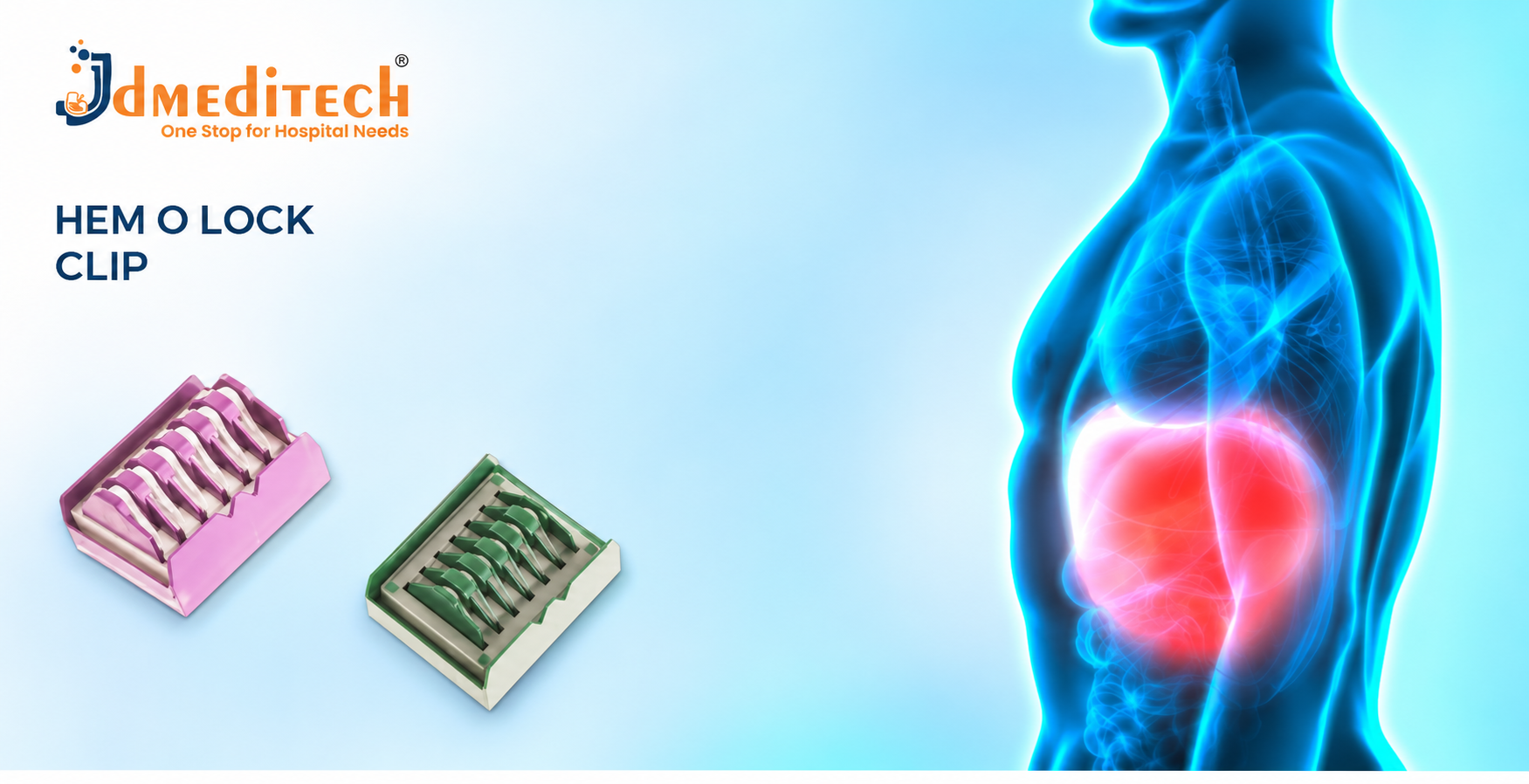
Hem O Lock Clip – Complete Guide to Uses, Sizes, Features and Surgical Applications
The Hem O Lock Clip is a surgical ligation device used to secure suitable blood vessels and tissue structures during selected surgical procedures. Locking polymer clips provide a mechanical method of ligation in appropriate open and minimally invasive operations.
Furthermore, these clips feature a specialized closure design that helps maintain the intended position after proper application. Surgeons use compatible clip appliers to place and close the clips around suitable anatomical structures.
JDMeditech supplies surgical instruments and medical devices for hospitals, surgical centers and medical distributors. Additionally, our team assists customers with available product configurations, technical information and quotation requests.
What Is a Hem O Lock Clip?
A Hem O Lock Clip is commonly described as a non-absorbable polymer locking ligation clip. It provides mechanical closure of selected blood vessels or other suitable tissue structures during surgery.
Unlike traditional surgical sutures, the clip uses a preformed closure mechanism. Consequently, the surgeon must select the appropriate size and compatible application instrument.
However, Hem-o-lok is also a registered product trademark. Therefore, customers should verify the actual manufacturer, brand and model of the supplied clips.
Purpose of Hem O Lock Surgical Clips
The main purpose of these clips is to support ligation of suitable anatomical structures.
For example, surgeons may use approved locking clips to close selected vessels during certain operations.
Additionally, some clip systems have indications involving specific ducts or other tissue structures.
However, the approved applications depend on the manufacturer’s instructions for use.
How Does a Hem O Lock Clip Work?
A locking polymer clip generally consists of two opposing arms connected by a flexible section.
First, the surgeon selects a clip that matches the intended tissue structure and approved size range.
Next, a compatible surgical clip applier positions and closes the device during the operation.
Once properly closed, the locking mechanism helps maintain the clip’s position.
However, successful ligation depends on appropriate patient anatomy, instrument compatibility and surgical technique.
Main Components of a Hem O Lock Clip
The design of a typical locking polymer clip may include several important elements.
- Opposing Clip Arms
- Flexible Hinge Section
- Mechanical Locking Mechanism
- Internal Gripping Surface
- Applier Engagement Features
Furthermore, manufacturers may use different geometries and locking designs.
1. Opposing Clip Arms
The opposing arms form the main body of the surgical clip.
Additionally, their dimensions determine the range of suitable tissue structures.
Therefore, surgeons must select the correct clip size for the intended application.
2. Flexible Hinge Section
The hinge connects the opposing clip arms.
Furthermore, it allows the clip to close according to its intended design.
However, hinge construction varies between different clip systems.
3. Mechanical Locking Mechanism
The locking mechanism helps retain the clip in its closed position after appropriate application.
Moreover, certain clip systems use a distinct latch or locking feature.
However, incorrect placement or incomplete closure may compromise the intended ligation.
4. Internal Gripping Surface
Some polymer clips feature internal surface patterns that support tissue engagement.
Additionally, these patterns may differ according to clip size and manufacturer.
Therefore, hospitals should review the official technical specifications.
5. Clip Cartridge
Manufacturers commonly supply surgical clips in cartridges or holders.
For example, a cartridge presents clips for loading into a compatible surgical applier.
However, cartridge design and clip quantity vary by product.
Key Features of Hem O Lock Clips
Depending on the selected model, locking polymer clips may offer the following features:
- Non-Absorbable Polymer Construction
- Mechanical Locking Design
- Different Available Clip Sizes
- Compatibility With Selected Surgical Appliers
- Cartridge-Based Presentation
- Applications in Selected Open Procedures
- Applications in Selected Laparoscopic Procedures
- Manufacturer-Specified Tissue Size Ranges
- Sterile Single-Use Configurations
However, exact features depend on the supplied model and manufacturer.
Clinical Applications of Hem O Lock Clips
Qualified surgeons may use compatible locking polymer clips during selected surgical procedures.
Potential applications include:
- Selected Laparoscopic Procedures
- Selected General Surgical Procedures
- Appropriate Blood Vessel Ligation
- Selected Urological Procedures
- Selected Open Surgical Procedures
- Other Manufacturer-Approved Applications
However, clinical suitability depends on the specific product’s indications and warnings.
Application in Laparoscopic Surgery
Laparoscopic procedures may require closure of selected blood vessels or tissue structures.
For example, surgeons may use compatible locking clips through a suitable laparoscopic applier.
Furthermore, the operating team must verify instrument dimensions and compatibility.
Therefore, proper product selection remains essential.
Application in General Surgery
Some general surgical procedures require mechanical ligation.
Additionally, appropriately selected clips may provide an alternative to certain conventional ligation techniques.
However, the surgeon must confirm the approved indication and tissue size.
Application in Urological Surgery
Selected urological procedures may involve surgical ligation of appropriate structures.
However, surgeons must review important product-specific restrictions.
In particular, the genuine Hem-o-lok system carries a warning against use for renal artery ligation during laparoscopic donor nephrectomy.
Therefore, clinicians must follow the current manufacturer’s instructions and contraindications.
Application in Open Surgery
Some open surgical procedures may use compatible locking polymer clips.
Furthermore, open surgical appliers may differ from laparoscopic appliers.
Consequently, hospitals should verify the correct clip and instrument combination.
Available Sizes of Hem O Lock Clips
Locking polymer clip systems may offer different sizes for different anatomical requirements.
For example, some product families use medium, medium-large, large and extra-large size categories.
However, exact dimensions and approved tissue diameter ranges depend on the manufacturer.
Therefore, customers should request the official size chart before purchasing.
How to Select the Correct Clip Size
Clip selection depends on the intended tissue structure and the manufacturer’s sizing recommendations.
Furthermore, the surgeon must consider tissue thickness and the approved application range.
However, an unsuitable clip may fail to provide the intended closure.
Therefore, clinical teams should follow the official instructions for use.
Technical Specifications of Hem O Lock Clips
Exact technical specifications vary according to the selected product. Therefore, buyers should verify the official manufacturer datasheet.
| Parameter | Product Information |
|---|---|
| Product Name | Hem O Lock Clip |
| Product Category | Surgical Ligation Clip |
| Product Type | Locking Polymer Clip, Where Specified |
| Primary Function | Ligation of Approved Anatomical Structures |
| Material | Confirm Manufacturer Specifications |
| Locking Mechanism | Model-Specific |
| Available Sizes | Confirm Official Size Chart |
| Approved Tissue Diameter | Confirm Manufacturer Instructions |
| Clip Colour | Model-Specific |
| Clips Per Cartridge | Confirm Supplied Configuration |
| Compatible Applier | Verify Manufacturer Compatibility |
| Sterile Status | Confirm Product Labeling |
| Single-Use Status | Confirm Product Labeling |
| Packaging | Confirm Manufacturer Details |
| Regulatory Documentation | Verify for Destination Market |
Hem O Lock Clip and Clip Applier Compatibility
Each surgical clip system requires an appropriate application instrument.
Furthermore, different clip sizes may require different applier models.
For example, a manufacturer may specify particular jaw designs for specific clips.
Therefore, hospitals must verify compatibility before use.
Hem O Lock Clip Versus Titanium Clip
Polymer locking clips and titanium clips differ in their construction.
For example, polymer systems use non-metallic materials, while titanium clips use metallic materials.
Additionally, the closure mechanism and applier design may differ.
However, neither clip type is suitable for every surgical application.
Hem O Lock Clip Versus Surgical Sutures
Surgical sutures use suitable thread material to approximate or ligate tissues.
In contrast, a surgical clip uses a preformed mechanical closure device.
Furthermore, the two techniques require different instruments and skills.
Therefore, the surgeon should select the method appropriate for the clinical situation.
Hem O Lock Clip Versus Absorbable Clips
Non-absorbable locking polymer clips are intended to remain in the body.
Meanwhile, absorbable clip systems use materials designed to degrade over time.
Additionally, different products may have different clinical indications.
Therefore, customers should verify the material and intended use before ordering.
Potential Benefits of Hem O Lock Clips
Appropriately selected locking polymer clips may offer several practical features.
- Mechanical Ligation of Suitable Tissue Structures
- Different Available Size Options
- Compatibility With Selected Laparoscopic Appliers
- Compatibility With Selected Open Surgical Appliers
- Cartridge-Based Clip Presentation
- Non-Metallic Construction
- Model-Specific Locking Features
Furthermore, compatible clip systems may support selected surgical workflows.
However, these characteristics do not guarantee improved clinical outcomes.
Important Safety Precautions
Only qualified surgical professionals should use implantable ligation clips.
Furthermore, surgeons must select the correct size and compatible applier.
Additionally, the operating team should inspect the product packaging and verify its sterile status.
Therefore, hospitals must follow the manufacturer’s instructions and established clinical protocols.
Potential Risks and Complications
Incorrect selection or application may result in complications.
Potential concerns include:
- Incomplete Ligation
- Bleeding
- Clip Dislodgement
- Clip Migration
- Incorrect Clip Placement
- Injury to Adjacent Tissue
- Device-Related Complications
However, actual risks depend on the procedure, patient factors and product design.
Contraindications and Warnings
Contraindications depend on the specific clip system.
For example, certain locking polymer clips have restrictions involving particular anatomical structures or procedures.
Furthermore, surgeons should avoid applying clips outside the approved tissue size range.
Therefore, clinicians must review all manufacturer warnings before use.
Inspection Before Surgical Use
Operating room personnel should inspect the clip system before use.
- Confirm Product Identification
- Verify Clip Size
- Inspect Packaging Integrity
- Check Expiry Date
- Confirm Sterile Status
- Verify Applier Compatibility
- Inspect Clip Cartridge
- Review Manufacturer Instructions
Additionally, staff must not use products with damaged or compromised packaging.
Sterility and Single-Use Requirements
Many implantable locking polymer clips are supplied sterile for single use.
However, exact labeling depends on the manufacturer.
Therefore, healthcare personnel must follow the supplied instructions and must not reuse products labeled for single use.
Storage and Handling
Proper storage helps protect sterile surgical clips.
For example, hospitals should follow the manufacturer’s recommended storage conditions.
Additionally, staff should protect the packaging from moisture, contamination and physical damage.
Therefore, inventory teams should monitor product identification and expiry dates.
How to Choose a Hem O Lock Clip
Hospitals and medical distributors should review several factors before purchasing.
- Approved Surgical Indications
- Clip Material
- Available Sizes
- Approved Tissue Diameter Range
- Locking Mechanism
- Compatible Clip Applier
- Clips Per Cartridge
- Sterile Status
- Single-Use Labeling
- Packaging Configuration
- Product Shelf Life
- Regulatory Documentation
- Manufacturer Warnings
Furthermore, the operating surgeon should confirm the appropriate clip system.
Applications in Hospitals
Hospitals may maintain different ligation clip systems for different surgical specialties.
Additionally, operating departments should verify compatibility with existing surgical appliers.
However, the required inventory depends on the procedures performed.
Applications in Laparoscopy Centers
Appropriately equipped surgical centers may use compatible locking clips during selected minimally invasive procedures.
Furthermore, standardized clip and applier combinations can support operating room preparation.
However, staff must follow approved device safety requirements.
Applications for Medical Distributors
Medical distributors should confirm the official clip size chart and compatible applier models.
For example, customers may require particular clip sizes or cartridge configurations.
Additionally, destination-market regulations may affect documentation requirements.
Therefore, distributors should request the appropriate technical and regulatory information.
Why Choose JDMeditech?
JDMeditech supplies medical devices and surgical accessories for hospitals, surgical centers and medical distributors.
Furthermore, our team can assist customers with available product information, technical specifications and quotation requests.
Customers can contact JDMeditech regarding:
- Hem O Lock Clip Product Inquiries
- Surgical Ligation Clip Requirements
- Available Clip Sizes
- Compatible Clip Applier Information
- Product Configuration Requests
- Medical Distributor Inquiries
- International Export Requests
However, exact availability, specifications and regulatory documentation require confirmation.
Frequently Asked Questions About Hem O Lock Clips
1. What Is a Hem O Lock Clip?
It is a surgical ligation clip commonly associated with non-absorbable polymer locking clip systems.
2. What Is the Main Purpose of This Clip?
Its purpose is to provide mechanical closure of suitable anatomical structures during approved surgical procedures.
3. Are Hem O Lock Clips Used in Laparoscopic Surgery?
Yes. Compatible clip systems may support selected laparoscopic procedures.
4. Can These Clips Be Used in Open Surgery?
Suitable systems may support selected open surgical applications.
5. Are Hem O Lock Clips Absorbable?
Non-absorbable polymer locking clips remain in the body. However, customers should verify the exact product material.
6. Are Different Clip Sizes Available?
Different sizes are available across product ranges. Therefore, buyers should request the official size chart.
7. Do These Clips Require a Special Applier?
Yes. Surgeons must use an applier identified as compatible by the manufacturer.
8. Are Polymer Clips the Same as Titanium Clips?
No. They differ in material, design and potentially in approved applications.
9. Can Surgical Clips Migrate?
Clip migration is a recognized potential complication. Therefore, appropriate selection and application remain essential.
10. Are Hem O Lock Clips Reusable?
Implantable surgical clips are generally single-use devices. Always follow the product labeling.
11. Are the Clips Supplied Sterile?
Many clip systems are supplied sterile. However, buyers should verify the packaging and labeling.
12. Can Any Clip Applier Be Used?
No. The manufacturer must identify the applier as compatible with the selected clip.
13. What Should Buyers Confirm Before Ordering?
Buyers should verify clip sizes, material, approved indications, applier compatibility, packaging and regulatory documentation.
14. Who Should Use These Clips?
Qualified surgical healthcare professionals should use the clips according to the manufacturer’s approved instructions.
15. Where Can Customers Request Product Information?
Hospitals, surgical centers and medical distributors can contact JDMeditech for available product information and quotations.
Conclusion
In conclusion, the Hem O Lock Clip is a surgical ligation device used for selected anatomical structures during appropriate procedures.
Furthermore, different locking polymer clip systems offer different sizes, designs and application requirements.
Additionally, compatible surgical appliers support the intended application process.
However, safe use requires correct clip selection, appropriate surgical technique and adherence to manufacturer warnings.
Therefore, healthcare facilities should verify all technical specifications before purchasing.
JDMeditech – One Stop for Hospital Needs
Website:
www.jdmeditech.com
Related Surgical Products
- Polymer Clip Applier
- Laparoscopic Clip Applier
- Titanium Ligation Clips
- Laparoscopic Grasping Forceps
- Laparoscopic Dissecting Forceps
- Laparoscopic Instrument Set
- Surgical Hemostatic Instruments
Medical Disclaimer
This article provides general educational and product information only. It does not replace professional medical advice, surgical training or manufacturer instructions. Qualified healthcare professionals must select and use surgical clips according to approved indications, technical specifications, contraindications and applicable safety requirements.




