



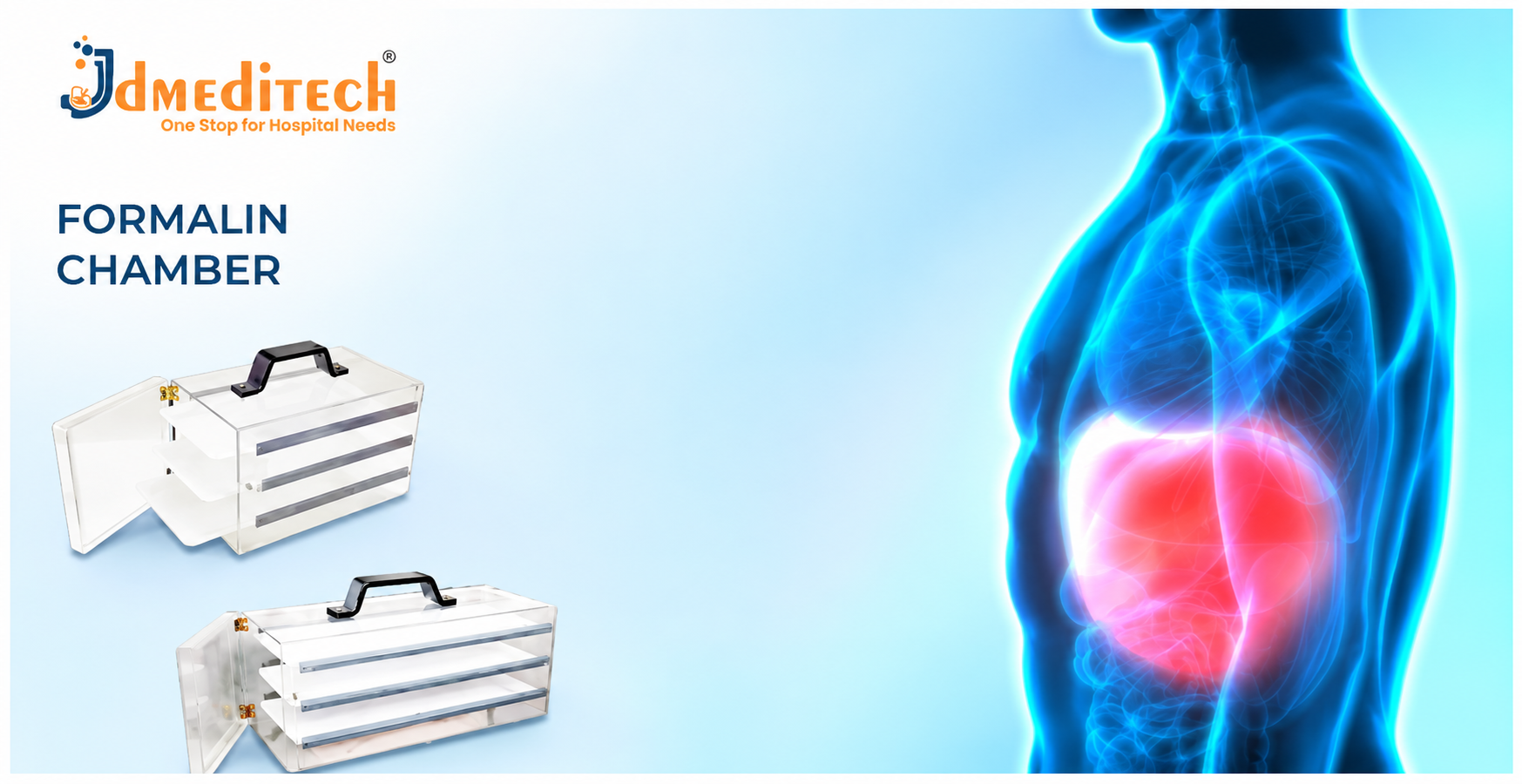
Formalin Chamber – Complete Guide to Uses, Features and Safety Guidelines
The Formalin Chamber is a medical equipment container associated with certain formaldehyde-based chemical processing systems. Some traditional hospital workflows have used these chambers for handling instruments and other compatible items.
However, formaldehyde presents significant health hazards. In addition, placing instruments inside a chamber does not automatically disinfect or sterilize them. Healthcare facilities must use validated processes that meet current infection prevention requirements.
JDMeditech supplies medical equipment, surgical instruments and hospital accessories. Furthermore, our team can assist hospitals and medical distributors with available product information, configurations and quotation requests.
What Is a Formalin Chamber?
A formalin chamber is a container associated with formaldehyde-based chemical treatment methods. Depending on the model, it may include a rigid enclosure, a lid or access door, and internal instrument supports.
Historically, some healthcare facilities used formaldehyde-containing products in instrument processing. However, modern infection prevention practice requires validated reprocessing methods and careful chemical risk management.
Therefore, buyers must verify the intended use of the specific chamber before purchasing or operating it.
What Is Formalin?
Formalin is an aqueous solution containing formaldehyde, commonly stabilized with methanol. Healthcare and laboratory facilities use certain formalin formulations for approved applications, including tissue preservation.
However, formalin is hazardous. Exposure may irritate the eyes, skin and respiratory system. Furthermore, formaldehyde is classified as carcinogenic to humans.
Consequently, healthcare facilities must follow applicable chemical safety regulations and product instructions.
Purpose of a Formalin Chamber
The intended purpose depends on the chamber’s design and manufacturer documentation.
For example, some traditional systems were associated with chemical exposure processes for selected medical items.
However, a basic chamber does not provide evidence of effective microbial elimination. Therefore, healthcare facilities should not treat it as a substitute for a validated sterilizer.
Importance of Validated Medical Instrument Reprocessing
Reusable medical instruments require appropriate cleaning, disinfection or sterilization between patient uses.
First, healthcare personnel must follow the instrument manufacturer’s cleaning instructions. Next, they must select the required reprocessing level according to the device’s intended clinical use.
Furthermore, critical surgical instruments generally require sterilization. Therefore, hospitals should use validated equipment and processes rather than relying on unverified chemical chamber methods.
Main Components of a Formalin Chamber
Depending on the selected model, a chamber may include the following components:
- Main Chamber Body
- Access Door or Lid
- External Carrying Handle
- Internal Instrument Supports
- Removable Shelves or Trays
- Model-Specific Closure Mechanism
- Additional Manufacturer-Specified Accessories
However, the supplied configuration varies between manufacturers.
1. Main Chamber Body
The main body provides the enclosure for the intended contents.
Furthermore, its material and construction determine its mechanical characteristics.
However, the enclosure must meet the manufacturer’s requirements for the intended application.
2. Access Door or Lid
The access door allows authorized personnel to reach the chamber interior.
Additionally, some models include a locking or closing mechanism.
However, an ordinary lid does not establish vapor containment or chemical exposure safety.
3. Carrying Handle
Some chamber models feature an external handle.
Furthermore, the handle may support movement of the empty container according to the manufacturer’s instructions.
However, personnel should not transport hazardous chemicals in a chamber unless its design and labeling specifically permit that activity.
4. Internal Shelves or Trays
Some models include shelves or instrument supports.
For example, these components may help organize compatible items inside the chamber.
However, internal arrangement alone does not establish effective disinfection or sterilization.
Key Features of Formalin Chambers
Depending on the model, available chambers may offer the following characteristics:
- Rigid Container Construction
- Different Available Chamber Dimensions
- Model-Specific Access Doors
- External Handle Options
- Internal Shelves or Trays
- Different Available Storage Capacities
- Different Material Configurations
- Manufacturer-Specified Closure Systems
However, exact features require confirmation from the official product datasheet.
Types of Formalin Chambers
Different manufacturers may offer different chamber configurations.
For example, some designs feature compact containers with internal shelves. Meanwhile, other models may offer larger enclosures or different access arrangements.
However, visual appearance does not confirm the chamber’s approved processing capabilities.
Compact Formalin Chamber
Compact chamber designs may provide a smaller internal compartment.
Additionally, certain models include removable supports for organizing suitable items.
However, the actual capacity and intended use depend on the manufacturer.
Multi-Shelf Formalin Chamber
Some chamber designs feature multiple internal shelves.
Furthermore, these shelves may help organize compatible contents.
However, buyers should verify the dimensions and approved loading configuration.
Medical Instrument Chamber Designs
Medical instrument chambers may differ in construction and intended function.
For example, some containers support storage or transport, while specialized equipment may support validated processing.
Therefore, customers should not assume that every instrument chamber performs sterilization.
Historical Applications of Formaldehyde Chambers
Historically, certain healthcare settings used formaldehyde-based methods for selected instrument processing activities.
However, these methods raise important questions about exposure control, process validation and device compatibility.
Furthermore, current clinical practice favors validated reprocessing systems that meet applicable infection prevention standards.
Formalin Chamber in Hospital Settings
Hospitals may encounter formalin chamber products during equipment procurement or legacy instrument management.
However, healthcare personnel must confirm whether a particular chamber meets current institutional requirements.
Therefore, infection prevention specialists and biomedical engineering personnel should review the intended use before any clinical deployment.
Formalin Chamber in Surgical Departments
Surgical departments require reliable instrument reprocessing procedures.
Furthermore, instruments that enter sterile tissue generally require validated sterilization.
However, an unvalidated formalin chamber should not replace approved sterilization equipment.
Consequently, surgical teams must follow established processing standards.
Formalin Chamber in Laboratory Environments
Laboratories may use formalin for approved specimen preservation activities.
However, specimen preservation and medical instrument sterilization are different applications.
Therefore, laboratory personnel should use equipment specifically approved for their intended task.
How Does a Formalin Chamber Work?
The working principle depends on the specific chamber and its documented intended use.
Some historical systems involved formaldehyde-based chemical exposure. However, chemical presence alone does not establish a validated microbial reduction process.
Furthermore, effective sterilization requires controlled and verified processing conditions.
Therefore, hospitals should use manufacturer-approved methods and validated equipment rather than improvising formaldehyde exposure procedures.
Difference Between Disinfection and Sterilization
Disinfection reduces or inactivates specified microorganisms under defined conditions.
In contrast, sterilization uses a validated process intended to eliminate all forms of viable microbial life, including bacterial spores.
Furthermore, high-level disinfection does not provide the same assurance as sterilization.
Therefore, healthcare facilities must choose the correct process for each medical device.
Formalin Chamber Versus Autoclave
An autoclave uses validated steam sterilization cycles for compatible instruments.
In contrast, a basic formalin chamber does not automatically provide a validated sterilization process.
Furthermore, autoclaves incorporate specified operating conditions and process monitoring requirements.
Therefore, the two devices are not interchangeable.
Formalin Chamber Versus Instrument Storage Box
An instrument storage box primarily supports the organization or protection of compatible items.
Meanwhile, a chamber associated with chemical treatment may have a different intended use.
However, neither product should be assumed to sterilize instruments without appropriate validation.
Formalin Chamber Versus Low-Temperature Sterilizer
Validated low-temperature sterilization systems may support compatible heat-sensitive medical devices.
For example, certain systems use vaporized hydrogen peroxide or other approved technologies.
However, these technologies have different equipment, compatibility and validation requirements.
Therefore, hospitals must follow the sterilizer and instrument manufacturers’ instructions.
Technical Specifications of a Formalin Chamber
Exact specifications depend on the manufacturer and selected configuration. Therefore, customers should request the official technical datasheet.
| Parameter | Product Information |
|---|---|
| Product Name | Formalin Chamber |
| Alternative Name | Formalin Box |
| Product Category | Medical Equipment Container |
| Intended Use | Confirm Manufacturer Documentation |
| Chamber Material | Confirm Official Specifications |
| External Dimensions | Confirm Available Models |
| Internal Dimensions | Model-Specific |
| Internal Capacity | Confirm Manufacturer Datasheet |
| Access Door | Model-Specific |
| Carrying Handle | Confirm Supplied Configuration |
| Internal Shelves | Model-Specific |
| Closure Mechanism | Confirm Manufacturer Specifications |
| Chemical Compatibility | Verify Manufacturer Documentation |
| Vapor Containment | Not Assumed; Requires Specific Validation |
| Sterilization Capability | Not Established Without Process Validation |
| Cleaning Requirements | Follow Manufacturer Instructions |
| Packaging | Confirm Supplied Configuration |
| Regulatory Documentation | Verify for Destination Market |
Importance of Chamber Material
Chamber materials influence durability and compatibility with the intended environment.
Furthermore, chemical exposure may affect certain metals, coatings or polymers.
However, material appearance does not establish chemical resistance.
Therefore, customers should verify the manufacturer’s material specifications.
Importance of Chamber Dimensions
Chamber dimensions determine the available internal space.
For example, some customers may require compact models for particular equipment arrangements.
Additionally, shelf dimensions may influence item organization.
Therefore, procurement teams should request accurate internal and external measurements.
Importance of Chemical Safety
Formaldehyde exposure can create significant occupational health risks.
Furthermore, the chemical may cause irritation, sensitization and other adverse health effects.
Additionally, long-term exposure presents carcinogenic concerns.
Therefore, facilities must apply appropriate exposure controls and chemical safety procedures.
Health Risks Associated With Formaldehyde
Formaldehyde exposure may cause several health problems.
- Eye Irritation
- Skin Irritation
- Respiratory Irritation
- Skin Sensitization
- Breathing Difficulties
- Occupational Exposure Concerns
- Long-Term Carcinogenic Risk
Furthermore, exposure severity depends on concentration, duration and individual susceptibility.
Important Safety Precautions
Only trained personnel should handle formaldehyde-containing chemicals.
Furthermore, facilities must follow applicable occupational safety regulations and product safety instructions.
- Review the Chemical Safety Data Sheet
- Use Appropriate Engineering Controls
- Follow Workplace Exposure Limits
- Use Required Personal Protective Equipment
- Prevent Uncontrolled Vapor Release
- Avoid Direct Chemical Contact
- Follow Spill Response Procedures
- Use Approved Chemical Storage Methods
- Follow Hazardous Waste Disposal Requirements
- Maintain Appropriate Staff Training
Additionally, facilities should avoid unvalidated chemical treatment procedures.
Why Proper Ventilation Matters
Formaldehyde vapors can create inhalation hazards.
Furthermore, ordinary room ventilation may not provide adequate exposure control.
Therefore, facilities should use engineering controls appropriate to the chemical and intended activity.
However, an ordinary chamber lid does not replace an approved containment system.
Potential Risks of Incorrect Chamber Use
Improper use may create serious safety concerns.
- Formaldehyde Vapor Exposure
- Chemical Spills
- Skin and Eye Contact
- Inadequate Instrument Reprocessing
- Cross-Contamination
- Material Degradation
- Improper Chemical Storage
- Unsafe Instrument Handling
- Regulatory Noncompliance
Therefore, hospitals must verify the equipment’s intended use and safety requirements.
Inspection Before Use
Authorized personnel should inspect the chamber before its intended use.
- Confirm Product Identification
- Inspect the Chamber Body
- Check the Access Door
- Examine the Carrying Handle
- Inspect Internal Shelves
- Check for Visible Damage
- Review Manufacturer Instructions
- Verify the Approved Application
Furthermore, personnel should remove damaged equipment from service.
Cleaning and Maintenance
Cleaning requirements depend on the chamber material and intended use.
Furthermore, chemical contamination may require specialized handling.
Therefore, only trained personnel should perform maintenance according to manufacturer instructions and facility safety procedures.
However, staff should not attempt unapproved chemical neutralization or equipment modifications.
Storage and Handling Guidelines
Proper storage helps protect equipment and reduce unnecessary hazards.
For example, facilities should store clean, empty equipment according to the manufacturer’s recommendations.
Additionally, any hazardous chemical storage must comply with applicable regulations.
Therefore, personnel should not treat an ordinary equipment chamber as an approved chemical storage container without specific authorization.
How to Choose the Right Formalin Chamber
Hospitals and procurement teams should review several factors before purchasing.
- Documented Intended Use
- Manufacturer Identification
- Chamber Material
- Internal and External Dimensions
- Internal Capacity
- Access Door Design
- Handle Configuration
- Shelf Arrangement
- Chemical Compatibility
- Occupational Safety Requirements
- Applicable Regulatory Requirements
- Manufacturer Instructions
- Product Documentation
Furthermore, infection prevention and occupational safety teams should review the equipment before clinical use.
Applications in Hospital Procurement
Hospital procurement departments may evaluate formalin chamber products for specific documented requirements.
However, purchasing decisions must consider current infection prevention and chemical safety standards.
Therefore, procurement teams should verify whether a validated alternative better meets the intended clinical need.
Applications for Medical Distributors
Medical distributors should confirm the intended use and technical specifications before preparing quotations.
For example, customers may request particular dimensions, shelf arrangements or construction materials.
Additionally, destination-market regulations may affect product availability and documentation requirements.
Therefore, distributors should request the official manufacturer specifications.
Why Choose JDMeditech?
JDMeditech supplies medical equipment, surgical instruments and hospital accessories for healthcare facilities and medical distributors.
Furthermore, our team can assist customers with available product information, technical specifications and quotation requests.
Customers can contact JDMeditech regarding:
- Formalin Chamber Product Inquiries
- Formalin Box Requirements
- Available Chamber Configurations
- Product Dimensions
- Material Information
- Hospital Equipment Inquiries
- Medical Distributor Requirements
- International Export Requests
However, exact availability, technical specifications and regulatory documentation require confirmation.
Frequently Asked Questions About Formalin Chambers
1. What Is a Formalin Chamber?
It is a medical equipment container associated with certain formaldehyde-based chemical processing systems.
2. What Is the Main Purpose of a Formalin Chamber?
Its intended purpose depends on the manufacturer and specific model.
3. Does a Formalin Chamber Sterilize Instruments?
Not automatically. Sterilization requires a validated process with appropriate controls and monitoring.
4. Is Formalin the Same as Formaldehyde?
Formalin is an aqueous solution containing formaldehyde.
5. Is Formaldehyde Hazardous?
Yes. Formaldehyde presents significant health hazards, including carcinogenic risk.
6. Are Different Chamber Sizes Available?
Different configurations may be available. Therefore, buyers should request the official size chart.
7. What Materials Are Used in Formalin Chambers?
Materials vary by manufacturer. Therefore, customers should verify the official technical specifications.
8. Does Every Chamber Include Shelves?
No. Shelf availability depends on the selected model and supplied configuration.
9. Can a Formalin Chamber Replace an Autoclave?
No. A basic chamber is not equivalent to a validated steam sterilizer.
10. Can Formalin Chambers Be Used for Surgical Instruments?
Only when the specific equipment and process meet applicable device reprocessing requirements. An unvalidated chamber must not replace approved sterilization.
11. Is Special Ventilation Required?
Activities involving formaldehyde may require specific engineering controls to manage occupational exposure.
12. Can Staff Handle Formalin Without Protective Equipment?
No. Personnel must follow the applicable safety data sheet, risk assessment and workplace safety requirements.
13. Is a Formalin Chamber the Same as a Sterilization Box?
No. The terms do not establish equivalent processing capabilities.
14. What Should Buyers Confirm Before Ordering?
Buyers should verify the intended use, dimensions, material, construction, safety requirements and regulatory documentation.
15. Where Can Customers Request Product Information?
Hospitals, healthcare facilities and medical distributors can contact JDMeditech for available product information and quotations.
Conclusion
In conclusion, the Formalin Chamber is a medical equipment container associated with certain formaldehyde-based chemical processing systems.
Furthermore, different models may offer different dimensions, construction materials and internal arrangements.
However, formaldehyde presents significant occupational hazards, and an ordinary chamber does not establish effective disinfection or sterilization.
Therefore, healthcare facilities must prioritize validated instrument reprocessing methods, appropriate chemical safety controls and manufacturer instructions.
JDMeditech – One Stop for Hospital Needs
Website:
www.jdmeditech.com
Related Medical Equipment
- Medical Instrument Tray
- Instrument Sterilization Tray
- CIDEX Tray
- Scope Tray With Holder
- Laparoscopic Instrument Tray
- Hospital Instrument Storage Accessories
Medical and Chemical Safety Disclaimer
This article provides general educational and product information only. It does not constitute instructions for formaldehyde exposure, medical device sterilization or chemical processing. Healthcare facilities must follow current manufacturer instructions, validated reprocessing protocols, infection prevention standards and applicable occupational safety regulations.




