



Port Cone – Features, Uses and Applications in Laparoscopy
The Port Cone is a surgical accessory associated with selected laparoscopic access systems. Depending on its design, it may provide a specialized interface or supporting component for a compatible port assembly.
During minimally invasive surgery, healthcare professionals use different instruments and access accessories. Therefore, selecting the correct components helps establish the intended equipment configuration.
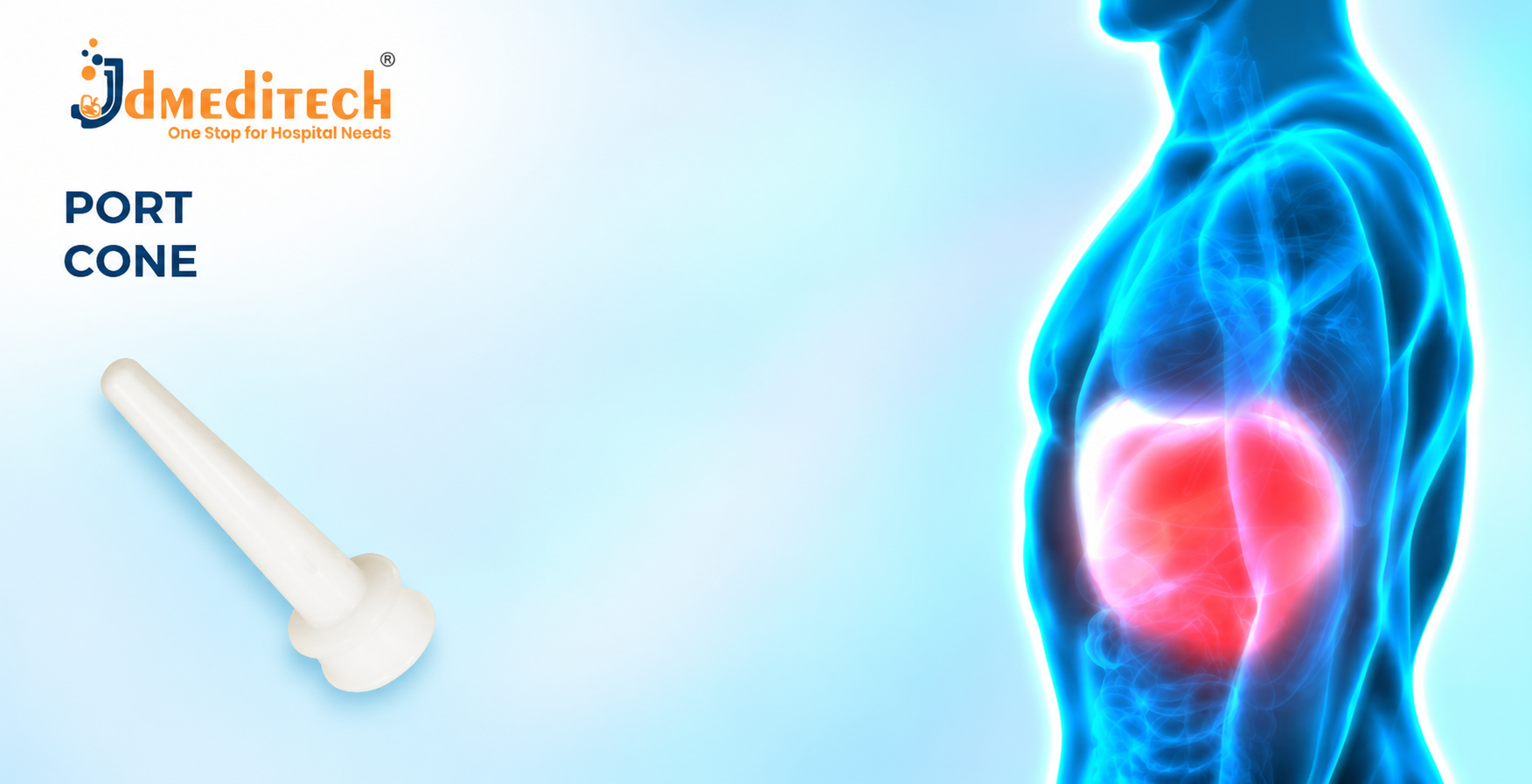
Furthermore, the illustrated accessory has a tapered elongated section and a wider base. However, the exact function, dimensions and compatible equipment require manufacturer confirmation.
JDMeditech supplies laparoscopic instruments, surgical accessories and medical equipment for hospitals, surgical centers and medical distributors.
What Is a Port Cone?
A port cone is a medical accessory whose design may support a specified surgical access system.
For example, some port-related accessories provide a shaped interface for compatible equipment.
Additionally, the component may form part of a larger surgical instrument assembly.
However, the term does not identify a universal device standard. Therefore, users must verify the manufacturer’s intended use.
Purpose of a Laparoscopic Port Cone
The primary purpose depends on the specific product design.
Furthermore, a compatible accessory may support the intended configuration of a laparoscopic port system.
However, the image alone does not establish whether the product is intended for positioning, sealing, access support or another function.
Therefore, hospitals should request the official product instructions before use.
Importance of Port Accessories in Laparoscopic Surgery
Laparoscopic procedures use specialized access devices and instruments.
Additionally, certain equipment systems require dedicated accessories.
Therefore, correct component selection helps support the approved surgical setup.
However, accessories must match the intended device and clinical application.
Design and Structure of the Port Cone
The illustrated product appears to have a tapered shaft and a wider base.
Furthermore, its smooth external shape may be relevant to the intended equipment interface.
However, exact construction details cannot be determined from the photograph.
Therefore, buyers should verify the dimensions, material and intended application.
Main Components of a Port Cone
The illustrated accessory appears to include the following structural sections:
- Elongated Tapered Section
- Wider Base Section
- Transition Area
- External Contact Surface
However, these are visual descriptions rather than confirmed manufacturer component names.
1. Elongated Tapered Section
The elongated section forms the main body of the illustrated accessory.
Furthermore, its taper may influence how the component interfaces with compatible equipment.
However, the exact function requires manufacturer confirmation.
2. Wider Base Section
The wider base forms the lower portion of the product.
Additionally, its shape may provide a designated contact or handling surface.
However, users should not assume that it performs a sealing or locking function without documentation.
3. Transition Area
The transition area joins the elongated section to the base.
Furthermore, its shape contributes to the overall component geometry.
However, the intended mechanical function depends on the approved product design.
4. External Contact Surface
The external surface forms the interface between the accessory and its surroundings.
Additionally, surface condition may affect compatibility with designated equipment.
Therefore, personnel should inspect the product for visible damage before use.
Key Features of Port Cones
Depending on the selected model, port cones may offer the following characteristics:
- Tapered Accessory Design
- Elongated Body Structure
- Wider Base Configuration
- Compact Surgical Accessory Form
- Model-Specific Dimensions
- Compatibility With Selected Equipment
- Different Material Configurations
- Single-Use or Reusable Options, Where Applicable
However, exact features vary between manufacturers and models.
How Does a Port Cone Work?
The operating principle depends on the intended use and compatible equipment.
First, healthcare professionals identify the product model and its approved application.
Next, they verify compatibility with the relevant surgical access system.
When used according to manufacturer instructions, the accessory performs its designated function within the approved assembly.
However, the image does not provide enough information to describe a specific insertion or operating method.
Role in Laparoscopic Access Systems
Laparoscopic access systems allow surgeons to introduce specialized instruments through designated access points.
Furthermore, different systems may use additional accessories.
However, a port cone’s exact role depends on the equipment manufacturer’s design.
Therefore, facilities must confirm its intended use before clinical application.
Importance of Correct Size Selection
Surgical accessories may come in different dimensions.
Furthermore, the selected size must match the intended equipment.
Therefore, buyers should verify the product’s length, diameter and connection geometry.
However, the image alone cannot establish these measurements.
Importance of Material Compatibility
Medical accessories may use different polymer or metal materials.
Additionally, material selection influences mechanical performance and reprocessing compatibility.
However, the illustrated product’s exact material cannot be confirmed visually.
Therefore, customers should request the official material specification.
Applications of Port Cones
The approved applications depend on the specific product design.
Potential equipment contexts may include:
- Compatible Laparoscopic Access Assemblies
- Selected Trocar Systems
- Designated Surgical Equipment Setups
- Minimally Invasive Surgical Accessories
- Other Manufacturer-Approved Applications
However, these examples do not establish approval for any particular clinical use.
Application in General Laparoscopic Surgery
General laparoscopic surgery uses specialized access instruments.
Furthermore, some systems include additional components.
However, the port cone must be approved for the selected equipment.
Application in Gynecological Laparoscopy
Gynecological laparoscopic procedures may use different access systems.
Additionally, compatible accessories may form part of designated equipment assemblies.
However, the actual suitability of a port cone requires manufacturer confirmation.
Application in Urological Laparoscopy
Selected urological procedures use minimally invasive surgical access.
Furthermore, equipment configurations vary between procedures.
Therefore, healthcare facilities should verify the required accessories before use.
Application in Surgical Centers
Surgical centers may use different laparoscopic instrument systems.
Additionally, accessory compatibility can influence equipment preparation.
Therefore, procurement teams should confirm the correct product model.
Types of Port-Related Accessories
Laparoscopic equipment systems may include different access accessories.
Examples include:
- Port Cone
- Trocar Reducer
- Trocar Cannula
- Port Sealing Components
- Trocar Valve Accessories
- Manufacturer-Specific Port Components
However, these products have different intended functions and are not interchangeable.
Port Cone Versus Trocar Reducer
A trocar reducer is designed to accommodate specified instrument sizes within a compatible access system.
In contrast, the illustrated port cone has a different external shape.
However, its exact function requires manufacturer confirmation.
Therefore, buyers should not substitute one product for another without technical approval.
Port Cone Versus Trocar Cannula
A trocar cannula provides an access channel for compatible surgical instruments.
Meanwhile, a port cone is a separate accessory designation.
However, the relationship between the components depends on the manufacturer’s equipment system.
Technical Specifications of a Port Cone
Exact specifications depend on the product model. Therefore, customers should request the official manufacturer datasheet.
| Parameter | Product Information |
|---|---|
| Product Name | Port Cone |
| Product Category | Laparoscopic Surgical Accessory |
| Illustrated Design | Elongated Tapered Body With Wider Base |
| Intended Function | Manufacturer Confirmation Required |
| Material | Confirm Official Specifications |
| Overall Length | Model-Specific |
| Maximum Outer Diameter | Confirm Product Datasheet |
| Minimum Outer Diameter | Confirm Product Datasheet |
| Base Diameter | Model-Specific |
| Compatible Equipment | Manufacturer Confirmation Required |
| Available Sizes | Confirm Official Size Chart |
| Sterile Status | Confirm Product Labeling |
| Reusable or Single-Use | Confirm Product Labeling |
| Cleaning Requirements | Follow Manufacturer Instructions |
| Sterilization Compatibility | Verify Manufacturer Validation |
| Packaging | Confirm Supplied Configuration |
| Regulatory Documentation | Verify for Destination Market |
Potential Benefits of Port Cones
When appropriately selected, a compatible accessory may provide several practical advantages.
- Dedicated Component for Approved Equipment
- Compact Accessory Configuration
- Model-Specific Tapered Design
- Compatibility With Selected Surgical Systems
- Different Available Sizes, Where Offered
- Support for the Intended Equipment Assembly
Furthermore, correct accessory selection helps establish the approved equipment configuration.
However, these characteristics do not independently guarantee improved surgical outcomes.
Important Safety Precautions
Only trained healthcare professionals should use surgical access accessories in clinical settings.
Furthermore, personnel must verify the manufacturer’s intended use.
- Confirm Product Identification
- Verify Equipment Compatibility
- Check Product Dimensions
- Inspect the Tapered Section
- Examine the Base
- Check for Cracks or Deformation
- Confirm Sterile Status When Required
- Follow Manufacturer Instructions
- Avoid Unapproved Modifications
- Do Not Substitute Incompatible Accessories
Additionally, damaged or unsuitable components should not be used.
Potential Risks of Incorrect Port Cone Use
Improper selection or handling may create equipment-related concerns.
- Incompatible Equipment Fit
- Accessory Damage
- Incorrect Assembly
- Unintended Disconnection
- Material Incompatibility
- Contamination
- Equipment Malfunction
- Potential Tissue Injury if Misused
Therefore, healthcare professionals must follow the manufacturer’s approved instructions.
Inspection Before Use
Healthcare personnel should inspect the accessory before use.
- Confirm the Correct Product Model
- Inspect the Elongated Section
- Check the Base
- Examine the External Surface
- Check for Visible Damage
- Verify Compatible Equipment
- Confirm Package Integrity
- Follow Manufacturer Instructions
Furthermore, personnel should remove damaged components from service.
Cleaning and Reprocessing
Reusable medical accessories require appropriate cleaning and reprocessing.
Furthermore, material selection influences the approved processing method.
However, the illustrated product’s reusable status is not established.
Therefore, facilities must follow the manufacturer’s instructions for use.
Sterilization Requirements
Sterilization compatibility depends on the product material and intended use.
For example, some reusable accessories may support specified sterilization methods.
However, other products may be single-use.
Therefore, users should not assume that every port cone is autoclavable.
Storage and Handling Guidelines
Proper storage helps protect surgical accessories.
For example, facilities should store clean components in designated areas.
Additionally, personnel should avoid excessive force and mechanical damage.
Therefore, hospitals should follow the manufacturer’s storage recommendations.
How to Choose the Right Port Cone
Hospitals and procurement teams should review several factors before purchasing.
- Manufacturer and Product Model
- Approved Intended Use
- Compatible Equipment System
- Overall Dimensions
- Taper Geometry
- Base Diameter
- Material Specification
- Reusable or Single-Use Status
- Sterile Packaging Requirements
- Cleaning and Sterilization Compatibility
- Regulatory Documentation
- Manufacturer Instructions
Furthermore, the clinical or biomedical engineering team should confirm the final selection.
Applications in Hospitals
Hospitals use different laparoscopic equipment systems.
Additionally, some systems require dedicated accessories.
However, the required port cone depends on the equipment configuration.
Applications for Medical Distributors
Medical distributors should confirm the required dimensions and intended application before preparing quotations.
For example, customers may request a specific compatible model.
Additionally, destination-market regulations may affect documentation requirements.
Therefore, distributors should request the official technical specifications.
Why Choose JDMeditech?
JDMeditech supplies laparoscopic instruments, medical equipment and surgical accessories for hospitals, surgical centers and medical distributors.
Furthermore, our team can assist customers with available product information, technical specifications and quotation requests.
Customers can contact JDMeditech regarding:
- Port Cone Product Inquiries
- Laparoscopic Accessory Requirements
- Compatible Surgical Equipment
- Available Product Configurations
- Hospital Procurement Requirements
- Medical Distributor Inquiries
- International Export Requests
However, exact availability and technical specifications require confirmation.
Frequently Asked Questions About Port Cones
1. What Is a Port Cone?
It is a surgical accessory associated with selected equipment systems. However, its exact function depends on the manufacturer.
2. What Is the Purpose of a Port Cone?
The purpose depends on the product’s approved design and intended application.
3. Is a Port Cone Used in Laparoscopy?
Some products may be intended for laparoscopic equipment. However, compatibility must be confirmed.
4. Does Every Port Cone Fit Every Trocar?
No. Compatibility depends on the equipment and product dimensions.
5. Are Different Sizes Available?
Different configurations may be available. Therefore, customers should request the official size chart.
6. What Materials Are Used?
Materials vary by manufacturer. Therefore, buyers should verify the product datasheet.
7. Is the Port Cone Reusable?
Reusable configurations may exist. However, the manufacturer must confirm the intended use.
8. Can It Be Autoclaved?
Only if the manufacturer validates steam sterilization for the specific product.
9. Is a Port Cone the Same as a Trocar Reducer?
No. These are different accessory designations and should not be treated as interchangeable without confirmation.
10. How Should Hospitals Select the Correct Product?
Hospitals should verify the intended use, dimensions and equipment compatibility.
11. What Should Buyers Confirm Before Ordering?
Buyers should confirm material, dimensions, intended use, packaging and regulatory documentation.
12. Can It Be Used With Different Laparoscopic Systems?
Only when the manufacturer approves compatibility with the intended equipment.
13. Why Is Correct Product Selection Important?
Correct selection helps establish the intended equipment configuration and reduces compatibility concerns.
14. Where Can Customers Request Product Information?
Hospitals, surgical centers and medical distributors can contact JDMeditech for product information and quotations.
Conclusion
In conclusion, the Port Cone is a specialized surgical accessory whose function depends on its approved product design.
Furthermore, the illustrated model features an elongated tapered section and a wider base.
Additionally, different products may offer different dimensions and material configurations.
However, safe use requires correct identification, equipment compatibility and compliance with manufacturer instructions.
Therefore, healthcare facilities should verify all technical specifications before purchasing.
JDMeditech – One Stop for Hospital Needs
Website:
www.jdmeditech.com
Related Laparoscopy Products
- Laparoscopic Trocar
- Metal Trocar Reducer
- Plastic Trocar Reducer
- Flip Type Trocar Reducer
- Laparoscopy Y Connector
- CO2 Insufflator Tubing
- Laparoscopic Instrument Accessories
Medical Disclaimer
This article provides general educational and product information only. It does not replace manufacturer instructions, surgical training or clinical judgment. Healthcare professionals must verify the product’s intended use, equipment compatibility, material, dimensions, sterile status and reprocessing requirements before use.




