



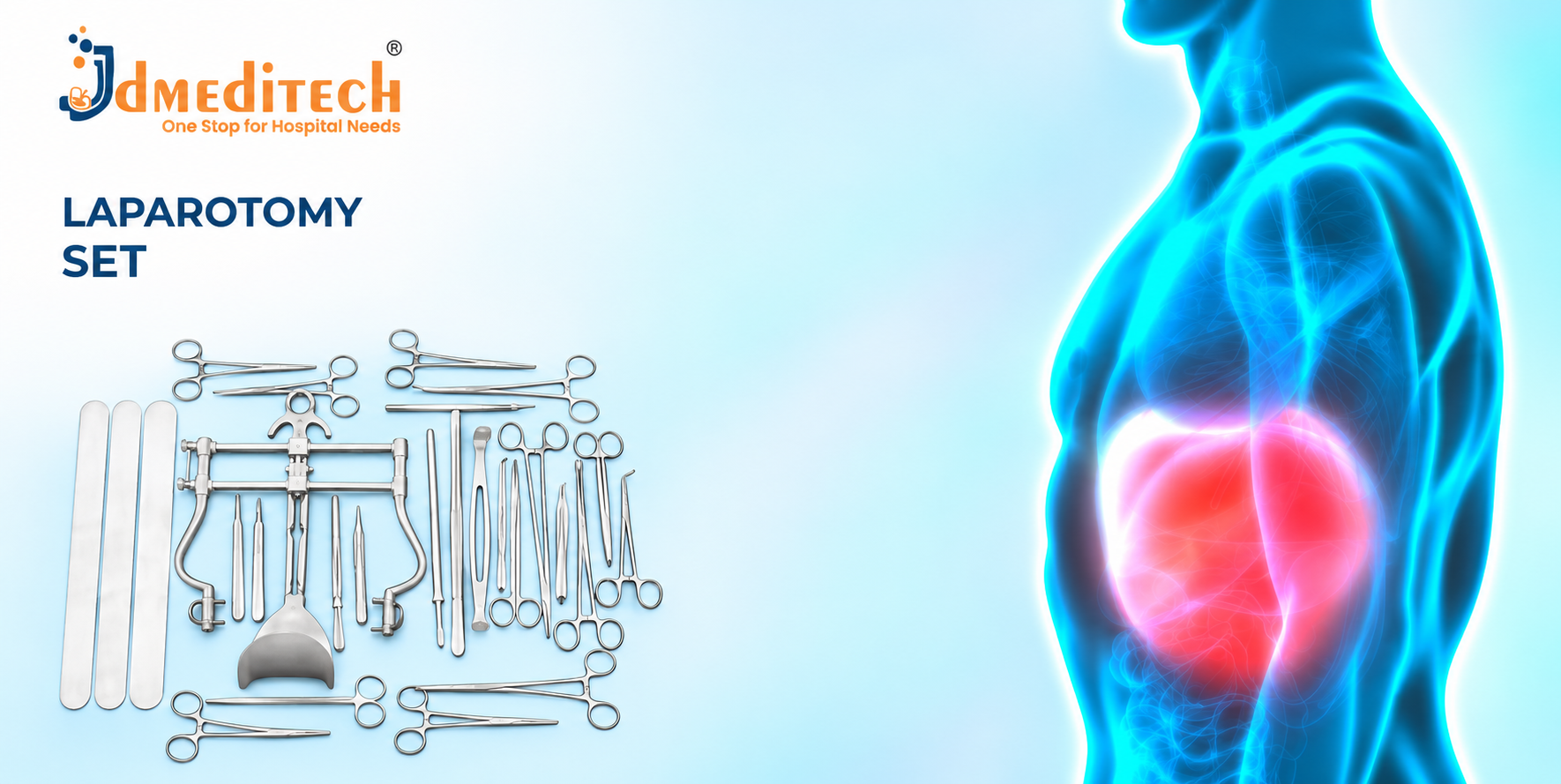
Laparotomy Set – Complete Surgical Instruments for Open Abdominal Surgery
A Laparotomy Surgical Instrument Set contains instruments used by trained surgical professionals during open abdominal procedures. The collection supports tissue handling, dissection, clamping, retraction, suturing and other essential surgical tasks.
During open abdominal surgery, surgeons require suitable instruments for different stages of an operation. Therefore, an organized instrument set helps the operating team prepare the required equipment.
Furthermore, the exact selection of instruments depends on the procedure, hospital preferences and surgeon’s requirements. As a result, hospitals should verify the complete instrument list before purchasing.
JDMeditech supplies general surgery instruments and medical equipment for hospitals, surgical centers and medical distributors.
What Is a Laparotomy Set?
A laparotomy set is a collection of surgical instruments intended for selected open abdominal procedures.
Unlike laparoscopic surgery, which typically uses small incisions and specialized access instruments, laparotomy involves an open surgical approach.
Additionally, the operating team may use different forceps, retractors, scissors and clamps throughout the procedure.
However, the instrument selection varies according to the clinical application.
Purpose of a Laparotomy Instrument Set
The primary purpose is to provide the surgical team with appropriate instruments for open abdominal surgery.
For example, surgeons may require instruments for tissue dissection, hemostasis, retraction and suturing.
Furthermore, an organized set can support instrument preparation and surgical workflow.
However, safe and effective use depends on surgical training, instrument condition and appropriate clinical judgment.
Importance of Surgical Instrument Sets in Laparotomy
Open abdominal surgery may involve several surgical stages.
First, the surgical team prepares the appropriate instruments and equipment.
Next, the surgeon selects instruments according to the operative requirements.
Furthermore, appropriate instrument availability helps the team respond to different surgical needs.
Therefore, hospitals should maintain complete, properly inspected surgical sets.
Main Instruments in a Laparotomy Set
The exact components depend on the manufacturer’s configuration and hospital requirements.
A typical laparotomy instrument collection may include:
- Artery Forceps
- Dissecting Forceps
- Allis Tissue Forceps
- Babcock Tissue Forceps
- Kocher Forceps
- Surgical Scissors
- Needle Holders
- Handheld Retractors
- Self-Retaining Retractors
- Sponge Holding Forceps
- Towel Clamps
- Scalpel Handles
- Intestinal Clamps
- Suction Instruments
- Instrument Trays
However, these are examples of instruments commonly associated with open abdominal surgery. The supplied kit may contain a different combination.
1. Artery Forceps
Artery forceps are used to clamp selected blood vessels or tissues during surgical procedures.
Furthermore, different patterns provide different jaw shapes and instrument lengths.
Therefore, surgeons select the appropriate forceps according to the operative requirement.
2. Dissecting Forceps
Dissecting forceps help surgeons hold and manipulate tissues.
Additionally, toothed and non-toothed designs serve different applications.
However, delicate tissues require careful handling to reduce injury.
3. Allis Tissue Forceps
Allis forceps provide a firm grip on selected tissues.
Furthermore, their toothed jaws help maintain traction.
However, they may damage delicate tissue and are unsuitable for some anatomical structures.
4. Babcock Tissue Forceps
Babcock forceps are designed to grasp selected delicate tubular tissues.
For example, surgeons may use them when handling suitable bowel or other soft tissue structures.
However, the surgeon must choose the correct instrument for the tissue involved.
5. Kocher Forceps
Kocher forceps are commonly used for firm tissue grasping.
Additionally, their jaw design provides secure holding in suitable applications.
However, these instruments are not intended for every tissue type.
6. Surgical Scissors
Surgical scissors support tissue dissection and cutting tasks.
For example, Mayo scissors and Metzenbaum scissors serve different purposes.
Furthermore, surgeons choose the appropriate blade design and length for the procedure.
7. Needle Holders
Needle holders help surgeons control surgical needles during suturing.
Additionally, different designs accommodate different needle sizes and surgical techniques.
Therefore, proper instrument selection supports accurate needle handling.
8. Surgical Retractors
Retractors help hold selected tissues away from the operative field.
Furthermore, they support exposure of the surgical area.
However, prolonged or excessive retraction may cause tissue injury.
9. Sponge Holding Forceps
Sponge holding forceps are used to hold suitable surgical sponges or swabs.
Additionally, they may support selected preparation and operative tasks.
However, use depends on the surgical protocol and instrument design.
10. Towel Clamps
Towel clamps help secure surgical drapes in appropriate configurations.
Furthermore, different clamp designs serve different draping requirements.
Therefore, the surgical team should select suitable instruments for the intended application.
11. Scalpel Handles
Scalpel handles accommodate compatible surgical blades.
Additionally, different handle sizes support different blade patterns.
However, personnel must follow sharps safety procedures when handling blades.
12. Intestinal Clamps
Selected intestinal clamps are designed for temporary control of suitable bowel segments.
Furthermore, different jaw patterns provide different clamping characteristics.
However, surgeons must avoid inappropriate compression of delicate tissues.
13. Suction Instruments
Suction instruments help remove fluids from the operative field.
Additionally, different tips may suit different surgical applications.
However, suction equipment must be compatible with the hospital’s approved system.
14. Surgical Instrument Tray
An instrument tray provides a designated arrangement for surgical instruments.
Furthermore, suitable trays may support transport, organization and approved reprocessing workflows.
However, tray compatibility with sterilization processes must be confirmed.
Key Features of a Laparotomy Set
Depending on the supplied configuration, a surgical set may offer the following features:
- Multiple General Surgery Instruments
- Dedicated Tissue Grasping Instruments
- Clamping and Hemostasis Instruments
- Surgical Cutting Instruments
- Needle Holding Instruments
- Different Retraction Options
- Multiple Instrument Lengths
- Reusable Instrument Configurations
- Hospital-Specific Set Arrangements
- Optional Instrument Storage Tray
However, the exact product features depend on the selected configuration.
How Does a Laparotomy Set Support Surgery?
A laparotomy set provides different instruments for different surgical tasks.
For example, surgeons use suitable forceps to manipulate tissue and appropriate scissors for dissection.
Meanwhile, retractors help maintain surgical exposure.
Additionally, clamps support selected hemostatic or tissue-control requirements.
Finally, needle holders assist with suturing when required.
However, the exact surgical workflow depends on the operation and clinical circumstances.
Applications of a Laparotomy Set
Open abdominal instrument sets may support selected procedures in general surgery and other specialties.
Common applications include:
- Exploratory Laparotomy
- Open Abdominal Surgery
- Selected Bowel Procedures
- Abdominal Trauma Surgery
- Selected Gastrointestinal Procedures
- Open Surgical Reconstruction
- Selected Emergency Abdominal Operations
- Other Approved Open Surgical Procedures
However, each procedure requires its own instrument selection and clinical planning.
Application in Exploratory Laparotomy
Exploratory laparotomy involves surgical examination of the abdominal cavity.
Furthermore, the surgeon may assess abdominal organs and identify the cause of a clinical problem.
Therefore, the operating team prepares appropriate instruments for the anticipated procedure.
Application in Gastrointestinal Surgery
Selected gastrointestinal operations use an open abdominal approach.
Additionally, the surgeon may require tissue forceps, clamps, retractors and suturing instruments.
However, the exact equipment depends on the operation.
Application in Abdominal Trauma Surgery
Some abdominal injuries require emergency open surgery.
Furthermore, the surgical team may need instruments for exposure, hemostasis and tissue repair.
Therefore, hospitals should maintain appropriate emergency surgical equipment.
Application in Bowel Surgery
Selected bowel procedures require specialized tissue-handling instruments.
Additionally, surgeons may use appropriate clamps and retractors.
However, instrument selection depends on the surgical technique and tissue condition.
Application in Emergency General Surgery
Emergency abdominal procedures may require rapid access to appropriate surgical instruments.
Furthermore, organized instrument preparation supports operating room readiness.
However, the surgical team must adapt the equipment selection to the clinical situation.
Types of Laparotomy Instrument Sets
Different hospitals may require different instrument configurations.
Examples include:
- Basic Laparotomy Instrument Set
- General Surgery Laparotomy Set
- Major Abdominal Surgery Set
- Exploratory Laparotomy Set
- Emergency Laparotomy Set
- Customized Open Surgery Instrument Set
However, these names do not represent universal standardized instrument lists.
Basic Laparotomy Set
A basic configuration may include commonly used instruments for selected open surgical procedures.
Furthermore, the exact quantity and instrument types vary.
Therefore, buyers should request the complete component list.
Major Laparotomy Set
A major configuration may include a broader selection of instruments.
Additionally, it may accommodate more complex surgical requirements.
However, hospitals should confirm the exact supplied contents.
Customized Laparotomy Set
Some suppliers offer instrument configurations based on hospital requirements.
For example, a surgical department may request specific forceps, retractors or scissors.
However, customization options and availability require supplier confirmation.
Technical Specifications of a Laparotomy Set
Exact specifications vary by instrument and set configuration. Therefore, customers should request the official product list and technical datasheets.
| Parameter | Product Information |
|---|---|
| Product Name | Laparotomy Set |
| Product Category | General Surgery Instrument Set |
| Primary Application | Open Abdominal Surgery |
| Instrument Types | Forceps, Scissors, Clamps, Retractors and Other Instruments |
| Number of Instruments | Confirm Supplied Component List |
| Instrument Material | Confirm Manufacturer Specifications |
| Instrument Lengths | Model-Specific |
| Handle Designs | Instrument-Specific |
| Jaw Configurations | Instrument-Specific |
| Surface Finish | Confirm Product Datasheet |
| Reusable or Single-Use | Confirm Product Labeling |
| Sterile Status | Confirm Product Labeling |
| Cleaning Requirements | Follow Manufacturer Instructions |
| Sterilization Compatibility | Verify Manufacturer Validation |
| Instrument Tray | Confirm Supplied Configuration |
| Packaging | Confirm Product Configuration |
| Regulatory Documentation | Verify for Destination Market |
Importance of Instrument Material
Reusable surgical instruments commonly use materials suitable for their intended clinical application and reprocessing requirements.
Furthermore, material selection influences corrosion resistance and durability.
However, the exact steel grade and surface finish depend on the manufacturer.
Therefore, buyers should verify official material specifications.
Importance of Instrument Quality
Surgical instruments require appropriate mechanical performance.
For example, forceps should operate according to their intended design.
Additionally, scissors and clamps require suitable working surfaces and mechanisms.
Therefore, hospitals should inspect instruments before use and maintain them according to manufacturer instructions.
Potential Benefits of a Laparotomy Set
An appropriately configured instrument set may offer several practical advantages.
- Organized Surgical Instrument Collection
- Availability of Multiple Instrument Types
- Support for Different Open Surgical Tasks
- Convenient Instrument Preparation
- Hospital-Specific Instrument Selection
- Reusable Instrument Options
- Potential Support for Inventory Management
- Suitable Configurations for General Surgery Departments
Furthermore, an organized set can help the surgical team prepare for anticipated requirements.
However, instrument availability alone does not guarantee better clinical outcomes.
Important Safety Precautions
Only trained healthcare professionals should use surgical instruments.
Furthermore, hospitals must verify the condition and intended use of every instrument.
- Confirm the Complete Instrument List
- Inspect Each Instrument
- Check Forceps and Clamp Alignment
- Verify Scissor Performance
- Inspect Needle Holder Jaws
- Check Retractor Integrity
- Verify Sterilization Status
- Follow Surgical Count Procedures
- Use Appropriate Sharps Safety Measures
- Follow Manufacturer Instructions
Additionally, damaged instruments should be removed from service.
Potential Risks of Incorrect Instrument Use
Improper instrument selection or handling may create clinical risks.
- Tissue Injury
- Unintended Bleeding
- Excessive Tissue Compression
- Instrument Breakage
- Mechanical Malfunction
- Contamination
- Surgical Site Infection
- Retained Surgical Items
Therefore, surgical teams must follow established clinical and instrument management protocols.
Inspection Before Use
Healthcare personnel should inspect the instrument set before surgery.
- Verify the Instrument Inventory
- Check for Missing Components
- Inspect Instrument Surfaces
- Examine Hinges and Joints
- Check Clamping Mechanisms
- Inspect Cutting Instruments
- Verify Instrument Integrity
- Confirm Sterile Packaging
- Follow Institutional Procedures
Furthermore, the surgical team should resolve any instrument discrepancies before use.
Cleaning and Reprocessing
Reusable instruments require validated cleaning and reprocessing.
Additionally, hinged instruments and complex surfaces may require particular attention.
However, the correct processing method depends on each instrument’s design and material.
Therefore, healthcare facilities must follow the manufacturer’s instructions for use.
Sterilization Requirements
Reusable surgical instruments require appropriate sterilization before clinical use.
Furthermore, the manufacturer should specify validated sterilization methods.
However, users should not assume that every instrument supports the same sterilization cycle.
Therefore, hospitals must verify compatibility before processing the set.
Storage and Handling Guidelines
Proper storage helps protect surgical instruments.
For example, facilities should organize instruments to reduce mechanical damage.
Additionally, sharp and delicate components may require suitable protection.
Therefore, hospitals should follow approved storage and handling procedures.
How to Choose the Right Laparotomy Set
Hospitals and procurement teams should review several factors before purchasing.
- Intended Surgical Procedures
- Complete Instrument List
- Required Instrument Quantities
- Instrument Sizes and Patterns
- Material Specifications
- Handle and Jaw Designs
- Reusable or Single-Use Status
- Cleaning and Sterilization Requirements
- Instrument Tray Requirements
- Hospital Preferences
- Regulatory Documentation
- Supplier Support
Furthermore, the surgical department should approve the final configuration.
Applications in Hospitals
Hospitals use laparotomy instrument sets for selected open abdominal procedures.
Additionally, different departments may require different configurations.
Therefore, procurement teams should coordinate with surgical professionals.
Applications in Surgical Centers
Surgical centers may require organized instrument collections for open surgical procedures.
Furthermore, suitable instrument preparation supports operating room readiness.
However, the exact configuration depends on the center’s clinical services.
Applications for Medical Distributors
Medical distributors should confirm the complete instrument list before preparing quotations.
For example, customers may request specific instrument quantities or patterns.
Additionally, destination-market regulations may affect documentation requirements.
Therefore, distributors should request official product specifications.
Why Choose JDMeditech?
JDMeditech supplies general surgery instruments, laparoscopic instruments and medical equipment for hospitals, surgical centers and medical distributors.
Furthermore, our team can assist customers with product inquiries, available configurations and technical information.
Customers can contact JDMeditech regarding:
- Laparotomy Set Inquiries
- General Surgery Instrument Requirements
- Available Instrument Configurations
- Hospital Procurement Requirements
- Surgical Instrument Quotations
- Medical Distributor Inquiries
- International Export Requests
However, exact product availability and specifications require confirmation.
Frequently Asked Questions About Laparotomy Sets
1. What Is a Laparotomy Set?
It is a collection of surgical instruments used during selected open abdominal procedures.
2. What Is the Main Purpose of the Set?
The set provides instruments for tissue handling, dissection, clamping, retraction and suturing.
3. Which Instruments Are Commonly Included?
Typical sets may include forceps, scissors, clamps, retractors and needle holders. However, the exact contents vary.
4. Is a Laparotomy Set Used for Open Surgery?
Yes. These sets are associated with selected open abdominal surgical procedures.
5. Is It the Same as a Laparoscopy Set?
No. Laparotomy involves open surgery, while laparoscopy uses specialized minimally invasive instruments.
6. Are Different Configurations Available?
Different configurations may be available. Therefore, customers should request the official component list.
7. What Materials Are Used?
Materials vary by instrument and manufacturer. Therefore, buyers should verify the product specifications.
8. Are Laparotomy Instruments Reusable?
Many surgical instruments are designed for reuse. However, the manufacturer must confirm the intended use of each component.
9. Can the Instruments Be Autoclaved?
Only when the manufacturer validates steam sterilization for the specific instruments.
10. Can Hospitals Request a Customized Set?
Some suppliers offer customized configurations. However, availability requires confirmation.
11. What Should Buyers Confirm Before Ordering?
Buyers should verify the instrument list, quantities, materials, dimensions, packaging and regulatory documentation.
12. Is an Instrument Tray Included?
Some configurations include a tray. However, customers should confirm the supplied accessories.
13. Who Should Use These Instruments?
Only appropriately trained surgical professionals should use them during clinical procedures.
14. Why Is Instrument Inspection Important?
Inspection helps identify damage, missing components and mechanical problems before use.
15. Where Can Customers Request Product Information?
Hospitals, surgical centers and medical distributors can contact JDMeditech for product information and quotations.
Conclusion
In conclusion, a Laparotomy Set provides a collection of instruments for selected open abdominal surgical procedures.
Furthermore, different configurations may include different forceps, scissors, clamps and retractors.
Additionally, suitable instrument selection supports surgical preparation and workflow.
However, safe use requires trained professionals, appropriate instrument inspection and compliance with manufacturer instructions.
Therefore, healthcare facilities should verify the complete component list and technical specifications before purchasing.
JDMeditech – One Stop for Hospital Needs
Website:
www.jdmeditech.com
Related General Surgery Products
- General Surgery Instrument Set
- Abdominal Surgery Instruments
- Surgical Retractors
- Artery Forceps
- Dissecting Forceps
- Surgical Scissors
- Needle Holders
- Surgical Instrument Trays
Medical Disclaimer
This article provides general educational and product information only. It does not replace surgical training, manufacturer instructions or clinical judgment. Healthcare professionals must verify the instrument list, intended use, sterile status, material specifications and reprocessing requirements before use.




