



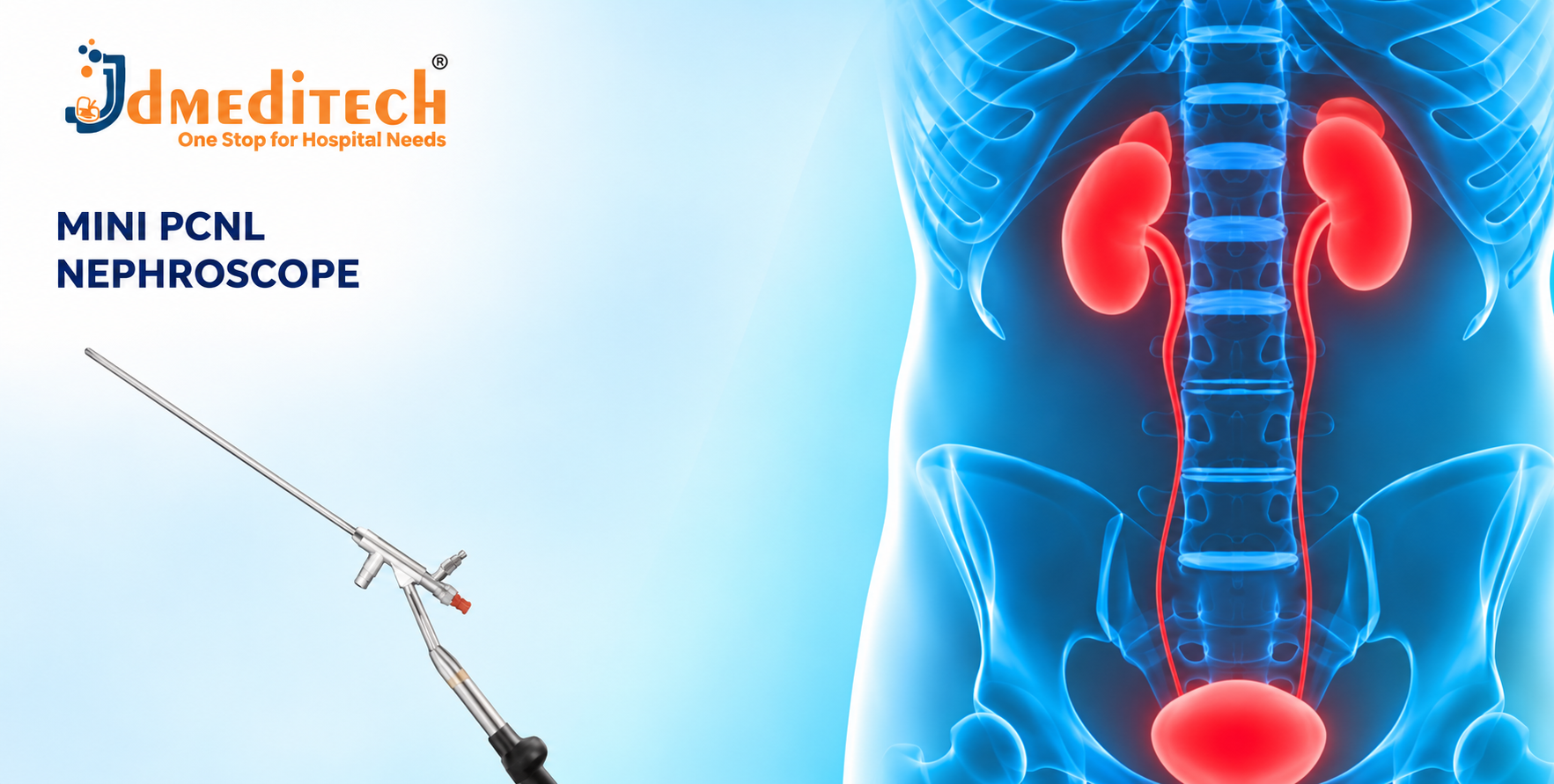
Mini PCNL Nephroscope – Features, Uses, Benefits and Specifications
The Mini PCNL Nephroscope is a specialized
urological endoscopic instrument used during minimally
invasive percutaneous kidney stone procedures.
It allows trained urologists to visualize the
renal collecting system through a compatible
percutaneous access tract.
Furthermore, the instrument supports selected
kidney stone treatment procedures when used with
appropriate access sheaths, irrigation systems
and compatible surgical accessories.
Miniaturized nephroscopes are important components
of modern endourology. Their smaller instrument
profiles may allow surgeons to use narrower access
tracts than those commonly associated with
standard PCNL.
JDMeditech supplies urology surgical instruments,
endoscopic accessories and medical equipment
for hospitals, surgical centers and medical
distributors.
What Is a Mini PCNL Nephroscope?
A mini nephroscope is a compact endoscopic
instrument designed for visualization during
mini-percutaneous nephrolithotomy procedures.
The surgeon uses the nephroscope through a
compatible percutaneous access sheath to
inspect the kidney’s collecting system.
Additionally, compatible working channels
may accommodate selected stone treatment
instruments.
However, working channel dimensions,
optical specifications and instrument
compatibility vary between models.
Understanding Mini Percutaneous Nephrolithotomy
Mini Percutaneous Nephrolithotomy, commonly
called Mini PCNL or Mini-PCNL, is a minimally
invasive surgical technique used to treat
selected kidney stones.
During the procedure, the surgeon establishes
a controlled percutaneous access route into
the renal collecting system.
Next, a compatible nephroscope provides
endoscopic visualization of the operative area.
Furthermore, the surgical team may use
appropriate lithotripsy and stone retrieval
instruments according to the treatment plan.
However, the procedure requires specialist
training, appropriate imaging and careful
patient selection.
Purpose of the Mini Nephroscope
The primary purpose of the instrument is to
provide endoscopic visualization during
selected percutaneous renal procedures.
Additionally, compatible configurations
may support the passage of instruments
used for stone fragmentation or retrieval.
Therefore, the nephroscope forms an important
part of the complete Mini PCNL system.
Key Features of the Mini PCNL Nephroscope
- Miniaturized endoscopic instrument design
- Designed for selected percutaneous renal procedures
- Optical visualization of the renal collecting system
- Compatibility with designated access sheaths
- Working channel options depending on model
- Connection interfaces for compatible accessories
- Irrigation arrangements depending on configuration
- Compatibility with selected stone treatment instruments
- Different optical and dimensional configurations
- Reusable or single-use options depending on product labeling
Furthermore, instrument features depend
on the selected model. Therefore, customers
should verify exact specifications before
purchasing.
Main Components of a Mini PCNL Nephroscope
Depending on the selected configuration,
a mini nephroscope system may include
the following components:
- Nephroscope shaft
- Distal optical assembly
- Eyepiece or camera connection interface
- Light cable connection interface
- Working channel
- Irrigation connection arrangement
- Instrument connector or bridge
- Compatible access sheath
- Associated endoscopic accessories
However, some components belong to the
complete surgical system rather than
the individual nephroscope.
1. Nephroscope Shaft
The shaft forms the main insertion section
of the instrument.
Its dimensions determine compatibility
with designated access sheaths.
Furthermore, the shaft supports the
intended optical and instrument pathways.
2. Optical System
The optical assembly allows the surgeon
to visualize the operative field.
Additionally, it works with compatible
illumination and imaging equipment.
However, viewing angle, field of view
and image characteristics vary between
available models.
3. Working Channel
Selected nephroscopes include a working
channel for compatible surgical accessories.
For example, the channel may accommodate
designated lithotripsy probes or
stone retrieval instruments.
However, users must confirm the channel
diameter and approved accessory compatibility.
4. Irrigation Connection
An appropriate irrigation arrangement
helps maintain endoscopic visualization
during the procedure.
Furthermore, the surgical team must
manage irrigation according to the
complete system’s instructions and
the patient’s clinical condition.
5. Light Connection Interface
The light connection interface allows
attachment of a compatible illumination
system when required by the model.
Consequently, adequate illumination
supports visualization of the renal
collecting system.
6. Camera or Eyepiece Interface
The proximal optical interface may connect
to a compatible camera system or eyepiece.
Additionally, video imaging may allow
the surgical team to observe the
endoscopic procedure on a monitor.
7. Compatible Access Sheath
The access sheath provides the intended
pathway for the nephroscope during
percutaneous renal surgery.
However, sheath selection depends on
the nephroscope dimensions and
the approved surgical technique.
Clinical Applications of Mini PCNL Nephroscope
Healthcare professionals may use
compatible mini nephroscopes during
selected percutaneous renal procedures.
- Mini Percutaneous Nephrolithotomy
- Selected Kidney Stone Removal Procedures
- Endoscopic Visualization of the Renal Collecting System
- Selected Percutaneous Stone Fragmentation Procedures
- Selected Stone Retrieval Procedures
- Other Manufacturer-Approved Renal Endoscopic Applications
However, the treating urologist must
determine whether the procedure is
appropriate for each patient.
Role in Kidney Stone Surgery
Kidney stones are solid deposits that
form within the urinary system.
Although some stones pass naturally,
others require medical or surgical treatment.
For selected patients, Mini PCNL provides
a percutaneous treatment option.
Furthermore, the nephroscope helps
the surgeon visualize the collecting
system during stone treatment.
However, stone size, location, composition,
anatomy and patient-specific factors
influence treatment selection.
Benefits of Mini PCNL Nephroscope
Miniaturized nephroscope systems may
offer several procedural advantages
in appropriately selected cases.
- Supports Minimally Invasive Renal Access
- Provides Direct Endoscopic Visualization
- Supports Compatible Stone Treatment Instruments
- May Allow Smaller Access Tracts Than Standard PCNL
- Supports Selected Kidney Stone Removal Procedures
- Offers Different System Configurations
- Supports Modern Endourology Techniques
Additionally, smaller access tracts may
reduce certain procedure-related risks
in selected patients.
However, outcomes depend on stone
characteristics, surgical technique,
equipment and patient condition.
Mini PCNL vs Standard PCNL
| Feature | Mini PCNL | Standard PCNL |
|---|---|---|
| Instrument Profile | Miniaturized | Generally Larger |
| Access Tract | Generally Smaller | Generally Larger |
| Visualization | Compatible Mini Nephroscope | Compatible Standard Nephroscope |
| Stone Treatment | Selected Kidney Stones | Selected Kidney Stones, Including Complex Cases |
| Working Channel | Model-Dependent | Model-Dependent |
| Clinical Selection | Patient-Specific | Patient-Specific |
Therefore, neither technique is universally
preferable. The surgeon selects the
appropriate method according to
clinical requirements.
Technical Specifications of Mini PCNL Nephroscope
The following table summarizes the
technical details that customers
should confirm before ordering.
| Parameter | Product Information |
|---|---|
| Product Name | Mini PCNL Nephroscope |
| Product Category | Urology Endoscopic Instruments |
| Instrument Type | Mini Percutaneous Nephroscope |
| Primary Application | Selected Mini PCNL Procedures |
| Primary Function | Endoscopic Renal Visualization |
| Shaft Diameter | Confirm Available Models |
| Working Length | Confirm Manufacturer Specifications |
| Viewing Angle | Confirm Optical Specifications |
| Working Channel Diameter | Confirm Manufacturer Specifications |
| Light Connection | Confirm Compatible Systems |
| Camera Compatibility | Confirm Compatible Systems |
| Access Sheath Compatibility | Confirm Approved Models |
| Instrument Material | Confirm Manufacturer Specifications |
| Reusable or Single-Use | Confirm Product Labeling |
| Sterile Status | Confirm Product Labeling |
| Reprocessing Method | Follow Manufacturer Instructions |
| Packaging | Confirm Supplied Configuration |
| Regulatory Documentation | Verify for Destination Market |
Importance of Optical Visualization
Clear endoscopic visualization is important
during percutaneous renal procedures.
Furthermore, the optical system allows
the surgeon to observe the intended
operative field.
However, image quality depends on
the complete imaging system,
illumination and irrigation conditions.
Importance of Working Channel Compatibility
The working channel must accommodate
the selected surgical accessories.
For example, lithotripsy probes and
retrieval devices require appropriate
channel dimensions.
Therefore, users should confirm
compatibility before the procedure.
Compatible Instruments and Accessories
Depending on the approved system,
the following accessories may be relevant:
- Mini PCNL Access Sheath
- Amplatz Dilator Set
- Guide Wire
- Percutaneous Access Needle
- Stone Retrieval Forceps
- Stone Retrieval Basket
- Compatible Lithotripsy Instruments
- Endoscopic Camera System
- Light Source and Light Cable
- Irrigation Accessories
However, these accessories are not
necessarily included with the nephroscope.
Customers should confirm the supplied
configuration before purchasing.
Safety Precautions
Only appropriately trained urologists
and healthcare professionals should
operate mini nephroscope systems.
- Verify the Approved Intended Use
- Confirm Access Sheath Compatibility
- Inspect the Optical Assembly
- Check the Instrument Shaft
- Verify Working Channel Compatibility
- Inspect Connection Interfaces
- Use Appropriate Imaging Guidance
- Follow Irrigation Management Protocols
- Verify Sterile or Reprocessed Status
- Follow Manufacturer Instructions
- Assess Patient-Specific Contraindications
Potential Risks and Complications
Mini PCNL is a surgical procedure
and carries potential clinical risks.
- Bleeding
- Urinary Tract Infection
- Sepsis
- Injury to the Kidney or Nearby Structures
- Urinary Leakage
- Residual Stone Fragments
- Need for Additional Treatment
- Complications Related to Access or Irrigation
Furthermore, the overall risk depends
on patient health, stone characteristics
and surgical technique.
Therefore, the treating team must
follow established clinical protocols.
Inspection Before Use
Healthcare professionals should inspect
the nephroscope before each procedure.
- Confirm Product Identification
- Inspect the Shaft for Damage
- Check the Optical Window
- Verify Image Quality
- Inspect Working Channel Openings
- Check Light Connection Compatibility
- Verify Camera Compatibility
- Confirm Access Sheath Compatibility
- Check Sterile or Reprocessed Status
Additionally, personnel should remove
damaged or malfunctioning instruments
from service.
Cleaning and Sterilization Guidelines
Reusable nephroscopes require validated
cleaning and reprocessing according
to the manufacturer’s instructions.
Furthermore, optical components,
working channels and connection
interfaces may require specific care.
However, not every instrument supports
the same sterilization method.
Therefore, healthcare facilities must
follow the approved instructions for use.
Storage and Handling Recommendations
- Store According to Manufacturer Instructions
- Protect the Optical Components
- Avoid Mechanical Impact
- Prevent Shaft Damage
- Protect Connection Interfaces
- Keep Instruments Properly Identified
- Inspect Before Every Use
- Remove Damaged Instruments From Service
How to Choose the Right Mini PCNL Nephroscope
Hospitals and medical distributors
should evaluate several factors
before selecting a nephroscope.
- Approved Clinical Application
- Required Shaft Diameter
- Working Length
- Viewing Angle
- Working Channel Diameter
- Access Sheath Compatibility
- Camera System Compatibility
- Light Source Compatibility
- Compatible Lithotripsy Accessories
- Reusable or Single-Use Classification
- Cleaning and Sterilization Requirements
- Regulatory Documentation
Furthermore, procurement teams should
consult the operating urologist before
selecting the final configuration.
Why Choose JDMeditech?
JDMeditech supplies urology surgical
instruments, endoscopic accessories
and medical equipment for hospitals,
surgical centers and medical distributors.
Additionally, our team assists customers
with product inquiries, available
configurations and quotation requests.
Customers can contact JDMeditech regarding:
- Mini PCNL Nephroscope
- Standard PCNL Nephroscope
- Mini PCNL Surgical Instruments
- Amplatz Dilator Set
- Percutaneous Access Accessories
- Stone Retrieval Instruments
- Urology Endoscopic Equipment
- Hospital Procurement Requirements
- International Distributor Inquiries
However, exact product availability,
specifications and compatibility
require confirmation.
Frequently Asked Questions
1. What Is a Mini PCNL Nephroscope?
It is a miniaturized endoscopic instrument
used for visualization during selected
percutaneous kidney stone procedures.
2. What Is the Main Purpose of the Instrument?
Its primary purpose is to provide
endoscopic visualization of the renal
collecting system during compatible procedures.
3. What Does Mini PCNL Mean?
Mini PCNL means Mini Percutaneous
Nephrolithotomy, a minimally invasive
technique used to treat selected kidney stones.
4. Is Mini PCNL Different From Standard PCNL?
Yes. Mini PCNL generally uses smaller
access tracts and miniaturized instruments.
However, both procedures require
appropriate patient selection.
5. Can a Mini Nephroscope Remove Kidney Stones?
The nephroscope provides visualization.
Compatible stone fragmentation and
retrieval instruments perform the
associated treatment functions.
6. Does Every Nephroscope Have a Working Channel?
Working channel design depends
on the selected model.
7. Can It Be Used With Any Access Sheath?
No. Users must confirm compatibility
with the selected sheath.
8. Is the Instrument Reusable?
Reuse depends on the manufacturer’s
approved product labeling and
reprocessing instructions.
9. Can the Instrument Be Autoclaved?
Only models with validated steam
sterilization instructions should
undergo autoclaving.
10. What Instruments Are Used With Mini PCNL?
Depending on the approved configuration,
the procedure may involve access sheaths,
guide wires, dilators, lithotripsy
instruments and stone retrieval accessories.
11. Who Should Operate a Mini Nephroscope?
Only appropriately trained urologists
and healthcare professionals should
operate these systems.
12. Where Can Customers Request Product Details?
Hospitals, urology departments
and medical distributors can
contact JDMeditech for product
information and quotations.
Conclusion
In conclusion, the Mini PCNL Nephroscope
is an important endoscopic instrument
for selected minimally invasive
kidney stone procedures.
Furthermore, its miniaturized design
supports visualization through
compatible percutaneous access systems.
However, safe operation depends on
correct equipment compatibility,
trained personnel and adherence
to manufacturer instructions.
Therefore, hospitals and medical
distributors should verify complete
technical specifications before purchasing.
JDMeditech – One Stop for Hospital Needs
Website:
www.jdmeditech.com
Related Urology Instruments
- Standard PCNL Nephroscope
- Mini PCNL Access Sheath
- Amplatz Dilator Set
- Percutaneous Access Needle
- Stone Retrieval Basket
- Stone Retrieval Forceps
- Urology Endoscopic Accessories
Medical Reference
For additional clinical information
about kidney stones and surgical
treatment options, visit the
European Association of Urology
Guidelines on Urolithiasis
.
Medical Disclaimer
This article provides general educational
and product information only.
It does not replace professional medical
advice, specialist training, clinical
judgment or manufacturer instructions.
Healthcare professionals must verify
instrument compatibility, approved
intended use, sterile status,
reprocessing requirements and
contraindications before use.




