



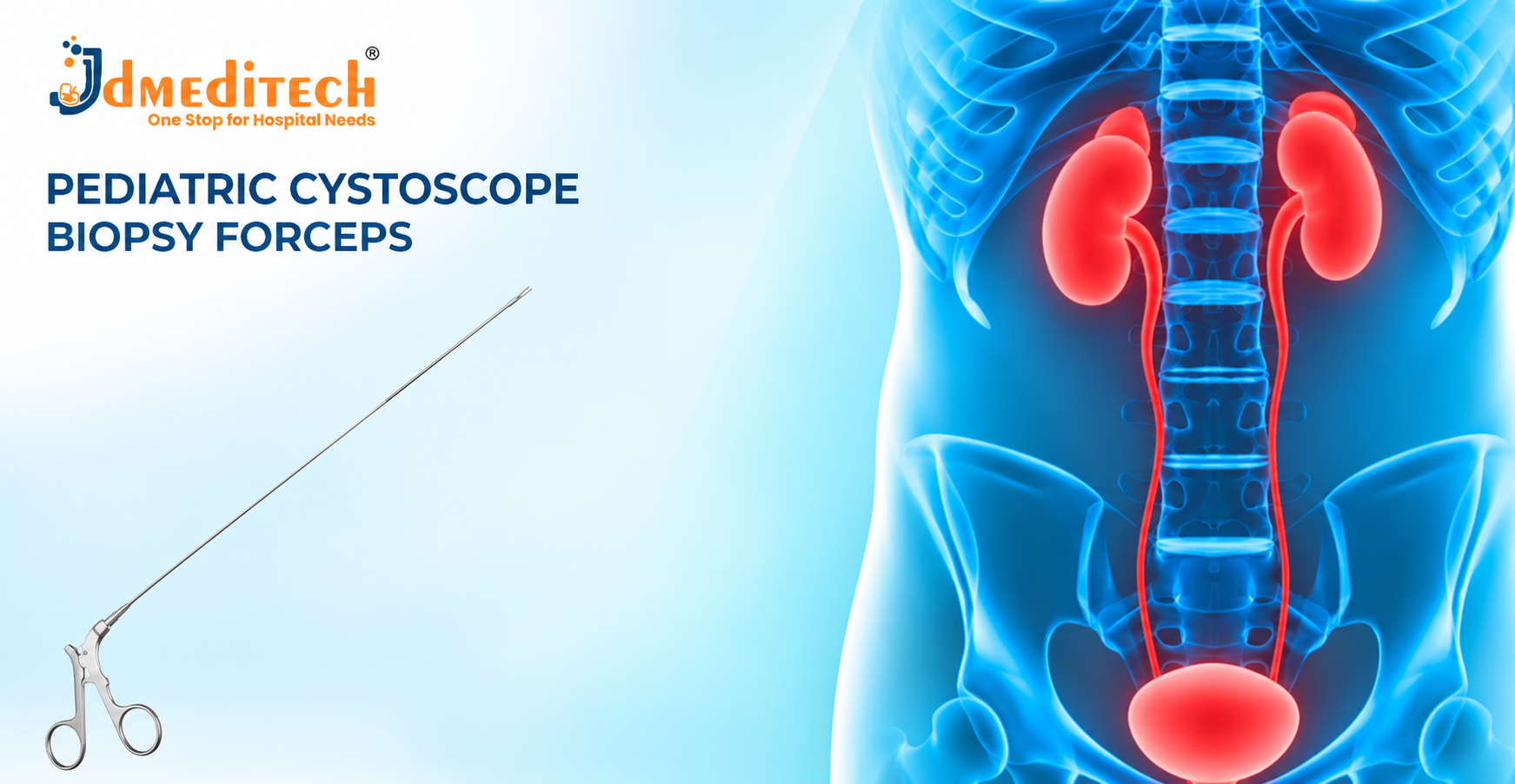
Pediatric Cystoscope Biopsy Forceps – Features, Uses and Specifications
The Pediatric Cystoscope Biopsy Forceps
is a specialized endoscopic instrument designed
for collecting small tissue specimens during
selected pediatric cystoscopy procedures.
Pediatric urologists use compatible biopsy
instruments when clinical evaluation requires
tissue sampling from the urinary tract.
Furthermore, pediatric procedures require
carefully selected instruments because
children have smaller urinary tract anatomy
than adults.
JDMeditech supplies urology surgical instruments,
endoscopic accessories and medical equipment
for hospitals, surgical centers and medical
distributors.
What Are Pediatric Cystoscope Biopsy Forceps?
These biopsy forceps are specialized urological
instruments used to obtain small tissue samples
during compatible pediatric cystoscopic procedures.
Typically, the instrument includes a slender
shaft, distal biopsy jaws and a proximal
operating handle.
Additionally, the instrument allows a trained
clinician to control the distal jaws through
the designated endoscopic instrument pathway.
However, shaft dimensions, jaw configurations
and compatibility vary by model.
Purpose of Pediatric Cystoscopy Biopsy Instruments
The primary purpose of these instruments
is to support diagnostic tissue sampling.
For example, a pediatric urologist may
collect tissue from an abnormal bladder
mucosal area when clinically appropriate.
Furthermore, histopathological examination
can help investigate selected urinary
tract abnormalities.
However, the instrument itself does not
diagnose a medical condition.
How Do Pediatric Biopsy Forceps Work?
The instrument uses a mechanical operating
mechanism to open and close its distal jaws.
During an approved cystoscopic procedure,
the clinician introduces a compatible
instrument through the designated working
channel or instrument pathway.
Next, the clinician positions the jaws
under direct endoscopic visualization.
The operating handle controls jaw movement
to collect a small tissue specimen.
Afterward, the surgical team processes
the specimen according to the required
pathology protocol.
However, pediatric tissue sampling
requires specialist training and
careful clinical assessment.
Key Features of Pediatric Cystoscope Biopsy Forceps
- Designed for selected pediatric cystoscopy procedures
- Slender instrument shaft
- Mechanical distal biopsy jaws
- Manual operating handle
- Ring-handle configuration on selected models
- Compatibility with designated pediatric cystoscopes
- Different working lengths depending on model
- Different shaft diameters depending on configuration
- Model-specific biopsy jaw designs
- Reusable or single-use options depending on labeling
Furthermore, exact instrument features
depend on the selected configuration.
Therefore, buyers should confirm the
official technical specifications.
Main Components of Pediatric Cystoscope Biopsy Forceps
- Instrument shaft
- Distal biopsy jaw assembly
- Proximal operating handle
- Finger rings or grip mechanism
- Internal actuation mechanism
- Connection components
1. Instrument Shaft
The shaft connects the proximal operating
handle with the distal biopsy jaws.
Furthermore, its diameter and length
must suit the selected pediatric
endoscopic system.
However, shaft construction varies
between available models.
2. Distal Biopsy Jaw Assembly
The distal jaws grasp and collect
small tissue specimens.
Additionally, jaw geometry may vary
according to the intended application.
Therefore, clinicians should select
an appropriate configuration.
3. Proximal Operating Handle
The proximal handle controls the
mechanical movement of the distal jaws.
Furthermore, ring handles may provide
a manual gripping mechanism.
However, handle designs vary
between instrument models.
4. Internal Actuation Mechanism
The internal mechanism transfers
movement from the handle to
the distal biopsy jaws.
Additionally, it supports the
instrument’s intended mechanical function.
Therefore, users should inspect
the mechanism before use.
Clinical Applications in Pediatric Urology
- Selected Pediatric Diagnostic Cystoscopy Procedures
- Selected Bladder Mucosal Biopsies
- Investigation of Suspicious Mucosal Lesions
- Selected Urethral Tissue Sampling
- Endoscopic Tissue Collection
- Other Manufacturer-Approved Pediatric Applications
However, clinical suitability depends
on the patient’s condition and
the device’s approved intended use.
Understanding Pediatric Cystoscopy
Pediatric cystoscopy allows a specialist
to examine the urethra and urinary bladder
using an appropriately sized cystoscope.
Furthermore, the examination may help
investigate selected urinary tract
abnormalities.
However, the clinician must consider
the child’s anatomy, age and
clinical requirements.
Role During Pediatric Bladder Biopsy
A bladder biopsy involves collecting
a small tissue specimen from a
selected area of the bladder lining.
For example, a clinician may investigate
an abnormal mucosal appearance
during cystoscopy.
Furthermore, histopathological
examination can provide diagnostic
information about the tissue.
However, the treating clinician
must interpret the findings
alongside other investigations.
Importance of Pediatric Instrument Sizing
Correct instrument sizing is especially
important during pediatric procedures.
Furthermore, the biopsy forceps
must fit the approved working channel
or instrument pathway.
However, pediatric endoscopes may
have smaller channel dimensions
than adult models.
Therefore, compatibility must
be confirmed before use.
Potential Benefits of Pediatric Biopsy Forceps
- Supports Selected Pediatric Endoscopic Biopsies
- Allows Collection of Small Tissue Samples
- Provides Mechanical Jaw Operation
- Supports Compatible Pediatric Cystoscopes
- Offers Different Instrument Configurations
- Supports Diagnostic Urological Evaluation
- Allows Tissue Sampling Under Endoscopic Visualization
However, these functional benefits
do not guarantee specific
diagnostic or clinical outcomes.
Pediatric vs Adult Cystoscopy Biopsy Forceps
| Feature | Pediatric Forceps | Adult Forceps |
|---|---|---|
| Intended Patient Group | Selected Pediatric Patients | Selected Adult Patients |
| Instrument Dimensions | Pediatric-Compatible Configurations | Adult-Compatible Configurations |
| Cystoscope Compatibility | Selected Pediatric Systems | Selected Adult Systems |
| Biopsy Jaw Design | Model-Dependent | Model-Dependent |
| Working Length | Model-Dependent | Model-Dependent |
Technical Specifications
| Parameter | Details |
|---|---|
| Product Name | Pediatric Cystoscope Biopsy Forceps |
| Category | Urology Endoscopic Instruments |
| Instrument Type | Pediatric Endoscopic Biopsy Forceps |
| Primary Function | Collection of Small Tissue Specimens |
| Application | Selected Pediatric Cystoscopy Procedures |
| Shaft Diameter | Confirm Manufacturer Specifications |
| Working Length | Confirm Manufacturer Specifications |
| Biopsy Jaw Configuration | Confirm Available Models |
| Handle Design | Confirm Available Configuration |
| Cystoscope Compatibility | Confirm Approved Models |
| Material | Confirm Manufacturer Specifications |
| Reusable or Single-Use | Confirm Product Labeling |
| Sterile Status | Confirm Product Labeling |
| Reprocessing Method | Follow Manufacturer Instructions |
| Packaging | Confirm Supplied Configuration |
Importance of Working Channel Compatibility
Working channel compatibility is essential
for proper instrument selection.
Furthermore, the instrument diameter
must suit the approved endoscopic pathway.
Therefore, users should verify compatibility
with the selected pediatric cystoscope.
Safety Precautions
- Verify Approved Intended Use
- Confirm Pediatric Cystoscope Compatibility
- Inspect Instrument Shaft
- Check Distal Biopsy Jaws
- Verify Handle Operation
- Avoid Excessive Force
- Do Not Use Damaged Instruments
- Verify Sterile or Reprocessed Status
- Follow Manufacturer Instructions
- Assess Patient-Specific Contraindications
Potential Risks and Complications
- Bleeding
- Urinary Tract Infection
- Urethral or Bladder Injury
- Post-Procedure Discomfort
- Inadequate Tissue Sampling
- Rare Perforation
- Anesthesia-Related Complications
Furthermore, overall risk depends
on the patient’s condition
and the procedure.
Inspection Before Use
- Confirm Product Identification
- Inspect Instrument Shaft
- Check Distal Jaw Assembly
- Verify Handle Function
- Inspect for Visible Damage
- Confirm Cystoscope Compatibility
- Verify Sterile Status
- Check Approved Reprocessing Status
Cleaning and Sterilization Guidelines
Reusable instruments require validated
cleaning and reprocessing according
to the manufacturer’s instructions.
Furthermore, the distal jaws
and instrument shaft may require
specific cleaning attention.
However, sterilization compatibility
varies between models.
Storage and Handling Recommendations
- Store According to Manufacturer Instructions
- Protect Distal Biopsy Jaws
- Avoid Mechanical Impact
- Prevent Shaft Damage
- Keep Instruments Properly Identified
- Inspect Before Every Use
- Remove Damaged Instruments From Service
How to Choose the Right Pediatric Biopsy Forceps
- Approved Intended Use
- Compatible Cystoscope Model
- Working Channel Diameter
- Required Shaft Diameter
- Working Length
- Biopsy Jaw Configuration
- Handle Design
- Material Specifications
- Reusable or Single-Use Classification
- Cleaning and Sterilization Requirements
- Applicable Regulatory Documentation
Furthermore, procurement teams
should consult the operating
pediatric urologist before
selecting the final configuration.
Why Choose JDMeditech?
JDMeditech supplies urology surgical
instruments, endoscopic accessories
and medical equipment for hospitals,
surgical centers and medical distributors.
Additionally, our team assists customers
with product inquiries, available
configurations and quotation requests.
Customers can contact JDMeditech regarding:
- Pediatric Cystoscope Biopsy Forceps
- Pediatric Cystoscopy Instruments
- Rigid Cystoscopy Biopsy Forceps
- Flexible Cystoscopy Biopsy Forceps
- Diagnostic Cystoscopy Sets
- Urology Grasping Forceps
- Endoscopic Biopsy Accessories
Frequently Asked Questions
1. What Are Pediatric Cystoscope Biopsy Forceps?
They are endoscopic instruments designed to collect small tissue specimens during selected pediatric cystoscopic procedures.
2. What Is Their Main Purpose?
Their primary purpose is to support diagnostic tissue sampling during compatible pediatric urological procedures.
3. Are They Used for Bladder Biopsies?
Yes. Compatible instruments may help collect selected bladder mucosal tissue specimens when clinically appropriate.
4. Can They Be Used With Any Pediatric Cystoscope?
No. Users must verify compatibility with the selected cystoscope and its working channel.
5. What Is the Function of the Distal Jaws?
The distal jaws grasp and collect small tissue specimens during approved procedures.
6. What Is the Function of the Operating Handle?
The operating handle controls the mechanical movement of the distal biopsy jaws.
7. Are Pediatric and Adult Biopsy Forceps Interchangeable?
Not necessarily. Users must verify instrument dimensions and endoscope compatibility before use.
8. Are These Instruments Reusable?
Reuse depends on the manufacturer’s approved labeling and reprocessing instructions.
9. Can They Be Autoclaved?
Only models with validated steam sterilization instructions should undergo autoclaving.
10. Can These Forceps Diagnose a Disease?
The instrument collects tissue specimens. However, qualified pathology professionals must examine the tissue to establish a diagnosis.
11. Who Should Operate Pediatric Biopsy Forceps?
Only appropriately trained healthcare professionals should operate these instruments.
12. Where Can Customers Request Product Information?
Hospitals, pediatric urology departments and medical distributors can contact JDMeditech for product information and quotations.
Conclusion
In conclusion, the Pediatric Cystoscope Biopsy Forceps
is an important endoscopic instrument
for selected pediatric diagnostic
urology procedures.
Furthermore, its shaft, distal biopsy
jaws and operating handle support
tissue collection through compatible
endoscopic systems.
However, safe operation depends on
correct instrument sizing,
equipment compatibility and
trained healthcare professionals.
Therefore, hospitals and medical
distributors should verify complete
technical specifications before purchasing.
JDMeditech – One Stop for Hospital Needs
Website:
www.jdmeditech.com
Related Urology Instruments
- Pediatric Cystoscopy Set
- Rigid Cystoscopy Biopsy Forceps
- Flexible Cystoscopy Biopsy Forceps
- Pediatric Urethrotome Set
- Diagnostic Cystoscopy Set
- Urology Endoscopic Accessories
Medical Reference
For additional information about
pediatric urology, visit the
European Association of Urology
Guidelines on Paediatric Urology
.
Medical Disclaimer
This article provides general educational
and product information only.
It does not replace professional medical
advice, specialist training, clinical
judgment or manufacturer instructions.
Healthcare professionals must verify
instrument compatibility, approved
intended use, sterile status,
reprocessing requirements and
contraindications before use.




