



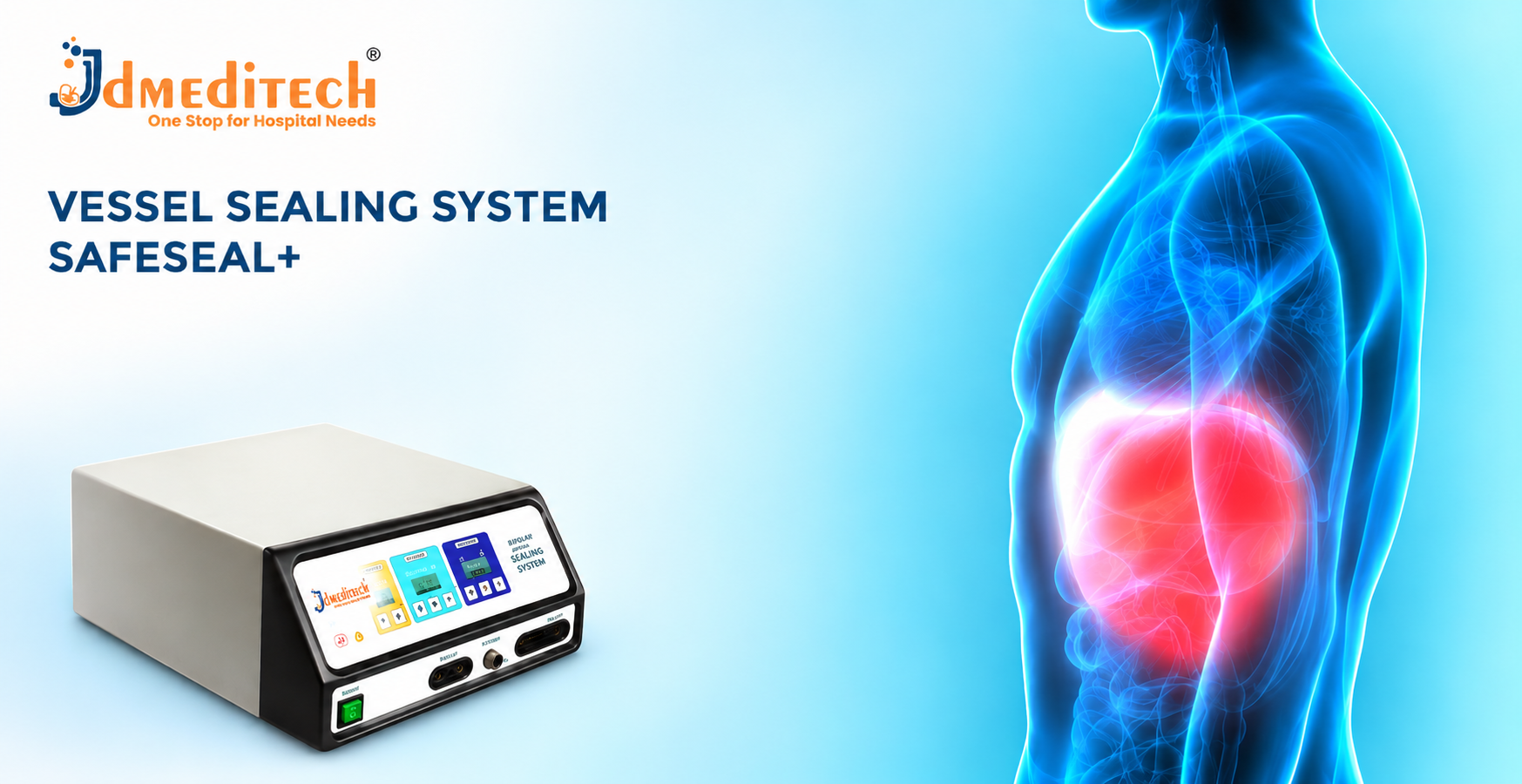
Vessel Sealing System SAFESEAL+ – Features, Uses and Specifications
The Vessel Sealing System SAFESEAL+
is an electrosurgical energy platform
presented for use with compatible vessel
sealing instruments during selected
surgical procedures.
Vessel sealing technology helps surgeons
achieve hemostasis by applying controlled
energy through designated surgical instruments.
Furthermore, compatible systems may support
tissue sealing during laparoscopic and
open surgical procedures, depending on
the manufacturer’s approved indications.
JDMeditech supplies surgical instruments,
laparoscopy equipment and medical devices
for hospitals, surgical centers and
medical distributors.
What Is a Vessel Sealing System?
A vessel sealing system is an electrosurgical
platform designed to deliver controlled
energy through compatible instruments.
During an approved surgical procedure,
the instrument applies mechanical pressure
and energy to designated tissue.
As a result, the tissue’s structural
proteins undergo changes that can
create a sealed tissue region.
However, the approved vessel diameter,
energy settings and tissue applications
depend on the specific system.
Understanding SAFESEAL+ Technology
SAFESEAL+ is the product name shown
for the vessel sealing platform.
The generator serves as the energy
source within a compatible
electrosurgical system.
Additionally, its controls and connection
interfaces support operation with
designated accessories.
However, exact control modes,
feedback functions and energy
specifications require confirmation
from the official product documentation.
Purpose of a Vessel Sealing Generator
The primary purpose of the generator
is to supply energy to compatible
vessel sealing instruments.
Furthermore, the complete system
supports surgical hemostasis
in approved applications.
However, the generator does not
independently grasp, dissect or
cut tissue.
Those functions depend on the
connected surgical instrument
and its approved design.
How Does Vessel Sealing Technology Work?
Bipolar vessel sealing technology
uses electrical energy between
electrodes within a compatible instrument.
First, the surgeon positions
the approved instrument around
the target tissue.
Next, the instrument applies
mechanical compression while
the system delivers energy.
Consequently, controlled tissue
heating can create a seal.
However, the exact energy delivery
algorithm and operating sequence
vary by manufacturer.
Therefore, trained professionals
must follow the approved
instructions for use.
Key Features of the SAFESEAL+ System
- Electrosurgical energy generator platform
- Designed for compatible vessel sealing instruments
- Front-panel operating controls
- Visual operating interface
- Instrument connection ports
- Energy delivery through designated accessories
- Compatibility with selected surgical applications
- Generator-based surgical energy platform
- Model-specific operating modes
- System-dependent safety and monitoring functions
Furthermore, customers should verify
the exact functions of the supplied
SAFESEAL+ model before purchasing.
Main Components of a Vessel Sealing System
A complete vessel sealing arrangement
may include several compatible components.
- Electrosurgical generator
- Front-panel display
- Operating controls
- Instrument connection ports
- Compatible vessel sealing handpiece
- Approved connection cable
- Activation controls where applicable
- Power connection
- Other manufacturer-approved accessories
However, not every accessory is
necessarily included with the generator.
1. Electrosurgical Generator
The generator provides electrical
energy for approved surgical functions.
Furthermore, it forms the central
equipment component of the system.
However, output characteristics
and available modes depend
on the selected model.
2. Front-Panel Display
The display presents operating
information according to
the generator configuration.
Additionally, it may show
selected modes or system status.
However, specific display
functions require confirmation.
3. Operating Controls
The operating controls allow
trained personnel to select
available system functions.
Furthermore, control arrangements
vary by generator design.
Therefore, users must follow
the official operating instructions.
4. Instrument Connection Ports
Connection ports provide designated
interfaces for approved accessories.
However, connector types and
instrument compatibility vary
between electrosurgical systems.
5. Compatible Vessel Sealing Instrument
The connected instrument performs
the tissue-contact function.
Depending on its approved design,
it may support grasping,
sealing or cutting functions.
However, the instrument’s
specific capabilities must
be verified separately.
6. Connection Cable and Accessories
Approved cables connect the
generator with compatible instruments.
Additionally, certain systems
may use designated activation
accessories.
Therefore, only approved
connections should be used.
Clinical Applications of Vessel Sealing Technology
Compatible vessel sealing systems
may support selected surgical
procedures across different specialties.
- Laparoscopic Surgery
- General Surgery
- Gynecological Surgery
- Selected Urological Procedures
- Selected Colorectal Procedures
- Open Surgical Procedures
- Other Manufacturer-Approved Applications
However, clinical indications
depend on the specific generator
and connected instrument.
Role in Laparoscopic Surgery
Laparoscopic surgery uses
specialized instruments and
visualization equipment through
small surgical access sites.
During selected procedures,
a compatible energy instrument
may help manage blood vessels
and designated tissue structures.
Furthermore, energy-based sealing
can support surgical hemostasis.
However, safe use requires
appropriate surgical training
and instrument selection.
Role in Open Surgery
Certain vessel sealing platforms
support approved open surgical
applications.
For example, compatible instruments
may assist with tissue sealing
during selected operations.
However, the surgeon must verify
the intended use of each
instrument and generator combination.
Potential Benefits of Vessel Sealing Systems
- Supports Surgical Hemostasis
- Delivers Energy Through Compatible Instruments
- Supports Selected Tissue Sealing Applications
- Offers Generator-Based Energy Control
- May Reduce Reliance on Some Conventional Ligation Methods
- Supports Selected Open and Laparoscopic Procedures
- Allows Use of Designated Surgical Accessories
Furthermore, clinical performance
depends on the approved system,
surgical technique and
patient-specific conditions.
Therefore, these potential
benefits do not guarantee
specific surgical outcomes.
Vessel Sealing vs Conventional Bipolar Coagulation
| Feature | Vessel Sealing | Conventional Bipolar Coagulation |
|---|---|---|
| Primary Purpose | Sealing Approved Tissue Structures | Coagulation and Hemostasis |
| Energy Delivery | System-Specific Bipolar Energy | Bipolar Electrosurgical Energy |
| Mechanical Compression | Important in Many Sealing Systems | Depends on Instrument Design |
| Vessel Size Capability | Manufacturer-Specified | Instrument and Technique Dependent |
| Instrument Compatibility | Approved Sealing Instruments | Approved Bipolar Instruments |
| Clinical Selection | Procedure-Specific | Procedure-Specific |
Therefore, these technologies
should not be considered
interchangeable without
appropriate clinical assessment.
Technical Specifications of SAFESEAL+
The following table identifies
important technical parameters
for procurement evaluation.
Exact electrical ratings and
operating characteristics must
be confirmed against the
manufacturer’s official datasheet.
| Parameter | Product Information |
|---|---|
| Product Name | Vessel Sealing System SAFESEAL+ |
| Product Category | Electrosurgical Equipment |
| Equipment Type | Vessel Sealing Generator |
| Primary Function | Energy Delivery to Compatible Sealing Instruments |
| Energy Technology | Confirm Manufacturer Specifications |
| Output Power | Confirm Manufacturer Specifications |
| Operating Frequency | Confirm Manufacturer Specifications |
| Input Voltage | Confirm Manufacturer Specifications |
| Operating Modes | Confirm Available Configuration |
| Display Type | Confirm Manufacturer Specifications |
| Instrument Compatibility | Confirm Approved Models |
| Maximum Vessel Diameter | Confirm Approved Instrument Indications |
| Activation Method | Confirm Manufacturer Specifications |
| Safety Features | Confirm Official Product Documentation |
| Dimensions | Confirm Manufacturer Specifications |
| Weight | Confirm Manufacturer Specifications |
| Supplied Accessories | Confirm Packaging Configuration |
| Regulatory Documentation | Verify for Destination Market |
Importance of Instrument Compatibility
Instrument compatibility is
essential for safe electrosurgical
system operation.
Furthermore, the generator must
support the selected handpiece,
cable and activation accessories.
However, connectors that appear
similar are not necessarily
electrically compatible.
Therefore, healthcare facilities
must use approved instrument combinations.
Electrical Safety Considerations
Electrosurgical generators require
appropriate electrical installation,
inspection and maintenance.
Furthermore, users should follow
the manufacturer’s instructions
for equipment setup and operation.
Additionally, hospitals should
follow applicable biomedical
equipment maintenance protocols.
Safety Precautions
- Verify the Approved Intended Use
- Use Only Compatible Instruments
- Inspect Electrical Cables
- Check Generator Connections
- Follow Approved Energy Settings
- Prevent Unintended Energy Activation
- Observe Electrosurgical Safety Protocols
- Assess Risks Near Sensitive Structures
- Follow Applicable Fire Safety Precautions
- Use Appropriate Surgical Training
- Follow Manufacturer Instructions
- Perform Required Equipment Maintenance
Potential Risks and Complications
Electrosurgical vessel sealing
carries potential device-related
and clinical risks.
- Thermal Injury to Nearby Tissue
- Unintended Tissue Damage
- Incomplete Vessel Sealing
- Bleeding
- Electrical Equipment Malfunction
- Instrument Connection Problems
- Unintended Energy Activation
- Surgical Smoke Exposure
- Operating Room Fire Risk
Furthermore, risk depends on
the procedure, equipment
and surgical technique.
Therefore, trained personnel
must follow approved safety protocols.
Inspection Before Use
- Confirm Equipment Identification
- Inspect Generator Housing
- Check Power Cable Condition
- Verify Approved Instrument Compatibility
- Inspect Connection Ports
- Check Display Operation
- Verify System Status Indicators
- Inspect Connected Accessories
- Confirm Maintenance Status
- Follow Manufacturer Pre-Use Checks
Cleaning and Maintenance Guidelines
Healthcare facilities should
clean the generator according
to the manufacturer’s instructions.
Furthermore, biomedical personnel
should perform required
preventive maintenance.
However, the generator must
not undergo instrument
sterilization processes.
Instead, reusable patient-contact
accessories require their own
validated reprocessing procedures.
Storage and Handling Recommendations
- Store According to Manufacturer Instructions
- Protect the Generator From Moisture
- Avoid Mechanical Impact
- Protect Electrical Connections
- Maintain Appropriate Ventilation
- Use Approved Power Connections
- Inspect Before Operation
- Remove Malfunctioning Equipment From Service
How to Choose the Right Vessel Sealing System
Hospitals and procurement teams
should evaluate several factors
before selecting an electrosurgical
vessel sealing platform.
- Approved Clinical Indications
- Generator Output Specifications
- Compatible Surgical Instruments
- Maximum Approved Vessel Diameter
- Available Operating Modes
- Electrical Input Requirements
- Activation Method
- System Safety Features
- Accessory Availability
- Cleaning and Maintenance Requirements
- Applicable Regulatory Documentation
- Service and Support Requirements
Furthermore, procurement teams
should consult surgeons and
biomedical engineers before
making the final selection.
Why Choose JDMeditech?
JDMeditech supplies surgical
instruments, laparoscopy accessories
and medical equipment for
hospitals, surgical centers
and medical distributors.
Additionally, our team assists
customers with product inquiries,
available configurations
and quotation requests.
Customers can contact JDMeditech regarding:
- Vessel Sealing Systems
- Electrosurgical Equipment
- Laparoscopic Vessel Sealing Instruments
- Bipolar Surgical Instruments
- Laparoscopic Hand Instruments
- Electrosurgical Accessories
- Hospital Procurement Requirements
- International Distributor Inquiries
However, exact SAFESEAL+ availability
and specifications require confirmation.
Frequently Asked Questions
1. What Is a Vessel Sealing System?
A vessel sealing system delivers controlled energy through compatible instruments to support surgical tissue sealing and hemostasis.
2. What Is SAFESEAL+?
SAFESEAL+ is the product name shown for the vessel sealing generator in the reference image.
3. What Is the Main Function of the Generator?
The generator supplies energy to designated surgical instruments during approved procedures.
4. Can It Be Used for Laparoscopic Surgery?
Compatible vessel sealing platforms may support selected laparoscopic procedures. However, users must verify the approved indications of the exact system.
5. Can It Be Used for Open Surgery?
Some vessel sealing systems support approved open surgical applications. Exact compatibility depends on the generator and connected instrument.
6. Does the Generator Cut Tissue?
The generator supplies energy. Tissue cutting, when available, depends on the approved connected instrument and system configuration.
7. What Vessel Diameter Can It Seal?
The maximum approved vessel diameter depends on the specific generator and instrument combination. Customers should verify the official instructions for use.
8. Can It Work With Any Vessel Sealing Instrument?
No. Only manufacturer-approved compatible instruments should be used.
9. Does the System Require Maintenance?
Yes. Healthcare facilities should follow the manufacturer’s inspection, maintenance and servicing requirements.
10. Is the Generator Sterilizable?
The generator itself is not intended for surgical instrument sterilization. Reusable patient-contact accessories have separate validated reprocessing requirements.
11. Who Should Operate the System?
Only appropriately trained healthcare professionals should operate electrosurgical vessel sealing equipment.
12. Where Can Customers Request Product Information?
Hospitals, surgical centers and medical distributors can contact JDMeditech for product details, configurations and quotations.
Conclusion
In conclusion, the Vessel Sealing System SAFESEAL+
is an electrosurgical generator
platform intended for use with
compatible surgical energy instruments.
Furthermore, vessel sealing
technology supports hemostasis
during selected surgical procedures.
However, safe operation depends
on approved instrument compatibility,
trained personnel and adherence
to manufacturer instructions.
Therefore, hospitals and medical
distributors should verify complete
technical specifications before purchasing.
JDMeditech – One Stop for Hospital Needs
Website:
www.jdmeditech.com
Related Surgical Equipment
- Electrosurgical Generator
- Laparoscopic Vessel Sealer With Cutter
- Laparoscopic Bipolar Forceps
- Laparoscopic Bipolar Electrodes
- Laparoscopic Cable
- Laparoscopic Hand Instruments
- Laparoscopic Surgical Accessories
Medical Reference
For general information about
electrosurgical safety, visit the
U.S. Food and Drug Administration –
Medical Devices
.
Medical Disclaimer
This article provides general
educational and product information
only. It does not replace professional
medical advice, specialist training,
clinical judgment or manufacturer
instructions. Healthcare professionals
must verify approved intended use,
electrical specifications,
instrument compatibility,
contraindications and safety
requirements before use.




