



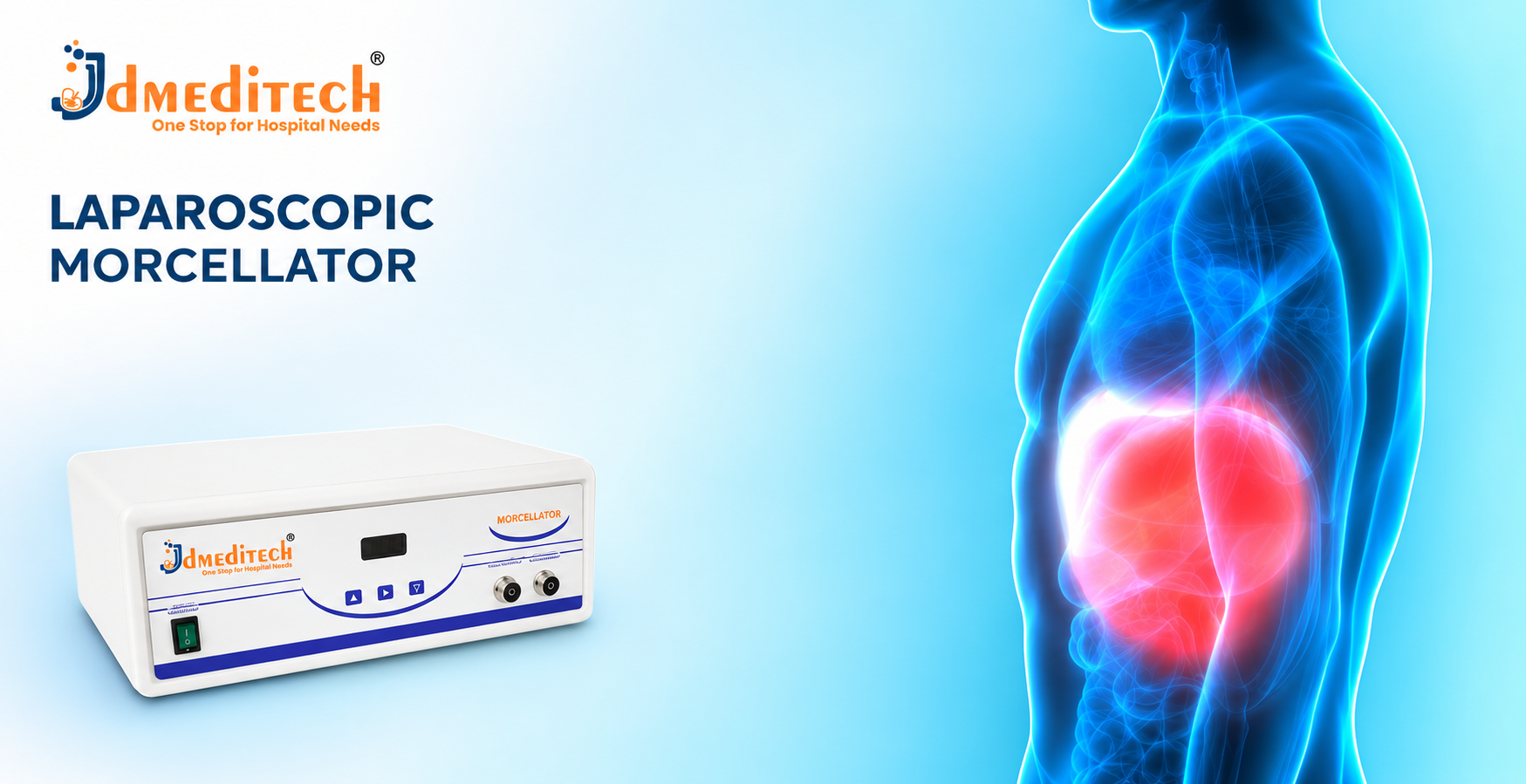
Laparoscopic Morcellator – Features, Applications and Specifications
The Laparoscopic Morcellator is a specialized
surgical device system used for tissue
fragmentation and removal during selected
minimally invasive procedures.
In appropriate cases, morcellation allows
surgeons to divide tissue into smaller
pieces for extraction through a
limited surgical access site.
Furthermore, compatible powered systems
may use a motorized cutting instrument
connected to a dedicated control unit.
However, power morcellation has important
clinical risks, including the potential
spread of unsuspected malignant or
benign tissue within the abdomen.
Therefore, surgeons must follow
current regulatory guidance,
patient-selection requirements
and manufacturer instructions.
JDMeditech supplies laparoscopy
surgical instruments, medical
equipment and accessories for
hospitals and medical distributors.
What Is a Laparoscopic Morcellator?
A laparoscopic morcellator is a surgical
system designed to fragment designated
tissue for removal during approved
minimally invasive procedures.
Depending on the configuration,
the complete system may include
a powered control unit,
compatible handpiece,
cutting components and accessories.
Additionally, the device may require
a compatible tissue containment
system for approved applications.
However, the generator or control
unit alone does not perform
tissue fragmentation.
Understanding Laparoscopic Morcellation
Morcellation refers to dividing
tissue into smaller fragments
to facilitate surgical extraction.
Surgeons may consider tissue
extraction methods during
selected minimally invasive operations.
However, uncontained power
morcellation can spread tissue
within the abdominal cavity.
Furthermore, preoperative evaluation
cannot reliably exclude every
occult malignancy.
Therefore, appropriate patient
selection and risk counseling
are essential.
Purpose of a Morcellator System
The primary purpose of a
compatible morcellation system
is to support tissue fragmentation
and extraction during approved
surgical applications.
Additionally, the system may
support minimally invasive
tissue removal when its
clinical benefits outweigh
the associated risks.
However, not every patient
or surgical procedure is
suitable for power morcellation.
How Does a Powered Morcellator Work?
A powered morcellator system
uses a compatible motorized
cutting mechanism to fragment
designated tissue.
The control unit provides
the required operating functions
for the approved handpiece.
Furthermore, compatible accessories
support the intended surgical workflow.
However, the exact operating
mechanism, cutting speed and
control functions vary by model.
Therefore, only trained surgeons
should operate the complete
system according to its
approved instructions for use.
Key Features of a Laparoscopic Morcellator
- Designed for selected minimally invasive procedures
- Dedicated surgical control unit
- Compatibility with designated morcellation handpieces
- Motorized tissue fragmentation on powered models
- Front-panel operating controls
- Model-specific operating modes
- Connection interfaces for approved accessories
- Compatibility with designated cutting components
- Potential integration with approved containment systems
- System-dependent safety and monitoring functions
Furthermore, exact functions
depend on the supplied model.
Therefore, customers should
verify the technical datasheet.
Main Components of a Morcellator System
A complete system may include
the following components,
depending on the configuration.
- Morcellator control unit
- Compatible motorized handpiece
- Designated cutting assembly
- Instrument shaft or tube
- Approved connection cable
- Activation control where applicable
- Power connection
- Compatible tissue containment system where required
- Other manufacturer-approved accessories
However, accessories may be
supplied separately.
1. Morcellator Control Unit
The control unit provides
operating functions for
the compatible powered instrument.
Additionally, its front panel
may display selected
operating information.
However, exact control functions
and electrical specifications
require manufacturer confirmation.
2. Motorized Handpiece
The handpiece supports
the powered cutting mechanism.
Furthermore, it connects to
the designated control unit.
However, handpiece compatibility
varies between systems.
3. Cutting Assembly
The cutting assembly fragments
designated tissue during
approved surgical applications.
Additionally, its dimensions
and construction depend
on the specific model.
Therefore, only approved
cutting components should
be used.
4. Instrument Shaft
The instrument shaft provides
the intended mechanical
pathway for the cutting assembly.
Furthermore, its dimensions
must match the approved
system configuration.
5. Connection Cable
The connection cable links
the control unit with
compatible accessories.
However, users must verify
electrical and mechanical
compatibility before use.
6. Tissue Containment System
A compatible containment system
may help limit the spread
of tissue fragments during
approved morcellation procedures.
Furthermore, the U.S. FDA
recommends performing laparoscopic
power morcellation for myomectomy
or hysterectomy only with
a legally marketed compatible
tissue containment system.
However, containment cannot
eliminate every risk of
tissue dissemination.
Clinical Applications of Laparoscopic Morcellation
The approved applications
depend on the specific
device and destination market.
Selected systems may be
considered for procedures
such as:
- Selected Laparoscopic Myomectomy Procedures
- Selected Laparoscopic Hysterectomy Procedures
- Other Manufacturer-Approved Tissue Extraction Applications
However, power morcellation
is not appropriate for every
patient undergoing these procedures.
Furthermore, the clinical team
must evaluate malignancy risk,
available alternatives
and regulatory restrictions.
Role in Laparoscopic Myomectomy
Myomectomy involves removing
uterine fibroids while
preserving the uterus.
In selected patients,
surgeons may consider
contained tissue extraction
methods during minimally
invasive surgery.
However, the decision
requires appropriate
preoperative assessment
and informed consent.
Additionally, the FDA advises
against laparoscopic power
morcellation in certain
higher-risk patient groups.
Role in Laparoscopic Hysterectomy
Hysterectomy involves surgical
removal of the uterus.
During selected minimally
invasive procedures,
the surgeon must choose
an appropriate tissue
extraction method.
However, power morcellation
can spread unsuspected
uterine malignancy.
Therefore, clinicians must
consider patient-specific
risk factors and alternatives.
Potential Benefits of Morcellation Technology
- Supports Tissue Fragmentation During Approved Procedures
- May Facilitate Extraction Through Limited Access Sites
- Provides Powered Operation on Compatible Systems
- Supports Selected Minimally Invasive Surgical Workflows
- Offers Different System Configurations
- May Be Used With Approved Containment Accessories
However, these potential
benefits must be weighed
against the risk of
tissue dissemination.
Furthermore, a minimally
invasive approach does
not automatically make
morcellation appropriate.
Power Morcellation vs Alternative Tissue Extraction Methods
| Method | General Description | Important Consideration |
|---|---|---|
| Power Morcellation | Powered Tissue Fragmentation | Risk of Tissue Dissemination |
| Manual Morcellation | Manual Tissue Fragmentation | Risks Depend on Technique and Containment |
| Mini-Laparotomy Extraction | Tissue Removal Through an Enlarged Incision | Incision-Related Considerations |
| Intact Specimen Removal | Removal Without Fragmentation | May Require a Different Extraction Route |
Therefore, the surgeon should
select the extraction method
according to clinical findings,
patient preferences
and applicable guidance.
Technical Specifications of Laparoscopic Morcellator
The supplied image shows
a morcellator control unit.
However, the image alone
does not establish its
electrical or mechanical
specifications.
Therefore, customers should
confirm the following details
against the official datasheet.
| Parameter | Product Information |
|---|---|
| Product Name | Laparoscopic Morcellator |
| Category | Laparoscopy Surgical Equipment |
| Equipment Type | Powered Morcellation System |
| Primary Function | Tissue Fragmentation for Approved Extraction Procedures |
| Control Unit | Shown in Reference Image |
| Operating Speed | Confirm Manufacturer Specifications |
| Motor Output | Confirm Manufacturer Specifications |
| Input Voltage | Confirm Manufacturer Specifications |
| Power Consumption | Confirm Manufacturer Specifications |
| Operating Modes | Confirm Available Configuration |
| Handpiece Compatibility | Confirm Approved Models |
| Cutting Assembly Dimensions | Confirm Manufacturer Specifications |
| Activation Method | Confirm Manufacturer Specifications |
| Containment Compatibility | Confirm Approved Systems |
| Safety Features | Confirm Official Product Documentation |
| Dimensions | Confirm Manufacturer Specifications |
| Weight | Confirm Manufacturer Specifications |
| Supplied Accessories | Confirm Packaging Configuration |
| Regulatory Documentation | Verify for Destination Market |
Important FDA Safety Considerations
The U.S. Food and Drug
Administration has issued
important safety communications
about laparoscopic power
morcellators.
Power morcellation may spread
unsuspected cancerous tissue
within the abdominal cavity.
Furthermore, it may spread
benign tissue and cause
additional complications.
The FDA recommends using
a legally marketed compatible
containment system when
laparoscopic power morcellation
is performed for myomectomy
or hysterectomy.
Additionally, the FDA advises
against using these devices
in patients with known
or suspected malignancy.
Certain patients, including
those over 50 years of age
or postmenopausal patients,
may face additional restrictions
for fibroid surgery.
Therefore, surgeons must
consult the latest applicable
FDA guidance and local
regulatory requirements.
Importance of Patient Selection
Appropriate patient selection
is essential before
considering power morcellation.
Furthermore, the surgical team
must assess the patient’s
medical history, imaging
findings and relevant
malignancy risk factors.
However, preoperative testing
cannot reliably identify
every occult uterine sarcoma.
Therefore, informed consent
must address the limitations
of available investigations.
Safety Precautions
- Verify Approved Intended Use
- Follow Current Regulatory Guidance
- Assess Malignancy Risk
- Consider Alternative Tissue Extraction Methods
- Use Approved Compatible Accessories
- Follow Containment Requirements
- Inspect the Control Unit
- Check Handpiece Compatibility
- Inspect Cutting Components
- Prevent Unintended Activation
- Follow Manufacturer Instructions
- Use Only Appropriately Trained Personnel
Potential Risks and Complications
- Spread of Unsuspected Malignant Tissue
- Dissemination of Benign Tissue
- Injury to Nearby Organs
- Bleeding
- Infection
- Mechanical Instrument Injury
- Equipment Malfunction
- Incomplete Tissue Retrieval
- Need for Additional Surgery
Furthermore, the risks depend
on the procedure, patient
condition and device configuration.
Therefore, clinicians must
carefully evaluate the
benefit-risk balance.
Inspection Before Use
- Confirm Equipment Identification
- Inspect Control Unit Housing
- Check Power Cable Condition
- Verify Handpiece Compatibility
- Inspect Approved Cutting Components
- Check Connection Interfaces
- Verify Activation Controls
- Confirm Containment System Compatibility
- Check Maintenance Status
- Follow Manufacturer Pre-Use Instructions
Cleaning and Maintenance Guidelines
Healthcare facilities should
clean the control unit according
to the manufacturer’s instructions.
Furthermore, biomedical personnel
should perform the required
equipment maintenance.
However, the electrical control
unit must not undergo surgical
instrument sterilization.
Instead, reusable patient-contact
components require their own
validated reprocessing methods.
Additionally, single-use
accessories must not be reused
unless their labeling and
applicable regulations permit it.
Storage and Handling Recommendations
- Store According to Manufacturer Instructions
- Protect the Control Unit From Moisture
- Avoid Mechanical Impact
- Protect Electrical Connections
- Store Cutting Components Safely
- Maintain Appropriate Ventilation
- Inspect Equipment Before Use
- Remove Malfunctioning Equipment From Service
How to Choose the Right Morcellator System
Hospitals and medical distributors
should evaluate several factors
before selecting a system.
- Approved Clinical Indications
- Current Regulatory Requirements
- Compatible Tissue Containment System
- Control Unit Specifications
- Handpiece Compatibility
- Cutting Assembly Dimensions
- Operating Modes
- Activation Method
- Safety Features
- Cleaning and Maintenance Requirements
- Availability of Approved Accessories
- Regulatory Documentation
- Service and Technical Support
Furthermore, procurement teams
should consult surgeons,
biomedical engineers
and regulatory personnel.
Why Choose JDMeditech?
JDMeditech supplies laparoscopy
surgical instruments, medical
equipment and accessories
for hospitals, surgical centers
and medical distributors.
Additionally, our team assists
customers with product inquiries,
available configurations
and quotation requests.
Customers can contact JDMeditech regarding:
- Laparoscopic Morcellator
- Laparoscopy Surgical Equipment
- Laparoscopic Hand Instruments
- Compatible Surgical Accessories
- Minimally Invasive Surgery Equipment
- Hospital Procurement Requirements
- International Distributor Inquiries
However, exact product availability,
approved indications and technical
specifications require confirmation.
Frequently Asked Questions
1. What Is a Laparoscopic Morcellator?
A laparoscopic morcellator is a surgical device system designed to fragment designated tissue for extraction during approved minimally invasive procedures.
2. What Is the Main Purpose of Morcellation?
Morcellation divides tissue into smaller fragments to facilitate extraction through a selected surgical access route.
3. Is Power Morcellation Safe for Every Patient?
No. Power morcellation carries important risks and is unsuitable for certain patients and clinical conditions.
4. Can Morcellation Spread Cancer?
Yes. Power morcellation can spread unsuspected malignant tissue within the abdominal cavity and potentially worsen clinical outcomes.
5. What Is a Tissue Containment System?
A tissue containment system is an accessory designed to help limit the spread of tissue fragments during compatible approved procedures. However, it cannot eliminate every risk.
6. Does the FDA Recommend Containment?
Yes. For laparoscopic power morcellation during myomectomy or hysterectomy, the FDA recommends using a legally marketed compatible tissue containment system.
7. Can the Device Be Used for Myomectomy?
Selected approved systems may be used in appropriately selected patients. However, clinicians must follow current regulatory restrictions and manufacturer indications.
8. Can the Device Be Used for Hysterectomy?
Some approved systems may be used in selected cases. However, the surgical team must assess malignancy risk and consider alternatives.
9. Is the Control Unit the Complete Morcellator?
No. A complete powered system may also require a compatible handpiece, cutting assembly and other designated accessories.
10. Can the Control Unit Be Sterilized?
The electrical control unit is not intended for surgical instrument sterilization. Patient-contact accessories have separate reprocessing requirements.
11. Who Should Operate the Equipment?
Only appropriately trained surgical professionals should operate a powered morcellator system.
12. Where Can Customers Request Product Information?
Hospitals, surgical centers and medical distributors can contact JDMeditech for product information and quotations.
Conclusion
In conclusion, the Laparoscopic Morcellator
is a specialized surgical
system for tissue fragmentation
during selected minimally
invasive procedures.
Furthermore, powered morcellation
may facilitate tissue extraction
through limited access sites.
However, its potential benefits
must be carefully weighed
against serious risks,
including tissue dissemination.
Therefore, healthcare professionals
must follow current regulatory
guidance, approved device indications
and manufacturer instructions.
JDMeditech – One Stop for Hospital Needs
Website:
www.jdmeditech.com
Related Laparoscopy Equipment
- Laparoscopic Hand Instruments
- Laparoscopic Trocar
- Laparoscopic Grasping Forceps
- Laparoscopic Scissors
- Laparoscopic Suction Irrigation Set
- Laparoscopic Surgical Accessories
Medical and Regulatory Reference
For important safety information
about laparoscopic power
morcellation, visit the
U.S. FDA Safety Communication
on Contained Power Morcellation
.
Medical Disclaimer
This article provides general
educational and product information
only. It does not replace
professional medical advice,
specialist training,
clinical judgment, regulatory
guidance or manufacturer instructions.
Healthcare professionals must
verify approved indications,
patient-selection requirements,
containment compatibility,
contraindications and device
specifications before use.




