



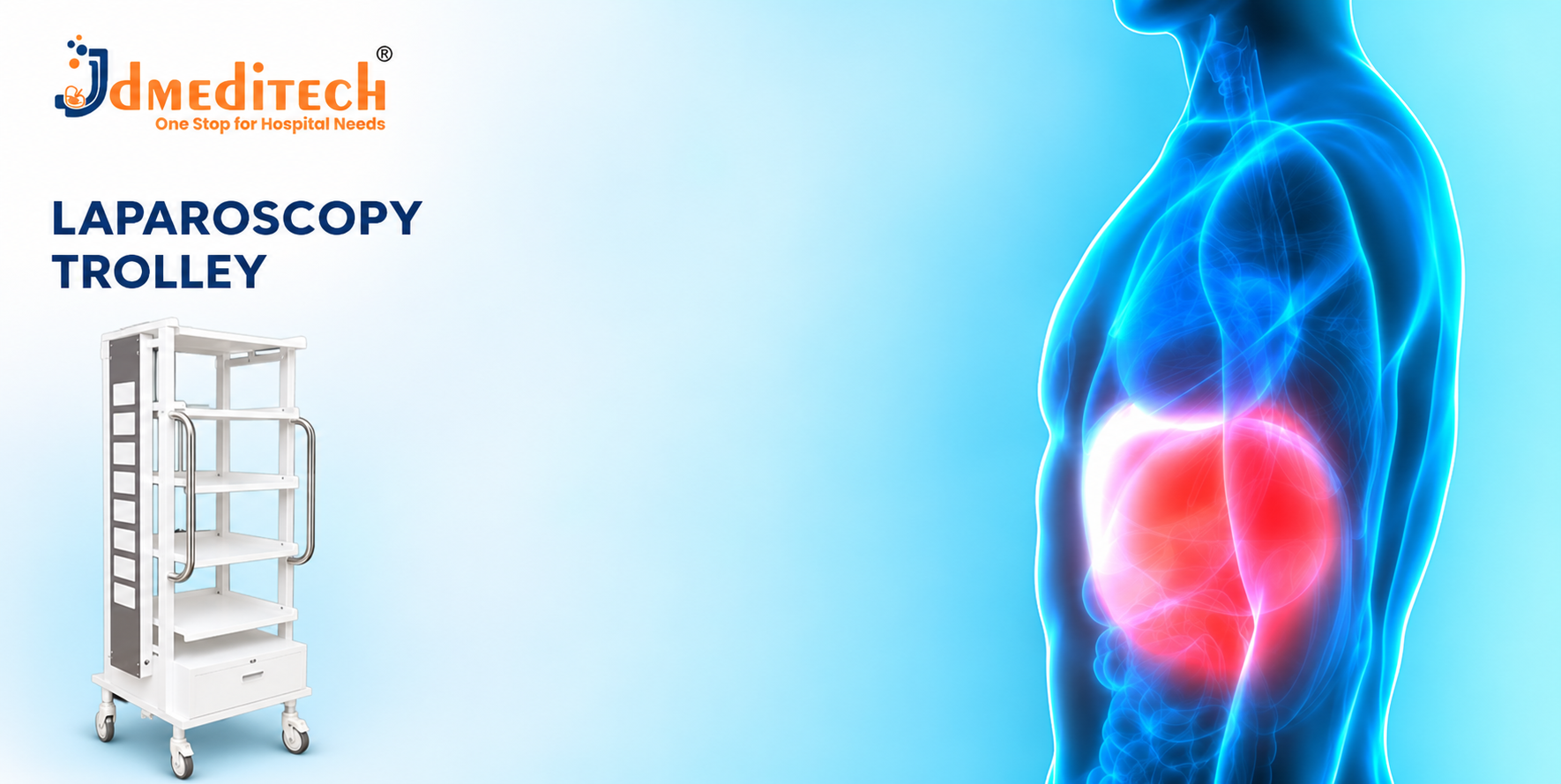
Laparoscopy Trolley – Features, Uses and Specifications
A Laparoscopy Trolley is a specialized
medical equipment cart designed to organize
and support compatible laparoscopic
devices inside an operating room.
During minimally invasive surgery,
medical teams use several devices,
including imaging equipment,
light sources and insufflation systems.
Therefore, a well-organized equipment
cart helps keep essential devices
accessible and appropriately positioned.
Furthermore, a suitable trolley
can support operating room
organization and equipment mobility.
JDMeditech supplies laparoscopy
equipment, surgical instruments
and medical accessories for
hospitals, surgical centers
and medical distributors.
What Is a Laparoscopy Trolley?
A laparoscopy trolley is a mobile
equipment support structure used
to accommodate selected devices
for laparoscopic procedures.
Typically, the trolley includes
a supporting frame, equipment
shelves and a wheeled base.
Additionally, certain models
feature side rails, cable
management accessories and
monitor mounting arrangements.
However, the exact design
and load capacity vary
between available models.
Purpose of a Laparoscopic Equipment Trolley
The primary purpose of the trolley
is to provide organized support
for compatible surgical equipment.
Furthermore, it helps operating
room personnel position devices
within the designated workspace.
For example, a properly configured
cart may accommodate a camera
control unit, light source
and insufflation equipment.
However, users must confirm
the size, weight and
mounting requirements
of each device.
Importance of Equipment Organization in Laparoscopy
Laparoscopic procedures rely
on coordinated use of
visualization and surgical
support equipment.
Therefore, equipment placement
plays an important role
in operating room preparation.
Furthermore, organized shelves
can help staff identify
and access designated devices.
Additionally, suitable cable
routing can reduce clutter
around the equipment area.
However, proper organization
does not replace electrical
and operating room safety protocols.
Key Features of a Laparoscopy Trolley
- Mobile equipment support structure
- Multiple equipment shelves
- Vertical supporting frame
- Wheeled base for movement
- Side support rails on selected models
- Equipment organization capability
- Compatibility with selected laparoscopic devices
- Accessible equipment positioning
- Optional cable management arrangements
- Model-specific mounting accessories
Furthermore, buyers should
verify the exact configuration
of the selected trolley.
Main Components of a Laparoscopy Trolley
A typical equipment cart
may include the following
structural components.
- Main supporting frame
- Upper equipment shelf
- Middle equipment shelves
- Lower equipment platform
- Vertical support columns
- Side support rails
- Wheeled base
- Castor wheels
- Wheel locking mechanisms where fitted
- Optional cable management accessories
1. Main Supporting Frame
The main frame provides
structural support for
the trolley assembly.
Furthermore, it connects
the shelves, support
columns and wheeled base.
However, the frame material
and load rating depend
on the selected model.
2. Equipment Shelves
Equipment shelves provide
designated platforms
for compatible devices.
For example, hospitals may
position selected camera
units or light sources
on suitable shelves.
However, each shelf must
support the device’s
weight and dimensions.
3. Vertical Support Columns
Vertical columns connect
the equipment platforms
and provide structural stability.
Additionally, certain models
allow shelf adjustment.
However, adjustable features
must be confirmed
from the product specifications.
4. Side Support Rails
Side rails may provide
additional support
or accessory attachment points.
Furthermore, they may
help organize selected
equipment arrangements.
However, their intended
load and mounting functions
vary by design.
5. Castor Wheels
Castor wheels allow
the trolley to move
between suitable locations.
Additionally, some models
include locking castors
to help prevent
unintended movement.
Therefore, users should
verify the wheel configuration
before purchasing.
6. Lower Equipment Platform
The lower platform provides
additional equipment space.
Furthermore, suitable placement
of heavier devices may
support stable load distribution.
However, all equipment
must remain within
the approved load limits.
Clinical and Hospital Applications
Medical equipment trolleys
support a variety of
hospital environments.
- Laparoscopic Operating Rooms
- General Surgery Departments
- Gynecological Laparoscopy Units
- Urology Operating Rooms
- Endoscopic Surgery Departments
- Minimally Invasive Surgery Centers
- Hospital Surgical Equipment Areas
- Other Compatible Clinical Environments
However, facilities should
confirm that the trolley
meets their operational
and equipment requirements.
Equipment Commonly Organized on a Laparoscopy Trolley
Depending on the trolley
configuration, hospitals
may organize several
laparoscopy devices.
- Laparoscopic Camera Control Unit
- Endoscopic Light Source
- CO2 Insufflator
- Video Recording Equipment
- Compatible Electrosurgical Equipment
- Approved Visualization Accessories
- Other Suitable Surgical Support Devices
However, not every trolley
supports all equipment types.
Therefore, users must
verify shelf dimensions,
load ratings and
electrical requirements.
Role in Minimally Invasive Surgery
Minimally invasive surgery
uses specialized equipment
to support visualization
and surgical access.
Furthermore, the operating
room team must arrange
devices according to
the planned procedure.
A suitable equipment cart
provides a centralized
support structure.
As a result, staff can
organize compatible devices
within the designated
operating room area.
Benefits of a Laparoscopy Trolley
- Supports Organized Equipment Placement
- Provides Multiple Device Platforms
- Allows Equipment Mobility
- Helps Reduce Workspace Clutter
- Supports Operating Room Preparation
- Offers Designated Equipment Storage Areas
- Accommodates Compatible Surgical Devices
- Supports Flexible Equipment Arrangements
Furthermore, the actual
benefits depend on
the trolley design
and equipment configuration.
Laparoscopy Trolley vs General Medical Trolley
| Feature | Laparoscopy Trolley | General Medical Trolley |
|---|---|---|
| Primary Purpose | Support Laparoscopy Equipment | General Medical Storage and Transport |
| Equipment Shelves | Designed for Compatible Devices | General Storage Platforms |
| Equipment Compatibility | Model-Specific Laparoscopy Devices | General Medical Supplies |
| Mobility | Wheeled Design | Often Wheeled |
| Accessory Mounting | May Include Specialized Options | Depends on Model |
| Operating Room Application | Selected Surgical Equipment Setups | General Clinical Support |
Technical Specifications of Laparoscopy Trolley
The following table identifies
important procurement parameters.
However, exact dimensions,
materials and load capacities
require confirmation
from the official datasheet.
| Parameter | Product Information |
|---|---|
| Product Name | Laparoscopy Trolley |
| Category | Surgical Equipment Trolley |
| Primary Function | Equipment Organization and Support |
| Structure | Mobile Equipment Support Frame |
| Number of Shelves | Confirm Available Configuration |
| Frame Material | Confirm Manufacturer Specifications |
| Shelf Material | Confirm Manufacturer Specifications |
| Overall Height | Confirm Manufacturer Specifications |
| Overall Width | Confirm Manufacturer Specifications |
| Overall Depth | Confirm Manufacturer Specifications |
| Total Load Capacity | Confirm Manufacturer Specifications |
| Individual Shelf Capacity | Confirm Manufacturer Specifications |
| Wheel Configuration | Confirm Manufacturer Specifications |
| Wheel Locking System | Confirm Available Configuration |
| Monitor Mount | Confirm Availability |
| Cable Management | Confirm Available Configuration |
| Electrical Accessories | Confirm Approved Configuration |
| Surface Finish | Confirm Manufacturer Specifications |
| Product Weight | Confirm Manufacturer Specifications |
| Packaging | Confirm Supplied Configuration |
Importance of Load Capacity
Load capacity is an essential
factor when selecting
a medical equipment trolley.
Furthermore, every shelf
must support the weight
of its designated devices.
Therefore, users should
verify both individual
shelf ratings and
total trolley capacity.
Additionally, balanced equipment
placement helps reduce
tipping risks.
Importance of Mobility and Stability
A mobile trolley helps
staff reposition equipment
within suitable clinical areas.
However, movement requires
careful attention to
floor conditions and
connected cables.
Furthermore, wheel locks
should be engaged when
required by the manufacturer.
Therefore, hospitals should
evaluate both mobility
and stability before use.
Cable Management Considerations
Laparoscopy equipment often
requires electrical,
video and other
system connections.
Therefore, suitable cable
routing helps organize
the equipment area.
Furthermore, staff should
avoid cable strain
and obstructed walkways.
However, the trolley’s
approved cable management
features depend on
its configuration.
Electrical Safety Considerations
Equipment mounted on
the trolley may require
electrical power.
Therefore, healthcare facilities
must follow applicable
medical electrical
safety requirements.
Furthermore, users should
verify the suitability
of any integrated
power distribution accessories.
However, the trolley
itself does not
automatically provide
medical-grade electrical protection.
Safety Precautions
- Verify Total Load Capacity
- Confirm Individual Shelf Ratings
- Distribute Equipment Weight Appropriately
- Inspect Castor Wheels
- Engage Wheel Locks Where Required
- Secure Mounted Equipment
- Prevent Cable Strain
- Avoid Overloading
- Inspect Structural Components
- Follow Manufacturer Instructions
- Keep Equipment Ventilation Openings Clear
- Follow Hospital Electrical Safety Procedures
Potential Risks of Improper Trolley Use
- Equipment Tipping
- Device Falling From Shelves
- Wheel or Castor Failure
- Cable Damage
- Electrical Hazards From Improper Connections
- Obstructed Equipment Ventilation
- Collision During Movement
- Structural Damage From Overloading
Furthermore, improper equipment
placement can increase
operating room hazards.
Therefore, facilities should
follow approved equipment
management procedures.
Inspection Before Use
- Inspect the Supporting Frame
- Check Shelf Stability
- Verify Castor Wheel Condition
- Test Wheel Locks Where Fitted
- Inspect Side Rails
- Check Equipment Mounting
- Verify Load Distribution
- Inspect Cable Routing
- Confirm Safe Equipment Placement
- Follow Manufacturer Inspection Requirements
Cleaning and Maintenance Guidelines
Healthcare facilities should
clean trolley surfaces
according to the
manufacturer’s instructions.
Furthermore, staff should
use cleaning products
compatible with the
surface materials.
Additionally, maintenance personnel
should inspect shelves,
wheels and structural
connections regularly.
However, cleaning methods
must not damage
mounted electrical equipment.
Storage and Handling Recommendations
- Store in a Suitable Clinical Environment
- Keep Shelves Clean
- Protect Against Excessive Moisture
- Avoid Mechanical Impact
- Secure Equipment During Movement
- Protect Mounted Devices
- Maintain Proper Weight Distribution
- Inspect Wheels and Locks Regularly
- Follow Manufacturer Storage Instructions
How to Choose the Right Laparoscopy Trolley
Hospitals and medical distributors
should evaluate several
important requirements
before selecting a trolley.
- Number of Required Shelves
- Overall Equipment Dimensions
- Individual Shelf Load Capacity
- Total Weight Capacity
- Frame Material
- Surface Finish
- Castor Wheel Design
- Wheel Locking Mechanism
- Monitor Mount Compatibility
- Cable Management Options
- Electrical Accessory Requirements
- Cleaning and Maintenance Requirements
- Available Customization Options
Furthermore, procurement teams
should consult surgeons,
operating room staff
and biomedical engineers.
Why Choose JDMeditech?
JDMeditech supplies laparoscopy
equipment, surgical instruments
and medical accessories
for hospitals, surgical centers
and medical distributors.
Additionally, our team assists
customers with product inquiries,
available configurations
and quotation requests.
Customers can contact JDMeditech regarding:
- Laparoscopy Trolley
- Laparoscopic Camera System
- Endoscopic Light Source
- CO2 Insufflator
- Laparoscopic Hand Instruments
- Laparoscopic Surgical Accessories
- Hospital Equipment Procurement
- International Distributor Requirements
Frequently Asked Questions
1. What Is a Laparoscopy Trolley?
A laparoscopy trolley is a mobile equipment cart designed to organize and support compatible laparoscopic devices.
2. What Is Its Main Purpose?
Its main purpose is to provide organized equipment placement and support within suitable surgical environments.
3. Can It Hold a Camera Control Unit?
Yes, if the shelf dimensions and load rating meet the camera unit’s requirements.
4. Can It Hold a CO2 Insufflator?
Yes, provided the trolley supports the equipment’s dimensions, weight and operating requirements.
5. Does Every Trolley Include a Monitor Mount?
No. Monitor mounting arrangements depend on the selected model and configuration.
6. Are the Shelves Adjustable?
Some models may offer adjustable shelves. However, customers should verify the exact configuration.
7. Does the Trolley Have Lockable Wheels?
Lockable castors may be available on selected models. Customers should confirm the supplied wheel configuration.
8. What Material Is Used?
Frame and shelf materials vary by model. Buyers should refer to the official technical specifications.
9. How Much Weight Can It Carry?
The approved load capacity depends on the trolley model and individual shelf ratings.
10. Can the Trolley Be Used in an Operating Room?
Yes, when its design and specifications meet the facility’s operating room requirements.
11. Does It Include Electrical Equipment?
Not necessarily. The trolley is primarily an equipment support structure. Any included electrical accessories must be confirmed separately.
12. Where Can Customers Request Product Information?
Hospitals, surgical centers and medical distributors can contact JDMeditech for product information and quotations.
Conclusion
In conclusion, the Laparoscopy Trolley
is an important equipment
support solution for
selected operating rooms.
Furthermore, its shelves,
supporting frame and
wheeled structure help
organize compatible devices.
However, safe operation
depends on proper
load distribution,
equipment compatibility
and regular inspection.
Therefore, hospitals and
medical distributors should
verify the complete
technical specifications
before purchasing.
JDMeditech – One Stop for Hospital Needs
Website:
www.jdmeditech.com
Related Laparoscopy Equipment
- Laparoscopic Camera System
- Endoscopic Light Source
- CO2 Insufflator
- Laparoscopic Instruments
- Laparoscopic Trocar
- Laparoscopic Surgical Accessories
Medical Equipment Reference
For general information about
medical equipment safety,
visit the
U.S. Food and Drug Administration –
Medical Devices
.
Disclaimer
This article provides general
product and educational
information only.
Actual product specifications,
load capacity, materials,
accessories and intended
applications depend on
the selected trolley model.
Healthcare facilities must
verify manufacturer instructions
and equipment compatibility
before use.




