



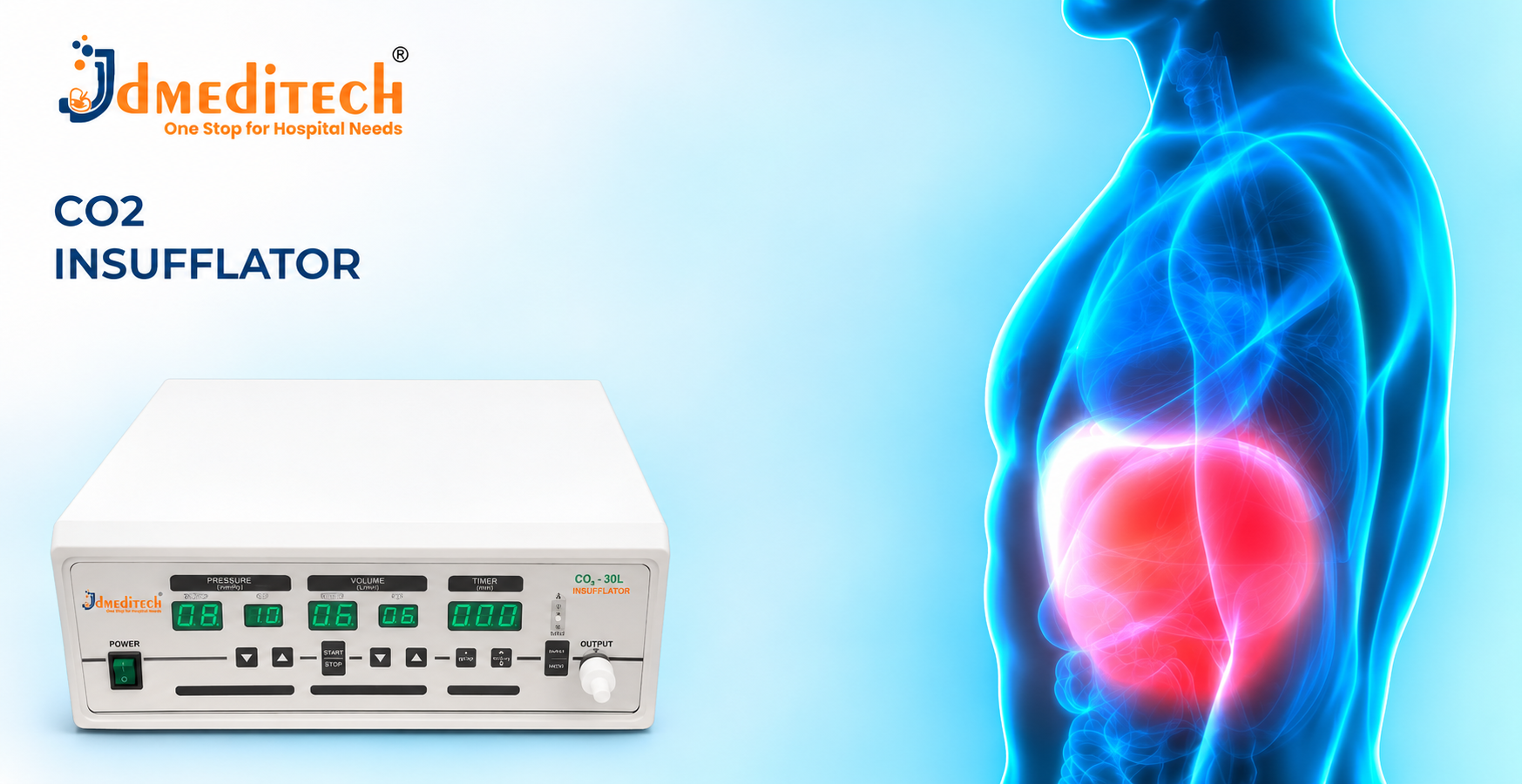
CO2 Insufflator – Features, Working Principle, Uses and Specifications
A CO2 Insufflator is a specialized medical
device used to deliver controlled carbon dioxide
gas during selected laparoscopic procedures.
During laparoscopy, surgeons create a
pneumoperitoneum by introducing gas
into the abdominal cavity.
As a result, the abdominal wall separates
from internal structures, creating
a working space for surgical instruments.
Furthermore, an appropriate insufflation
system helps the surgical team monitor
and regulate gas delivery.
JDMeditech supplies laparoscopy
equipment, surgical instruments
and medical accessories for
hospitals and medical distributors.
What Is a CO2 Insufflator?
A carbon dioxide insufflator is an
electronic surgical device that
regulates the delivery of CO2 gas
during approved minimally invasive
procedures.
Typically, the equipment includes
a control unit, display,
operating controls and
gas connection interfaces.
Additionally, compatible tubing
connects the insufflation system
to the designated surgical
access device.
However, the exact equipment
configuration varies by model.
Purpose of a Laparoscopic Insufflation System
The primary purpose of an
insufflation system is to
support the creation and
maintenance of pneumoperitoneum.
Furthermore, the device regulates
gas delivery according to
its approved operating functions.
For example, compatible systems
may allow clinicians to select
a target abdominal pressure
and gas flow setting.
However, the available
pressure and flow ranges
depend on the specific model.
Why Is Carbon Dioxide Used in Laparoscopy?
Carbon dioxide is commonly
used for laparoscopic
insufflation because it
is nonflammable and
readily absorbed by the body.
Furthermore, the respiratory
system can eliminate
absorbed carbon dioxide.
However, CO2 absorption
may increase blood
carbon dioxide levels.
Therefore, anesthesia teams
monitor ventilation and
physiological parameters
throughout the procedure.
How Does a CO2 Insufflator Work?
The device receives medical-grade
carbon dioxide from an
approved gas source.
Next, its internal regulation
system controls gas delivery
through compatible tubing.
During the procedure,
the system monitors relevant
operating parameters according
to its design.
Furthermore, the generator
may adjust gas delivery
to support the selected
insufflation settings.
However, the exact control
mechanism and monitoring
functions vary by manufacturer.
Understanding Pneumoperitoneum
Pneumoperitoneum refers
to the presence of gas
within the peritoneal cavity.
During laparoscopic surgery,
controlled insufflation creates
space for visualization
and instrument movement.
Furthermore, this working
space helps the surgeon
access selected anatomical
structures.
However, abdominal pressure
must remain appropriate
for the patient’s condition
and the surgical procedure.
Key Features of a CO2 Insufflator
- Controlled Carbon Dioxide Gas Delivery
- Electronic Insufflation Control Unit
- Front-Panel Operating Display
- Gas Flow Regulation
- Pressure Monitoring Functions
- Compatible Gas Connection Interface
- Operating Controls
- Compatibility With Designated Insufflation Tubing
- Model-Specific Alarm Functions
- System-Dependent Safety Features
Furthermore, exact features
depend on the selected
equipment configuration.
Therefore, customers should
verify the manufacturer’s
technical datasheet.
Main Components of a CO2 Insufflator
A complete insufflation
arrangement may include
the following components.
- Electronic Control Unit
- Digital Display
- Pressure Control Interface
- Gas Flow Control Interface
- Gas Inlet Connection
- Gas Outlet Connection
- Compatible Insufflation Tubing
- Approved Gas Supply Connection
- Power Connection
- Other Manufacturer-Approved Accessories
However, not every accessory
is necessarily supplied
with the main unit.
1. Electronic Control Unit
The electronic control unit
manages the device’s
insufflation functions.
Furthermore, it supports
gas delivery regulation
according to the selected
operating mode.
2. Digital Display
The display presents
operating information
according to the device design.
For example, selected
models may show
pressure and flow data.
However, display functions
vary between manufacturers.
3. Pressure Control Interface
The pressure control
interface allows trained
personnel to select
approved operating settings.
Furthermore, the system
may monitor pressure
during insufflation.
However, pressure settings
must follow clinical
and manufacturer guidance.
4. Gas Flow Control Interface
The gas flow control
interface regulates
the delivery rate
of carbon dioxide.
Additionally, available
flow settings depend
on the model.
5. Gas Inlet Connection
The inlet connection
receives CO2 from
the designated gas supply.
Furthermore, the gas
source must meet
the equipment’s
approved requirements.
6. Gas Outlet Connection
The outlet connection
delivers regulated gas
to compatible tubing.
However, users must
verify connector and
accessory compatibility.
7. Insufflation Tubing
Insufflation tubing
provides a pathway
between the control
unit and the
surgical access device.
Furthermore, tubing
requirements vary
by equipment configuration.
Therefore, only approved
tubing and filtration
accessories should be used.
Clinical Applications of CO2 Insufflation
Carbon dioxide insufflation
supports selected minimally
invasive surgical procedures.
- General Laparoscopic Surgery
- Laparoscopic Cholecystectomy
- Laparoscopic Appendectomy
- Selected Gynecological Laparoscopy
- Selected Urological Laparoscopy
- Selected Colorectal Surgery
- Diagnostic Laparoscopy
- Other Approved Laparoscopic Procedures
However, the clinical
team must assess
patient-specific suitability.
Role in Laparoscopic Cholecystectomy
Laparoscopic cholecystectomy
involves removing the
gallbladder using
minimally invasive
surgical techniques.
During the procedure,
controlled pneumoperitoneum
helps establish
the working space.
Furthermore, the surgeon
uses laparoscopic visualization
and instruments to
perform the operation.
Role in Gynecological Laparoscopy
Gynecological laparoscopy
may involve diagnostic
or therapeutic procedures.
Furthermore, insufflation
helps create a working
space within the
abdominal cavity.
However, clinicians must
consider the patient’s
condition and
planned procedure.
Role in Urological Laparoscopy
Selected urological procedures
use laparoscopic access
to reach designated
anatomical structures.
Furthermore, compatible
insufflation systems
support the required
operative workspace.
However, equipment settings
depend on the surgical
approach and patient.
Potential Benefits of a CO2 Insufflator
- Supports Controlled Pneumoperitoneum
- Helps Maintain a Surgical Working Space
- Supports Laparoscopic Visualization
- Provides Regulated Gas Delivery
- Offers Model-Specific Pressure Monitoring
- Supports Selected Minimally Invasive Procedures
- Allows Connection to Approved Accessories
Furthermore, performance
depends on the equipment,
clinical technique
and patient condition.
Therefore, these benefits
do not guarantee
specific surgical outcomes.
CO2 Insufflator vs Conventional Gas Delivery
| Feature | Electronic CO2 Insufflator | Unregulated Gas Delivery |
|---|---|---|
| Gas Delivery | Device-Controlled | Not Suitable for Routine Surgical Insufflation |
| Pressure Regulation | Model-Specific Regulation | No Equivalent Automatic Regulation |
| Operating Display | Available on Selected Models | Not Applicable |
| Clinical Application | Approved Laparoscopic Procedures | Not an Appropriate Substitute |
| Safety Functions | Manufacturer-Specified | Not Equivalent |
Technical Specifications of CO2 Insufflator
The supplied product image
shows an electronic
insufflation control unit.
However, the image alone
does not confirm exact
flow rates, pressure
ranges or electrical ratings.
Therefore, customers should
verify the official
technical specifications.
| Parameter | Product Information |
|---|---|
| Product Name | CO2 Insufflator |
| Category | Laparoscopy Surgical Equipment |
| Equipment Type | Electronic Gas Insufflation System |
| Gas Type | Medical-Grade Carbon Dioxide |
| Primary Function | Controlled Gas Delivery for Pneumoperitoneum |
| Maximum Flow Rate | Confirm Manufacturer Specifications |
| Pressure Setting Range | Confirm Manufacturer Specifications |
| Pressure Monitoring | Confirm Available Functions |
| Display Type | Confirm Manufacturer Specifications |
| Operating Modes | Confirm Available Configuration |
| Gas Inlet Requirements | Confirm Manufacturer Specifications |
| Gas Outlet Connection | Confirm Approved Connector Type |
| Tubing Compatibility | Confirm Approved Accessories |
| Alarm Functions | Confirm Manufacturer Specifications |
| Input Voltage | Confirm Manufacturer Specifications |
| Power Consumption | Confirm Manufacturer Specifications |
| Dimensions | Confirm Manufacturer Specifications |
| Weight | Confirm Manufacturer Specifications |
| Supplied Accessories | Confirm Packaging Configuration |
| Regulatory Documentation | Verify for Destination Market |
Importance of Pressure Regulation
Pressure regulation is
an essential function
of laparoscopic insufflation.
Furthermore, excessive
intra-abdominal pressure
may affect cardiovascular
and respiratory physiology.
Therefore, clinicians
must select settings
appropriate for the
patient and procedure.
Importance of Gas Flow Control
Gas flow control
helps regulate the
rate of carbon
dioxide delivery.
Furthermore, the required
flow may change
during a procedure.
However, higher flow
does not automatically
improve surgical safety.
Therefore, trained
personnel must follow
the approved clinical
operating protocol.
Patient Monitoring During Insufflation
Pneumoperitoneum can affect
respiratory and cardiovascular
physiology.
Therefore, anesthesia teams
monitor relevant
patient parameters.
Furthermore, absorbed CO2
may influence end-tidal
carbon dioxide levels.
However, monitoring
requirements depend
on the patient
and procedure.
Safety Precautions
- Use Approved Medical-Grade CO2
- Verify Gas Supply Compatibility
- Inspect Gas Connections
- Use Approved Insufflation Tubing
- Follow Appropriate Pressure Settings
- Monitor Patient Physiology
- Check Equipment Alarm Functions
- Prevent Unintended Gas Delivery
- Follow Manufacturer Instructions
- Use Appropriately Trained Personnel
- Perform Required Equipment Maintenance
Potential Risks and Complications
- Hypercapnia
- Subcutaneous Emphysema
- Gas Embolism
- Cardiovascular Changes
- Respiratory Changes
- Excessive Intra-Abdominal Pressure
- Insufflation-Related Discomfort
- Gas Leakage
- Equipment Malfunction
Furthermore, some complications
may require immediate
clinical intervention.
Therefore, healthcare teams
must maintain appropriate
monitoring and emergency
response readiness.
Inspection Before Use
- Confirm Equipment Identification
- Inspect Generator Housing
- Check Power Cable Condition
- Verify Gas Supply
- Inspect Gas Inlet Connection
- Inspect Gas Outlet Connection
- Check Tubing Compatibility
- Verify Display Operation
- Check Alarm Status
- Confirm Maintenance Status
- Follow Manufacturer Pre-Use Checks
Cleaning and Maintenance Guidelines
Healthcare facilities
should clean the
external equipment surfaces
according to the
manufacturer’s instructions.
Furthermore, biomedical
personnel should perform
required preventive
maintenance and calibration.
However, the electronic
control unit must
not undergo surgical
instrument sterilization.
Instead, reusable
patient-contact accessories
require their own
validated reprocessing procedures.
Storage and Handling Recommendations
- Store According to Manufacturer Instructions
- Protect the Device From Moisture
- Avoid Mechanical Impact
- Protect Gas Connections
- Protect Electrical Connections
- Maintain Appropriate Ventilation
- Store Accessories Properly
- Inspect Equipment Before Use
- Remove Malfunctioning Equipment From Service
How to Choose the Right CO2 Insufflator
Hospitals and procurement
teams should evaluate
several technical and
clinical requirements
before purchasing.
- Approved Clinical Applications
- Maximum Gas Flow Rate
- Pressure Setting Range
- Pressure Monitoring Accuracy
- Display Configuration
- Alarm Functions
- Gas Supply Compatibility
- Approved Tubing and Filtration Accessories
- Electrical Input Requirements
- Cleaning and Maintenance Requirements
- Regulatory Documentation
- Service and Technical Support
Furthermore, procurement
teams should consult
surgeons, anesthesiologists
and biomedical engineers.
Why Choose JDMeditech?
JDMeditech supplies laparoscopy
equipment, surgical instruments
and medical accessories
for hospitals, surgical
centers and medical distributors.
Additionally, our team
assists customers with
product inquiries,
available configurations
and quotation requests.
Customers can contact
JDMeditech regarding:
- CO2 Insufflator
- Laparoscopy Trolley
- Laparoscopic Camera System
- Endoscopic Light Source
- Insufflation Tubing
- Laparoscopic Trocar
- Laparoscopic Hand Instruments
- Hospital Equipment Procurement
- International Distributor Requirements
Frequently Asked Questions
1. What Is a CO2 Insufflator?
A CO2 insufflator is an electronic medical device that regulates carbon dioxide gas delivery during approved laparoscopic procedures.
2. Why Is CO2 Used in Laparoscopy?
Carbon dioxide is commonly used because it is nonflammable and readily absorbed by the body. However, clinicians must monitor physiological effects.
3. What Is Pneumoperitoneum?
Pneumoperitoneum refers to gas within the peritoneal cavity. During laparoscopy, controlled gas insufflation creates surgical working space.
4. Does the Device Control Gas Pressure?
Compatible electronic insufflators regulate gas delivery and provide model-specific pressure control functions.
5. Does Every Insufflator Have the Same Flow Rate?
No. Maximum flow rates and operating ranges vary by manufacturer and model.
6. Can It Be Used for Laparoscopic Cholecystectomy?
Yes. Appropriate CO2 insufflation systems support pneumoperitoneum during selected laparoscopic cholecystectomy procedures.
7. Can It Be Used for Gynecological Laparoscopy?
Yes, when the equipment is approved for the intended procedure and patient population.
8. What Gas Is Required?
The device requires an approved medical-grade carbon dioxide supply that meets the manufacturer’s specifications.
9. Does the Device Require Special Tubing?
Users must select tubing and connection accessories approved for the specific insufflator model.
10. What Are the Main Risks of CO2 Insufflation?
Potential risks include hypercapnia, cardiovascular changes, subcutaneous emphysema and rare gas embolism.
11. Does the Device Require Maintenance?
Yes. Healthcare facilities should follow the manufacturer’s inspection, calibration and maintenance instructions.
12. Where Can Customers Request Product Information?
Hospitals, surgical centers and medical distributors can contact JDMeditech for equipment details and quotations.
Conclusion
In conclusion, the CO2 Insufflator
is an important medical
device for controlled
gas delivery during
selected laparoscopic procedures.
Furthermore, its pressure
regulation and gas
delivery functions
support the creation
of surgical working space.
However, safe operation
depends on correct
equipment selection,
patient monitoring
and trained personnel.
Therefore, hospitals
and medical distributors
should verify complete
technical specifications
before purchasing.
JDMeditech – One Stop for Hospital Needs
Website:
www.jdmeditech.com
Related Laparoscopy Equipment
- Laparoscopy Trolley
- Laparoscopic Camera System
- Endoscopic Light Source
- CO2 Insufflator Tubing
- Laparoscopic Trocar
- Laparoscopic Hand Instruments
Medical Equipment Reference
For general information
about medical device
safety, visit the
U.S. Food and Drug Administration –
Medical Devices
.
Medical Disclaimer
This article provides general
educational and product information
only. It does not replace
professional medical advice,
specialist training,
clinical judgment or
manufacturer instructions.
Healthcare professionals must
verify approved indications,
gas supply compatibility,
pressure and flow specifications,
accessory compatibility
and safety requirements
before use.




