



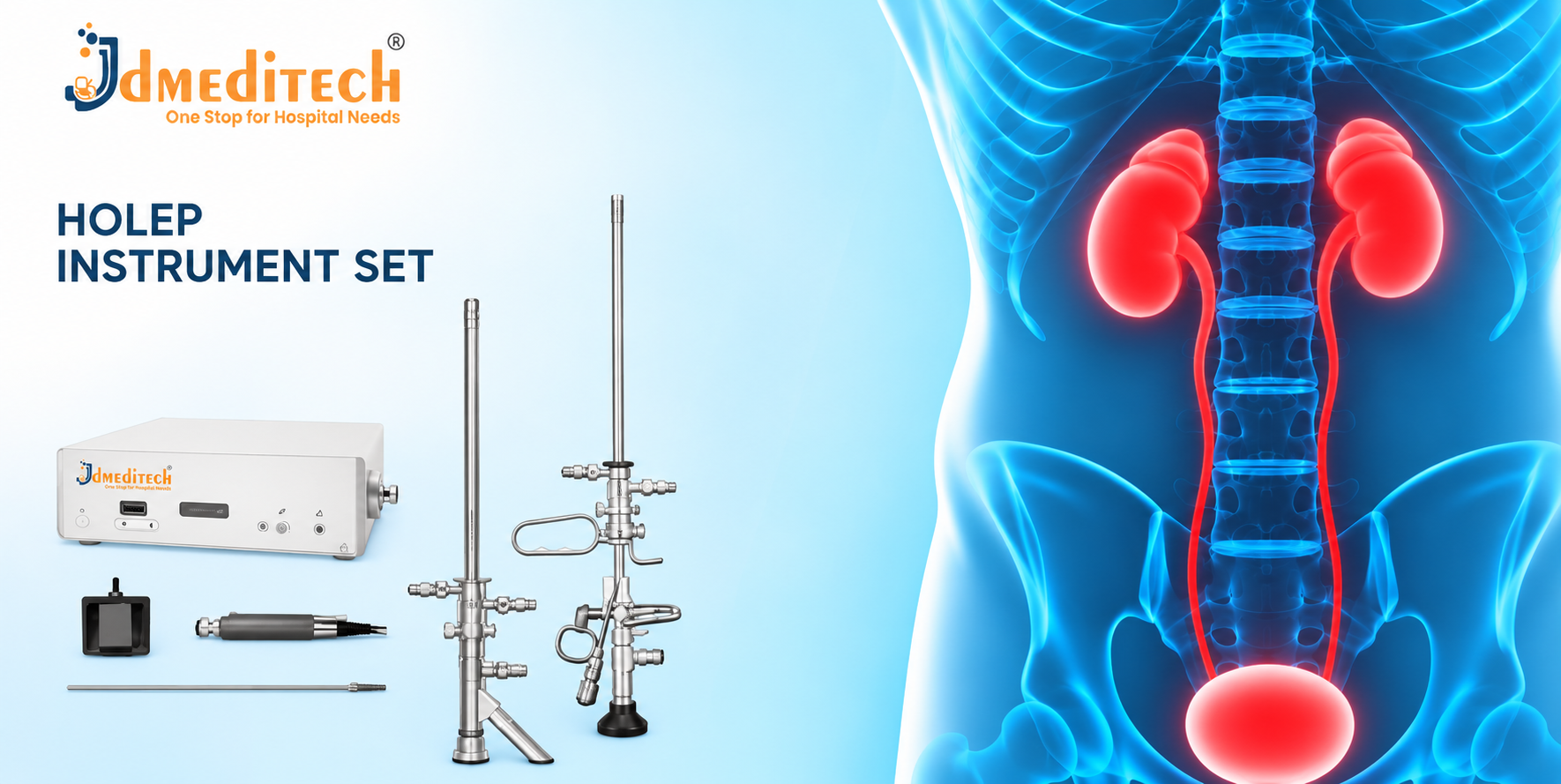
HoLEP Instrument Set – Components, Features, Uses and Benefits
The HoLEP Instrument Set supports holmium laser enucleation of the prostate. Urologists use this endoscopic procedure to treat selected patients with benign prostatic hyperplasia (BPH). As a result, patients may experience relief from urinary obstruction.
Furthermore, specialized instruments help surgeons access the prostate and guide the laser fiber. The system also supports endoscopic visualization. Therefore, compatible equipment plays an important role in the surgical procedure.
JDMeditech supplies urology instruments and endoscopic surgical accessories. Additionally, our team assists hospitals and medical distributors with product information and quotation requests.
What Is a HoLEP Instrument Set?
A HoLEP surgical set contains specialized instruments for endoscopic prostate surgery. Its components support surgical access, visualization and laser fiber handling.
Moreover, compatible instruments help the surgeon work through the urethra. Consequently, the procedure does not require a conventional abdominal incision.
However, the exact components vary between product configurations. Therefore, buyers should review the manufacturer’s official packing list before ordering.
Understanding HoLEP Surgery
HoLEP stands for Holmium Laser Enucleation of the Prostate. Surgeons use a holmium laser to separate obstructing prostate tissue.
During surgery, the specialist introduces compatible endoscopic instruments through the urethra. Next, the laser supports tissue separation under direct visualization.
Afterward, a suitable morcellation system may remove the separated tissue. Finally, the clinical team provides postoperative care based on patient needs.
What Is Benign Prostatic Hyperplasia?
Benign prostatic hyperplasia describes noncancerous enlargement of the prostate. As the gland enlarges, it may compress the urethra and restrict urine flow.
Consequently, some patients experience bothersome urinary symptoms. However, other medical conditions can cause similar symptoms.
Common Symptoms of an Enlarged Prostate
- Weak Urinary Stream
- Difficulty Starting Urination
- Frequent Urination
- Nighttime Urination
- Urinary Urgency
- Incomplete Bladder Emptying
- Intermittent Urinary Flow
- Urinary Retention
Therefore, patients should seek a qualified urologist’s assessment before choosing a treatment.
How Does HoLEP Surgery Work?
The surgeon uses a compatible endoscope to visualize the prostate. Next, a holmium laser delivers energy through an approved optical fiber.
The specialist then separates obstructing prostate tissue from the surgical capsule. Meanwhile, suitable irrigation helps maintain the endoscopic view.
After enucleation, a compatible tissue retrieval system may remove the tissue. As a result, the procedure can relieve obstruction in appropriately selected patients.
Working Principle of Holmium Laser Technology
Holmium laser systems generate pulsed laser energy. Water-containing tissues absorb this energy strongly.
Consequently, the surgeon can use appropriate laser techniques for tissue separation and coagulation. Furthermore, endoscopic visualization supports assessment of the surgical field.
However, energy settings and laser fiber compatibility depend on the approved equipment configuration.
Key Features of HoLEP Surgical Instruments
- Endoscopic Surgical Instrument Design
- Compatible Laser Fiber Guidance
- Specialized Working Element
- Endoscopic Visualization Support
- Compatible Irrigation Connections
- Model-Specific Outer Sheath
- Suitable Optical Instrument Connections
- Manufacturer-Defined Instrument Dimensions
- Reusable Components Where Specified
- Compatible Laser Surgery Applications
- Approved Cleaning and Sterilization Methods
Additionally, individual product configurations may offer different instrument sizes. Therefore, customers should confirm the available specifications.
Main Components of a HoLEP Instrument Set
A typical surgical configuration may include several specialized components. For example, these can include an outer sheath, working element and telescope.
- Endoscopic Outer Sheath
- Compatible Obturator
- Working Element
- Endoscopic Telescope
- Laser Fiber Guide
- Irrigation Connectors
- Compatible Instrument Adapters
- Optional Morcellation Accessories
However, the exact supplied items depend on the manufacturer’s package.
1. Endoscopic Outer Sheath
The outer sheath supports access through the urethra. Additionally, its design accommodates compatible endoscopic components.
However, sheath diameter and length vary between models.
2. Obturator
A compatible obturator assists instrument introduction. Furthermore, the selected obturator must match the outer sheath.
3. Working Element
The working element supports instrument manipulation during endoscopic surgery.
Additionally, selected designs provide compatible laser fiber guidance. However, the mechanism depends on the instrument model.
4. Endoscopic Telescope
The telescope provides optical visualization during the procedure. Furthermore, compatible camera equipment displays the surgical field.
Therefore, telescope diameter, viewing angle and connector compatibility require verification.
5. Laser Fiber Guide
The laser fiber guide supports positioning of an approved laser delivery fiber.
Moreover, proper compatibility helps integrate the laser fiber with the endoscopic instrument.
6. Irrigation Connections
Irrigation helps maintain visibility during endoscopic surgery. Additionally, the clinical team monitors fluid management according to procedural requirements.
7. Tissue Morcellation Accessories
A compatible morcellation system can remove enucleated prostate tissue. However, manufacturers may supply this equipment separately.
Therefore, hospitals should verify the included accessories before purchasing a complete system.
Clinical Applications of HoLEP Instruments
Urologists primarily use these instruments during holmium laser prostate enucleation.
Furthermore, compatible equipment supports selected endoscopic prostate procedures.
- Holmium Laser Enucleation of the Prostate
- Selected BPH Surgical Treatment
- Endoscopic Prostate Tissue Enucleation
- Compatible Laser-Based Prostate Surgery
- Specialist Urology Surgical Training
Potential Benefits of HoLEP Surgery
HoLEP provides an established endoscopic treatment option for selected patients with BPH.
Furthermore, the procedure can remove obstructing prostate tissue across a range of prostate sizes.
- Minimally Invasive Endoscopic Access
- Removal of Obstructing Prostate Tissue
- Potential Improvement in Urinary Flow
- Potential Relief From Urinary Symptoms
- Suitable for Selected Prostate Sizes
- Tissue Collection for Histological Examination
- Established BPH Surgical Treatment Option
However, clinical outcomes depend on patient characteristics and surgical expertise.
HoLEP vs TURP – Key Differences
Both HoLEP and TURP treat selected patients with prostate-related urinary obstruction.
However, they use different energy technologies and tissue removal techniques.
| Feature | HoLEP | TURP |
|---|---|---|
| Energy Technology | Holmium Laser | Electrosurgical Energy |
| Tissue Technique | Enucleation | Resection |
| Surgical Access | Transurethral | Transurethral |
| Tissue Retrieval | Usually Morcellation | Removal of Resection Chips |
| Clinical Selection | Patient-Dependent | Patient-Dependent |
HoLEP vs ThuLEP
HoLEP uses holmium laser technology. In contrast, ThuLEP uses thulium laser technology.
Both techniques support endoscopic prostate tissue enucleation. However, their laser characteristics and equipment requirements differ.
Therefore, hospitals must verify instrument compatibility with the selected laser system.
Technical Specifications of HoLEP Instruments
Technical specifications vary between instrument configurations. Therefore, buyers should review the manufacturer’s official datasheet.
| Parameter | Product Information |
|---|---|
| Product Name | HoLEP Instrument Set |
| Product Category | Urology Endoscopic Instruments |
| Primary Application | Holmium Laser Prostate Enucleation |
| Outer Sheath Diameter | Confirm Manufacturer Specifications |
| Outer Sheath Length | Confirm Manufacturer Specifications |
| Working Element | Confirm Available Configuration |
| Telescope Diameter | Confirm Manufacturer Specifications |
| Telescope Viewing Angle | Confirm Manufacturer Specifications |
| Laser Fiber Compatibility | Confirm Approved Specifications |
| Holmium Laser Compatibility | Confirm Approved Equipment |
| Irrigation Connections | Confirm Available Configuration |
| Instrument Material | Confirm Manufacturer Specifications |
| Morcellator Compatibility | Confirm Approved Equipment |
| Included Accessories | Confirm Official Packing List |
| Reprocessing Method | Follow Manufacturer Instructions |
| Regulatory Documentation | Verify for Destination Market |
Importance of Instrument Compatibility
Compatible instruments support appropriate system assembly. Furthermore, the selected sheath and telescope must match the working element.
Therefore, hospitals should confirm all connection and dimension requirements.
Importance of Laser Fiber Compatibility
The laser fiber transfers energy from the holmium laser system to the surgical field.
However, different systems require specific fiber designs. Therefore, users should select only approved components.
Importance of Endoscopic Visualization
Clear visualization supports the surgeon during prostate enucleation.
Furthermore, suitable illumination and camera equipment help display the surgical field.
Consequently, hospitals should verify telescope and imaging system compatibility.
Safety Precautions for HoLEP Instruments
Patient safety requires appropriate equipment selection and trained clinical personnel.
Additionally, the surgical team must follow the manufacturer’s laser safety requirements.
- Verify Instrument Compatibility
- Inspect Instruments Before Use
- Follow Laser Safety Requirements
- Use Approved Laser Fibers
- Check Irrigation Connections
- Protect Optical Components
- Follow Validated Reprocessing Instructions
- Use Qualified Surgical Personnel
- Remove Damaged Instruments From Service
Potential Risks of HoLEP Surgery
Like other surgical procedures, HoLEP carries potential risks. For example, patients may experience bleeding or temporary urinary symptoms.
- Bleeding
- Urinary Tract Infection
- Temporary Urinary Symptoms
- Urinary Incontinence
- Urethral Stricture
- Bladder Neck Contracture
- Retrograde Ejaculation
- Injury to Urinary Structures
- Anesthesia-Related Complications
However, individual risks vary according to patient health and clinical factors. Therefore, patients should discuss treatment options with their urologist.
Cleaning and Sterilization Guidelines
Healthcare facilities should follow the manufacturer’s validated cleaning instructions. Furthermore, reusable instruments require appropriate inspection and reprocessing.
Additionally, staff should protect delicate optical components from damage. However, sterilization compatibility varies by model.
Storage and Handling Recommendations
- Store Instruments in a Clean Environment
- Use Suitable Instrument Trays
- Protect Optical Components
- Avoid Mechanical Impact
- Follow Manufacturer Storage Conditions
- Maintain Reprocessing Records
- Inspect Instruments Before Use
How to Choose the Right HoLEP Instrument Set
Hospitals should evaluate technical requirements before purchasing surgical instruments.
For example, the sheath diameter and telescope compatibility must suit the intended system.
Additionally, procurement teams should confirm laser fiber compatibility and available accessories.
- Approved Clinical Intended Use
- Outer Sheath Dimensions
- Working Element Configuration
- Telescope Compatibility
- Laser Fiber Compatibility
- Holmium Laser Compatibility
- Irrigation Requirements
- Morcellator Compatibility
- Instrument Material
- Cleaning and Sterilization Requirements
- Included Components
- Regulatory Documentation
- Technical Support Availability
Why Choose JDMeditech?
JDMeditech supplies urology instruments and endoscopic surgical equipment for healthcare facilities.
Furthermore, our team assists medical distributors with product information and quotation requests.
Additionally, customers can inquire about compatible urology equipment and surgical accessories.
Related Urology Equipment
- Holmium Laser Systems
- Prostate Morcellation Devices
- Laser TURP Resectoscope Sets
- Bipolar TURP Resectoscope Sets
- Monopolar TURP Resectoscope Sets
- Optical Urethrotome Sets
- Endoscopic Surgical Accessories
Frequently Asked Questions
1. What Is a HoLEP Instrument Set?
It is a collection of specialized endoscopic instruments for holmium laser prostate surgery.
2. What Does HoLEP Stand For?
HoLEP stands for Holmium Laser Enucleation of the Prostate.
3. What Is HoLEP Surgery Used For?
Urologists use HoLEP to treat selected patients with urinary obstruction caused by BPH.
4. Does HoLEP Require a Holmium Laser?
Yes. The procedure uses a compatible holmium laser system and approved delivery fiber.
5. Does the Set Include a Laser Generator?
Not necessarily. Therefore, customers should verify the official packing list.
6. Does HoLEP Require a Morcellator?
Conventional HoLEP commonly uses morcellation to retrieve enucleated tissue. However, equipment arrangements vary.
7. Is HoLEP Different From TURP?
Yes. HoLEP uses laser enucleation, while TURP uses electrosurgical resection.
8. Can HoLEP Treat Large Prostates?
HoLEP can treat selected patients across a range of prostate sizes. However, specialist assessment remains essential.
9. Are HoLEP Instruments Reusable?
Some components are reusable. However, users must follow the manufacturer’s labeling.
10. Can the Instruments Be Sterilized?
Reusable instruments may undergo validated sterilization methods. Therefore, hospitals must follow the applicable manufacturer instructions.
11. Why Is Laser Compatibility Important?
Compatible components help support correct equipment integration and safe use.
12. Where Can Customers Request Product Details?
Hospitals and distributors can contact JDMeditech for available specifications and quotation requests.
Conclusion
In conclusion, the HoLEP Instrument Set supports holmium laser prostate enucleation through an endoscopic approach.
Furthermore, compatible instruments provide access, visualization and laser fiber guidance.
However, technical specifications and included components vary between product configurations. Therefore, customers should verify the manufacturer’s documentation before purchasing.
JDMeditech – One Stop for Hospital Needs. Website: www.jdmeditech.com ##### Medical Equipment Reference
For general information about medical device safety, visit the World Health Organization – Medical Devices .
Medical Disclaimer
This article provides general educational and product information only. It does not replace professional medical advice, clinical judgment, specialist training or manufacturer instructions. Healthcare professionals must verify instrument compatibility, laser safety, reprocessing requirements and regulatory documentation before clinical use.\




