



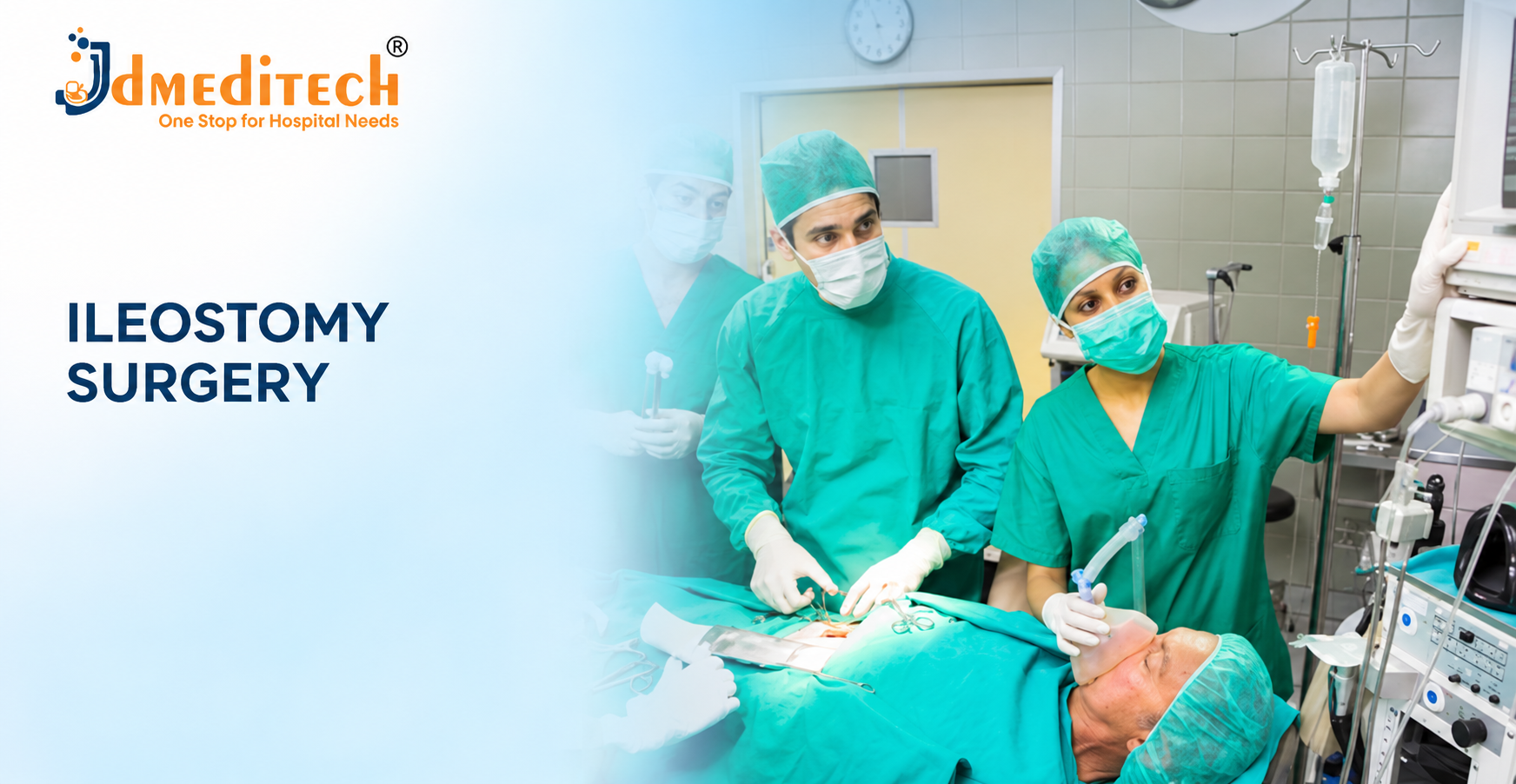
Ileostomy Surgery – Procedure, Types, Indications, Benefits and Recovery
Ileostomy surgery creates an opening
in the abdominal wall to redirect intestinal waste.
A surgeon brings part of the small intestine,
called the ileum, through this opening.
As a result, intestinal output leaves the body
through a surgically created stoma.
Furthermore, an external ostomy pouch collects
the output. This procedure may help patients
who cannot safely pass intestinal contents
through their usual bowel route.
JDMeditech supplies surgical instruments
and medical equipment for healthcare facilities.
Additionally, our team assists hospitals
and medical distributors with product inquiries.
What Is Ileostomy Surgery?
An ileostomy is a surgical opening that
connects the ileum to the abdominal surface.
The opening allows intestinal contents
to pass into an external collection pouch.
Surgeons may create a temporary or permanent
ileostomy. However, the choice depends
on the underlying medical condition
and the patient’s treatment plan.
For example, some patients need temporary
bowel diversion while another intestinal
connection heals. In contrast, others
require a permanent stoma after
removal of the colon and rectum.
Understanding the Digestive System
The digestive system processes food
and absorbs nutrients. After digestion,
intestinal contents move through
the small and large intestines.
The ileum forms the final section
of the small intestine. Normally,
it connects to the large intestine.
However, certain diseases or surgical
conditions may interrupt this pathway.
Therefore, a surgeon may recommend
an ileostomy to redirect intestinal output.
Why Is an Ileostomy Performed?
Doctors recommend this operation
for selected intestinal conditions.
For example, severe bowel disease,
certain cancers or surgical complications
may require intestinal diversion.
Furthermore, temporary diversion may
protect a healing intestinal connection.
However, the decision requires
careful clinical evaluation.
Common Indications for Ileostomy
- Ulcerative Colitis Requiring Surgery
- Selected Cases of Crohn’s Disease
- Colorectal Cancer Surgery
- Familial Adenomatous Polyposis
- Selected Bowel Injuries
- Complex Intestinal Obstruction
- Protection of a Distal Bowel Anastomosis
- Selected Congenital Intestinal Conditions
- Severe Intestinal Complications
Nevertheless, not every patient with
these conditions needs an ileostomy.
A specialist evaluates the diagnosis,
treatment options and overall health.
Types of Ileostomy Surgery
Surgeons use different ileostomy
configurations according to the
patient’s clinical requirements.
The main types include end ileostomy
and loop ileostomy. Additionally,
some patients may receive specialized
continent ileostomy procedures.
1. End Ileostomy
An end ileostomy brings the end
of the ileum through the abdominal wall.
Consequently, intestinal output passes
directly into an ostomy pouch.
Surgeons commonly use this configuration
after selected bowel resections.
Furthermore, an end ileostomy may
be temporary or permanent.
2. Loop Ileostomy
A loop ileostomy brings a loop
of the small intestine to
the abdominal surface.
The surgeon creates an opening
in the loop to divert intestinal
contents. As a result, less output
travels through the downstream bowel.
Additionally, surgeons often use
this approach for temporary diversion.
However, reversal depends on
the patient’s recovery and anatomy.
3. Temporary Ileostomy
A temporary ileostomy diverts
intestinal output for a limited period.
For example, it may protect
a healing bowel connection.
Once the patient recovers,
the surgical team may consider
reversal. However, reversal
is not always possible.
4. Permanent Ileostomy
A permanent ileostomy provides
a long-term route for intestinal output.
Surgeons may recommend this option
when the normal bowel pathway
cannot be restored.
Therefore, long-term stoma care
and suitable ostomy supplies
become important parts of daily life.
5. Continent Ileostomy
A continent ileostomy uses
a surgically created internal
reservoir in selected patients.
Unlike a conventional ileostomy,
this arrangement may not require
continuous external pouch collection.
However, it requires specialized
surgical expertise and ongoing care.
How Does Ileostomy Surgery Work?
The surgeon creates a route
between the small intestine
and the abdominal surface.
Consequently, intestinal contents
can leave the body through the stoma.
Before surgery, the clinical team
evaluates the patient’s condition.
Additionally, a trained stoma
care professional may help
identify a suitable stoma location.
During the operation, the surgeon
uses an open or minimally invasive
approach according to clinical needs.
Afterward, the team monitors
stoma function and patient recovery.
Preoperative Preparation
Preparation begins with a
medical assessment.
The surgeon reviews the diagnosis,
medical history and treatment options.
Furthermore, the healthcare team
may arrange blood tests,
imaging or other investigations.
A stoma care nurse can explain
pouch management and daily care.
As a result, patients can prepare
for the changes after surgery.
Overview of the Surgical Procedure
The operation takes place
under appropriate anesthesia.
First, the surgical team
prepares and monitors the patient.
Next, the surgeon performs
the required intestinal procedure
and creates the planned stoma.
The exact technique depends
on the patient’s condition.
Finally, the team assesses
the stoma and completes
the operation. Postoperative
monitoring then begins.
Only qualified surgical professionals
should perform this procedure.
Open Ileostomy Surgery
Open surgery uses an abdominal
incision to access the intestine.
The surgeon performs the required
bowel procedure and creates
the planned stoma.
However, the incision and
operative approach depend
on the underlying condition.
Laparoscopic Ileostomy Surgery
Laparoscopic surgery uses a camera
and specialized instruments
through small abdominal incisions.
Furthermore, the surgeon can
visualize internal structures
on a surgical monitor.
For selected patients,
a minimally invasive approach
may offer recovery advantages.
However, clinical suitability
varies between cases.
Robotic-Assisted Ileostomy Surgery
Selected surgical centers use
robotic-assisted techniques
during complex bowel procedures.
These systems provide specialized
instrument control and visualization.
However, the surgical approach
depends on available expertise
and patient-specific factors.
Surgical Instruments Used in Ileostomy Procedures
Surgeons use different instruments
according to the planned operation.
For example, an open procedure
requires a different equipment
configuration from laparoscopic surgery.
A typical surgical setup may
include the following equipment.
- Surgical Scissors
- Dissecting Forceps
- Tissue Grasping Forceps
- Hemostatic Forceps
- Needle Holders
- Surgical Retractors
- Surgical Suction Equipment
- Electrosurgical Instruments
- Bowel Clamps Where Appropriate
- Approved Surgical Stapling Devices
- Compatible Laparoscopic Instruments
- Endoscopic Camera System
- Surgical Light Source
- Ostomy Collection Supplies
However, not every procedure
requires every listed instrument.
Therefore, hospitals should
confirm the surgical equipment
list with the operating team.
1. Surgical Scissors
Surgical scissors support
tissue cutting and dissection.
Furthermore, different designs
serve specific surgical tasks.
2. Dissecting Forceps
Dissecting forceps help surgeons
handle tissue during the operation.
Additionally, suitable jaw designs
support different handling requirements.
3. Hemostatic Forceps
Hemostatic forceps help control
selected bleeding points.
However, the surgeon chooses
the appropriate instrument
for each clinical situation.
4. Needle Holders
Needle holders support surgical
suturing. Furthermore, the surgeon
selects suitable instruments
according to the suture and tissue.
5. Surgical Retractors
Retractors help maintain access
to the operative field.
Consequently, the surgeon
can visualize the relevant
anatomical structures.
6. Electrosurgical Equipment
Compatible electrosurgical devices
support selected tissue cutting
and coagulation tasks.
However, energy settings and
instrument compatibility must
follow manufacturer instructions.
7. Surgical Stapling Devices
Surgeons may use approved stapling
devices during selected bowel
resection or anastomosis procedures.
Furthermore, device selection
depends on tissue characteristics
and the intended application.
8. Laparoscopic Instruments
Laparoscopic instruments support
minimally invasive surgical access.
For example, surgeons may use
graspers, scissors and compatible
energy instruments.
9. Endoscopic Camera System
A camera system displays
the operative field during
laparoscopic procedures.
Additionally, suitable illumination
helps the surgical team
visualize anatomical structures.
10. Ostomy Collection System
An ostomy pouch collects
intestinal output after surgery.
Furthermore, suitable skin barriers
help protect the surrounding skin.
However, pouch selection depends
on the stoma and individual needs.
Technical Considerations for Surgical Equipment
Equipment requirements depend
on the procedure and selected
surgical approach.
Therefore, hospitals should
verify product specifications
before purchasing instruments.
| Parameter | Information |
|---|---|
| Procedure | Ileostomy Surgery |
| Specialty | Gastrointestinal and Colorectal Surgery |
| Surgical Approaches | Open, Laparoscopic or Robotic-Assisted |
| Stoma Types | End or Loop Ileostomy |
| Instrument Configuration | Depends on Surgical Technique |
| Instrument Dimensions | Confirm Manufacturer Specifications |
| Instrument Material | Confirm Manufacturer Specifications |
| Electrosurgical Compatibility | Confirm Approved Equipment |
| Stapling Device Compatibility | Confirm Approved Devices |
| Reusable Instruments | Follow Manufacturer Labeling |
| Sterilization Requirements | Follow Validated Instructions |
| Regulatory Documentation | Verify for Destination Market |
Potential Benefits of Ileostomy Surgery
An ileostomy can provide
an alternative route for
intestinal output.
As a result, the procedure
may support treatment
of selected bowel conditions.
- Diverts Intestinal Contents
- May Protect a Healing Bowel Connection
- Supports Selected Colorectal Treatment Plans
- Can Relieve Certain Forms of Bowel Obstruction
- May Form Part of Definitive Bowel Surgery
- Provides an Alternative Waste Elimination Route
However, benefits depend on
the underlying condition
and treatment goals.
Ileostomy vs Colostomy
Both procedures create
a surgically formed stoma.
However, they use different
sections of the intestine.
| Feature | Ileostomy | Colostomy |
|---|---|---|
| Intestinal Segment | Ileum | Colon |
| Typical Output | Liquid to Pasty | Varies From Liquid to Formed |
| Stoma Location | Often Right Abdomen | Depends on Colon Segment |
| Temporary or Permanent | Both Possible | Both Possible |
| Care Requirements | Ostomy Care and Hydration Monitoring | Ostomy Care Based on Output |
Possible Complications of Ileostomy Surgery
Like other major operations,
this procedure carries
potential risks.
For example, patients may
develop bleeding, infection
or bowel-related complications.
- Bleeding
- Surgical Site Infection
- Dehydration
- Electrolyte Imbalance
- High Stoma Output
- Skin Irritation
- Stoma Retraction
- Stoma Prolapse
- Parastomal Hernia
- Bowel Obstruction
- Stoma Ischemia
- Anesthesia-Related Complications
Furthermore, ileostomy output
can contain substantial fluid
and electrolytes.
Therefore, patients require
appropriate hydration guidance.
Recovery After Ileostomy Surgery
Recovery varies according
to the patient’s health
and the type of operation.
Initially, the clinical team
monitors bowel function,
fluid balance and stoma appearance.
Additionally, staff assess
pain and wound healing.
As recovery progresses,
patients learn pouch management
and skin care.
However, the recovery timeline
differs between individuals.
Diet and Nutrition After Ileostomy
Dietary recommendations depend
on the recovery stage
and individual medical needs.
For example, the healthcare
team may recommend gradual
diet progression after surgery.
Furthermore, patients may need
specific guidance about hydration.
However, dietary restrictions
should follow professional advice.
A registered dietitian can
provide individualized support.
Hydration and Electrolyte Management
People with an ileostomy
may lose additional fluids
and electrolytes through
intestinal output.
Consequently, dehydration
can become a concern,
especially with high output.
Patients should follow
their clinical team’s
hydration instructions.
Additionally, persistent
high output or signs of
dehydration require prompt
medical assessment.
Daily Stoma Care
Proper stoma care helps
maintain comfort and
protect surrounding skin.
Furthermore, patients should
use suitable pouching systems
and follow guidance from
their stoma care nurse.
- Check Stoma Appearance
- Monitor Output as Directed
- Maintain Appropriate Skin Care
- Use Suitable Ostomy Pouches
- Follow Pouch Replacement Guidance
- Monitor Hydration
- Attend Scheduled Follow-Up Visits
- Report Concerning Changes Promptly
When Should Patients Seek Medical Attention?
Certain symptoms require
prompt medical evaluation.
For example, persistent
vomiting or markedly
reduced stoma output
may indicate obstruction.
Additionally, severe dehydration,
significant bleeding or
a darkening stoma may
signal serious complications.
Therefore, patients should
seek urgent medical care
when these warning signs occur.
Can a Temporary Ileostomy Be Reversed?
Some temporary ileostomies
can be reversed after
the downstream bowel heals.
However, reversal depends
on the patient’s anatomy,
overall health and
underlying condition.
Therefore, the surgeon
evaluates whether restoring
intestinal continuity
is appropriate.
Role of Surgical Instruments in Ileostomy Procedures
Suitable instruments support
the surgeon throughout
the operation.
For example, grasping and
dissecting instruments help
handle tissues during surgery.
Additionally, compatible
surgical equipment supports
visualization and hemostasis.
However, instrument selection
depends on the planned
surgical technique.
Importance of Instrument Compatibility
Surgical instruments must
suit the intended procedure.
Furthermore, compatible
equipment helps the team
prepare an appropriate
operating-room setup.
Therefore, hospitals should
verify dimensions, connections
and approved intended uses.
Cleaning and Sterilization of Surgical Instruments
Healthcare facilities must
follow validated reprocessing
instructions for reusable
surgical instruments.
Additionally, staff should
inspect instruments for
damage before use.
However, cleaning and
sterilization requirements
vary between products.
Therefore, manufacturer
instructions remain essential.
Why Choose JDMeditech?
JDMeditech supplies surgical
instruments and medical
equipment for hospitals,
clinics and medical distributors.
Furthermore, our team assists
customers with product inquiries,
available configurations
and quotation requests.
Customers can contact JDMeditech
regarding surgical equipment
and compatible accessories.
Related Surgical Equipment
- Laparoscopic Surgical Instruments
- Laparoscopic Trocar Systems
- Laparoscopic Grasping Forceps
- Laparoscopic Scissors
- Electrosurgical Equipment
- Vessel Sealing Systems
- Surgical Suction Equipment
- Endoscopy Camera Systems
- LED Surgical Light Sources
Frequently Asked Questions
1. What Is Ileostomy Surgery?
It is an operation that creates
a stoma using part of the ileum.
As a result, intestinal output
passes into an external pouch.
2. Why Do Patients Need an Ileostomy?
Doctors may recommend the
procedure for selected bowel
diseases or surgical conditions.
However, indications vary
between patients.
3. Is an Ileostomy Permanent?
Not always. Some ileostomies
are temporary, while others
remain permanent.
4. What Is a Loop Ileostomy?
A loop ileostomy uses a loop
of small intestine to divert
intestinal contents.
Furthermore, surgeons often
use it for temporary diversion.
5. What Is an End Ileostomy?
An end ileostomy connects
the end of the ileum
to the abdominal surface.
6. Can Surgeons Perform Ileostomy Laparoscopically?
Yes. Selected patients
may undergo laparoscopic
surgery. However, the
approach depends on
clinical circumstances.
7. What Is an Ostomy Pouch?
An ostomy pouch collects
intestinal output from
the stoma. Additionally,
a suitable skin barrier
helps protect the skin.
8. Can Patients Eat Normally After Surgery?
Many patients gradually
return to a varied diet.
However, dietary advice
depends on recovery,
output and individual needs.
9. Why Is Hydration Important?
Ileostomy output contains
fluid and electrolytes.
Consequently, some patients
face an increased risk
of dehydration.
10. Can an Ileostomy Be Reversed?
Some temporary ileostomies
can be reversed. However,
the surgeon must assess
whether reversal is suitable.
11. What Are Common Ileostomy Complications?
Possible complications include
dehydration, skin irritation,
obstruction and stoma problems.
Therefore, regular clinical
follow-up is important.
12. Where Can Hospitals Find Surgical Equipment?
Hospitals and medical distributors
can contact JDMeditech for
information about surgical
instruments and equipment.
Conclusion
In conclusion,
ileostomy surgery
provides an alternative
route for intestinal output.
Surgeons use this procedure
for selected gastrointestinal
conditions and treatment plans.
Furthermore, appropriate surgical
equipment supports the
operative process.
However, patient outcomes
depend on the underlying
condition and clinical care.
Therefore, patients should
follow their surgical team’s
advice regarding recovery,
hydration and stoma management.
JDMeditech – One Stop for Hospital Needs.
Website:
www.jdmeditech.com
Medical Information Reference
For patient information about
living with an ileostomy,
visit the
NHS – Ileostomy
.
Medical Disclaimer
This article provides general
educational information only.
It does not replace medical
advice, clinical judgment
or professional surgical training.
Patients should consult qualified
healthcare professionals about
treatment options, possible risks,
recovery and stoma care.




