



Penile Prosthesis – Types, Features, Uses and Benefits
A Penile Prosthesis is a surgically implanted medical device used to treat selected patients with erectile dysfunction (ED). Urologists may recommend this treatment when other suitable therapies do not provide satisfactory results.
Furthermore, penile implants offer a mechanical way to create sufficient penile rigidity for sexual activity. However, the device does not restore natural erectile function or sexual desire.
JDMeditech supplies urology products and surgical equipment for hospitals, clinics and medical distributors. Additionally, our team assists customers with product information and quotation requests.
What Is a Penile Prosthesis?
A penile implant is a medical device that a qualified urologist places surgically inside the penis. It provides mechanical support for patients with selected forms of erectile dysfunction.
Moreover, manufacturers offer different implant designs. For example, commonly used options include malleable and inflatable devices.
Therefore, patients should discuss their medical history, treatment expectations and available alternatives with a specialist before choosing surgery.
Understanding Erectile Dysfunction
Erectile dysfunction describes persistent difficulty achieving or maintaining an erection sufficient for satisfactory sexual activity.
Several conditions can contribute to this problem. For example, diabetes, vascular disease, neurological disorders, certain medications and previous pelvic surgery may affect erectile function.
Additionally, psychological factors can contribute to erectile difficulties. Consequently, appropriate medical assessment helps identify potential causes and treatment options.
When Do Doctors Recommend a Penile Implant?
Urologists may consider implant surgery when erectile dysfunction persists despite suitable nonsurgical treatment.
For example, a patient may not respond adequately to oral medication or may be unable to use other available therapies.
However, the decision requires specialist assessment, informed consent and a discussion of surgical risks.
- Persistent erectile dysfunction
- Unsatisfactory response to suitable medication
- Inability to use selected nonsurgical treatments
- Selected cases following pelvic surgery
- Selected neurological or vascular conditions
- Other specialist-approved clinical indications
Types of Penile Prosthesis
Manufacturers offer several implant configurations. Furthermore, each design has different mechanical features and handling requirements.
1. Malleable Penile Prosthesis
A malleable implant typically consists of two bendable rods placed within the penile erectile bodies.
The patient can position the penis for sexual activity and adjust it afterward. Additionally, this design generally uses fewer mechanical components than an inflatable system.
However, the penis remains relatively firm at all times. Therefore, concealment and comfort may differ from those of an inflatable implant.
2. Two-Piece Inflatable Penile Prosthesis
A two-piece inflatable system generally includes paired penile cylinders and a connected pump assembly.
The system transfers fluid between its components to create rigidity. Furthermore, its design differs from a three-piece system because it does not use a separate abdominal reservoir.
However, available designs and performance characteristics depend on the manufacturer.
3. Three-Piece Inflatable Penile Prosthesis
A three-piece inflatable implant generally includes two penile cylinders, a pump and a separate fluid reservoir.
When activated, the system transfers fluid into the cylinders. Consequently, the penis becomes sufficiently rigid for sexual activity.
Afterward, the user can operate the deflation mechanism according to the manufacturer’s instructions.
Main Components of a Penile Prosthesis
The components depend on the selected implant design. For example, a malleable device has a different structure from an inflatable system.
- Penile implant rods or cylinders
- Proximal extensions where applicable
- Implantable pump in inflatable models
- Fluid reservoir in selected inflatable models
- Connection tubing where applicable
- Manufacturer-specific accessories
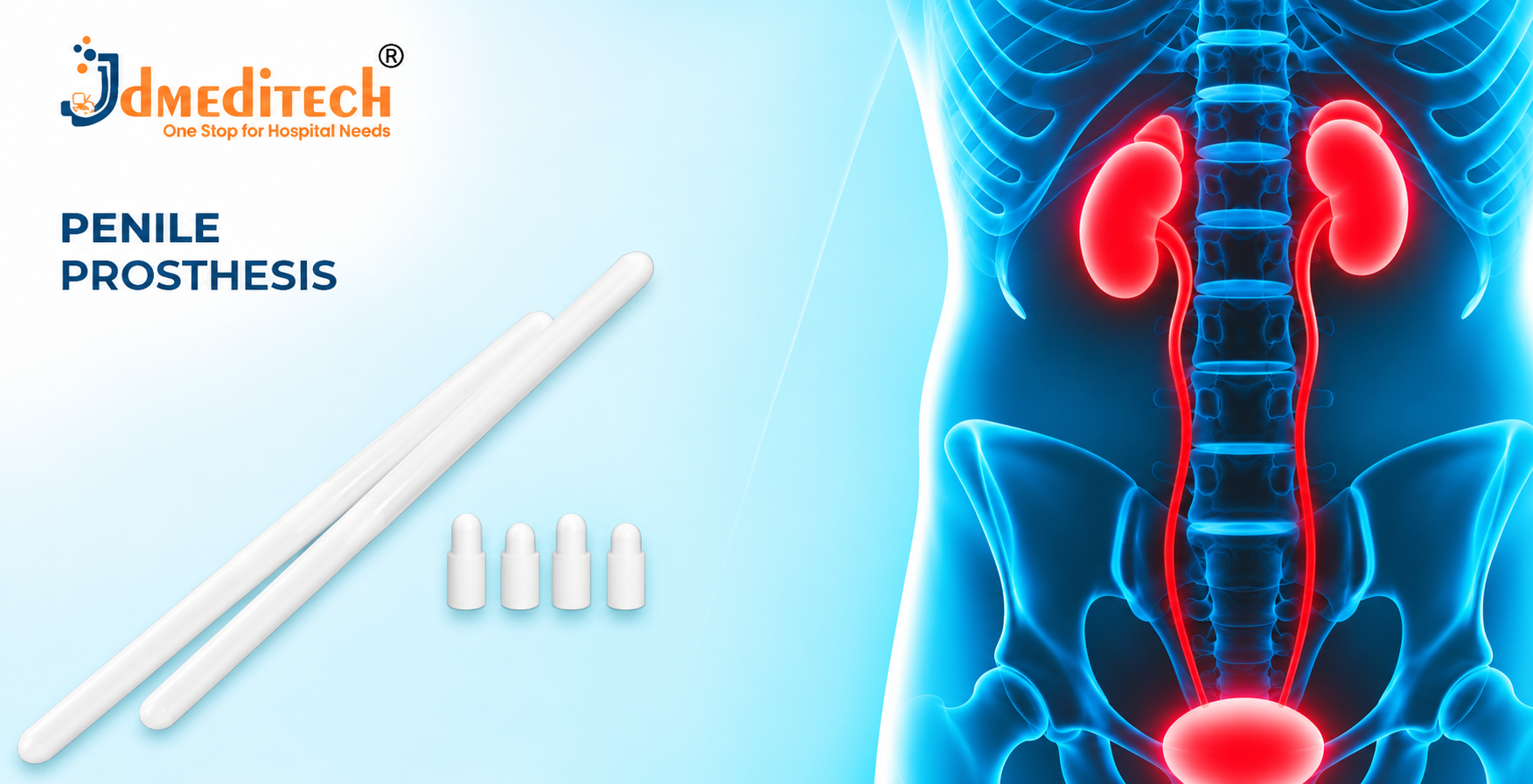
However, the uploaded image does not confirm the complete product configuration. Therefore, customers should verify the official packing list.
1. Implant Rods or Cylinders
The implant rods or cylinders provide mechanical support within the penis.
Furthermore, their dimensions must match the patient’s anatomy and the manufacturer’s approved sizing system.
2. Proximal Extensions
Selected implant systems include rear-tip or proximal extensions. These accessories help surgeons achieve an appropriate implant fit when indicated.
However, compatibility and available dimensions vary between models.
3. Implantable Pump
Inflatable systems use a pump mechanism to control fluid movement. Additionally, selected designs include controls for deflation.
In contrast, malleable implants do not require an inflation pump.
4. Fluid Reservoir
Some inflatable systems include a separate fluid reservoir. This component stores fluid when the implant is not inflated.
However, reservoir placement and configuration depend on the approved device design.
5. Connection Tubing
Selected inflatable systems use tubing to connect their components. Consequently, the tubing supports fluid transfer during inflation and deflation.
Key Features of Penile Implant Systems
- Implantable medical device design
- Mechanical support for penile rigidity
- Malleable or inflatable configurations
- Different implant dimensions
- Model-specific implant materials
- Patient-specific sizing options
- Manufacturer-defined accessories
- Specialist surgical implantation
- Device-specific operating instructions
- Approved packaging and labeling
Nevertheless, features differ between products. Therefore, procurement teams should verify the manufacturer’s technical documentation.
Clinical Applications of Penile Prosthesis
Specialists primarily use penile implants to treat selected patients with erectile dysfunction.
Furthermore, implant surgery may be considered in certain complex cases after appropriate evaluation.
- Persistent erectile dysfunction
- Selected medication-resistant cases
- Selected cases after prostate surgery
- Selected neurological conditions
- Selected vascular-related erectile dysfunction
- Specialist-approved reconstructive indications
However, clinical suitability depends on the individual patient.
How Does a Penile Prosthesis Work?
The working principle depends on the implant design.
For example, a malleable device provides permanent internal support through bendable rods. In contrast, an inflatable device changes rigidity through controlled fluid movement.
Therefore, patients should receive device-specific training after surgery.
Overview of Penile Implant Surgery
First, a qualified urologist evaluates the patient’s condition and discusses available treatments.
Next, the clinical team prepares the patient and selects an appropriate anesthesia method.
During surgery, the specialist places the selected implant components using an approved surgical technique.
Afterward, the team monitors recovery and provides instructions for wound care, follow-up and device use.
However, surgical methods and recovery plans vary between patients and implant designs.
Potential Benefits of Penile Implant Surgery
Penile implant surgery can provide an effective treatment option for appropriately selected patients with erectile dysfunction.
Furthermore, the device can help patients achieve the mechanical rigidity required for sexual activity.
- Mechanical support for erections
- Treatment option after unsuccessful nonsurgical therapy
- Different implant configurations
- Potential improvement in sexual function
- Potential improvement in patient satisfaction
- No need to rely on an oral erectile dysfunction medicine for device-generated rigidity
However, individual outcomes vary. Additionally, surgery does not guarantee satisfaction or eliminate every sexual health concern.
Malleable vs Inflatable Penile Prosthesis
Both systems provide mechanical support. However, they differ in design, operation and concealment.
| Feature | Malleable Implant | Inflatable Implant |
|---|---|---|
| Design | Bendable rods | Fluid-filled cylinders |
| Operation | Manual positioning | Pump-controlled inflation |
| Rigidity | Relatively constant | Adjustable through inflation |
| Mechanical Components | Generally fewer | More components |
| Concealment | May be less natural | May provide a more natural flaccid appearance |
| Selection | Patient-dependent | Patient-dependent |
Technical Specifications of Penile Prosthesis
Technical details vary by manufacturer and implant configuration. Therefore, hospitals should verify the official datasheet before ordering.
| Parameter | Product Information |
|---|---|
| Product Name | Penile Prosthesis |
| Product Category | Implantable Urology Device |
| Primary Application | Selected Erectile Dysfunction Treatment |
| Implant Type | Confirm Available Model |
| Implant Material | Confirm Manufacturer Specifications |
| Implant Diameter | Confirm Available Sizes |
| Implant Length | Confirm Available Sizes |
| Extension Accessories | Model-Dependent |
| Inflation Mechanism | Inflatable Models Only |
| Implant Components | Confirm Official Packing List |
| Sterility | Confirm Product Labeling |
| Single-Use Status | Confirm Product Labeling |
| MRI Conditions | Confirm Model-Specific MRI Labeling |
| Packaging | Confirm Manufacturer Specifications |
| Shelf Life | Confirm Product Labeling |
| Regulatory Documentation | Verify for Destination Market |
Importance of Implant Sizing
Appropriate sizing is an important part of penile implant surgery. Therefore, surgeons select device dimensions according to the patient’s anatomy and the manufacturer’s instructions.
Furthermore, incorrect sizing can increase the risk of discomfort or other complications.
Importance of Implant Material
Manufacturers use medical-grade materials selected for their intended implant applications.
However, material composition varies between models. Consequently, customers should verify biocompatibility documentation and product specifications.
Patient Selection and Preoperative Assessment
Before surgery, the urologist evaluates the patient’s medical history, erectile dysfunction treatment history and expectations.
Additionally, the specialist assesses relevant infection risks and other medical conditions.
Therefore, patient selection remains essential for appropriate treatment planning.
Possible Risks and Complications
Like other surgical procedures, penile implant surgery carries potential risks.
- Surgical site or implant infection
- Bleeding and hematoma
- Pain and swelling
- Device malfunction
- Implant erosion
- Mechanical failure
- Changes in perceived penile length
- Persistent discomfort
- Need for revision or removal surgery
- Anesthesia-related complications
Furthermore, infection involving an implanted device can require additional surgery. Therefore, patients should discuss these risks with their urologist.
Recovery After Penile Implant Surgery
Recovery depends on the implant type, surgical approach and individual health factors.
Initially, patients may experience discomfort, swelling and bruising. Additionally, the surgical team provides wound care and activity guidance.
However, patients should not activate or manipulate the implant before receiving appropriate instructions and clearance from their surgeon.
Postoperative Care and Follow-Up
Follow-up appointments help the urologist assess wound healing and device function.
Furthermore, patients with inflatable implants receive instructions on operating the device when appropriate.
However, fever, increasing redness, wound drainage or severe pain requires prompt medical assessment.
Does a Penile Prosthesis Affect Sensation?
A penile implant primarily provides mechanical rigidity. It does not directly replace the nerves responsible for penile sensation.
Many patients retain their existing sensation and ability to orgasm. However, outcomes depend on underlying health conditions and surgical factors.
Does a Penile Implant Increase Penile Size?
A penile implant is not intended as a cosmetic enlargement device.
Instead, its primary purpose is to provide functional rigidity. Therefore, patients should discuss realistic expectations with their surgeon.
Does a Penile Prosthesis Affect Fertility?
A penile implant does not directly restore sperm production or treat infertility.
Furthermore, fertility depends on several reproductive and medical factors. Therefore, patients with fertility concerns should seek specialist advice.
How Long Does a Penile Prosthesis Last?
Device lifespan varies according to implant design, mechanical wear and individual circumstances.
Although many implants function for years, mechanical failure or other complications may require revision surgery.
Consequently, patients should discuss expected device longevity with their surgeon.
Safety Precautions for Penile Implants
- Confirm appropriate clinical indications
- Use qualified implant surgeons
- Verify implant dimensions and compatibility
- Follow manufacturer instructions
- Maintain appropriate infection prevention practices
- Verify packaging integrity and sterility
- Check expiration dates
- Review patient-specific medical risks
- Follow approved postoperative care
- Arrange appropriate follow-up
Storage and Handling Recommendations
Healthcare facilities should store implantable devices according to manufacturer instructions.
Furthermore, procurement teams should maintain product traceability and verify package integrity before use.
- Follow manufacturer storage conditions
- Protect sterile packaging
- Check product identification and lot details
- Verify expiration dates
- Prevent mechanical damage
- Maintain implant traceability records
- Follow applicable regulatory requirements
How to Choose the Right Penile Prosthesis
Urologists should evaluate patient needs and the available implant designs before choosing a device.
For example, manual dexterity, anatomical factors and patient preferences may influence implant selection.
Additionally, hospitals should verify technical compatibility and regulatory documentation.
- Approved intended use
- Malleable or inflatable configuration
- Available implant dimensions
- Patient anatomical requirements
- Material specifications
- Component compatibility
- Device operation requirements
- Manufacturer support
- Sterility and packaging
- Regulatory approval for the destination market
Why Choose JDMeditech?
JDMeditech supplies urology products and medical equipment for healthcare facilities and medical distributors.
Furthermore, our team assists customers with product inquiries, available configurations and quotation requests.
For implantable devices, customers should request the relevant technical documentation and verify regulatory authorization before purchase or clinical use.
Related Urology Products
- Urology Surgical Instrument Sets
- Optical Urethrotome Sets
- Urology Endoscopic Instruments
- Urethral Dilator Sets
- Silicone Foley Catheters
- Urology Surgical Accessories
- Endoscopic Camera Systems
Frequently Asked Questions
1. What Is a Penile Prosthesis?
It is a surgically implanted device that provides mechanical rigidity for selected patients with erectile dysfunction.
2. What Are the Main Types of Penile Implants?
The main categories include malleable and inflatable implants. Furthermore, inflatable systems may have two-piece or three-piece configurations.
3. Who May Need a Penile Implant?
Urologists may recommend an implant for selected patients with persistent erectile dysfunction when other suitable treatments are unsuccessful or inappropriate.
4. Is Penile Implant Surgery Permanent?
Implant surgery permanently changes the penile erectile tissues. Although surgeons can remove or replace devices, natural erectile function may not return.
5. Can a Penile Implant Restore Natural Erections?
No. The implant provides mechanical rigidity rather than restoring the natural erectile mechanism.
6. Does the Implant Affect Sexual Desire?
The device does not directly increase sexual desire. However, patients may experience changes in sexual confidence or satisfaction.
7. Is Penile Implant Surgery Painful?
The surgical team provides appropriate anesthesia. Additionally, postoperative pain management helps patients during recovery.
8. Can the Device Malfunction?
Yes. Mechanical components can fail over time. Therefore, some patients may require revision or replacement surgery.
9. Can a Penile Implant Cause Infection?
Yes. Implant infection is a recognized complication and may require device removal. Consequently, infection prevention is essential.
10. How Long Does Recovery Take?
Recovery varies between patients. Therefore, the surgeon determines when normal activities and device use can resume.
11. Are Penile Implants MRI Compatible?
MRI conditions depend on the specific implant model. Therefore, patients must provide the device identification information to their imaging team.
12. Can a Penile Prosthesis Be Replaced?
Yes. Specialists can perform revision surgery when clinically appropriate. However, replacement carries additional surgical risks.
13. Does a Penile Implant Treat Infertility?
No. The implant treats erectile rigidity rather than sperm production or other causes of infertility.
14. Is a Malleable Implant Different From an Inflatable Implant?
Yes. Malleable implants use bendable rods, while inflatable systems use fluid movement to change rigidity.
15. Where Can Hospitals Request Product Information?
Hospitals and medical distributors can contact JDMeditech for information about available urology products and quotation requests.
Conclusion
In conclusion, a Penile Prosthesis provides an established surgical treatment option for selected patients with erectile dysfunction.
Furthermore, malleable and inflatable implants offer different functional characteristics. Therefore, treatment selection should reflect individual patient needs and specialist recommendations.
However, device specifications, implant materials and regulatory documentation vary between manufacturers. Consequently, hospitals should verify all technical information before procurement.
JDMeditech – One Stop for Hospital Needs.
Website:
www.jdmeditech.com
Medical Information and References
For further information about erectile dysfunction and available treatments, visit the
National Institute of Diabetes and Digestive and Kidney Diseases (NIDDK).
Additionally, healthcare professionals can consult the
European Association of Urology – Sexual and Reproductive Health Guidelines.
Medical Disclaimer
This article provides general educational and product information only. It does not replace professional medical advice, specialist assessment, surgical training or manufacturer instructions. Penile implant surgery requires qualified healthcare professionals. Customers must verify implant specifications, compatibility, sterility, regulatory authorization and approved indications before clinical use.




