



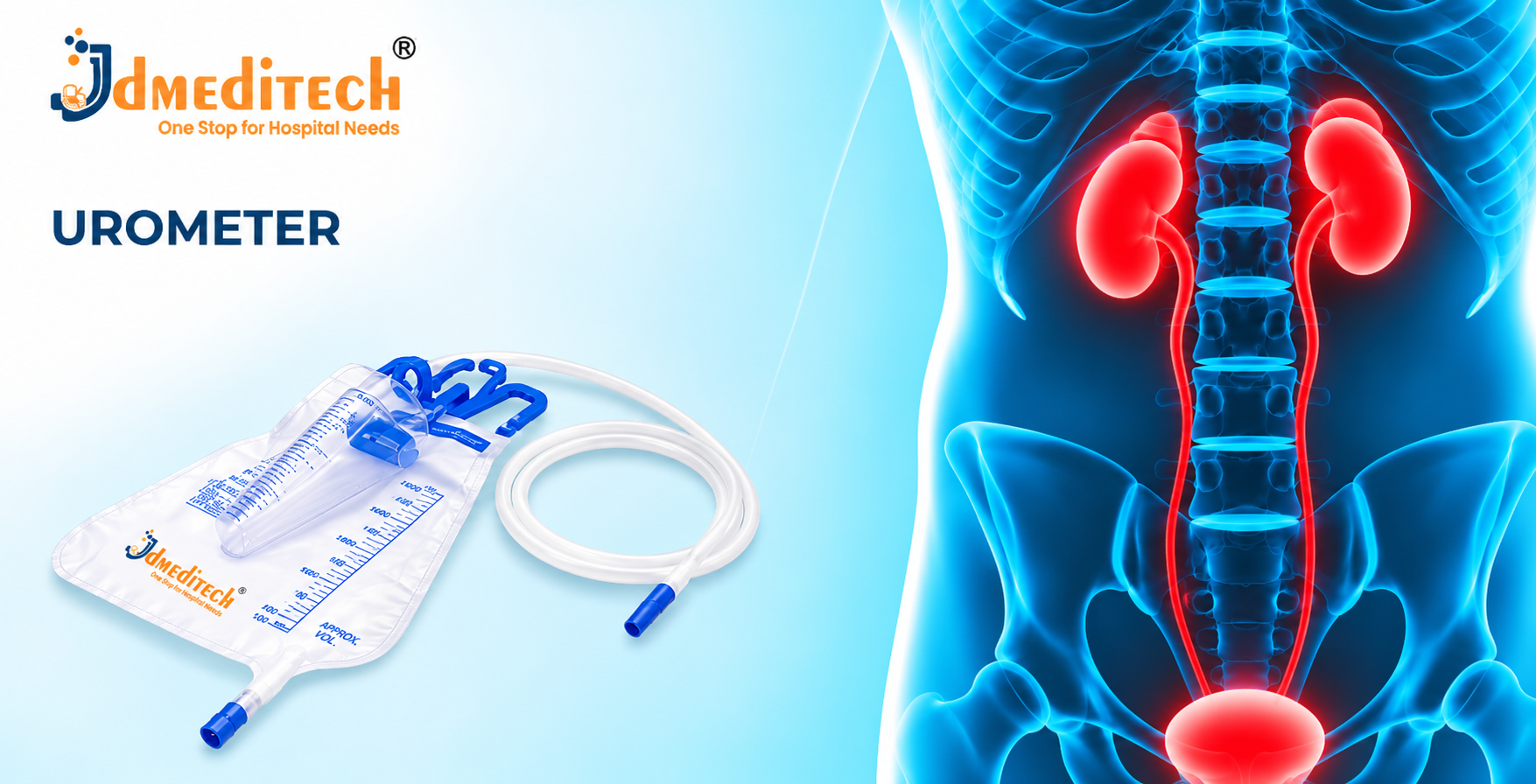
Urometer – Features, Components, Applications and Benefits
A Urometer is a urine collection and measurement device that helps healthcare professionals monitor urinary output. It typically combines a graduated measuring chamber with a larger drainage bag.
Furthermore, the system connects to a compatible urinary catheter. As a result, healthcare professionals can measure collected urine while maintaining an appropriate drainage setup.
JDMeditech supplies urology consumables and medical devices for healthcare facilities. Additionally, our team assists hospitals and medical distributors with product information and quotation requests.
What Is a Urometer?
A urine meter drainage system collects urine from a catheterized patient. Its graduated chamber allows staff to measure urine output at clinically appropriate intervals.
Moreover, the larger collection bag provides additional drainage capacity. Therefore, the system can support ongoing urine output monitoring in selected clinical settings.
However, device specifications vary between manufacturers. Consequently, buyers should confirm the approved configuration before purchasing.
Understanding Urine Output Monitoring
Urine output is an important clinical observation. Healthcare professionals may use it alongside other findings to assess fluid balance and kidney function.
For example, changes in urine production can occur during dehydration, acute illness or certain kidney conditions.
However, urine output alone cannot establish a diagnosis. Therefore, clinicians interpret the results alongside the patient’s overall condition.
How Does a Urometer Work?
A compatible urinary catheter directs urine into the collection system. The measuring chamber displays graduated volume markings.
As urine collects, healthcare staff can read the volume according to clinical protocols. Additionally, the drainage bag provides storage for collected urine.
However, measurement and transfer mechanisms vary between product designs. Therefore, users must follow the manufacturer’s instructions.
Key Features of a Urine Meter Drainage Bag
The device supports urine collection and measurement. Furthermore, selected designs include features that assist clinical monitoring.
- Graduated Urine Measuring Chamber
- Integrated Urine Collection Bag
- Compatible Drainage Tubing
- Catheter Connection Port
- Visible Volume Markings
- Urine Drainage Outlet
- Bag Suspension Arrangement
- Model-Specific Anti-Reflux Features
- Optional Needle-Free Sampling Port
- Manufacturer-Defined Sterile Packaging
However, not every model includes every listed feature. Therefore, customers should verify the official datasheet.
Main Components of a Urometer
A typical urine measurement system contains several connected components. For example, these may include a measuring chamber, collection bag and tubing.
- Graduated Measuring Chamber
- Urine Collection Bag
- Drainage Tube
- Catheter Connector
- Drainage Outlet
- Suspension Hook or Hanger
- Optional Sampling Port
- Optional Anti-Reflux Valve
1. Graduated Measuring Chamber
The measuring chamber displays volume graduations. Consequently, clinical staff can observe urine output during monitoring.
However, graduation intervals and chamber capacity depend on the model.
2. Urine Collection Bag
The collection bag stores urine after it leaves the measuring chamber.
Furthermore, its capacity depends on the selected product configuration.
3. Drainage Tubing
The drainage tube connects the urinary catheter to the collection system.
Additionally, appropriate tubing positioning helps maintain unobstructed urine drainage.
4. Catheter Connector
The connector provides a connection between compatible urinary catheters and the drainage tubing.
However, connector compatibility must follow the manufacturer’s approved specifications.
5. Drainage Outlet
The drainage outlet allows authorized healthcare staff to empty collected urine according to clinical procedures.
Furthermore, appropriate handling helps reduce contamination risks.
6. Suspension Hook or Hanger
A suitable hanger supports placement of the drainage system near the patient’s bed.
However, staff should maintain the collection system below bladder level and prevent floor contact.
7. Sampling Port
Some models include a sampling port. This feature allows appropriate urine sampling when clinically required.
However, staff must use the manufacturer’s approved aseptic sampling method.
8. Anti-Reflux Valve
Selected designs contain an anti-reflux mechanism. This feature aims to limit backward urine flow.
Nevertheless, its presence and performance depend on the product design.
Clinical Applications of Urometer
Healthcare professionals use urine measurement systems when accurate urine output tracking is clinically important.
Furthermore, these devices may support fluid balance monitoring in selected patients.
- Intensive Care Unit Monitoring
- Postoperative Urine Output Monitoring
- Selected Critical Care Patients
- Fluid Balance Assessment
- Selected Kidney Function Monitoring
- Emergency and Acute Care Settings
- Hospitalized Catheterized Patients
- Selected High-Acuity Clinical Situations
However, catheter use requires a valid clinical indication. Therefore, healthcare teams should avoid unnecessary urinary catheterization.
Importance of Hourly Urine Output Monitoring
Hourly urine output can provide useful clinical information. For example, clinicians may monitor it during critical illness.
Furthermore, changes in urine output may prompt additional patient assessment.
However, clinical decisions must consider vital signs, fluid intake and other relevant measurements.
Urometer in Intensive Care Units
Critical care teams often monitor fluid balance closely.
A graduated urine chamber can support frequent urine volume observations. Additionally, recorded measurements help clinicians review patient trends.
Nevertheless, staff must follow infection prevention and catheter care protocols.
Urometer in Postoperative Care
Selected postoperative patients require urine output monitoring. For example, the surgical team may track fluid balance after major surgery.
Furthermore, a suitable urine meter can assist with repeated measurements.
However, catheter duration should remain limited to clinical necessity.
Urometer in Kidney Function Assessment
Urine output forms one part of kidney function assessment.
Additionally, clinicians may review laboratory results and other clinical observations.
Therefore, a urine meter supports data collection but does not independently diagnose kidney disease.
Potential Benefits of a Urometer
A suitable device can support organized urine collection and monitoring.
Furthermore, graduated measurements may help staff document urine output consistently.
- Supports Urine Volume Measurement
- Facilitates Frequent Output Monitoring
- Combines Measuring Chamber and Collection Bag
- Supports Clinical Fluid Balance Records
- Provides Visible Volume Graduations
- Supports Catheterized Patient Care
- Offers Model-Specific Drainage Features
However, measurement accuracy depends on the product and correct clinical use.
Technical Specifications of Urometer
Specifications vary between available models. Therefore, hospitals should verify the official product datasheet before purchasing.
| Parameter | Product Information |
|---|---|
| Product Name | Urometer |
| Product Category | Urine Measurement and Collection System |
| Primary Application | Urine Output Monitoring |
| Measuring Chamber Capacity | Confirm Manufacturer Specifications |
| Collection Bag Capacity | Confirm Manufacturer Specifications |
| Graduation Intervals | Confirm Manufacturer Specifications |
| Drainage Tube Length | Confirm Manufacturer Specifications |
| Connector Type | Confirm Approved Compatibility |
| Sampling Port | Model-Dependent |
| Anti-Reflux Feature | Model-Dependent |
| Material | Confirm Manufacturer Specifications |
| Sterility | Confirm Product Labeling |
| Single-Use Status | Confirm Product Labeling |
| Packaging | Confirm Available Configuration |
| Shelf Life | Confirm Manufacturer Labeling |
| Regulatory Documentation | Verify for Destination Market |
Urometer vs Standard Urine Collection Bag
Both products collect urine from compatible urinary catheters. However, their designs serve different monitoring requirements.
| Feature | Urometer | Standard Urine Bag |
|---|---|---|
| Primary Function | Collection and Detailed Measurement | Urine Collection |
| Measuring Chamber | Typically Included | Usually Not Included |
| Frequent Volume Monitoring | Designed to Support | Less Detailed Graduations |
| Collection Bag | Included | Included |
| Clinical Use | Selected High-Monitoring Settings | General Catheter Drainage |
Importance of Accurate Urine Measurement
Accurate documentation helps clinicians assess changes in urine output.
Furthermore, consistent measurement intervals support clinical records.
However, device readings may be affected by positioning and handling. Therefore, staff should follow the approved measurement procedure.
Safety Precautions for Urometer Use
Safe use requires appropriate catheter care and infection prevention practices.
Additionally, staff should inspect the system before connecting it.
- Confirm Clinical Indication
- Verify Catheter Compatibility
- Inspect Packaging Before Use
- Follow Aseptic Connection Practices
- Maintain a Closed Drainage System
- Keep the Bag Below Bladder Level
- Prevent Tubing Kinks
- Avoid Placing the Bag on the Floor
- Follow Approved Sampling Procedures
- Record Urine Output as Directed
- Remove Catheters When No Longer Required
Potential Risks and Limitations
Urinary drainage systems carry potential risks, especially when patients require prolonged catheterization.
- Catheter-Associated Urinary Tract Infection
- Drainage Tubing Obstruction
- Leakage
- Accidental Disconnection
- Contamination During Handling
- Incorrect Volume Readings
- Catheter-Related Discomfort
However, appropriate clinical protocols help manage these risks.
Infection Prevention and Catheter Care
Healthcare facilities should follow established urinary catheter care guidelines.
Furthermore, staff should maintain unobstructed urine flow and avoid unnecessary system disconnections.
Therefore, catheter use and maintenance require ongoing clinical review.
Storage and Handling Recommendations
- Store According to Product Labeling
- Protect Packaging From Damage
- Inspect Sterile Barriers Where Applicable
- Check Expiration Dates
- Avoid Excessive Tubing Compression
- Follow Manufacturer Storage Conditions
- Dispose of Used Products Appropriately
How to Choose the Right Urometer
Hospitals should evaluate their clinical monitoring requirements before selecting a device.
For example, the measuring chamber capacity and graduation intervals may influence product choice.
Additionally, procurement teams should verify catheter compatibility and available safety features.
- Measuring Chamber Capacity
- Collection Bag Capacity
- Graduation Accuracy
- Drainage Tubing Length
- Connector Compatibility
- Sampling Port Availability
- Anti-Reflux Features
- Material Specifications
- Sterility and Single-Use Labeling
- Packaging Requirements
- Regulatory Documentation
Why Choose JDMeditech?
JDMeditech supplies urology consumables and medical equipment for healthcare facilities.
Furthermore, our team assists hospitals and medical distributors with product inquiries.
Additionally, customers can request available specifications and quotation details.
Related Urology Products
- Urine Collection Bag
- Silicone Foley Catheter
- Foley Balloon Catheter
- Urinary Drainage Accessories
- Intermittent Catheters
- Urodynamic Catheters
- Uroflowmetry System
- Bladder Scanner
Frequently Asked Questions
1. What Is a Urometer?
It is a urine collection system with a graduated measuring chamber.
2. What Is the Main Use of a Urometer?
Healthcare professionals use it to monitor urine output in catheterized patients.
3. Where Is a Urometer Commonly Used?
Hospitals may use it in intensive care, postoperative care and other selected clinical settings.
4. Does a Urometer Measure Hourly Urine Output?
Yes. The graduated chamber supports repeated measurements. However, staff must follow the clinical monitoring plan.
5. Does a Urometer Include a Collection Bag?
Typical systems include a larger urine collection bag. However, exact configurations vary.
6. Is a Urometer Sterile?
Sterility depends on the product configuration. Therefore, customers must verify the label.
7. Is a Urometer Reusable?
Many urine drainage systems are intended for single use. However, the manufacturer’s labeling determines the approved use.
8. Does a Urometer Prevent Infection?
No device can guarantee infection prevention. Therefore, healthcare professionals must follow catheter care protocols.
9. Can a Urometer Monitor Kidney Function?
It helps collect urine output data. However, clinicians need additional information to assess kidney function.
10. What Is the Difference Between a Urometer and a Urine Bag?
A urine meter includes a graduated measuring chamber. In contrast, a standard urine bag primarily collects urine.
11. What Capacities Are Available?
Available capacities depend on the manufacturer. Therefore, buyers should request the official datasheet.
12. Where Can Hospitals Request Product Information?
Hospitals and medical distributors can contact JDMeditech for product information and quotations.
Conclusion
In conclusion, a Urometer supports urine collection and measurement in selected clinical settings.
Furthermore, its graduated chamber helps healthcare professionals monitor urinary output.
However, product specifications and safety features vary. Therefore, hospitals should verify the manufacturer’s documentation before purchasing.
JDMeditech – One Stop for Hospital Needs.
Website: www.jdmeditech.com
Medical Device Safety Reference
For guidance on urinary catheter infection prevention, visit the CDC – Catheter-Associated Urinary Tract Infection .
Medical Disclaimer
This article provides general educational and product information only. It does not replace clinical judgment, professional medical advice or manufacturer instructions. Healthcare professionals must verify device compatibility, approved indications, sterility and regulatory requirements before use.




