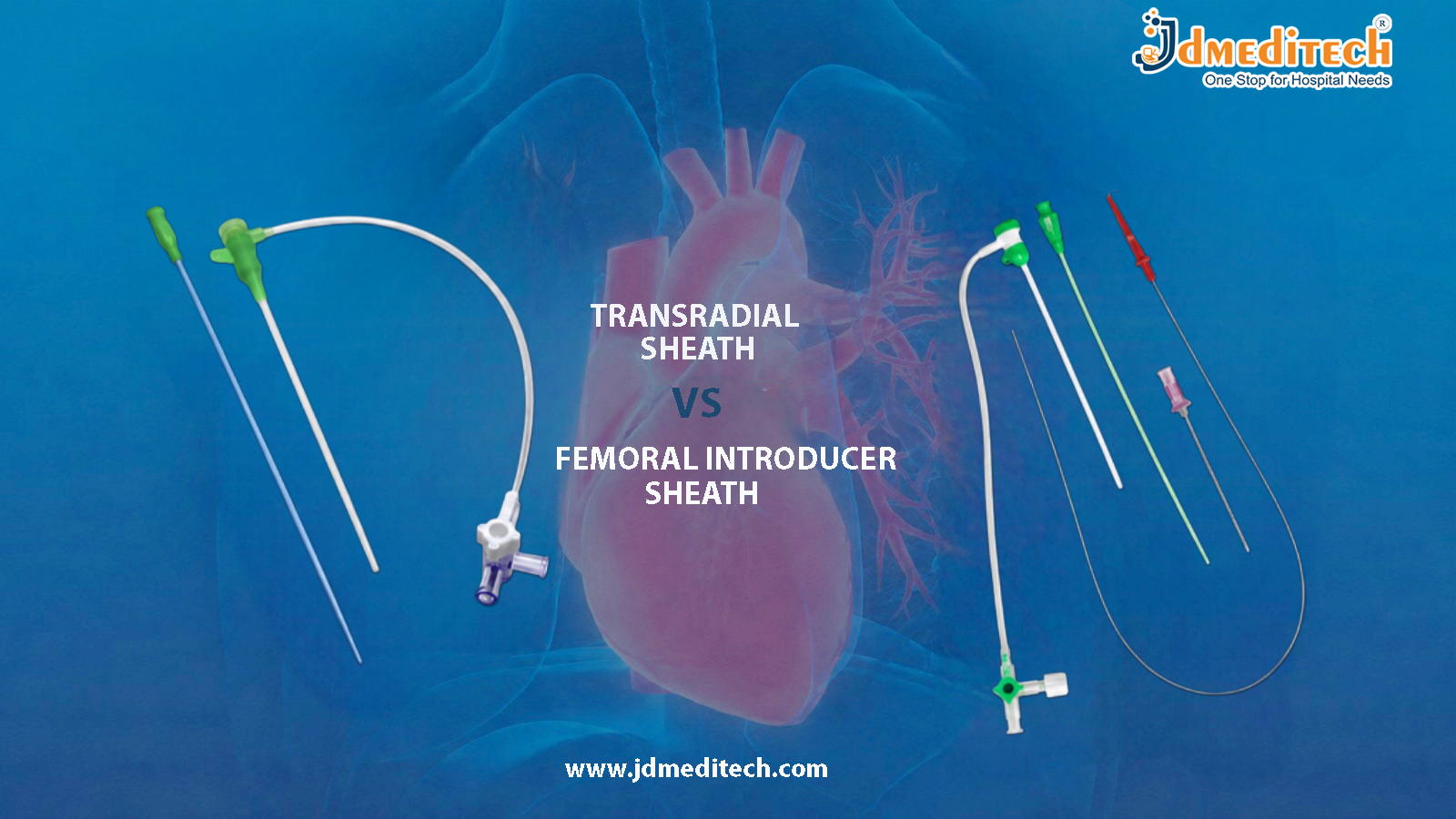
Vascular access plays a crucial role in modern interventional cardiology procedures. Whether cardiologists perform coronary angiography, angioplasty, or complex cardiac interventions, they must select the most appropriate vascular access site to ensure procedural success and patient safety.
Traditionally, cardiologists preferred the femoral artery because it offers easy access and accommodates larger devices. However, in recent years, the transradial approach has gained widespread acceptance due to its lower complication rates and faster patient recovery.
This article compares both vascular access options and highlights their advantages, limitations, and clinical applications.
What is a Femoral Introducer Sheath?
A Femoral Introducer Sheath is a medical device that physicians insert into the femoral artery, typically in the groin region. The sheath provides stable vascular access and allows clinicians to introduce catheters, guidewires, balloons, and other interventional devices during cardiovascular procedures.
Moreover, femoral access supports larger catheter sizes and complex interventions. Therefore, physicians still rely on femoral access for numerous advanced procedures.
What is a Transradial Sheath?
A Transradial Sheath is an introducer sheath that physicians insert through the radial artery located in the wrist. The sheath enables cardiologists to perform diagnostic and therapeutic cardiac procedures using the transradial approach.
Because the radial artery lies superficially and allows easy compression after the procedure, transradial access significantly reduces vascular complications.
Consequently, many cardiac centers now prefer transradial access as the first-line approach for routine coronary interventions.
Femoral Introducer Sheath vs Transradial Sheath: Key Differences
Access Site
Femoral Introducer Sheath: Physicians insert the sheath through the femoral artery in the groin.
Transradial Sheath: Physicians insert the sheath through the radial artery in the wrist.
Patient Comfort
Femoral access generally requires prolonged bed rest after the procedure. Therefore, patients may experience discomfort and delayed mobility.
In contrast, transradial access allows early ambulation. As a result, patients often report greater comfort and satisfaction.
Risk of Bleeding
The femoral approach carries a relatively higher risk of bleeding and vascular complications, especially in patients receiving anticoagulant therapy.
Conversely, transradial access significantly reduces major bleeding complications because clinicians can easily compress the radial artery.
Hospital Stay
Patients undergoing femoral access procedures may require longer observation periods.
On the other hand, transradial procedures frequently enable same-day discharge, thereby reducing hospital stay and healthcare costs.
Device Compatibility
Femoral access accommodates larger catheter sizes and complex interventional devices. Consequently, physicians often select femoral access for structural heart interventions and high-risk procedures.
Although transradial access supports most routine coronary procedures, it may not accommodate certain large-bore devices.
Advantages of Femoral Introducer Sheath
- Supports large-bore catheters and devices
- Facilitates complex cardiovascular interventions
- Provides excellent vascular access stability
- Offers a familiar technique for many physicians
- Simplifies structural heart procedures
- Supports peripheral vascular interventions
Advantages of Transradial Sheath
- Reduces bleeding complications
- Enhances patient comfort
- Enables early patient mobilization
- Shortens hospital stay
- Decreases access-site complications
- Improves patient satisfaction
- Reduces overall healthcare costs
When Should Physicians Choose Femoral Access?
Physicians often choose femoral access in the following situations:
- Complex coronary interventions
- Structural heart procedures
- Transcatheter Aortic Valve Replacement (TAVR)
- Endovascular aneurysm repair
- Peripheral vascular interventions
- Cases requiring large-bore devices
Furthermore, physicians may prefer femoral access when radial artery anatomy presents technical challenges.
When Should Physicians Choose Transradial Access?
Cardiologists commonly select transradial access for:
- Diagnostic coronary angiography
- Routine Percutaneous Coronary Intervention (PCI)
- Elective coronary procedures
- Patients at high bleeding risk
- Same-day discharge programs
- Elderly or frail patients
Consequently, transradial access continues to expand across catheterization laboratories worldwide.
Which Vascular Access Option is Better?
Neither vascular access option is universally superior. Instead, physicians should select the access route according to patient characteristics, procedural complexity, anatomical considerations, and operator expertise.
For routine coronary interventions, many cardiologists now favor transradial access because it offers superior safety and patient comfort.
However, physicians still rely heavily on femoral access for complex interventions requiring larger devices.
Ultimately, individualized patient assessment remains the key to achieving optimal clinical outcomes.
Why Choose JDMeditech Introducer Sheaths?
JDMeditech manufactures high-quality Femoral Introducer Sheaths and Transradial Sheaths designed to support safe and effective cardiovascular interventions.
Key Features
- Smooth and atraumatic insertion
- Kink-resistant construction
- Excellent torque control
- Hemostatic valve technology
- Superior biocompatibility
- Multiple sizes available
- Sterile and ready-to-use configuration
Conclusion
Both Femoral Introducer Sheaths and Transradial Sheaths play essential roles in modern cardiology practice. While transradial access offers improved patient comfort and lower complication rates, femoral access remains indispensable for complex and large-device procedures.
Therefore, physicians should carefully evaluate each clinical scenario before selecting the most appropriate vascular access option.
By choosing high-quality vascular access devices from JDMeditech, healthcare professionals can improve procedural efficiency, enhance patient safety, and achieve better clinical outcomes.
Get Connected:
+91 79909 93062 | +91 63513 72032 | exports@jdmeditech.com