Modern cystoscopic procedures require precision, efficiency, and reliable instrument access. Consequently, urologists depend on high-quality cystoscope bridges to perform diagnostic and therapeutic procedures safely and effectively.
Among the various options available, single-channel and double-channel cystoscope bridges remain the most commonly used instrument access systems. Although both bridges facilitate endoscopic procedures, they differ significantly in functionality, workflow, and clinical applications.
Therefore, understanding these differences helps surgeons choose the most appropriate cystoscope bridge for specific urological procedures.
What is a Cystoscope Bridge?
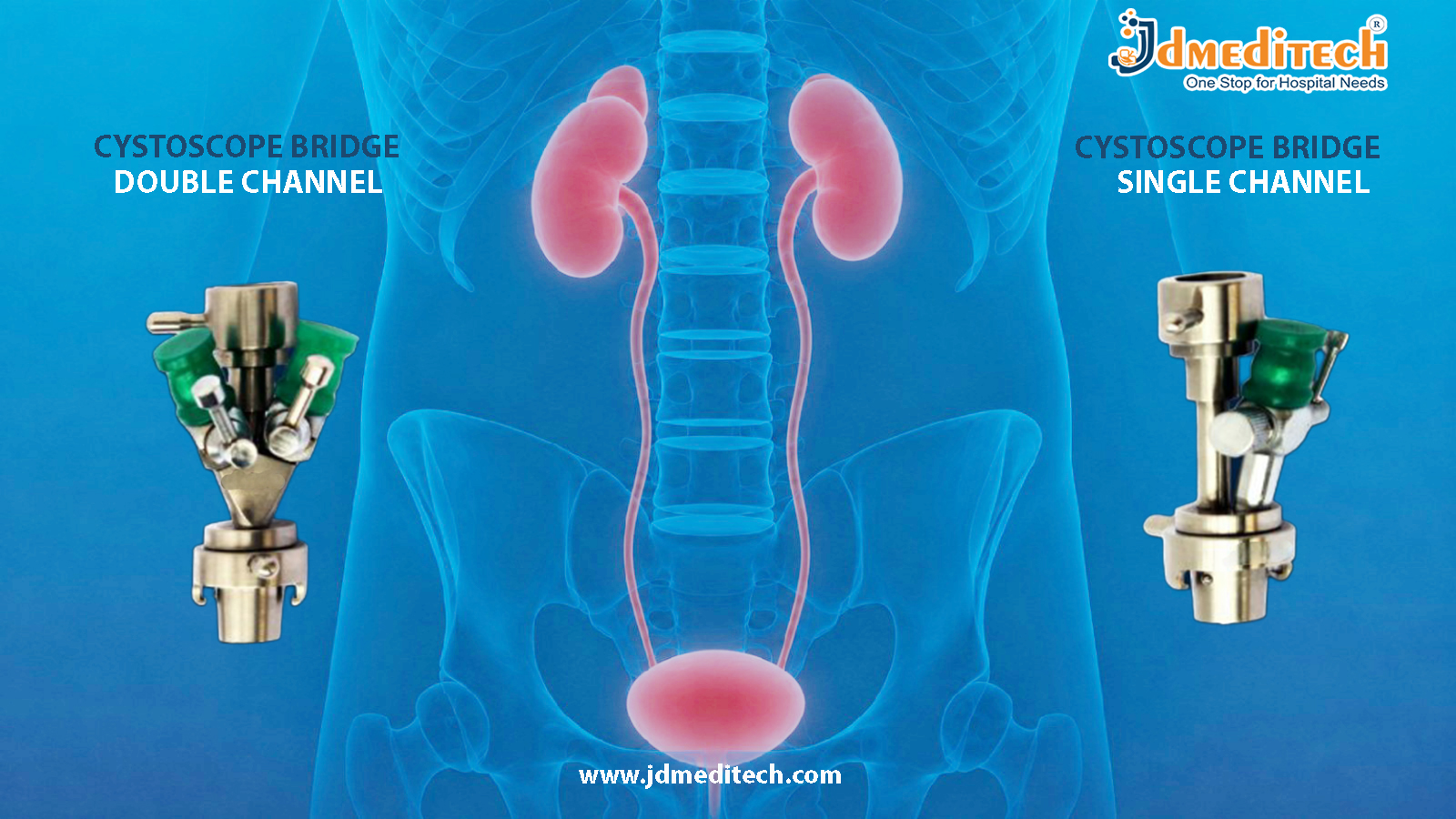
A cystoscope bridge is an essential component of a cystoscopic system that connects to the cystoscope sheath and telescope. The bridge allows surgeons to introduce surgical instruments, irrigation devices, electrodes, biopsy forceps, and other accessories into the urinary tract during endoscopic procedures.
Moreover, the bridge provides controlled instrument access while maintaining visualization throughout the procedure.
What is a Single-Channel Cystoscope Bridge?
A single-channel cystoscope bridge features one working channel for introducing surgical instruments or accessories.
Surgeons commonly use this bridge for routine diagnostic cystoscopy and simple therapeutic procedures that require only one instrument at a time.
Because the design remains simple and compact, the single-channel bridge offers easy handling and excellent maneuverability.
What is a Double-Channel Cystoscope Bridge?
A double-channel cystoscope bridge incorporates two separate working channels. As a result, surgeons can introduce two instruments simultaneously or combine instrument access with continuous irrigation.
Furthermore, the additional channel improves procedural efficiency during complex urological interventions.
Consequently, many urologists prefer double-channel bridges for advanced endoscopic procedures.
Cystoscope Bridge Single Channel vs Double Channel: Key Differences
Number of Working Channels
Single-Channel Bridge: Provides one working channel for instrument access.
Double-Channel Bridge: Provides two independent working channels for simultaneous instrument use.
Instrument Flexibility
Single-channel bridges accommodate one instrument at a time. Therefore, surgeons may need to exchange instruments frequently during procedures.
In contrast, double-channel bridges allow surgeons to use two instruments simultaneously. Consequently, they reduce instrument exchanges and improve workflow efficiency.
Procedural Complexity
Surgeons typically use single-channel bridges for routine diagnostic and minor therapeutic procedures.
However, surgeons often select double-channel bridges for complex procedures requiring multiple instruments or continuous irrigation.
Irrigation Capability
Although single-channel bridges support standard irrigation, they offer limited flexibility when surgeons require simultaneous instrumentation.
On the other hand, double-channel bridges allow surgeons to perform irrigation and instrumentation simultaneously. As a result, visualization remains optimal throughout lengthy procedures.
Procedure Efficiency
Single-channel systems provide adequate efficiency for straightforward procedures.
Conversely, double-channel systems enhance procedural efficiency, especially during advanced endourological interventions.
Advantages of Single-Channel Cystoscope Bridge
- Compact and lightweight design
- Easy instrument handling
- Excellent maneuverability
- Suitable for routine cystoscopy
- Simplifies diagnostic procedures
- Cost-effective solution
- Requires minimal setup
Advantages of Double-Channel Cystoscope Bridge
- Supports simultaneous use of two instruments
- Enhances procedural efficiency
- Reduces instrument exchange frequency
- Improves irrigation management
- Facilitates complex interventions
- Maintains superior visualization
- Optimizes surgical workflow
Clinical Applications of Single-Channel Cystoscope Bridge
Healthcare professionals commonly use single-channel bridges for:
- Diagnostic cystoscopy
- Routine bladder examinations
- Simple biopsy procedures
- Minor endoscopic interventions
- Urethral assessments
Clinical Applications of Double-Channel Cystoscope Bridge
Urologists frequently use double-channel bridges for:
- Bladder tumor resection procedures
- Complex endoscopic interventions
- Foreign body retrieval
- Stone management procedures
- Advanced therapeutic cystoscopy
- Continuous irrigation procedures
Which Cystoscope Bridge Should You Choose?
Neither bridge is universally superior. Instead, surgeons should select the bridge according to procedural complexity, instrument requirements, and clinical objectives.
For routine diagnostic procedures, a single-channel bridge often provides sufficient functionality while offering simplicity and cost-effectiveness.
However, for advanced therapeutic procedures, a double-channel bridge delivers greater flexibility, improved efficiency, and enhanced surgical control.
Ultimately, the correct choice depends on the surgeon’s preference and procedural requirements.
Why Choose JDMeditech Cystoscope Bridges?
JDMeditech manufactures premium-quality cystoscope bridges designed to support modern endourological procedures.
Key Features
- High-quality stainless steel construction
- Precision engineering
- Excellent instrument compatibility
- Superior durability
- Ergonomic design
- Smooth instrument passage
- Reusable and sterilizable configuration
Conclusion
Both single-channel and double-channel cystoscope bridges play important roles in modern urology practice. While single-channel bridges offer simplicity and ease of use, double-channel bridges provide greater versatility and procedural efficiency.
Therefore, healthcare professionals should carefully evaluate their clinical needs before selecting an instrument access system.
By choosing high-quality cystoscope bridges from JDMeditech, surgeons can enhance procedural precision, improve workflow efficiency, and achieve optimal patient outcomes.
Get Connected:
+91 79909 93062 | +91 63513 72032 | exports@jdmeditech.com