



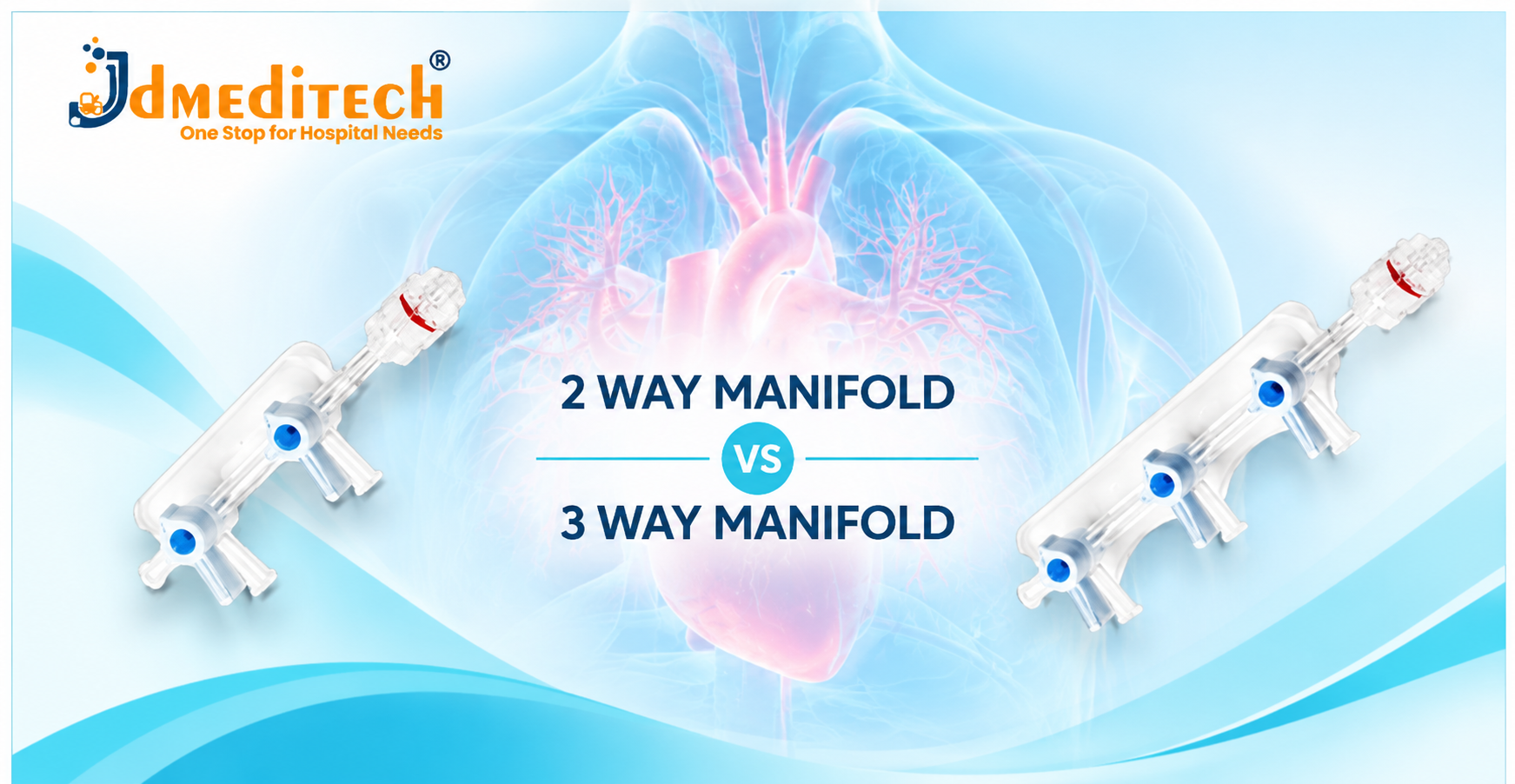
The 2 Way Manifold vs 3 Way Manifold comparison is important in interventional cardiology. Both devices help healthcare professionals manage contrast media, saline, and pressure monitoring connections during angiographic procedures.
JDMeditech offers cardiology medical devices and accessories for hospitals, catheterization laboratories, and international medical distributors.
What Is a 2 Way Manifold?
A 2 Way Manifold is a fluid-control device commonly used in angiography and cardiac catheterization. It typically includes two controlled side branches or stopcock positions, allowing clinicians to manage connected fluid lines.
Applications of a 2 Way Manifold
- Coronary angiography
- Diagnostic cardiac catheterization
- Contrast media administration
- Saline flushing
- Pressure monitoring connections
What Is a 3 Way Manifold?
A 3 Way Manifold generally includes three controlled side branches, offering additional connection and flow-routing options. It is useful when a procedural setup requires more fluid lines or monitoring connections.
Applications of a 3 Way Manifold
- Coronary angiography
- Percutaneous coronary intervention (PCI)
- Cardiac catheterization
- Interventional radiology
- Multi-line fluid management
2 Way Manifold vs 3 Way Manifold: Key Differences
| Feature | 2 Way Manifold | 3 Way Manifold |
|---|---|---|
| Controlled branches | Typically two | Typically three |
| Fluid management | Fewer connections | Additional connections |
| Common use | Simpler setups | More complex setups |
| Contrast delivery | Supported when compatible | Supported when compatible |
| Pressure monitoring | Supported when configured | Supported when configured |
| Equipment selection | Based on procedure | Based on procedure |
How Do Cardiology Manifolds Work?
A manifold uses manually operated stopcocks to open, close, or redirect selected fluid pathways.
Depending on the device configuration, these pathways can connect contrast media, saline, syringes, catheters, and pressure monitoring equipment.
Before clinical use, trained staff must check connections, remove air from the system, and follow the manufacturer’s instructions.
Benefits of Selecting an Appropriate Manifold
Organized Fluid Management: Manifolds help organize multiple fluid pathways within the catheterization laboratory.
Convenient Flow Control: Stopcocks allow healthcare professionals to select the required connections during a procedure.
Contrast Delivery Support: Compatible manifolds can be integrated into angiography contrast injection systems.
Pressure Monitoring Integration: Suitable configurations support connections to hemodynamic monitoring equipment.
Procedural Flexibility: Different manifold configurations help meet varying clinical requirements.
How to Choose the Right Manifold
Hospitals and healthcare professionals should consider several factors when selecting a manifold:
- Number of required fluid connections
- Maximum rated operating pressure
- Stopcock design and operation
- Connection compatibility
- Sterile packaging and single-use requirements
- Manufacturer’s instructions for use
A 3 Way Manifold is not automatically better than a 2 Way Manifold. The appropriate choice depends on the intended procedure and the equipment configuration.
JDMeditech Cardiology Products
JDMeditech offers cardiology medical devices and accessories for healthcare institutions, hospitals, and international medical distributors.
Our team supports product inquiries, technical specification requests, and international business requirements.
For available manifold configurations, product information, and quotations, visit www.jdmeditech.com.
Frequently Asked Questions
1. What is the main difference between a 2 Way and 3 Way Manifold?
A 2 Way Manifold generally has two controlled side branches, while a 3 Way Manifold has three. The exact number of connectors and flow paths depends on the manufacturer’s design.
2. Are manifolds used during coronary angiography?
Yes. Compatible manifolds help manage contrast media, saline, and pressure monitoring connections during angiographic procedures.
3. Can a manifold connect to a pressure transducer?
Yes, provided the manifold and pressure monitoring system are designed and configured for compatible use.
4. Can every manifold withstand high-pressure injection?
No. Pressure ratings vary between products. Healthcare professionals must verify the specific manifold’s rated pressure and instructions for use.
5. Where can I inquire about JDMeditech cardiology manifolds?
Visit www.jdmeditech.com to contact the JDMeditech team for available configurations, specifications, and quotations.
Conclusion
Understanding the 2 Way Manifold vs 3 Way Manifold comparison helps healthcare professionals and purchasing teams select suitable fluid-management devices.
Both configurations have important applications in cardiology and angiography. The correct selection depends on the procedure, required connections, and device specifications.
Contact JDMeditech for cardiology product information and international business inquiries.
Medical Disclaimer: This article provides general educational information. Product specifications and clinical use must be confirmed against approved manufacturer documentation and instructions for use.




