



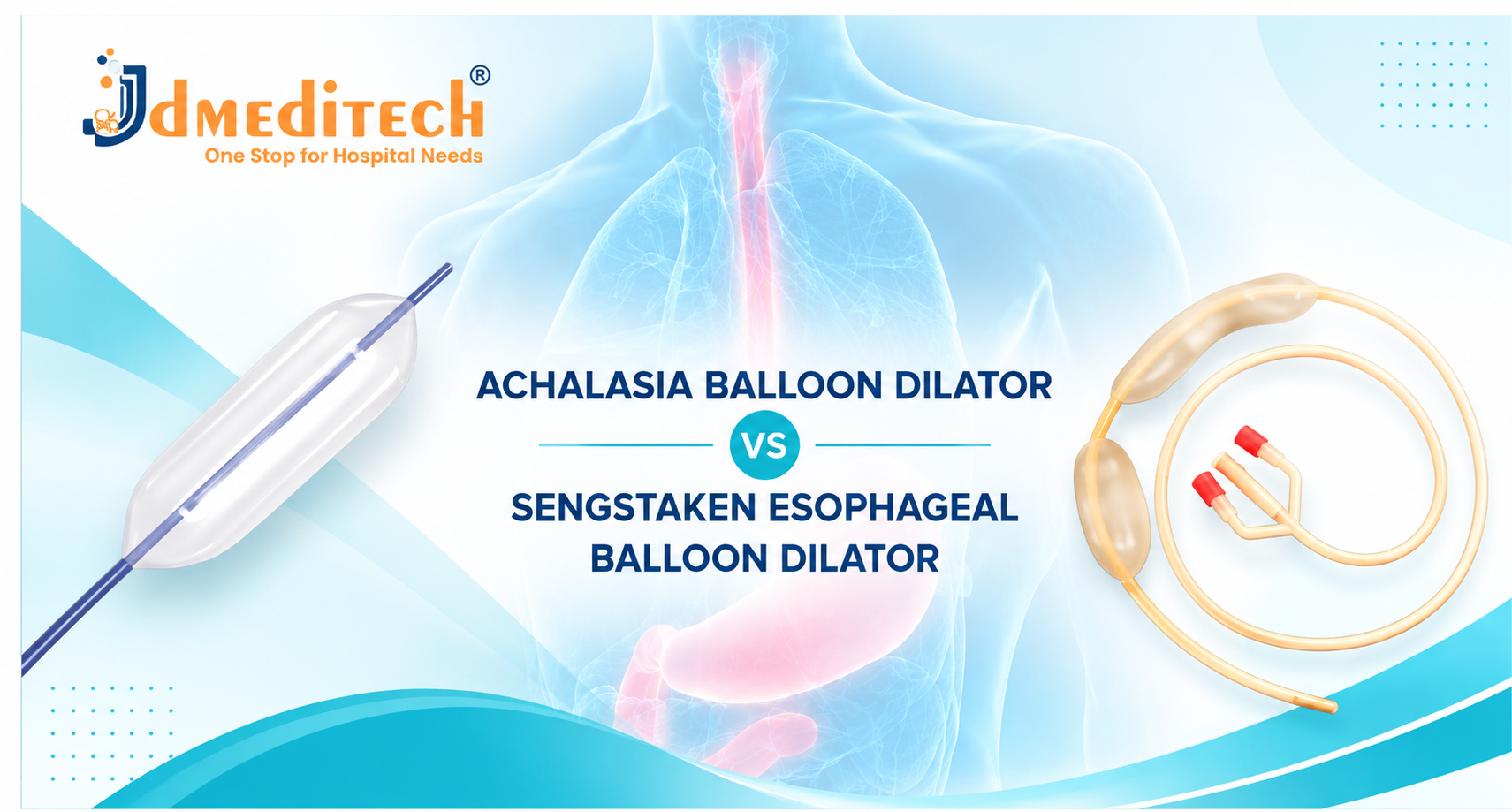
Achalasia Balloon Dilator vs Sengstaken Esophageal Balloon Dilator: Key Differences and Applications
Achalasia Balloon Dilator vs Sengstaken Esophageal Balloon Dilator is an important comparison in gastroenterology. Although both devices use inflatable balloons, they serve completely different clinical purposes.
An achalasia balloon dilator helps treat selected patients with achalasia by stretching the lower esophageal sphincter. In contrast, a Sengstaken-Blakemore tube provides temporary compression to control severe variceal bleeding.
Therefore, healthcare professionals must understand the differences in device design, clinical applications, and safety requirements. In this guide, JDMeditech explains both technologies and their roles in gastrointestinal care.
What Is an Achalasia Balloon Dilator?
An achalasia balloon dilator is a medical device that supports pneumatic dilation of the lower esophageal sphincter.
Achalasia is a condition in which the lower esophageal sphincter does not relax properly. Additionally, the esophagus loses normal movement that helps transport food into the stomach.
Consequently, patients may experience difficulty swallowing, regurgitation, and other symptoms.
During pneumatic dilation, a trained specialist positions a suitable balloon across the lower esophageal sphincter. The specialist then inflates the balloon under controlled conditions to disrupt sphincter muscle fibers.
As a result, the treatment can improve the passage of food and liquids into the stomach.
Key Features of Achalasia Balloon Dilators
- Inflatable balloon designed for pneumatic dilation
- Supports treatment of selected achalasia patients
- Designed for controlled expansion at the lower esophageal sphincter
- Requires appropriate imaging or endoscopic guidance
- Available in different configurations depending on the manufacturer
- Requires specialist training and careful patient selection
Clinical Applications of Achalasia Balloon Dilators
Healthcare professionals primarily use pneumatic dilation to treat suitable patients with achalasia.
For example, specialists may consider this treatment for patients with type I or type II achalasia. However, treatment selection depends on patient characteristics, disease subtype, and available expertise.
Additionally, clinicians may compare pneumatic dilation with other treatments, including laparoscopic Heller myotomy and peroral endoscopic myotomy.
Therefore, a gastroenterologist must assess the patient before recommending treatment.
What Is a Sengstaken Esophageal Balloon Dilator?
The term Sengstaken esophageal balloon dilator commonly refers to the Sengstaken-Blakemore tube. However, this device is a balloon tamponade tube rather than an esophageal dilation instrument.
Healthcare professionals use it as an emergency rescue device for selected cases of uncontrolled variceal bleeding.
Esophageal varices are enlarged veins that can develop in patients with portal hypertension. If these veins rupture, they may cause life-threatening bleeding.
In such emergencies, a Sengstaken-Blakemore tube can temporarily compress bleeding varices. However, the device does not provide definitive treatment.
Therefore, clinicians use balloon tamponade only as a temporary bridge to more definitive care when appropriate.
Key Features of Sengstaken-Blakemore Tubes
- Balloon tamponade design
- Gastric and esophageal balloon components
- Gastric aspiration capability in standard designs
- Supports temporary compression of bleeding varices
- Intended for emergency rescue use
- Requires airway protection and specialist monitoring
Furthermore, device configurations and lumen arrangements may vary by manufacturer.
Achalasia Balloon Dilator vs Sengstaken Esophageal Balloon Dilator: Comparison
Although both devices contain inflatable balloons, their functions differ significantly. Therefore, the following table explains their main characteristics.
| Feature | Achalasia Balloon Dilator | Sengstaken-Blakemore Tube |
|---|---|---|
| Primary Purpose | Treat selected achalasia patients | Temporarily control severe variceal bleeding |
| Working Principle | Pneumatic dilation | Balloon tamponade |
| Target | Lower esophageal sphincter | Bleeding gastroesophageal varices |
| Clinical Setting | Planned specialist procedure | Emergency rescue care |
| Treatment Goal | Improve swallowing by reducing sphincter resistance | Temporarily reduce bleeding |
| Major Risks | Esophageal perforation and bleeding | Aspiration, tissue injury and perforation |
| Definitive Treatment | Can provide lasting symptom relief | Temporary measure only |
How Does an Achalasia Balloon Dilator Work?
An achalasia balloon dilator uses controlled balloon expansion to reduce resistance at the lower esophageal sphincter.
First, a trained specialist assesses the patient’s condition and selects an appropriate treatment approach.
Next, the specialist positions the balloon across the target area using suitable guidance.
Then, controlled balloon inflation stretches and disrupts the sphincter muscle fibers.
Consequently, the procedure can improve esophageal emptying and reduce swallowing difficulties in suitable patients.
However, pneumatic dilation carries a risk of esophageal perforation. Therefore, experienced specialists must perform the procedure in a setting that can manage serious complications.
How Does a Sengstaken-Blakemore Tube Work?
A Sengstaken-Blakemore tube uses balloon compression to temporarily control severe bleeding from gastroesophageal varices.
First, an emergency care team assesses the patient and provides appropriate resuscitation and airway protection.
Next, trained specialists may use the device when bleeding remains uncontrolled and suitable definitive treatment is unavailable or delayed.
The balloon system applies pressure to the bleeding area. As a result, it may temporarily reduce blood loss.
However, balloon tamponade carries serious risks, including aspiration, pressure injury, and esophageal rupture.
Therefore, clinicians must closely monitor the patient and arrange definitive treatment without delay.
Achalasia Balloon Dilator vs Sengstaken Tube: Clinical Purpose
The main difference between these devices is their clinical purpose.
An achalasia balloon dilator supports the treatment of an esophageal movement disorder. In contrast, a Sengstaken-Blakemore tube supports emergency bleeding control.
Furthermore, pneumatic dilation aims to improve swallowing function. Balloon tamponade, however, provides temporary compression during a potentially life-threatening emergency.
Consequently, clinicians cannot substitute one device for the other.
Important Safety Considerations
Both devices require trained healthcare professionals and appropriate clinical facilities.
Before selecting either device, healthcare teams should consider:
- Confirmed clinical indication
- Patient-specific risks
- Manufacturer instructions for use
- Device specifications and compatibility
- Required monitoring and specialist expertise
- Potential complications
- Availability of emergency treatment facilities
Additionally, clinicians must recognize that balloon tamponade is a high-risk emergency intervention.
Therefore, hospitals should maintain appropriate clinical protocols and ensure trained personnel manage these devices.
JDMeditech Gastroenterology Devices
JDMeditech offers medical devices and gastroenterology accessories for hospitals, healthcare institutions, importers, and medical distributors.
Our gastroenterology product range includes devices for different diagnostic and therapeutic applications.
Additionally, customers can contact our team to discuss product configurations, available specifications, and international supply requirements.
Explore the JDMeditech medical device range for further information.
Frequently Asked Questions
1. What is an Achalasia Balloon Dilator?
An achalasia balloon dilator supports pneumatic dilation of the lower esophageal sphincter. Consequently, it may improve swallowing in suitable patients with achalasia.
2. What is a Sengstaken-Blakemore tube used for?
Healthcare professionals use it as a temporary rescue measure for severe uncontrolled variceal bleeding. However, it does not replace definitive treatment.
3. Are these two devices interchangeable?
No. An achalasia balloon dilator treats a swallowing disorder, while a Sengstaken-Blakemore tube provides temporary bleeding control.
4. Is pneumatic dilation a treatment option for achalasia?
Yes. Pneumatic dilation is an established treatment option for selected patients. However, specialists must consider the achalasia subtype and other available treatments.
5. Is a Sengstaken tube a permanent treatment?
No. Balloon tamponade is a temporary emergency measure. Therefore, healthcare teams must arrange definitive treatment as quickly as possible.
6. What are the main risks of these devices?
Achalasia balloon dilation may cause esophageal perforation. In contrast, Sengstaken-Blakemore tube use can cause aspiration, pressure injury, and perforation.
7. Where can I find JDMeditech gastroenterology products?
Visit www.jdmeditech.com for product information and international business inquiries.
Conclusion
Understanding Achalasia Balloon Dilator vs Sengstaken Esophageal Balloon Dilator helps healthcare professionals recognize two very different gastrointestinal devices.
An achalasia balloon dilator supports pneumatic dilation for selected patients with achalasia. In contrast, a Sengstaken-Blakemore tube provides temporary emergency control of severe variceal bleeding.
Therefore, healthcare professionals must select the correct device according to the clinical indication, patient condition, and manufacturer instructions.
For gastroenterology device inquiries and international medical equipment supply, contact JDMeditech.
JDMeditech – One Stop for Hospital Needs.
Clinical References
- American College of Gastroenterology – Diagnosis and Management of Achalasia
- NCBI Bookshelf – Sengstaken-Blakemore Tube
- ESGE – Endoscopic Treatment of Variceal Upper Gastrointestinal Bleeding
Medical Disclaimer: This article provides general educational information for healthcare professionals. It does not replace clinical judgment, manufacturer instructions, or applicable treatment guidelines.




