



Introduction
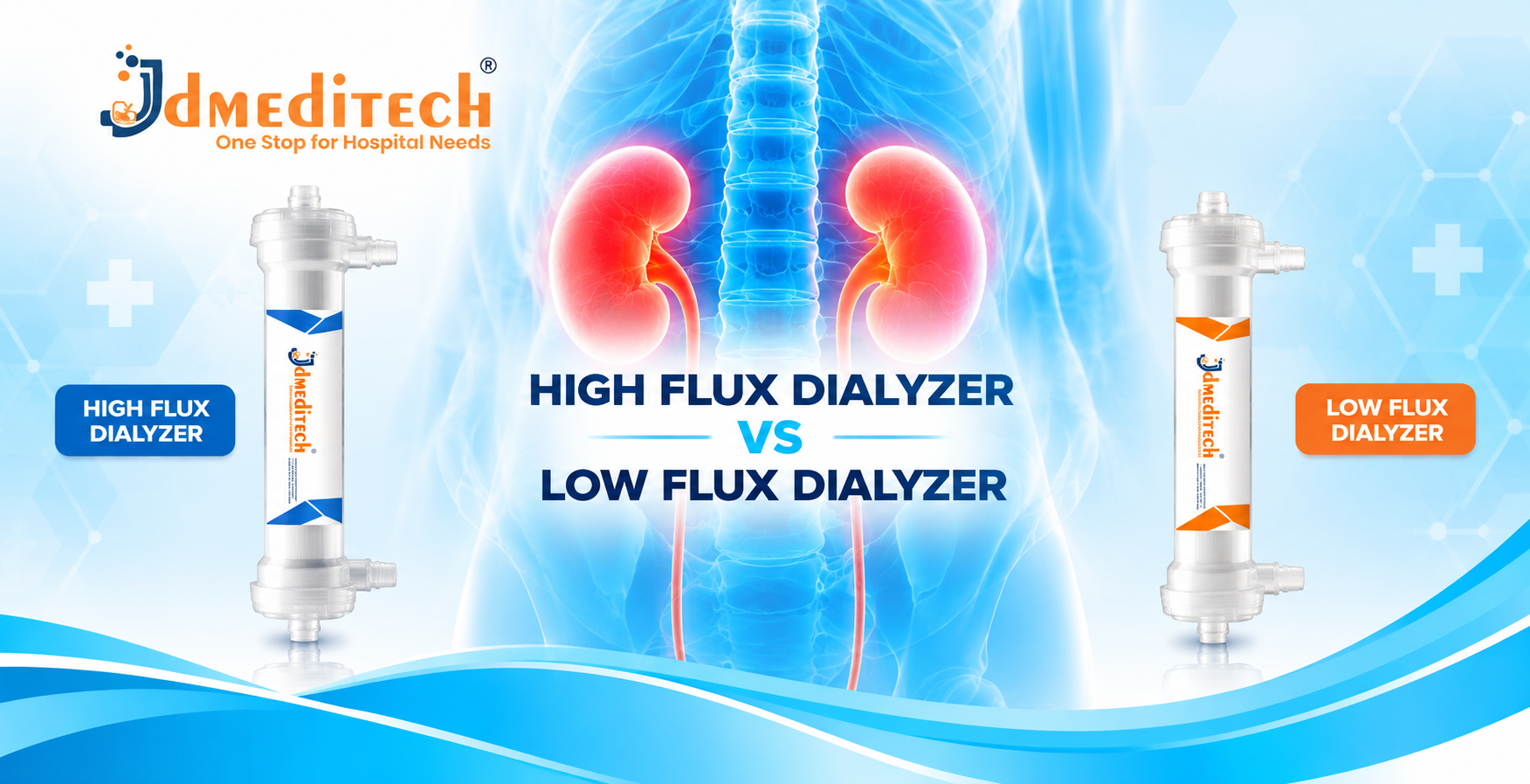
The High Flux Dialyzer vs Low Flux Dialyzer comparison helps healthcare professionals understand two types of dialysis filters used during hemodialysis.
Both dialyzers help remove waste products and excess fluid from the blood. However, their membranes have different filtration properties.
A high flux dialyzer generally removes more middle-sized waste molecules. In contrast, a low flux dialyzer mainly removes smaller waste molecules.
Therefore, doctors select a suitable dialyzer based on the patient’s needs and dialysis treatment plan.
What Is a Hemodialysis Dialyzer?
A hemodialysis dialyzer is a medical device that helps filter blood during dialysis treatment.
It contains a special membrane that separates blood from dialysis fluid. Small waste molecules can move across this membrane.
Meanwhile, the dialysis system controls fluid removal according to the prescribed treatment.
As a result, hemodialysis helps patients whose kidneys cannot adequately remove waste and excess fluid.
What Is a High Flux Dialyzer?
A High Flux Dialyzer uses a membrane with relatively high water permeability and improved removal of certain middle-sized molecules.
For example, high flux membranes generally provide greater removal of beta-2 microglobulin than low flux membranes.
Moreover, these membranes support fluid movement under controlled dialysis conditions.
Key Features of a High Flux Dialyzer
- Higher membrane water permeability
- Improved clearance of selected middle-sized molecules
- Removal of small waste molecules
- Different membrane surface area options
- Use in compatible hemodialysis systems
- Performance based on the specific membrane design
Applications of a High Flux Dialyzer
Healthcare professionals may select high flux dialyzers for:
- Maintenance hemodialysis
- Treatment plans requiring greater middle-molecule clearance
- Selected high-efficiency dialysis treatments
- Compatible hemodiafiltration treatments, when the dialyzer is approved for that use
However, the clinical team must verify the device specifications and treatment requirements.
What Is a Low Flux Dialyzer?
A Low Flux Dialyzer uses a membrane with lower water permeability and more limited removal of middle-sized waste molecules.
It primarily supports the removal of smaller waste products, including urea and creatinine.
In addition, it supports controlled fluid removal during suitable hemodialysis treatments.
Key Features of a Low Flux Dialyzer
- Lower membrane water permeability
- Removal of small waste molecules
- Limited clearance of many middle-sized molecules
- Different membrane surface area options
- Use in compatible hemodialysis systems
- Performance based on the product design
Applications of a Low Flux Dialyzer
Healthcare professionals may use low flux dialyzers for:
- Conventional hemodialysis
- Selected maintenance dialysis treatments
- Treatment plans focused on small-solute clearance
- Patients for whom the clinical team considers a low flux membrane appropriate
Therefore, the final choice should follow the patient’s dialysis prescription.
High Flux Dialyzer vs Low Flux Dialyzer: Key Differences
| Feature | High Flux Dialyzer | Low Flux Dialyzer |
|---|---|---|
| Water permeability | Higher | Lower |
| Small waste molecule removal | Yes | Yes |
| Middle-molecule removal | Generally greater | More limited |
| Beta-2 microglobulin clearance | Generally higher | Generally lower |
| Fluid removal | Controlled by the dialysis system | Controlled by the dialysis system |
| Membrane properties | Higher permeability | Lower permeability |
| Common application | High flux hemodialysis | Conventional low flux hemodialysis |
| Selection | Based on clinical needs | Based on clinical needs |
In short, membrane permeability and middle-molecule clearance are the main differences.
How Does a High Flux Dialyzer Work?
A high flux dialyzer allows blood and dialysis fluid to flow on opposite sides of a special membrane.
First, blood enters the dialyzer through the blood tubing system.
Next, small waste molecules move across the membrane into the dialysis fluid.
In addition, the higher membrane permeability supports greater removal of selected middle-sized molecules.
Meanwhile, the dialysis machine controls fluid removal according to the prescribed treatment.
Finally, the filtered blood returns to the patient.
How Does a Low Flux Dialyzer Work?
A low flux dialyzer uses a similar basic dialysis process.
First, blood flows through the dialyzer while dialysis fluid moves along the other side of the membrane.
Next, small waste molecules pass into the dialysis fluid.
However, the membrane has lower permeability to many middle-sized molecules.
Therefore, low flux dialysis generally provides less middle-molecule clearance than high flux dialysis.
Benefits of a High Flux Dialyzer
1. Greater Middle-Molecule Clearance
High flux membranes generally remove more beta-2 microglobulin than low flux membranes.
2. Small-Solute Removal
Moreover, high flux dialyzers also remove small waste products during hemodialysis.
3. Different Treatment Options
Certain high flux dialyzers support specialized dialysis treatments when approved for those applications.
4. Multiple Product Configurations
Manufacturers offer different membrane materials and surface areas.
Therefore, clinicians can select a device that matches the prescribed treatment.
Benefits of a Low Flux Dialyzer
1. Small Waste Molecule Removal
Low flux dialyzers support the removal of urea, creatinine, and other small waste molecules.
2. Conventional Hemodialysis Use
These dialyzers can support suitable routine dialysis treatments.
3. Different Membrane Options
Manufacturers offer low flux membranes in different materials and surface areas.
4. Procedure-Based Selection
Furthermore, clinicians can select a low flux dialyzer when it meets the patient’s treatment needs.
How to Choose the Right Dialyzer
Choosing between a High Flux Dialyzer vs Low Flux Dialyzer requires careful clinical review.
First, the healthcare team should assess the patient’s dialysis requirements.
Next, they should review the dialyzer’s performance and compatibility.
Important factors include:
- Membrane type and material
- Membrane surface area
- Ultrafiltration coefficient (Kuf)
- Urea clearance
- Beta-2 microglobulin clearance
- Blood flow requirements
- Dialysate flow requirements
- Dialysis machine compatibility
- Sterilization method
- Manufacturer’s instructions for use
Moreover, the healthcare team should consider the patient’s medical condition and treatment goals.
Therefore, no single dialyzer is the best choice for every patient.
Safety and Quality Considerations
Hemodialysis requires trained healthcare professionals and suitable medical equipment.
First, staff should inspect the dialyzer packaging and product label.
Next, they should confirm that the selected device matches the prescribed dialysis treatment.
In addition, healthcare teams must follow the manufacturer’s instructions for priming, handling, and disposal.
Dialysis teams should also monitor treatment performance, fluid removal, and possible patient reactions.
Therefore, proper device selection and clinical supervision remain essential.
JDMeditech Dialysis Products
JDMeditech offers dialysis medical devices and consumables for hospitals, dialysis centers, and international medical distributors.
Our product range includes dialysis-related equipment and accessories for selected hemodialysis applications.
Furthermore, our team supports product inquiries, technical specification requests, and international business requirements.
For available High Flux Dialyzer and Low Flux Dialyzer configurations, contact JDMeditech.
Website: https://www.jdmeditech.com/
Frequently Asked Questions
1. What is the main difference between a high flux and low flux dialyzer?
A high flux dialyzer generally has higher membrane water permeability and greater middle-molecule clearance.
In contrast, a low flux dialyzer mainly removes smaller waste molecules.
2. Which dialyzer removes beta-2 microglobulin more effectively?
High flux dialyzers generally provide greater beta-2 microglobulin clearance than low flux dialyzers.
However, performance varies by membrane design and treatment conditions.
3. Can a low flux dialyzer remove urea and creatinine?
Yes. Low flux dialyzers support the removal of small waste products such as urea and creatinine.
4. Does a high flux dialyzer remove more fluid?
Not automatically. Although high flux membranes have higher water permeability, the dialysis machine and treatment prescription control fluid removal.
5. Is a high flux dialyzer always better?
No. The most suitable dialyzer depends on the patient’s clinical needs, the dialysis prescription, and the available equipment.
6. Are high flux and low flux dialyzers available in different sizes?
Yes. Manufacturers offer different membrane surface areas and configurations.
However, product availability depends on the specific manufacturer.
7. Can all high flux dialyzers be used for hemodiafiltration?
No. The device must be suitable for the planned treatment and used with compatible equipment.
Therefore, clinicians should verify the manufacturer’s approved instructions.
8. Where can I inquire about JDMeditech dialysis products?
Hospitals and medical distributors can contact JDMeditech through www.jdmeditech.com for product information and quotations.
Conclusion
The High Flux Dialyzer vs Low Flux Dialyzer comparison highlights the importance of membrane properties in hemodialysis.
A high flux dialyzer generally provides greater clearance of selected middle-sized waste molecules.
Meanwhile, a low flux dialyzer mainly supports the removal of smaller waste molecules.
Both types play a role in dialysis care. Therefore, healthcare professionals should select a dialyzer based on the patient’s treatment needs and the manufacturer’s specifications.
Contact JDMeditech for dialysis products, technical information, and international business inquiries.
Medical Disclaimer: This article provides general educational information. Dialyzer selection and dialysis treatment must follow qualified clinical judgment, the prescribed treatment plan, and approved manufacturer instructions.




